Biology · Transport in Cells
Viewing as
Teacher view: every answer and mark scheme set out in full.
Diffusion
Cells constantly need to take things in and get rid of waste. Much of this happens by diffusion, with no energy needed. This lesson explains what diffusion is, which substances move this way, and what makes it faster or slower.
Learning Objectives
- 1Define diffusion in terms of particles, concentration and net movement.
- 2Give examples of substances that move into and out of cells by diffusion.
- 3Explain how the concentration gradient, the temperature and the surface area of the membrane affect the rate of diffusion.
- 4Calculate a rate of diffusion from a change and the time taken.
Retrieval practice
-
1
What does the cell membrane do?
Show answerHide answer
It controls which substances pass into and out of the cell.
-
2
Which sub-cellular structure releases energy by aerobic respiration?
Show answerHide answer
The mitochondrion.
-
3
What is meant by a concentrated solution?
Show answerHide answer
One with a lot of dissolved substance in it compared with the amount of water.
-
4
Name the process that makes two genetically identical cells from one.
Show answerHide answer
Mitosis.
Movement without energy
Every cell takes in oxygen and food and gets rid of carbon dioxide and other waste, and all of it has to cross the cell membrane. Many substances do this by diffusion. It needs no energy from the cell, because the particles move on their own. That makes diffusion the cheapest way for a cell to move things, and the reason it matters so much in your body.
What is diffusion?
Diffusion is the spreading out of the particles of any substance in solution, or particles of a gas, resulting in a net movement from an area of higher concentration to an area of lower concentration.
-
Particles are always moving
The particles of a gas, or of a substance dissolved in a liquid, move about randomly all the time.
-
Net movement
Particles move in every direction, but there are more particles in the region of higher concentration, so more of them move out of it than into it.
-
Down the concentration gradient
The difference in concentration between two places is the concentration gradient. Particles move down it, from high to low.
-
No energy needed
The particles use their own movement, so the cell does not have to use energy from respiration.
Diffusion across a cell membrane
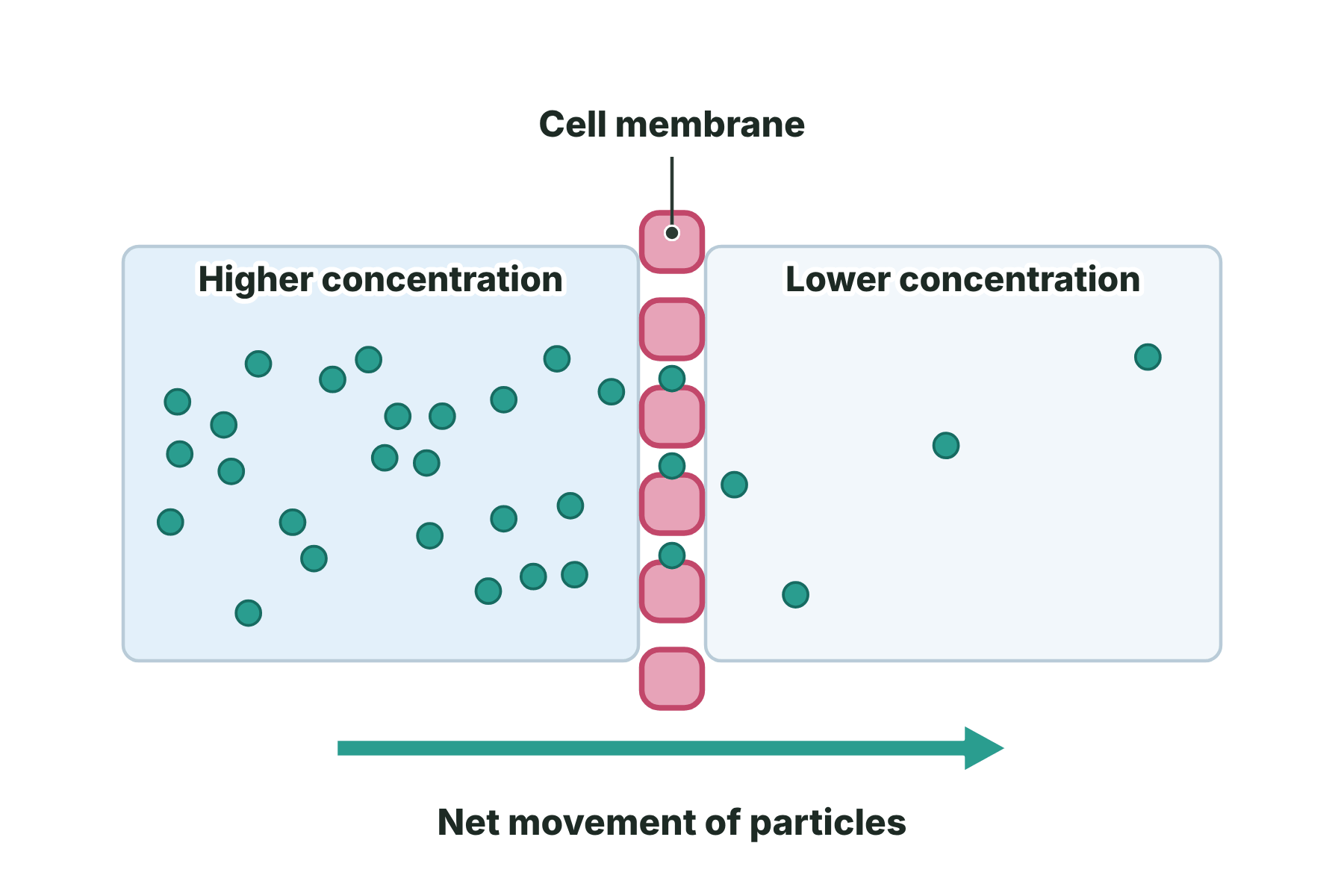
Particles move across the membrane from the side with more of them to the side with fewer.
Spreading out until evenly mixed
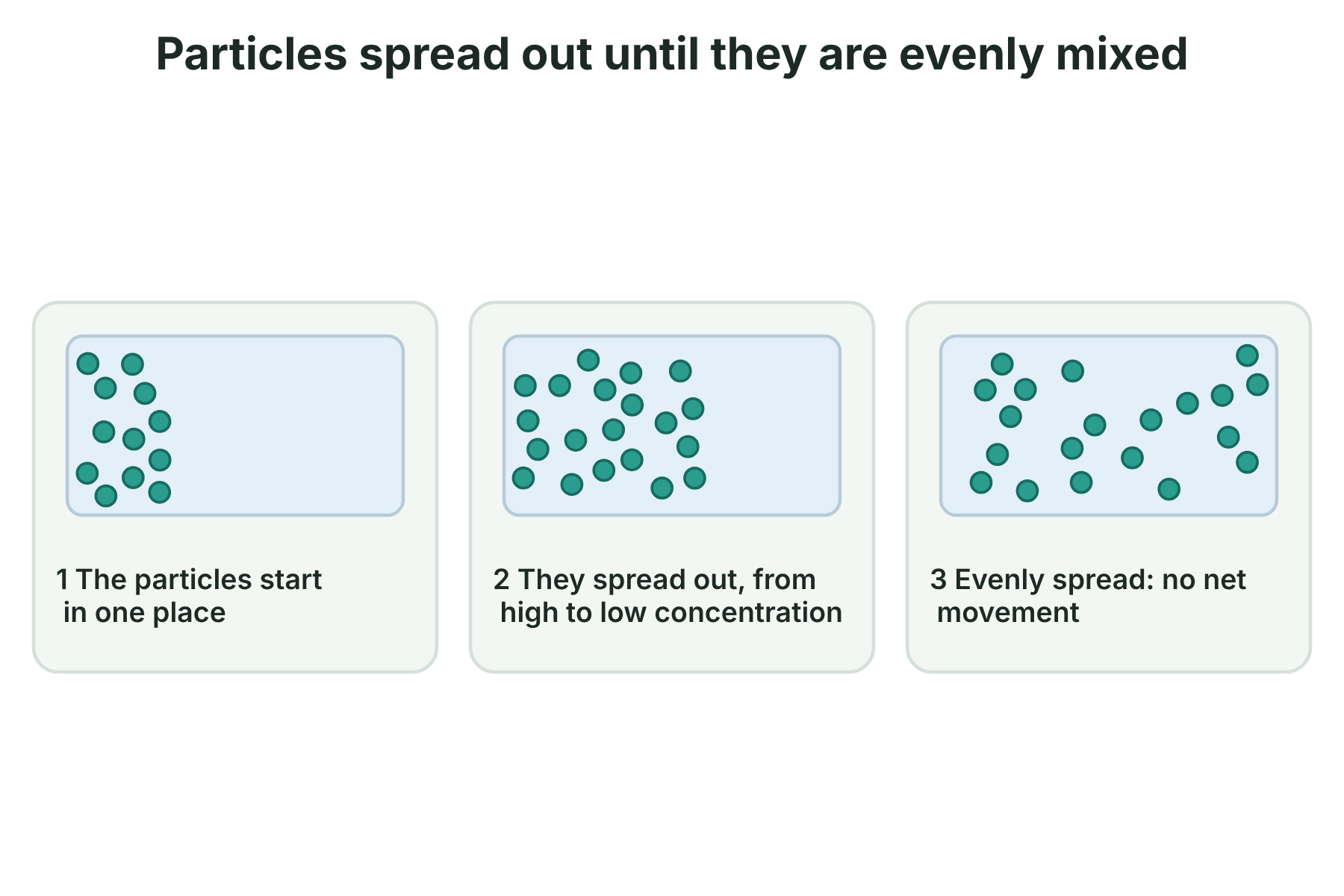
Diffusion carries on until the particles are evenly spread. The particles keep moving, but there is no net movement.
Substances that diffuse in living things
Some of the substances that move into and out of cells by diffusion are oxygen and carbon dioxide in gas exchange, and the waste product urea.
-
Oxygen
Cells use oxygen for respiration, so it is always at a lower concentration inside a cell than outside. Oxygen diffuses in.
-
Carbon dioxide
Respiration makes carbon dioxide, so it is at a higher concentration inside the cell than outside. It diffuses out.
-
Urea
Urea is a waste product made in cells. It diffuses from the cells into the blood plasma, and the kidneys then remove it from the blood so that it can be excreted.
Following oxygen from the air to a muscle cell
Diffusion happens at each stage, because each place has a lower concentration of oxygen than the one before.
-
1
Breathing in
Air in the lungs has a high concentration of oxygen.
-
2
Into the blood
Oxygen diffuses from the air in the alveoli into the blood, which has a lower concentration of oxygen.
-
3
Round the body
The blood carries the oxygen to the muscles.
-
4
Into the cells
The muscle cells use oxygen up, so its concentration in them is low, and oxygen diffuses from the blood into them.
Three things that change the rate of diffusion
The rate of diffusion is how fast the particles spread. Three factors affect it.
-
Concentration gradient
The bigger the difference in concentration, the faster the diffusion. Many more particles move one way than the other.
-
Temperature
At a higher temperature the particles have more energy and move faster, so they spread out faster.
-
Surface area of the membrane
The larger the area of membrane, the more particles can cross it at once, so the faster the diffusion.
Concentration gradient, temperature and surface area
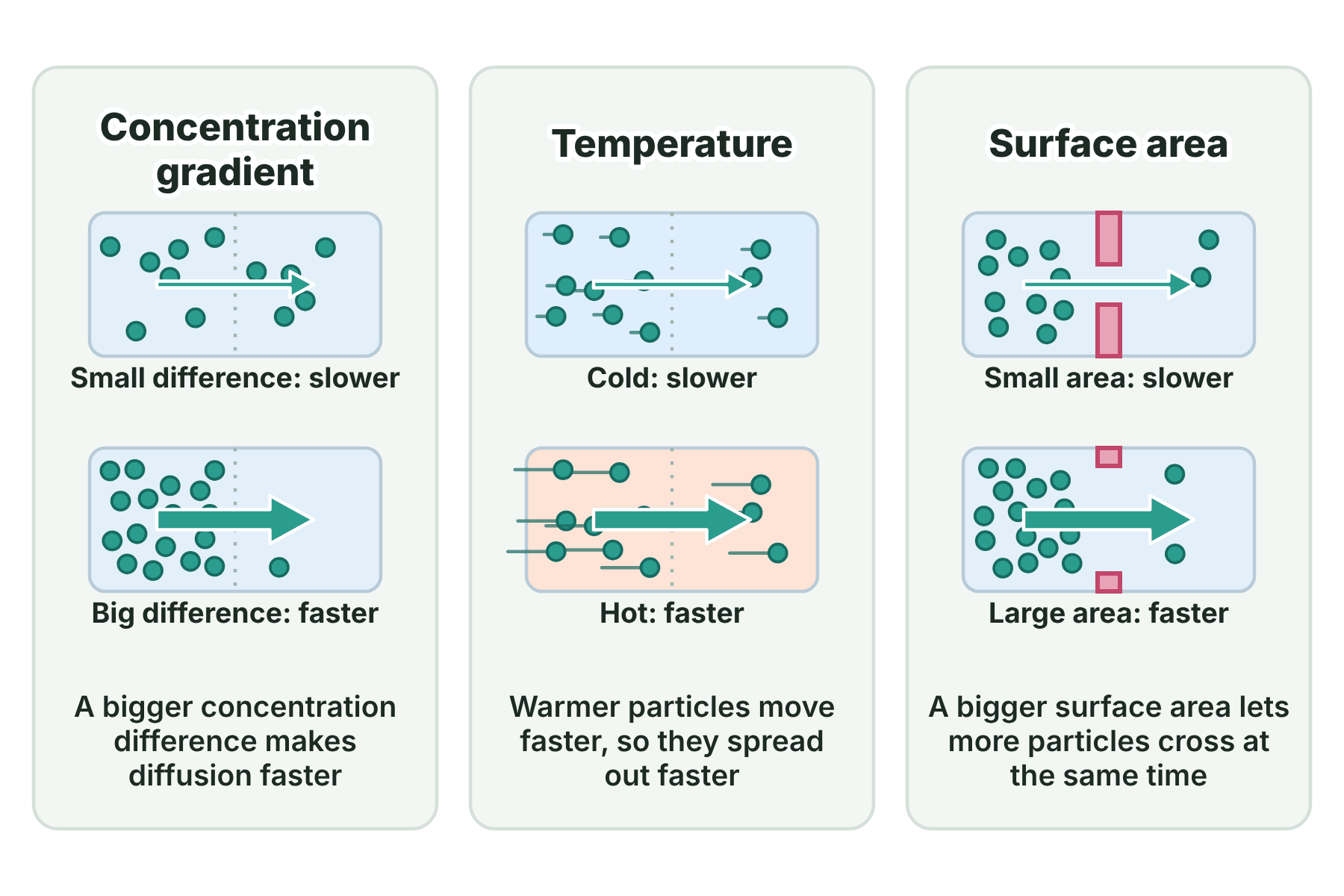
A bigger gradient, a higher temperature and a larger surface area each make diffusion faster.
Calculating a rate of diffusion
A cell takes in 24 micrograms of a substance by diffusion in 8 minutes. Calculate the mean rate of uptake in micrograms per minute.
Show the solutionHide the solution
- 1 Write the rate as a change divided by a time Rate = amount taken in ÷ time taken.
- 2 Put in the numbers Rate = 24 ÷ 8.
- 3 Work it out, and give the unit Rate = 3 micrograms per minute.
Answer3 micrograms per minute.
Case study
Gas exchange in the air sacs of the lungs
Air that is breathed in has about 21% oxygen and air that is breathed out has about 16%. Oxygen diffuses from the air in the alveoli into the blood, and carbon dioxide diffuses the other way. The gradient stays steep because breathing keeps bringing fresh air in and the flowing blood keeps carrying oxygen away.
The definition to learn
Diffusion is the net movement of particles from an area of higher concentration to an area of lower concentration.
Say "net movement": particles move in both directions, but more go one way than the other.
Diffusion
Diffusion
-
What it is
- net movement of particles from high to low concentration
-
Examples
- oxygen
- carbon dioxide
- urea
-
No energy
- the particles move on their own
-
Concentration gradient
- steeper gradient
- faster diffusion
-
Temperature
- warmer
- faster
-
Surface area
- larger area
- faster
Summary and exam focus
- Diffusion is the spreading out of particles, resulting in a net movement from a higher to a lower concentration.
- Oxygen, carbon dioxide and urea move into and out of cells by diffusion.
- A bigger concentration difference makes diffusion faster.
- A higher temperature makes diffusion faster.
- A larger surface area of membrane makes diffusion faster.
- Diffusion does not need energy from respiration.
Exam focus
Explain three factors that affect the rate of diffusion. (6 marks) (6 marks)
For each factor, give the change and the effect together: "the greater the concentration difference, the faster the diffusion". For temperature, say that the particles have more energy and move faster. Do not say that particles "want" to spread out.
Key terms
The words this lesson expects you to use. Each one is linked from the first place it appears above.
- Diffusion
- The spreading out of particles of a gas, or of a substance in solution, resulting in a net movement from an area of higher concentration to an area of lower concentration.
- Concentration
- The amount of a substance in a given volume.
- Concentration gradient
- The difference in concentration between two places.
- Net movement
- The overall movement of particles in one direction, after those moving the other way are taken into account.
- Particle
- A very small piece of a substance, such as a molecule of oxygen.
- Cell membrane
- The thin layer around a cell that controls what enters and leaves it.
- Urea
- A waste product made in cells, which diffuses into the blood plasma and is excreted by the kidneys.
- Rate
- How much something changes in a given time.
- Surface area
- The total area of the outside of an object, or of a membrane.
Questions and answers
19 questions set on this lesson, with the mark schemes and model answers open.
Name the waste product that diffuses from cells into the blood plasma, to be excreted by the kidneys.
Mark scheme — 1 mark available
- Urea — 1 mark
Model answer
Urea.
Describe what is meant by diffusion.
Mark scheme — 2 marks available
- Particles spread out / move randomly — 1 mark
- Net movement from higher to lower concentration — 1 mark
Model answer
The spreading out of particles (of a gas or of a substance in solution), resulting in a net movement from an area of higher concentration to an area of lower concentration.
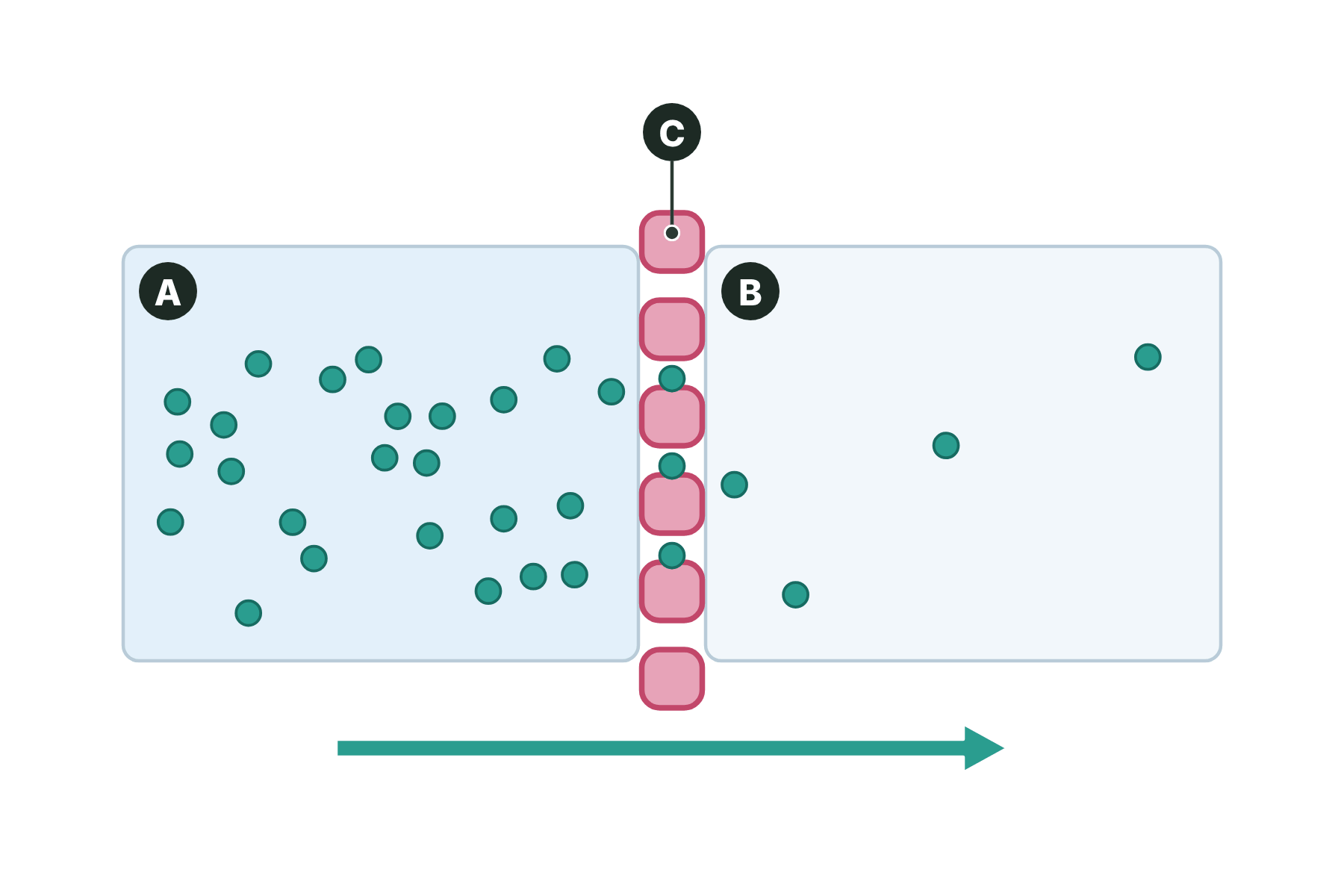
Figure 1 shows particles on both sides of a cell membrane. Name the parts labelled A, B and C.
Mark scheme — 3 marks available
- A: higher concentration — 1 mark
- B: lower concentration — 1 mark
- C: (cell) membrane — 1 mark
Model answer
A is the region of higher concentration. B is the region of lower concentration. C is the cell membrane.
Give two substances that move into or out of cells by diffusion.
Mark scheme — 2 marks available
- Oxygen — 1 mark
- Carbon dioxide — 1 mark
- Urea — 1 mark
Model answer
Any two from: oxygen, carbon dioxide, urea.
State three factors that affect the rate of diffusion.
Mark scheme — 3 marks available
- Concentration gradient — 1 mark
- Temperature — 1 mark
- Surface area (of the membrane) — 1 mark
Model answer
The concentration gradient (difference in concentration); the temperature; the surface area of the membrane.
Explain why diffusion is faster at a higher temperature.
Mark scheme — 2 marks available
- Particles have more energy — 1 mark
- So they move faster / spread out faster — 1 mark
Model answer
At a higher temperature the particles have more energy, so they move faster and spread out more quickly.
A cell takes in 36 micrograms of a substance by diffusion in 9 minutes. Calculate the mean rate of uptake, in micrograms per minute.
Mark scheme — 2 marks available
- 36 ÷ 9 — 1 mark
- 4 micrograms per minute (unit needed) — 1 mark
Model answer
36 ÷ 9 = 4 micrograms per minute.
Explain why oxygen diffuses from the air in the alveoli into the blood.
Mark scheme — 3 marks available
- Higher concentration of oxygen in the alveoli — 1 mark
- Lower concentration of oxygen in the blood — 1 mark
- Net movement down the concentration gradient — 1 mark
Model answer
The concentration of oxygen is higher in the air in the alveoli than in the blood. So there is a net movement of oxygen from the alveoli into the blood, down the concentration gradient.
Explain how the concentration gradient, the temperature and the surface area of the membrane each affect the rate of diffusion.
What the examiner wants: Give the change and the effect for each factor, and a reason where you can.
Mark scheme — 6 marks available
- Bigger concentration difference gives faster diffusion — 1 mark
- Because more particles move down the gradient — 1 mark
- Higher temperature gives faster diffusion — 1 mark
- Because particles have more energy / move faster — 1 mark
- Larger surface area gives faster diffusion — 1 mark
- Because more particles can cross at once — 1 mark
Model answer
The greater the concentration difference between the two sides, the faster the rate of diffusion, because more particles move down the gradient than back against it. The higher the temperature, the faster the rate of diffusion, because the particles have more energy and move faster. The larger the surface area of the membrane, the faster the rate of diffusion, because more particles can cross at the same time.
Which statement describes diffusion?
Why: Diffusion is the net movement of particles from a region of higher concentration to a region of lower concentration.
Which of these moves into cells by diffusion?
Why: Oxygen diffuses into respiring cells. Urea and carbon dioxide diffuse out of them.
What happens to the rate of diffusion if the temperature is increased?
Why: The particles have more energy and move faster, so diffusion is faster.
Which change would make diffusion across a membrane slower?
Why: A smaller surface area lets fewer particles cross at once, so the rate falls.
A cell takes in 50 units of a substance in 10 minutes. What is the rate of uptake?
Why: Rate = 50 ÷ 10 = 5 units per minute.
Where does urea diffuse to from the cells?
Why: Urea diffuses from the cells into the blood plasma, and the kidneys then excrete it.
Does diffusion need energy from respiration?
Why: No. The particles move on their own, so the cell does not have to use energy.
Why does carbon dioxide diffuse out of respiring cells?
Why: Respiration makes carbon dioxide, so its concentration is higher inside the cell than outside, and it moves down the gradient.
What does a steeper concentration gradient do to the rate of diffusion?
Why: A bigger difference in concentration means more particles move down the gradient, so diffusion is faster.
Once the particles are evenly spread out, what is true?
Why: The particles are still moving, but as many move one way as the other, so there is no net movement.