Viewing as
Teaching this? The teacher view adds 2 files, the mark schemes and the model answers.
Business · Spotting a business opportunity
Market mapping
A market map plots the businesses in a market against two features customers care about, showing where competitors sit and where there might be a gap. It is useful - but a gap is not always an opportunity.
Last Lesson
Answer from memory before the answers appear.
-
What is market segmentation?
Dividing a market into groups of customers with similar needs.
-
Name the five ways to segment a market.
Location, demographics, lifestyle, income and age.
-
What is a target market?
The segment a business aims its product and marketing at.
-
Give one benefit of segmentation.
Better meets needs, targeted marketing, spots gaps, or higher sales.
Learning Objectives
- 1Explain what a market map is.
- 2Construct and interpret a market map.
- 3Explain how a market map can identify a gap in the market and the competition.
- 4Evaluate the benefits and limitations of market mapping.
What Is a Market Map?
A market map is a diagram that shows where the products or businesses in a market are positioned.
-
Two axes
The map has two lines crossing in the middle, each showing a feature customers care about - for example low to high price, and low to high quality.
-
Plotting competitors
Each business or product is placed on the map according to how customers see it on both features.
-
Four areas
The axes split the map into four areas, such as high price and high quality, or low price and low quality.
-
The purpose
To see where competitors are crowded together, and where there is space that nobody is filling.
How to Draw a Market Map
Five steps, from a blank page to a possible opportunity.
-
1
Choose two features
Pick two things customers care about, such as price and quality, or healthy and unhealthy.
-
2
Draw the axes
Draw two lines crossing in the middle and label each end, such as Low price and High price.
-
3
Research competitors
Use market research to find out how customers see each business on both features.
-
4
Plot each business
Place each competitor on the map where it belongs.
-
5
Look for gaps
Find areas of the map with few or no businesses in them.
A Market Map in Action
This market map shows six places to buy lunch in a town centre. The cheap places are all unhealthy, and the healthy places are all expensive. Nobody is selling healthy food at a low price - so there may be a gap in the market for a new business.
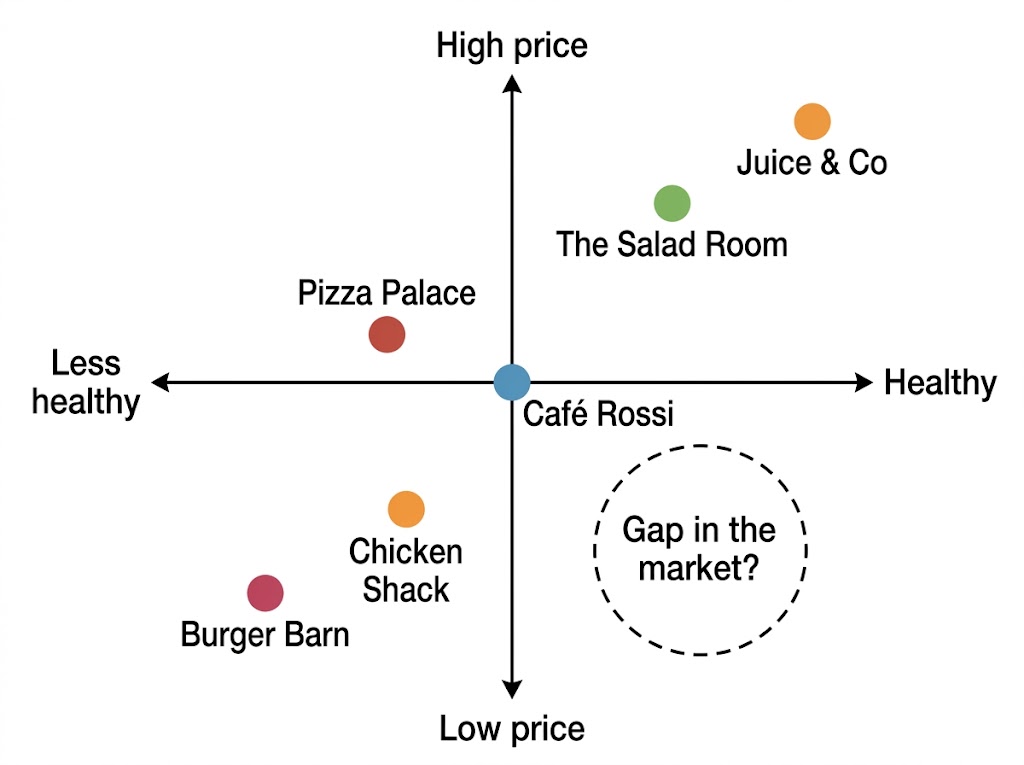
Six lunch places plotted on price and healthiness. The low price, healthy corner is empty.
Reading the Map
What the lunch map tells an entrepreneur.
-
Crowded areas
Two businesses sit in the low price, less healthy corner, so competition there is strong - a new business there would have to fight for customers.
-
The gap
The low price, healthy corner is empty. No business is meeting the needs of customers who want healthy food they can afford.
-
Nearest competitors
The Salad Room and Juice & Co are the closest to the gap, so they are the rivals a new business would need to beat.
-
The next step
Before opening, the entrepreneur must research whether enough customers actually want cheap healthy food - and whether it can be made cheaply enough to make a profit.
Market Mapping: For and Against
Benefits
- Shows gaps in the market that a new business could fill.
- Shows where competitors are and how crowded each area is.
- Helps a business decide how to position its product.
- Simple, quick and cheap to draw.
- Easy for owners and investors to understand.
Limitations
- A gap may exist because there is no demand for it.
- Only two features can be shown at once.
- Where competitors sit is often based on opinion, not fact.
- Markets change, so the map soon goes out of date.
- It does not show how big each competitor is.
Is Every Gap an Opportunity?
Not always. Before filling a gap, a business must ask why it is empty.
-
No demand
Nobody may want a product in that part of the map - for example very expensive, very low-quality food.
-
Too costly
It may be impossible to make the product cheaply enough to sell at that price and still make a profit.
-
Others have tried
Businesses may have filled the gap before and failed.
-
The test
Use market research to check there are enough customers who want the product before spending money.
Map Your Own Market
Draw a market map for places to buy coffee or snacks in your local area. Choose two features customers care about, draw and label the axes, then plot at least five businesses. Circle any gap you find and write two sentences on whether it is a real opportunity.
1. Choose two features and label both ends of each axis.
2. Plot at least five businesses.
3. Circle a gap.
4. Decide whether it is a real opportunity, and explain why.
A good answer shows: A correctly labelled map with at least five businesses plotted, a gap identified, and a judgement about whether customers would actually want it.
Can I...?
- 1Explain what a market map is.
- 2Draw and label a market map.
- 3Use a market map to identify a gap in the market.
- 4Use a market map to identify competitors.
- 5Explain the benefits of market mapping.
- 6Explain the limitations of market mapping.
Summary & Exam Focus
- A market map plots competitors against two features customers care about.
- It shows where competition is crowded and where there may be a gap.
- It is simple and cheap, and helps a business position its product.
- But a gap may have no demand, only two features are shown, and positions are based on opinion.
Exam focus
Explain one limitation to a business of using a market map. (3 marks) (3 marks)
The strongest limitation answers explain what could go wrong for the business - a gap that has no demand leads to low sales and possible failure.
Key terms
The vocabulary this lesson expects you to use. Each one is linked from the first place it appears above.
- Market map
- A diagram that plots the businesses or products in a market against two features, such as price and quality.
- Axis
- One of the two lines on a market map, each showing a feature from low to high.
- Gap in the market
- An area of a market where customers' needs are not being met by any business.
- Positioning
- Where a business places its product in the market compared with competitors.
- Competitor
- Another business selling similar products to the same customers.
Downloads
Free to keep, print and annotate.
- Market mapping.pptx Built from the lesson script on 24 September 2026. View
- Market mapping - Completed Notes.docx The full notes for the lesson, to revise from. Built from the lesson script on 24 September 2026. View
- Market mapping - Exam Questions.docx Built from the lesson script on 24 September 2026. View
Something here looks wrong?
Tell us what and we will go and look. It goes to whoever writes these pages, nobody else, and we do not ask who you are — so there is nothing to sign and nothing comes back to you.