Viewing as
Teaching this? The teacher view adds 2 files, the mark schemes and the model answers.
Business · Understanding external influences on business
The economy and business
No small business can control the economy, but every one is affected by it: unemployment, consumer incomes, inflation, interest rates, taxation and exchange rates all change how much customers spend and how much a business pays.
Last Lesson
Answer from memory before the answers appear.
-
Under consumer law, what three things must goods be?
Of satisfactory quality, fit for purpose and as described.
-
What can a customer get within 30 days for faulty goods?
A full refund.
-
Name the four areas of employment law.
Recruitment, pay, discrimination and health and safety.
-
Give one consequence of breaking the law.
Fines, compensation, bad publicity or closure.
Learning Objectives
- 1Explain how unemployment and changing consumer incomes affect businesses.
- 2Explain how inflation affects businesses.
- 3Explain how changes in interest rates affect businesses.
- 4Explain how government taxation affects businesses.
- 5Explain how changes in exchange rates affect businesses that import or export.
The Economic Climate
The economic climate is the state of the economy as a whole - whether people have jobs, money to spend and confidence.
-
Outside the business's control
A small business cannot change the economy; it can only respond to it.
-
Good times
Most people have jobs and rising incomes, so they spend more and businesses sell more.
-
Hard times
Jobs are lost and incomes fall, so customers cut back and many businesses struggle.
-
Some businesses gain
In hard times, discount shops and repair services may do better as customers look for cheaper options.
Unemployment
Unemployment is when people who want to work cannot find a job.
-
Less spending
Unemployed people have less income, so they spend less - especially on luxuries such as meals out and holidays.
-
Lower sales
Businesses selling non-essentials see sales fall.
-
Easier to recruit
More people are looking for work, so a small business can find staff more easily and may not need to raise pay.
-
Cheaper goods do better
Businesses selling cheaper alternatives may gain customers.
Changing Levels of Consumer Income
Consumer income is the money people have to spend after tax.
-
Rising income
Customers spend more, and buy more luxuries and higher-quality products. Sales rise.
-
Falling income
Customers cut back, look for cheaper options and delay big purchases. Sales of luxuries fall.
-
Different businesses, different effects
A budget supermarket may gain customers when incomes fall; an upmarket restaurant may lose them.
-
The business's response
Adjust the marketing mix - value deals when incomes fall, premium products when they rise.
Inflation
Inflation is the rise in the general level of prices over time, usually measured as a percentage each year.
-
Higher costs
A business pays more for materials, energy and stock, and staff ask for higher wages to keep up.
-
Pressure on prices
To protect its profit, the business raises its own prices - but customers may buy less.
-
Customers cut back
If wages rise more slowly than prices, customers' real incomes fall and they spend less.
-
Planning is harder
Rising costs make it harder to forecast costs, prices and profit.
Calculating a Percentage Price Rise
Edexcel often asks for percentage changes. Show your working.
A café's coffee beans cost £12.00 a bag last year. This year they cost £13.20. Calculate the percentage increase.
- 1 Find the change £13.20 - £12.00 = £1.20
- 2 Divide by the original £1.20 ÷ £12.00 = 0.1
- 3 Multiply by 100 0.1 × 100 = 10%
AnswerThe price rose by 10%.
Changes in Interest Rates
The interest rate is the cost of borrowing money, and the reward for saving it. The Bank of England sets the Bank Rate, which banks follow.
-
Borrowing costs more
When interest rates rise, loan and overdraft repayments go up, increasing a business's costs and reducing profit.
-
Customers spend less
Customers with mortgages and loans pay more interest, so they have less to spend.
-
Saving is more attractive
Higher rates encourage people to save rather than spend.
-
The reverse
When interest rates fall, borrowing is cheaper, customers have more to spend, and businesses are more willing to borrow to grow.
When Interest Rates Rise
One change, felt all the way down the chain.
-
1
Interest rates rise
The Bank of England raises the Bank Rate.
-
2
Borrowing costs more
Customers' mortgage and loan repayments rise, and so do the business's.
-
3
Customers spend less
They have less money left over for non-essentials.
-
4
Sales fall and costs rise
The business sells less and pays more interest.
-
5
Profit falls
The business may delay plans, cut costs or look for new customers.
UK Inflation and Interest Rates, 2020-2024
In 2022 prices in the UK rose faster than at any time in forty years. To slow inflation, the Bank of England raised interest rates quickly - making borrowing more expensive for businesses and customers alike. Small businesses were hit twice: by rising costs, and by customers with less money to spend.
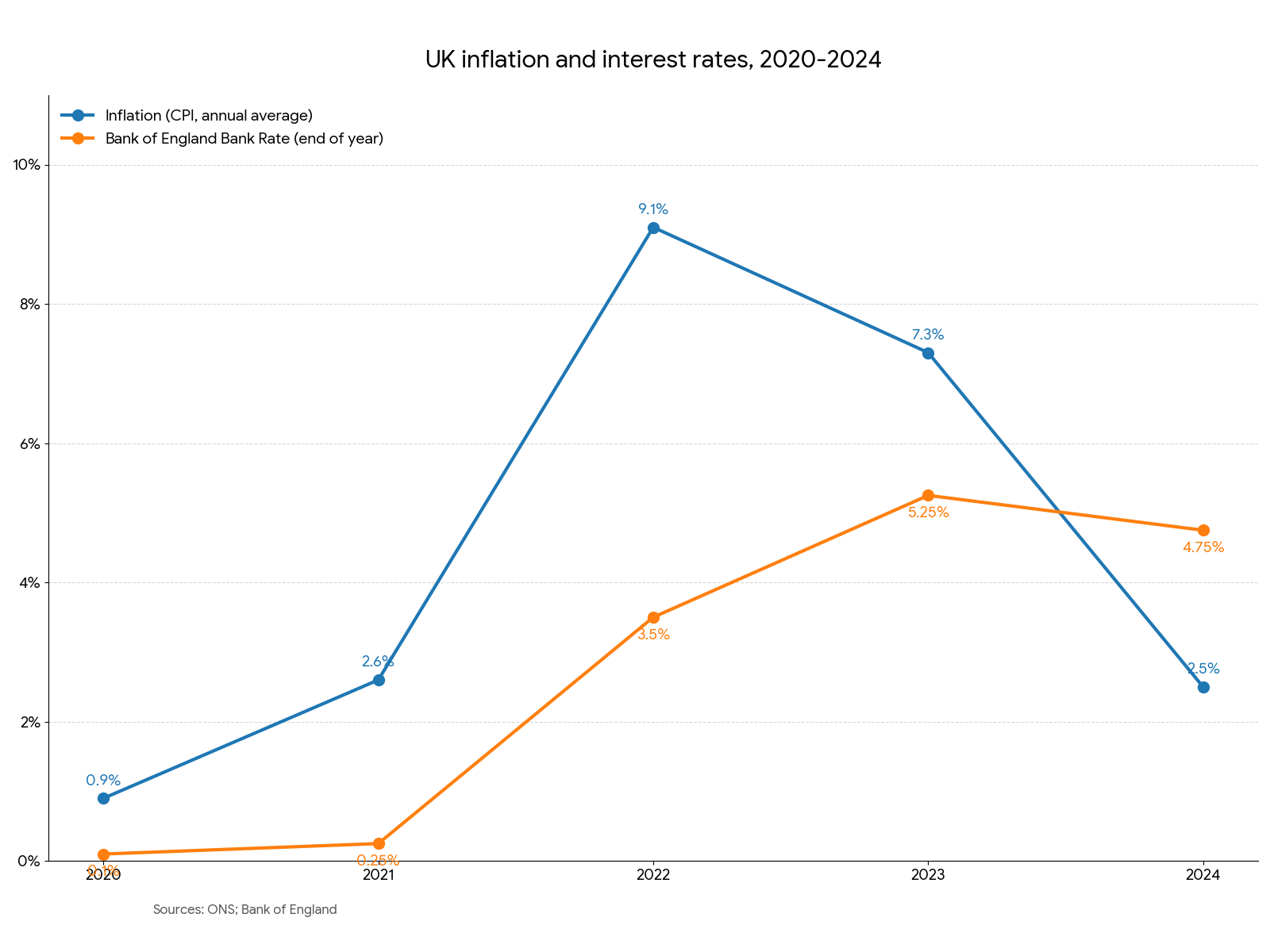
Inflation shot up in 2022, and the Bank of England raised interest rates to bring it back down.
The Figures Behind the Chart
-
2020
Inflation (CPI, annual average): 0.9%. Bank Rate (end of year): 0.1%
-
2021
Inflation (CPI, annual average): 2.6%. Bank Rate (end of year): 0.25%
-
2022
Inflation (CPI, annual average): 9.1%. Bank Rate (end of year): 3.5%
-
2023
Inflation (CPI, annual average): 7.3%. Bank Rate (end of year): 5.25%
-
2024
Inflation (CPI, annual average): 2.5%. Bank Rate (end of year): 4.75%
Government Taxation
Taxes are payments to the government that businesses and customers must make.
-
VAT
A tax added to the price of most goods and services - 20% at the standard rate. A rise makes products more expensive, so customers may buy less.
-
Income tax
A tax on people's wages. Higher income tax leaves customers with less to spend.
-
Taxes on business profits
Sole traders pay income tax on their profits; companies pay corporation tax. Higher taxes leave the owners with less profit.
-
Employer costs
Businesses also pay National Insurance on their employees' wages, so a rise increases the cost of employing staff.
Feeling the Squeeze
When inflation is high, interest rates rise or taxes go up, customers look more carefully at every price. They buy fewer items, switch to cheaper brands and cut back on treats - and small businesses see it straight away in their sales.
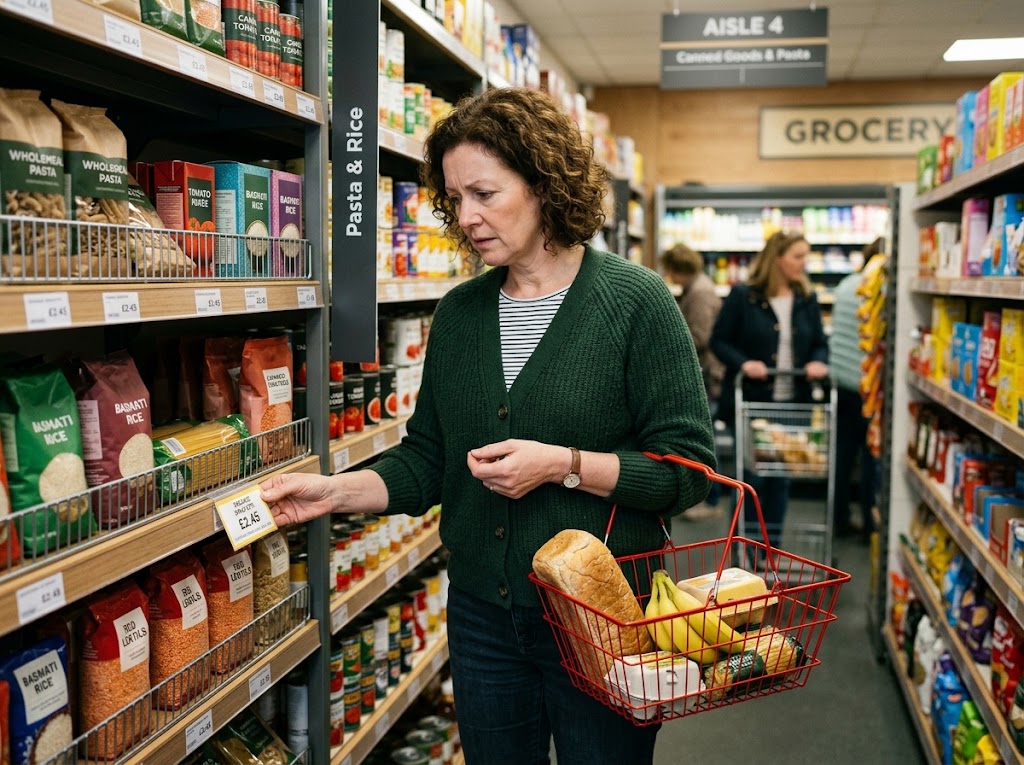
When prices rise faster than wages, customers buy less.
Changes in Exchange Rates
The exchange rate is the value of one currency in terms of another, for example £1 = €1.15.
-
Importing
A small business that buys supplies from abroad - a café importing Italian coffee, a shop buying stock from China - pays in foreign currency.
-
Exporting
A small business that sells abroad - such as an online shop with customers in Europe - is paid in foreign currency or sets prices in it.
-
A stronger pound
Buys more foreign currency, so imports become cheaper, but UK exports become more expensive for foreign customers.
-
A weaker pound
Buys less foreign currency, so imports become more expensive, but UK exports become cheaper for foreign customers.
SPICED: Strong Pound, Imports Cheap, Exports Dear
When the pound is STRONG
- £1 buys more foreign currency.
- Imports are cheaper: good for a business buying supplies from abroad.
- Exports are dearer (more expensive) for foreign customers.
- A business selling abroad may lose sales.
When the pound is WEAK
- £1 buys less foreign currency.
- Imports are dearer: bad for a business buying supplies from abroad.
- Exports are cheaper for foreign customers.
- A business selling abroad may gain sales.
Exchange Rates in Action
To convert pounds to euros, multiply by the exchange rate.
A UK online shop sells a handmade bag for £40 to customers in France. The exchange rate changes from £1 = €1.10 to £1 = €1.20. Calculate the price in euros before and after, and explain the effect.
- 1 Price before £40 × 1.10 = €44
- 2 Price after £40 × 1.20 = €48
- 3 The effect The pound has strengthened, so the same bag now costs French customers €4 more
Answer€44 before, €48 after - the stronger pound makes the export dearer, so sales may fall.
Winners and Losers
For each change, name one small business that would suffer and one that might benefit, and explain why: unemployment rises; interest rates rise; inflation reaches 10%; the pound gets weaker against the euro.
1. Name a business that suffers, and explain why.
2. Name a business that benefits, and explain why.
A good answer shows: A loser and a winner for each change, with a chain of reasoning - e.g. a weak pound hurts a café importing Italian coffee but helps a UK gift shop selling online to European customers.
Can I...?
- 1Explain the impact of unemployment.
- 2Explain the impact of changing consumer incomes.
- 3Explain the impact of inflation.
- 4Calculate a percentage change.
- 5Explain the impact of interest rate changes.
- 6Explain the impact of taxation.
- 7Explain the impact of exchange rate changes.
- 8Convert a price using an exchange rate.
Summary & Exam Focus
- Rising unemployment and falling incomes cut customer spending.
- Inflation raises costs and makes customers cut back.
- Higher interest rates raise borrowing costs and reduce customer spending.
- Higher taxes leave customers and owners with less money.
- A strong pound makes imports cheap and exports dear (SPICED).
Exam focus
Explain one impact on a small business of a rise in interest rates. (3 marks) (3 marks)
Economic questions have two sides - the business's own costs and its customers' spending. The strongest answers pick one side and take it all the way to sales or profit.
Key terms
The vocabulary this lesson expects you to use. Each one is linked from the first place it appears above.
- Economic climate
- The state of the economy, including jobs, incomes and prices.
- Unemployment
- When people who want to work cannot find a job.
- Consumer income
- The money people have to spend.
- Inflation
- A rise in the general level of prices over time.
- Interest rate
- The cost of borrowing money, and the reward for saving it.
- Taxation
- Payments to the government, such as VAT and income tax.
- Exchange rate
- The value of one currency in terms of another.
- Import
- A good or service bought from another country.
- Export
- A good or service sold to another country.
Downloads
Free to keep, print and annotate.
- The economy and business.pptx Built from the lesson script on 25 September 2026. View
- The economy and business - Completed Notes.docx The full notes for the lesson, to revise from. Built from the lesson script on 25 September 2026. View
- The economy and business - Exam Questions.docx Built from the lesson script on 25 September 2026. View
Something here looks wrong?
Tell us what and we will go and look. It goes to whoever writes these pages, nobody else, and we do not ask who you are — so there is nothing to sign and nothing comes back to you.