Exam questions · Biology · Plant Disease
Plant Defence Responses
- 7 exam questions
- 19 marks
- 8 quick checks
-
1 State [1 mark]
Name the material that makes up the cell walls of plant cells.
Show answerHide answer
Model answer
Cellulose.
Mark scheme
- Cellulose — 1 mark
-
2 Describe [2 marks]
Describe how the bark of a tree helps to protect it against pathogens.
Show answerHide answer
Model answer
The bark is made of layers of dead cells, which form a barrier that pathogens cannot easily pass. The layers fall off, which carries away microorganisms on the surface.
Mark scheme
- Layers of dead cells form a barrier — 1 mark
- Fall off and take pathogens with them — 1 mark
-
3 Name [3 marks]
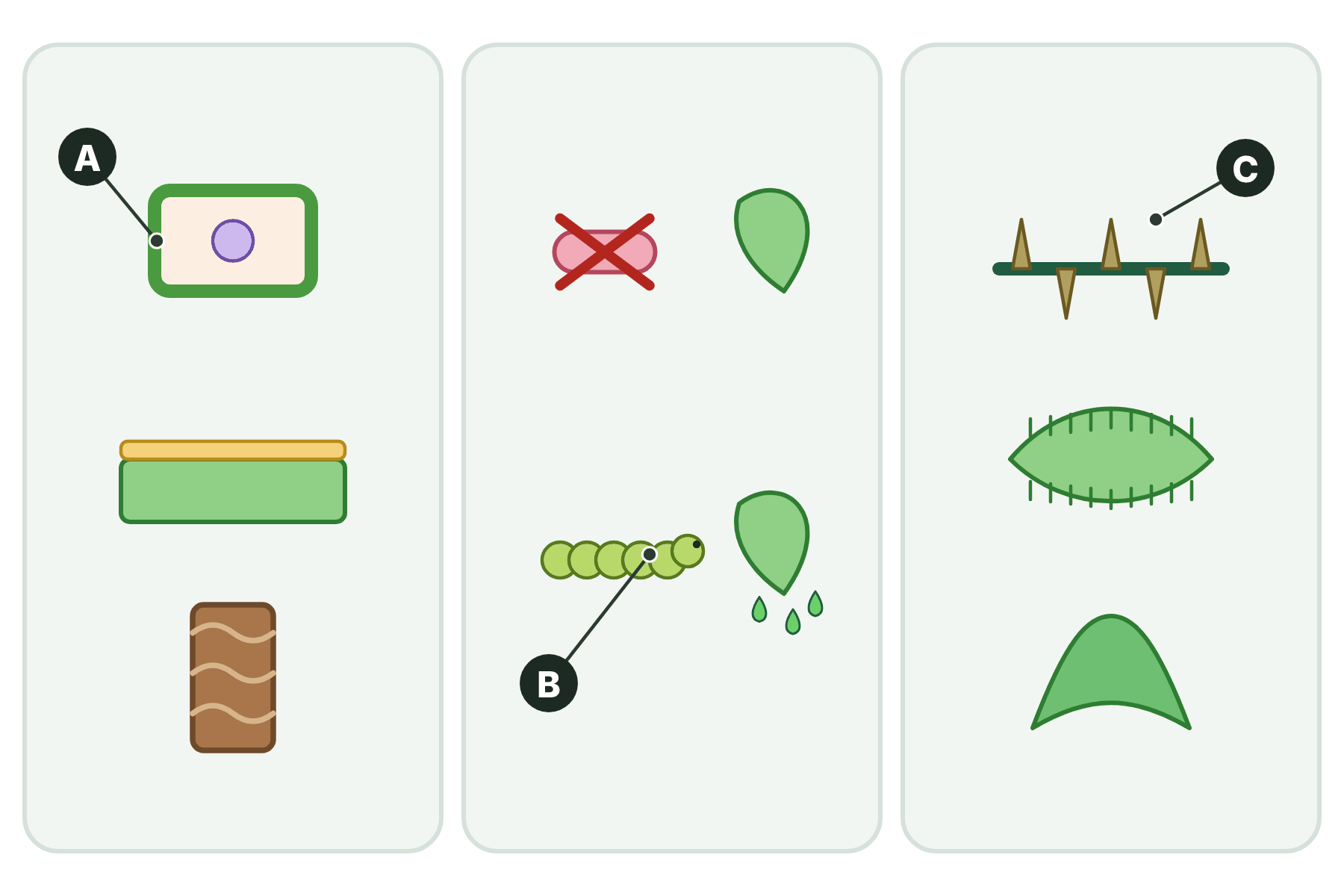
Figure 1 shows some defences of plants. Name the type of defence shown at A, B and C (physical, chemical or mechanical).
Show answerHide answer
Model answer
A is a physical defence. B is a chemical defence. C is a mechanical adaptation.
Mark scheme
- A: physical — 1 mark
- B: chemical — 1 mark
- C: mechanical — 1 mark
-
4 Explain [3 marks]
Explain how a poison made by a plant can protect the plant from being eaten.
Show answerHide answer
Model answer
Animals that eat the plant take in the poison, which makes them ill or kills them. They learn not to eat that plant, and other animals avoid it, so the plant survives with less damage.
Mark scheme
- Poison harms animals that eat it — 1 mark
- Animals learn to avoid it — 1 mark
- Plant is damaged less / survives — 1 mark
-
5 Describe [3 marks]
Describe three mechanical adaptations that deter animals from eating a plant.
Show answerHide answer
Model answer
Thorns that are sharp and hurt the animal. Hairs on the leaves or stem that deter animals. Leaves that curl or droop when touched. (Also accept mimicry, for example looking like something unpleasant.)
Mark scheme
- Thorns — 1 mark
- Hairs — 1 mark
- Drooping or curling leaves / mimicry — 1 mark
-
6 Explain [3 marks]
Explain why the cellulose cell wall and the waxy cuticle are both useful defences against the invasion of microorganisms.
Show answerHide answer
Model answer
The cellulose cell wall is a strong barrier around each cell, which most microorganisms cannot easily break through. The waxy cuticle is a tough layer on the leaf surface that microorganisms cannot easily get through, and water runs off it so they do not collect there. Together they make it harder for microorganisms to get in.
Mark scheme
- Cell wall is a strong barrier — 1 mark
- Waxy cuticle is a tough barrier on the surface — 1 mark
- Together they make entry harder — 1 mark
-
7 Evaluate [4 marks]
A plant has thorns, poisonous leaves and bark. Explain how each of these features protects the plant, and say which type of defence each one is.
Show answerHide answer
Model answer
The thorns are a mechanical adaptation, which deter animals from eating the plant. The poison is a chemical defence, which makes animals that eat the leaves ill. The bark is a physical defence, made of dead cells, which resists the invasion of microorganisms. Together, they protect the plant from both animals and pathogens.
Mark scheme
- Thorns: mechanical, deter animals — 1 mark
- Poison: chemical, harms animals — 1 mark
- Bark: physical, resists microorganisms — 1 mark
- Together they defend against animals and pathogens — 1 mark
Quick check
-
1
What is the bark of a tree made of?
Show answerHide answer
B: Dead cells
The bark is made of layers of dead cells, which form a barrier against microorganisms.
-
2
Which of these is a chemical defence of a plant?
Show answerHide answer
C: A poison
Antibacterial chemicals and poisons are chemical defences.
-
3
Which of these is a mechanical adaptation?
Show answerHide answer
A: Thorns
Thorns are a mechanical adaptation that deters animals.
-
4
What is a herbivore?
Show answerHide answer
D: An animal that eats plants
A herbivore is an animal that eats plants.
-
5
What does the waxy cuticle do?
Show answerHide answer
B: It is a barrier on the leaf surface
The cuticle is a tough barrier on the surface of the leaf.
-
6
What is mimicry in plants?
Show answerHide answer
C: Looking like something else
In mimicry, a plant looks like something else to trick animals.
-
7
Why do leaves that curl when touched help a plant?
Show answerHide answer
A: They are harder for animals to eat
They are harder to eat and may scare animals away.
-
8
Which defence is made of cellulose?
Show answerHide answer
D: The cell wall
Plant cell walls are made of cellulose and form a barrier to microorganisms.