Biology · Plant Disease
Plant Defence Responses
Plants cannot run away from pathogens or from animals that eat them, so they defend themselves in other ways. This lesson covers the physical barriers, chemical defences and mechanical adaptations of plants.
Learning Objectives
- 1Describe the physical defences of plants against the invasion of microorganisms.
- 2Describe the chemical defences of plants.
- 3Describe the mechanical adaptations that deter animals.
- 4Explain how each defence helps the plant to survive.
Retrieval practice
-
1
What is the cell wall of a plant made of?
Show answerHide answer
-
2
What is the waxy cuticle for?
Show answerHide answer
It reduces water loss from the leaf.
-
3
What is a pathogen?
Show answerHide answer
A microorganism that causes disease.
-
4
What is an adaptation?
Show answerHide answer
A feature that helps an organism to survive in its environment.
Defending without moving
A plant cannot hide from a pathogen or a hungry animal, so it has to defend itself where it stands. Its defences are built into its structure and chemistry. Some are always there, and others are switched on only when the plant is attacked. They fall into three groups: physical defences, chemical defences and mechanical adaptations.
Physical defences
These are barriers that resist the invasion of microorganisms.
-
Cellulose cell walls
Every plant cell has a strong wall of cellulose, which most microorganisms cannot easily get through.
-
Tough waxy cuticle
The leaves are covered by a waxy layer that microorganisms cannot easily break and that water runs off, so microorganisms are not trapped on the surface.
-
Layers of dead cells
Around stems, as in the bark of trees, layers of dead cells form a barrier, and then fall off, taking any pathogens with them.
Chemical defences
Many plants make chemicals that protect them.
-
Antibacterial chemicals
Some plants make chemicals that kill or prevent the growth of bacteria. Some are used as the basis of medicines.
-
Poisons to deter herbivores
Some plants make poisons, so animals that eat them become ill or die and learn to avoid them.
Mechanical adaptations
Mechanical defences are features of a plant's body that physically deter animals.
-
Thorns and hairs
Sharp thorns and stinging or bristly hairs deter animals from eating the plant.
-
Leaves that droop or curl
Some leaves droop or curl when touched, which makes them harder for an animal to eat and may scare it away.
-
Mimicry
Some plants look like something else, for example the leaves of one passion flower have markings that look like butterfly eggs, so butterflies do not lay their eggs there.
How plants defend themselves
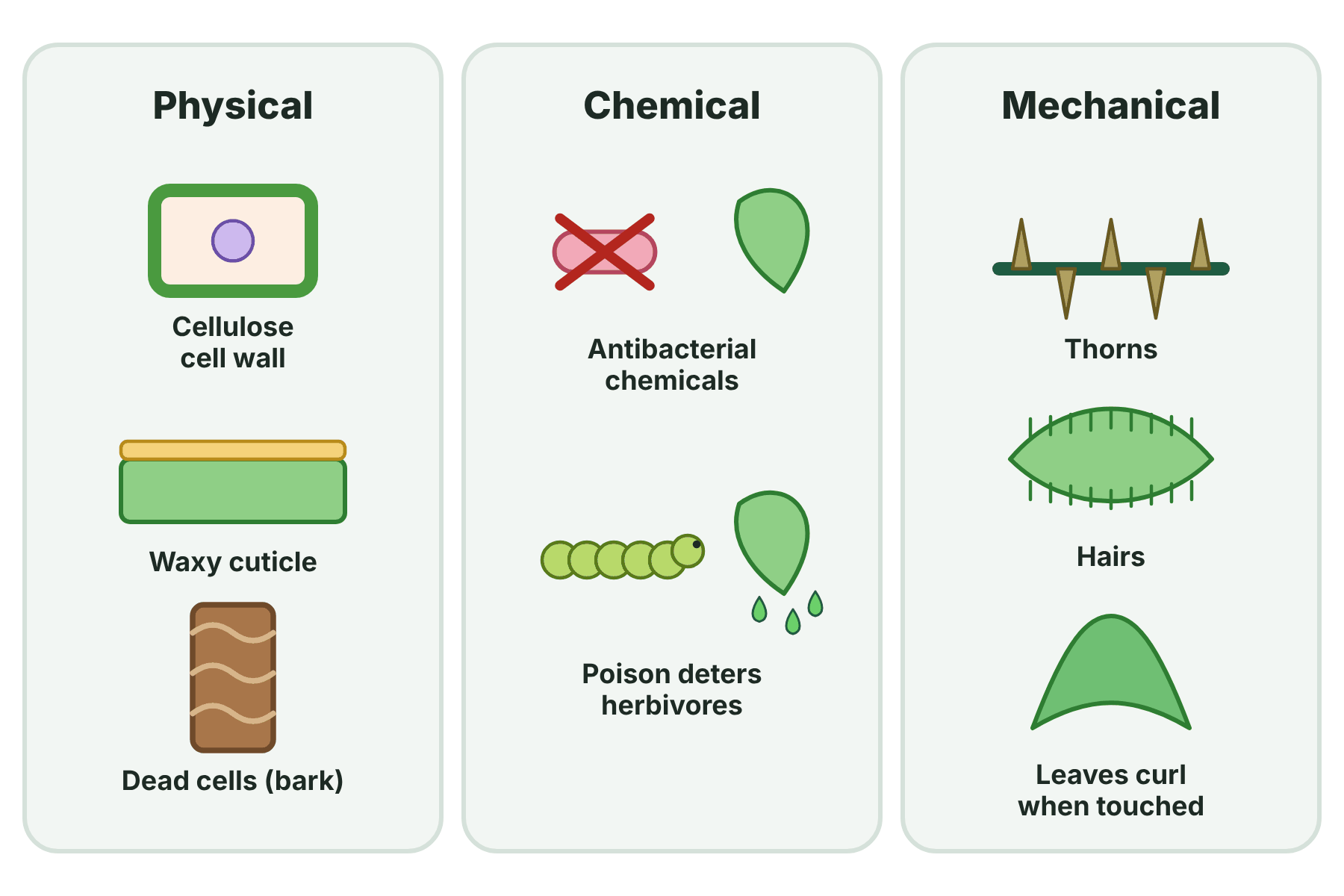
Plants have physical, chemical and mechanical defences.
Physical, chemical and mechanical defences compared
Physical and chemical
- Cell walls, waxy cuticle and dead cells resist microorganisms
- Antibacterial chemicals kill bacteria
- Poisons make animals ill
- Mostly protect against microorganisms and herbivores
Mechanical
- Thorns and hairs deter animals physically
- Drooping or curling leaves
- Mimicry tricks animals
- Mostly deter animals that eat the plant
Case study
Why bark falls off
The outer layer of a tree trunk is made of dead cells. They are tough and waterproof, so most pathogens cannot get through them. Because the layer of dead cells is slowly shed, any microorganisms that have settled on it are carried away with it. At the same time, new layers form underneath, so the barrier is constantly renewed.
The big idea
Plants have physical, chemical and mechanical defences, built in to their structure.
Plant defences
Plant defences
-
Physical
- cellulose cell walls
- waxy cuticle
- dead cells in bark
-
Chemical
- antibacterial chemicals
- poisons
-
Mechanical
- thorns
- hairs
- drooping leaves
- mimicry
-
Purpose
- resist pathogens
- deter herbivores
Summary and exam focus
- Physical defences include cellulose cell walls, a waxy cuticle and layers of dead cells.
- Chemical defences include antibacterial chemicals and poisons.
- Mechanical adaptations include thorns, hairs, leaves that droop or curl, and mimicry.
- Physical defences resist the invasion of microorganisms.
- Chemical and mechanical defences deter animals that eat plants.
Exam focus
Describe three ways in which a plant can defend itself against attack. (3 marks) (3 marks)
Choose one from each group if you can: a physical defence (such as the cell wall or waxy cuticle), a chemical defence (antibacterial chemicals or poisons) and a mechanical adaptation (thorns, hairs or leaves that curl).
Key terms
The words this lesson expects you to use. Each one is linked from the first place it appears above.
- Physical defence
- A barrier, such as a cell wall or waxy cuticle, that stops pathogens getting into a plant.
- Chemical defence
- A chemical, such as an antibacterial substance or poison, made by a plant to protect itself.
- Mechanical adaptation
- A feature of a plant's structure, such as a thorn, that deters animals.
- Herbivore
- An animal that eats plants.
- Cuticle
- A waxy layer on the surface of a leaf.
- Thorn
- A sharp, pointed part of a plant that deters animals.
- Mimicry
- When an organism looks like something else, to trick other organisms.
- Cellulose
- The material that makes up the cell walls of plants.
You've finished the notes
Check your understanding
Test yourself while it is fresh. Start with the flashcards, then try the exam questions.
Something here looks wrong?
Tell us what and we will go and look. It goes to whoever writes these pages, nobody else, and we do not ask who you are — so there is nothing to sign and nothing comes back to you.