Exam questions · Biology · Plant Tissues and Transport
Plant Tissues and Organs
- 7 exam questions
- 18 marks
- 8 quick checks
-
1 State [1 mark]
Name the tissue in a leaf where most photosynthesis takes place.
Show answerHide answer
Model answer
Palisade mesophyll.
Mark scheme
- Palisade (mesophyll) — 1 mark
-
2 Name [3 marks]
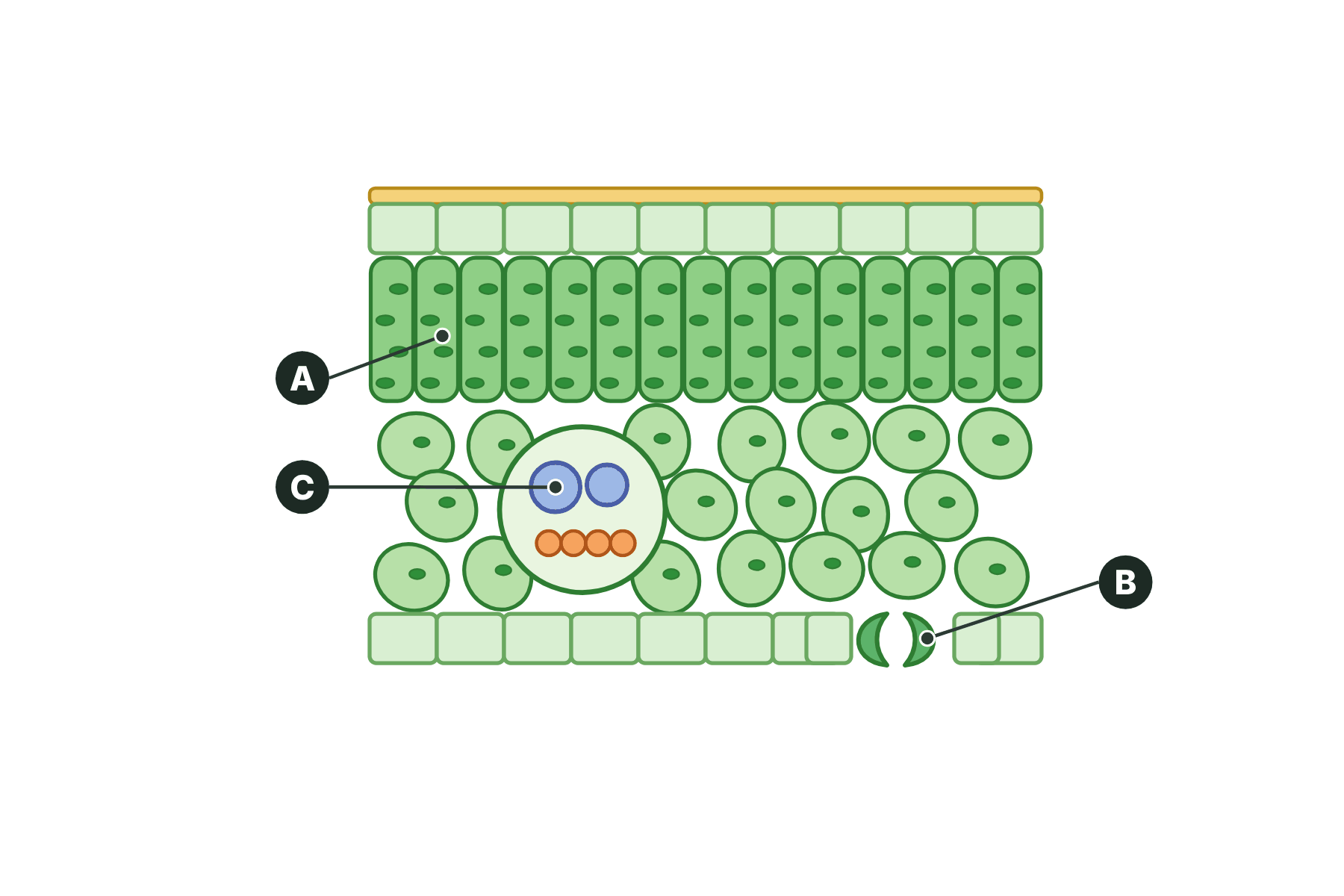
Figure 1 shows a section through a leaf. Name the parts labelled A, B and C.
Show answerHide answer
Model answer
A is the palisade mesophyll. B is a guard cell. C is the xylem.
Mark scheme
- A: palisade mesophyll — 1 mark
- B: guard cell — 1 mark
- C: xylem — 1 mark
-
3 Explain [3 marks]
Explain how the structure of the palisade mesophyll is related to its function.
Show answerHide answer
Model answer
The palisade cells contain many chloroplasts, which absorb light for photosynthesis. They are tall and tightly packed, so many cells fit near the top of the leaf. They are just below the transparent upper epidermis, where most light arrives.
Mark scheme
- Many chloroplasts to absorb light — 1 mark
- Tightly packed near the top of the leaf — 1 mark
- Where most light arrives / under a transparent epidermis — 1 mark
-
4 Explain [2 marks]
Explain why the spongy mesophyll has air spaces between its cells.
Show answerHide answer
Model answer
The air spaces allow carbon dioxide and oxygen to diffuse through the leaf. They also give the cells a large surface area for gas exchange.
Mark scheme
- Gases diffuse through the leaf — 1 mark
- Large surface area for gas exchange — 1 mark
-
5 Describe [3 marks]
Describe how guard cells control the opening of the stomata.
Show answerHide answer
Model answer
When the plant has plenty of water, water enters the guard cells by osmosis and they become turgid, which opens the stoma. When the plant is short of water, the guard cells lose water and become flaccid, which closes the stoma. This stops more water being lost.
Mark scheme
- Turgid guard cells open the stoma — 1 mark
- Flaccid guard cells close the stoma — 1 mark
- Closing reduces water loss — 1 mark
-
6 Explain [2 marks]
Suggest why most stomata are found in the lower epidermis of a leaf.
Show answerHide answer
Model answer
The lower surface is cooler and shadier than the upper surface. Less water is lost by evaporation, but gases can still be exchanged.
Mark scheme
- Cooler / less light — 1 mark
- Less water lost — 1 mark
-
7 Describe [4 marks]
Describe the functions of the upper epidermis, the palisade mesophyll, the spongy mesophyll and the guard cells.
Show answerHide answer
Model answer
The upper epidermis covers and protects the leaf and is transparent so light can pass through. The palisade mesophyll carries out most of the photosynthesis. The spongy mesophyll has air spaces, which allow gases to diffuse through the leaf. The guard cells open and close the stomata to control gas exchange and water loss.
Mark scheme
- Epidermis covers / protects / transparent — 1 mark
- Palisade does photosynthesis — 1 mark
- Spongy mesophyll allows gas exchange — 1 mark
- Guard cells control the stomata — 1 mark
Quick check
-
1
Which layer of a leaf is covered by a waxy cuticle?
Show answerHide answer
B: Upper epidermis
The upper epidermis has a waxy cuticle that reduces water loss.
-
2
Which tissue has the most chloroplasts?
Show answerHide answer
C: Palisade mesophyll
Palisade mesophyll cells are packed with chloroplasts and do most of the photosynthesis.
-
3
What do guard cells do?
Show answerHide answer
A: Open and close the stomata
Guard cells change shape to open and close the stomata.
-
4
What are the air spaces in the spongy mesophyll for?
Show answerHide answer
D: Gas exchange
They allow gases to diffuse through the leaf and give a large surface area for gas exchange.
-
5
What happens to the guard cells when a plant is short of water?
Show answerHide answer
B: They become flaccid and close the stoma
The guard cells become flaccid and close the stomata, which reduces water loss.
-
6
Where are meristem cells found?
Show answerHide answer
C: At the tips of roots and shoots
Meristem tissue is at the growing tips of the roots and shoots.
-
7
Why is the upper epidermis transparent?
Show answerHide answer
A: To let light through to the palisade cells
Light has to pass through it to reach the palisade cells.
-
8
Which tissue carries sugars away from the leaf?
Show answerHide answer
D: Phloem
Phloem transports dissolved sugars. Xylem brings water.