Exam questions · Biology · The Circulatory System
Blood
- 7 exam questions
- 18 marks
- 8 quick checks
-
1 State [1 mark]
Name the part of the blood that carries oxygen.
Show answerHide answer
Model answer
Red blood cells (haemoglobin in the red blood cells).
Mark scheme
- Red blood cells — 1 mark
-
2 Name [3 marks]
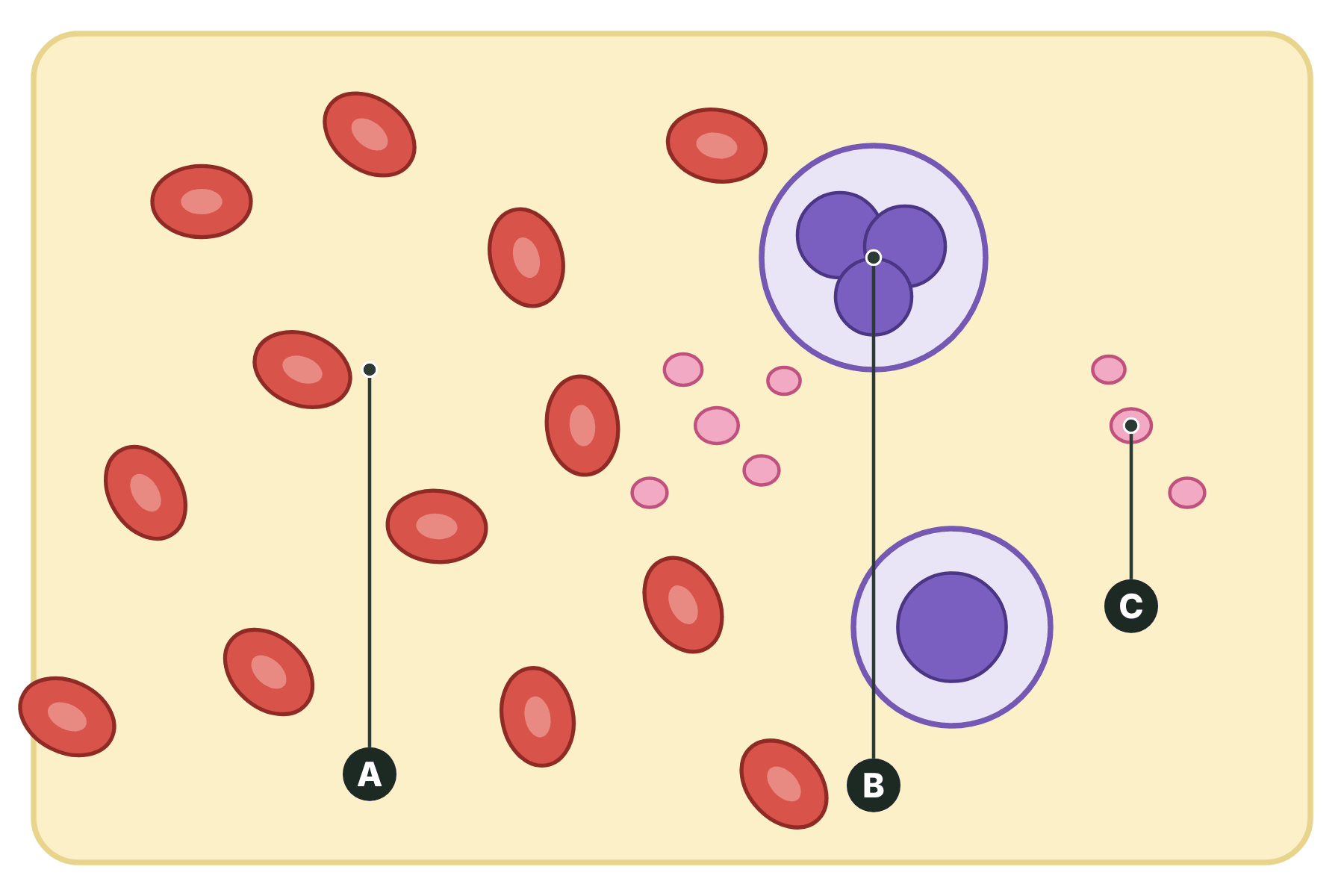
Figure 1 shows some of the components of blood. Name the parts labelled A, B and C.
Show answerHide answer
Model answer
A is a red blood cell. B is a white blood cell. C is a platelet.
Mark scheme
- A: red blood cell — 1 mark
- B: white blood cell — 1 mark
- C: platelet — 1 mark
-
3 State [2 marks]
Name two substances carried in the plasma, and state where each one is carried to.
Show answerHide answer
Model answer
Carbon dioxide is carried to the lungs. Urea is carried to the kidneys. Accept glucose carried to the body cells, or hormones carried to their target organs.
Mark scheme
- A named substance — 1 mark
- Its correct destination — 1 mark
-
4 Explain [3 marks]
Explain how a red blood cell is adapted to carry oxygen.
Show answerHide answer
Model answer
It contains haemoglobin, which joins with oxygen. It has no nucleus, so there is more room for haemoglobin. Its biconcave shape gives a large surface area for oxygen to diffuse in and out.
Mark scheme
- Contains haemoglobin — 1 mark
- No nucleus so more room for haemoglobin — 1 mark
- Biconcave shape gives a large surface area — 1 mark
-
5 Describe [2 marks]
Describe the function of platelets.
Show answerHide answer
Model answer
Platelets help the blood to clot at a wound. The clot forms a scab that stops the bleeding and prevents microorganisms entering.
Mark scheme
- Help the blood to clot — 1 mark
- Stops blood loss / stops pathogens getting in — 1 mark
-
6 Describe [3 marks]
A photograph of blood shows many small round cells, a few much larger cells with a dark purple centre, and some tiny fragments. Describe how you can identify each of these using what you know about blood cells.
Show answerHide answer
Model answer
The many small round cells with no nucleus are red blood cells. The few larger cells with a dark stained nucleus are white blood cells. The tiny fragments with no nucleus are platelets.
Mark scheme
- Small round cells with no nucleus are red blood cells — 1 mark
- Larger cells with a nucleus are white blood cells — 1 mark
- Tiny fragments are platelets — 1 mark
-
7 Evaluate [4 marks]
Blood transfusions use blood products from donors. Evaluate the risks and benefits of using blood products.
Show answerHide answer
Model answer
A transfusion can save the life of a person who has lost a lot of blood or who has a blood disorder. However, there are risks. The donor blood could be infected with a pathogen, although screening reduces this risk. If the blood group is not matched, the patient can have a serious reaction. Some patients may have an allergic reaction. On balance the benefits usually outweigh the risks because blood is screened and matched.
Mark scheme
- Benefit: saves life / replaces lost blood — 1 mark
- Risk: infection from donor blood — 1 mark
- Risk: mismatched blood group / allergic reaction — 1 mark
- A conclusion weighing risks and benefits — 1 mark
Quick check
-
1
Which part of the blood carries oxygen?
Show answerHide answer
B: Red blood cells
Red blood cells contain haemoglobin, which joins with oxygen.
-
2
Which part of the blood helps it to clot?
Show answerHide answer
D: Platelets
Platelets are cell fragments that help blood clot at a wound.
-
3
Which blood cell has a nucleus?
Show answerHide answer
C: White blood cell
White blood cells have a nucleus. Red blood cells and platelets do not.
-
4
What is carried in the plasma from the liver to the kidneys?
Show answerHide answer
A: Urea
Urea is made in the liver and carried in the plasma to the kidneys.
-
5
Why do red blood cells have no nucleus?
Show answerHide answer
B: To make more room for haemoglobin
It leaves more room for haemoglobin, so the cell can carry more oxygen.
-
6
What is the red pigment in red blood cells?
Show answerHide answer
C: Haemoglobin
Haemoglobin joins with oxygen in the lungs and releases it in the tissues.
-
7
What do phagocytes do?
Show answerHide answer
D: Engulf pathogens
Phagocytes are white blood cells that engulf and digest pathogens.
-
8
Which component of blood is a fragment of a cell?
Show answerHide answer
A: Platelets
Platelets are small fragments of cells with no nucleus.