Exam questions · Biology · The Circulatory System
The Lungs and Gas Exchange
- 7 exam questions
- 19 marks
- 8 quick checks
-
1 Name [3 marks]
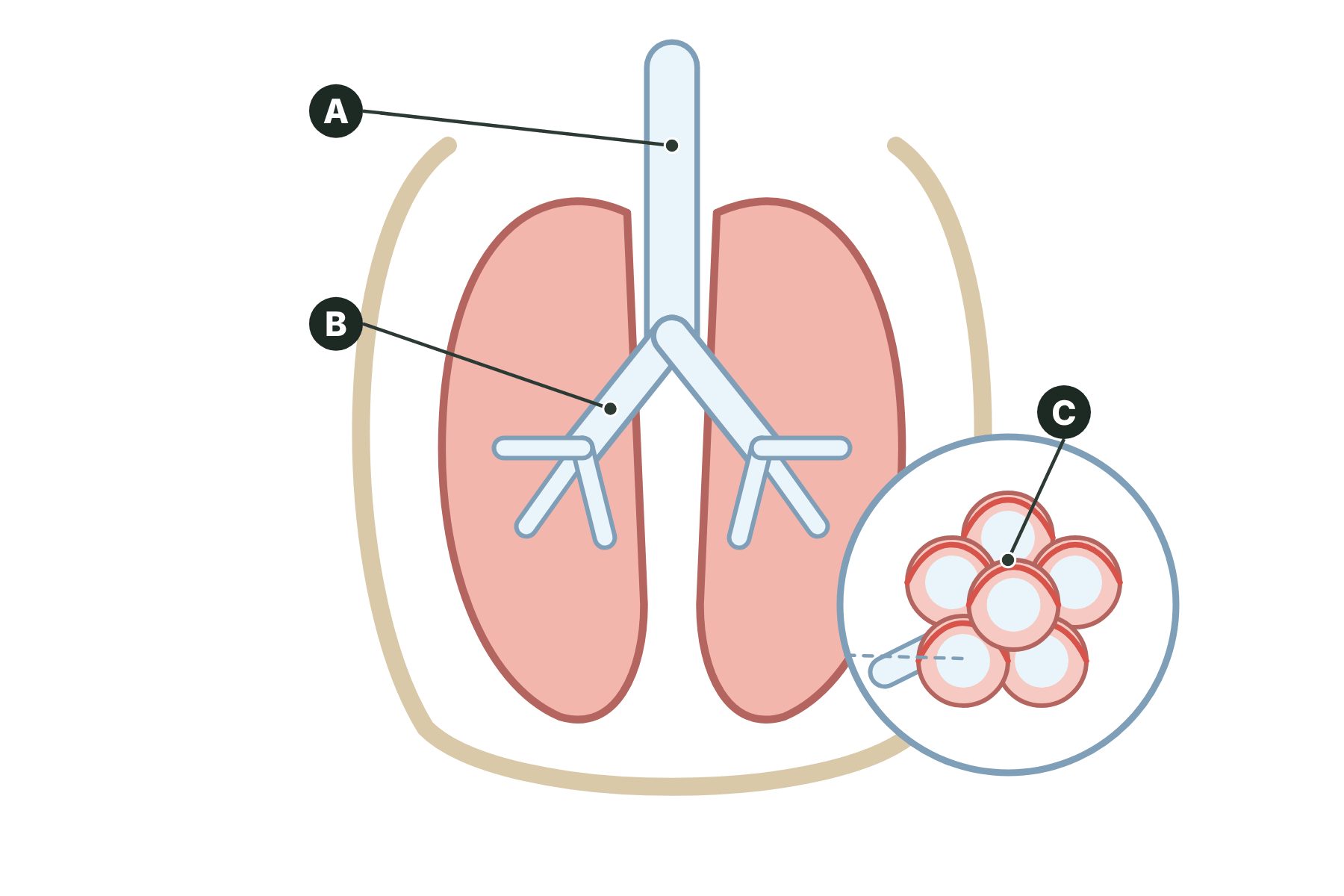
Figure 1 shows the lungs. Name the parts labelled A, B and C.
Show answerHide answer
Model answer
A is the trachea. B is a bronchus. C is the alveoli (air sacs).
Mark scheme
- A: trachea — 1 mark
- B: bronchus — 1 mark
- C: alveoli — 1 mark
-
2 State [2 marks]
Name the two gases exchanged in the alveoli and state the direction each one moves.
Show answerHide answer
Model answer
Oxygen moves from the alveoli into the blood. Carbon dioxide moves from the blood into the alveoli.
Mark scheme
- Oxygen from the alveoli into the blood — 1 mark
- Carbon dioxide from the blood into the alveoli — 1 mark
-
3 Explain [2 marks]
Explain why the walls of the alveoli are only one cell thick.
Show answerHide answer
Model answer
A thin wall gives a short diffusion path. Oxygen and carbon dioxide can therefore diffuse across quickly.
Mark scheme
- Short diffusion path — 1 mark
- Faster diffusion of gases — 1 mark
-
4 Explain [3 marks]
Explain why oxygen diffuses from the alveoli into the blood.
Show answerHide answer
Model answer
The concentration of oxygen is higher in the air in the alveoli than in the blood. Oxygen therefore diffuses down the concentration gradient. The gradient is kept steep by breathing and by the blood carrying oxygen away.
Mark scheme
- Higher concentration of oxygen in the alveoli — 1 mark
- Diffuses down the concentration gradient — 1 mark
- Gradient kept steep by ventilation / blood flow — 1 mark
-
5 Calculate [2 marks]
A person takes 15 breaths per minute. Each breath takes in 400 cm³ of air. Calculate the volume of air breathed in per minute.
Show answerHide answer
Model answer
400 × 15 = 6000 cm³ per minute.
Mark scheme
- 400 × 15 — 1 mark
- 6000 cm³ per minute — 1 mark
-
6 Explain [4 marks]
Explain how the lungs are adapted for gaseous exchange.
Show answerHide answer
Model answer
The lungs contain millions of alveoli, which give a very large surface area. The walls of the alveoli and capillaries are one cell thick, so the diffusion path is short. A rich supply of blood in the capillaries carries oxygen away and brings carbon dioxide, keeping the concentration gradient steep. Breathing ventilates the alveoli, which also keeps the gradient steep.
Mark scheme
- Millions of alveoli give a large surface area — 1 mark
- Walls one cell thick, short diffusion path — 1 mark
- Rich blood supply keeps the gradient steep — 1 mark
- Ventilation keeps the gradient steep — 1 mark
-
7 Explain [3 marks]
A person has emphysema, a disease that destroys the walls of the alveoli. Explain why this person feels short of breath.
Show answerHide answer
Model answer
Destroying the walls reduces the surface area of the alveoli. Less oxygen can diffuse into the blood. The body cells therefore receive less oxygen for respiration, so the person feels short of breath.
Mark scheme
- Reduced surface area — 1 mark
- Less oxygen diffuses into the blood — 1 mark
- Less oxygen for respiration in cells — 1 mark
Quick check
-
1
What are the tiny air sacs in the lungs called?
Show answerHide answer
C: Alveoli
Alveoli are the air sacs where gases are exchanged with the blood.
-
2
Which gas diffuses from the blood into the alveoli?
Show answerHide answer
B: Carbon dioxide
Carbon dioxide is at a higher concentration in the blood arriving at the lungs, so it diffuses into the alveoli.
-
3
What is the trachea?
Show answerHide answer
A: The windpipe
The trachea is the windpipe, which carries air from the mouth and nose to the bronchi.
-
4
How many cells thick is the wall of an alveolus?
Show answerHide answer
D: One
The wall is one cell thick, which gives a short diffusion path.
-
5
Which feature of the lungs keeps the concentration gradients steep by moving air?
Show answerHide answer
C: Ventilation
Ventilation, or breathing, moves fresh air in and stale air out.
-
6
What surrounds each alveolus?
Show answerHide answer
B: A network of capillaries
A network of capillaries brings blood past the alveolus for gas exchange.
-
7
A person breathes 20 times a minute and takes in 300 cm³ each time. What volume do they breathe in per minute?
Show answerHide answer
D: 6000 cm³
300 × 20 = 6000 cm³ per minute.
-
8
Why do the lungs have millions of alveoli?
Show answerHide answer
A: To give a large surface area
Many alveoli give a very large surface area for gas exchange.