Biology · The Circulatory System
The Lungs and Gas Exchange
The lungs bring oxygen into the blood and take carbon dioxide out. This lesson follows air from the trachea to the alveoli and explains how the lungs are adapted for gas exchange.
Learning Objectives
- 1Describe the structure of the lungs: the trachea, bronchi, alveoli and the capillary network around the alveoli.
- 2Explain how the lungs are adapted for gas exchange.
- 3Describe how oxygen and carbon dioxide move between the alveoli and the blood.
- 4Calculate a breathing rate and a volume of air breathed per minute.
Retrieval practice
-
1
What is an exchange surface?
Show answerHide answer
A surface specialised for swapping substances with the surroundings.
-
2
Name the four features of a good exchange surface.
Show answerHide answer
Large surface area, thin membrane, good blood supply and ventilation.
-
3
What carries blood to the lungs from the heart?
Show answerHide answer
The pulmonary artery.
-
4
What is diffusion?
Show answerHide answer
The net movement of particles from a higher to a lower concentration.
Getting oxygen to the blood
Every cell in the body needs oxygen for aerobic respiration, and every cell makes carbon dioxide that must be removed. The lungs are the organs that do this job. They are in the chest, protected by the ribs, and the air that is breathed in travels through a branching system of tubes until it reaches tiny air sacs. There the oxygen crosses into the blood and carbon dioxide crosses out.
The path of air into the lungs
The knowledge needed for the lungs is limited to four structures.
-
Trachea
The windpipe. It carries air from the nose and mouth down towards the lungs.
-
Bronchi
The trachea splits into two tubes, one bronchus for each lung. Each bronchus branches into smaller tubes called bronchioles.
-
Alveoli
The bronchioles end in millions of tiny air sacs called alveoli. This is where gas exchange takes place.
-
Capillary network
Each alveolus is wrapped in a network of capillaries that carries blood past its surface.
The human lungs
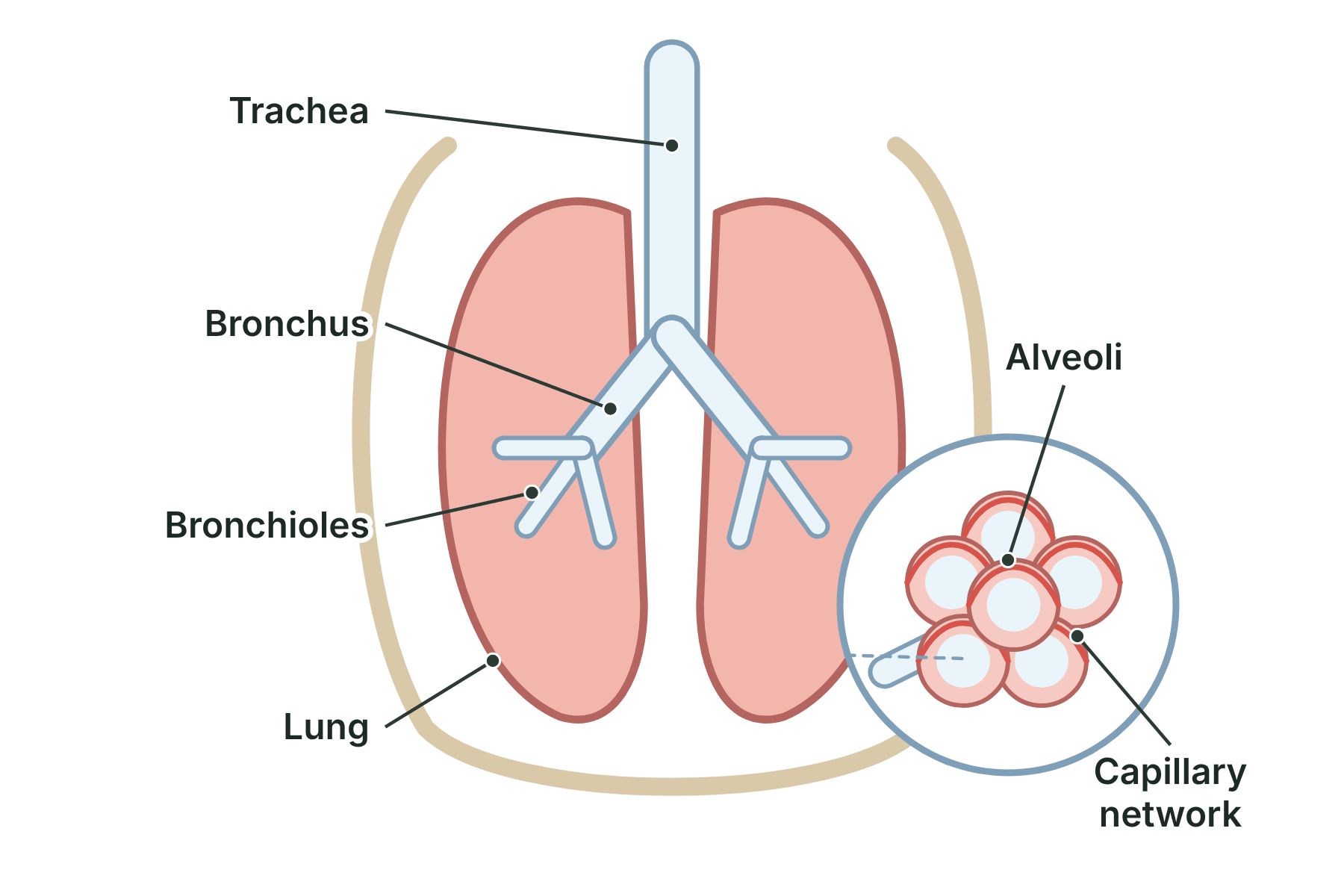
Air travels down the trachea and the bronchi to the alveoli.
How the lungs are adapted for gas exchange
The alveoli have all four features of an effective exchange surface.
-
Large surface area
There are millions of alveoli in each lung, so there is a very large area for oxygen to diffuse across.
-
Thin walls
The wall of an alveolus is one cell thick, and so is the wall of a capillary, so the diffusion path is very short.
-
A rich blood supply
The capillary network takes oxygen away and brings carbon dioxide, which keeps the concentration gradients steep.
-
Ventilation
Breathing in and out keeps fresh air moving into the alveoli and stale air moving out, which keeps the concentration gradients steep.
Gas exchange in an alveolus
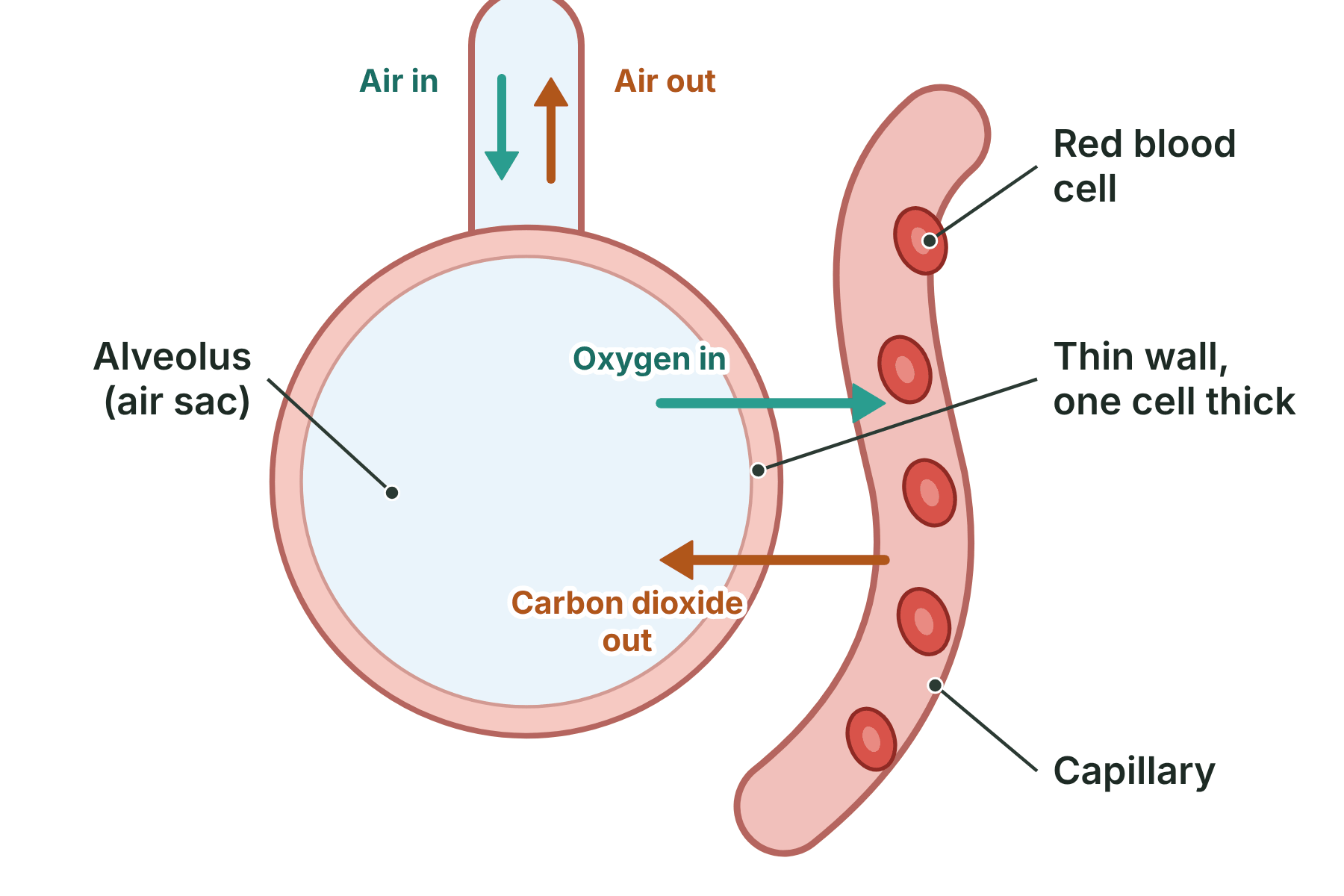
Oxygen diffuses into the blood and carbon dioxide diffuses out.
Gas exchange in the alveoli
Diffusion moves each gas down its concentration gradient.
-
1
Breathe in
Fresh air fills the alveoli. It has a high concentration of oxygen and a low concentration of carbon dioxide.
-
2
Oxygen diffuses in
The blood arriving is low in oxygen, so oxygen diffuses from the alveolus across the thin walls into the blood.
-
3
Carbon dioxide diffuses out
The blood arriving is high in carbon dioxide, so it diffuses from the blood into the alveolus.
-
4
Breathe out
The air that leaves has less oxygen and more carbon dioxide than the air breathed in.
-
5
Blood leaves
The oxygenated blood returns along the pulmonary vein to the heart, ready to be pumped round the body.
Calculating the volume of air breathed per minute
At rest, a person takes 12 breaths per minute and breathes in 500 cm³ of air with each breath. Calculate the volume of air they breathe in each minute.
Show the solutionHide the solution
- 1 Write the formula Volume per minute = volume per breath × breaths per minute
- 2 Substitute the values \(500\text{ cm}^3 \times 12\)
- 3 Calculate and give the unit \(= 6000\text{ cm}^3\) per minute, which is 6 dm³ per minute
AnswerThey breathe in 6000 cm³ of air per minute.
Case study
When the alveoli are damaged
Smoking can damage the alveoli. In the lung disease emphysema the thin walls of the alveoli break down, so that many small air sacs merge into a few large ones. The surface area for gas exchange becomes much smaller, so less oxygen reaches the blood and the person is left short of breath. This is a good example of how a smaller surface area means less effective exchange.
The big idea
The alveoli are one cell thick, packed with capillaries and ventilated by breathing, which makes them a very effective exchange surface.
The lungs
The lungs
-
Structure
- trachea
- bronchi
- bronchioles
- alveoli
- capillary network
-
Adaptations
- large surface area
- thin walls
- blood supply
- ventilation
-
Gas exchange
- oxygen in
- carbon dioxide out
- by diffusion
-
Calculation
- volume per minute = volume per breath × breaths per minute
Summary and exam focus
- Air travels down the trachea, into the bronchi and bronchioles, and into the alveoli.
- Each alveolus is surrounded by a network of capillaries.
- Oxygen diffuses from the alveoli into the blood and carbon dioxide diffuses the other way.
- The alveoli have a large surface area, thin walls, a rich blood supply and are ventilated.
- Damaged alveoli reduce the surface area for gas exchange.
Exam focus
Explain how the lungs are adapted for gaseous exchange. (4 marks) (4 marks)
Give four adaptations and say why each helps: large surface area from millions of alveoli, thin walls for a short diffusion path, a rich capillary blood supply and ventilation, which keep a steep concentration gradient.
Key terms
The words this lesson expects you to use. Each one is linked from the first place it appears above.
- Trachea
- The windpipe, the tube that carries air from the mouth and nose towards the lungs.
- Bronchus
- One of the two tubes that branch from the trachea, one into each lung.
- Bronchiole
- A smaller tube that branches from a bronchus and ends in alveoli.
- Alveolus
- A tiny air sac in the lungs where gas exchange takes place.
- Gas exchange
- The swapping of oxygen and carbon dioxide between the air and the blood.
- Ventilation
- Breathing, which moves fresh air into the lungs and stale air out.
- Concentration gradient
- A difference in the concentration of a substance between two places.
- Capillary network
- The net of tiny blood vessels that surrounds each alveolus.
You've finished the notes
Check your understanding
Test yourself while it is fresh. Start with the flashcards, then try the exam questions.
Something here looks wrong?
Tell us what and we will go and look. It goes to whoever writes these pages, nobody else, and we do not ask who you are — so there is nothing to sign and nothing comes back to you.