Exam questions · Biology · Homeostasis and the Nervous System
The Eye
- 8 exam questions
- 24 marks
- 7 quick checks
-
1 State [2 marks]
State the function of the iris and the function of the retina.
Show answerHide answer
Model answer
The iris controls the amount of light entering the eye. The retina contains the receptor cells that detect light.
Mark scheme
- Iris controls the amount of light entering — 1 mark
- Retina contains the light receptor cells — 1 mark
-
2 Name [3 marks]
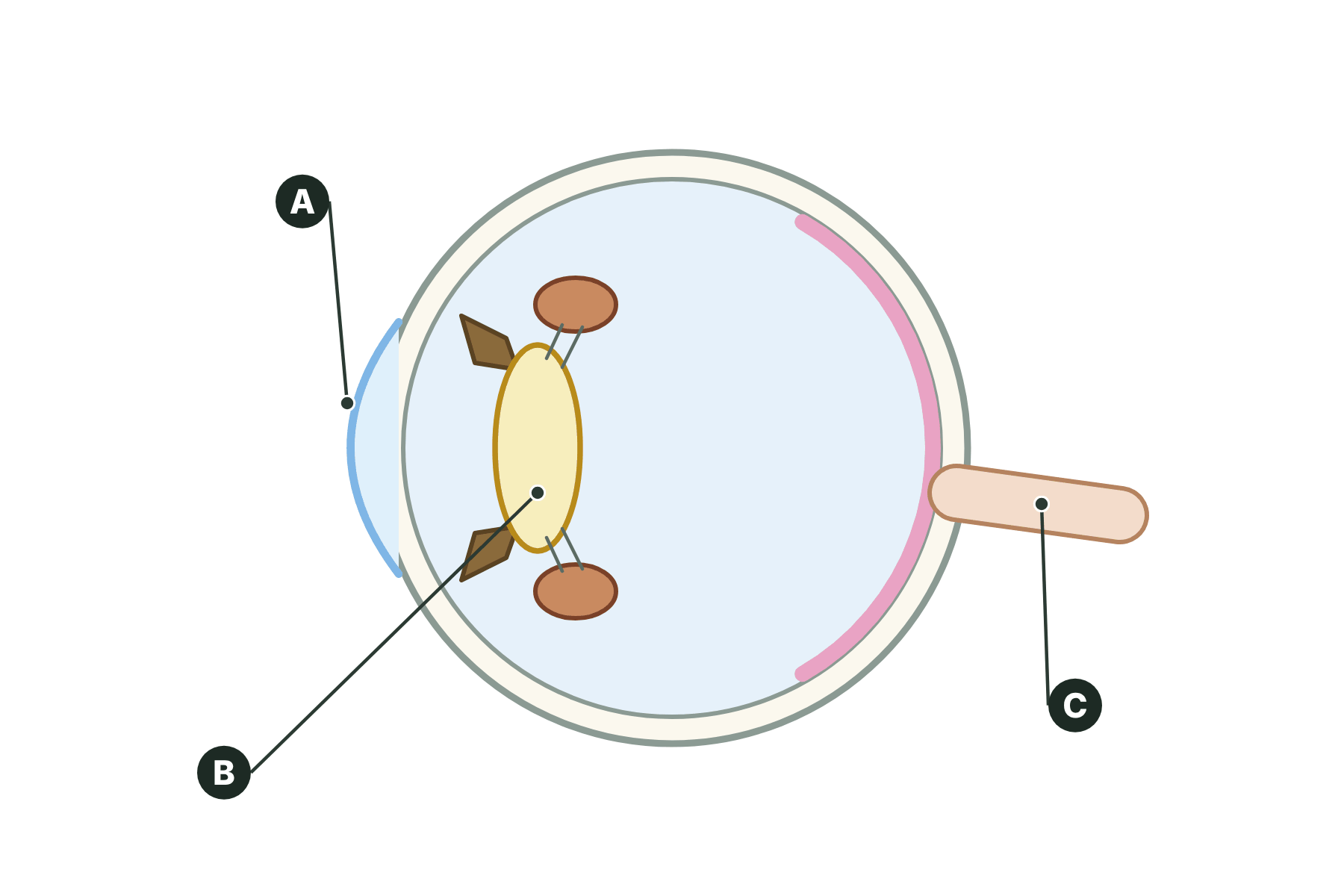
Figure 1 shows a section through the eye. Name the parts shown at A, B and C.
Show answerHide answer
Model answer
A is the cornea. B is the lens. C is the optic nerve.
Mark scheme
- A: cornea — 1 mark
- B: lens — 1 mark
- C: optic nerve — 1 mark
-
3 Explain [3 marks]
Explain how the pupil changes when a person moves from a dim room into bright sunlight.
Show answerHide answer
Model answer
The circular muscles of the iris contract and the radial muscles relax. The pupil gets smaller. This reduces the amount of light that enters, which protects the retina from damage.
Mark scheme
- Circular muscles contract and radial muscles relax — 1 mark
- Pupil gets smaller — 1 mark
- Less light enters, protecting the retina — 1 mark
-
4 Explain [4 marks]
Explain how the eye focuses on a near object.
Show answerHide answer
Model answer
The ciliary muscles contract. This slackens the suspensory ligaments. The lens becomes thicker and more curved. It refracts the light more, so that the light is focused on the retina.
Mark scheme
- Ciliary muscles contract — 1 mark
- Suspensory ligaments slacken — 1 mark
- Lens becomes thicker — 1 mark
- Light is focused on the retina — 1 mark
-
5 Explain [3 marks]
A person has myopia (short sight). Explain why distant objects look blurred and how the problem can be corrected.
Show answerHide answer
Model answer
The lens is too strong or the eyeball is too long, so the light from distant objects is focused in front of the retina. The image on the retina is blurred. A concave lens in spectacles spreads the light out so that it is focused on the retina.
Mark scheme
- Light focused in front of the retina — 1 mark
- Image on the retina is blurred — 1 mark
- Concave lens corrects it — 1 mark
-
6 Describe [3 marks]
Describe three ways in which a focusing problem in the eye can be overcome.
Show answerHide answer
Model answer
Wearing spectacles with the correct lenses, wearing contact lenses, laser eye surgery to reshape the cornea, or replacing the lens with an artificial one.
Mark scheme
- Any three of spectacles, contact lenses, laser surgery, replacement lens — 3 marks
-
7 Explain [3 marks]
A person has hyperopia (long sight). Explain why near objects look blurred and how a spectacle lens corrects the problem.
Show answerHide answer
Model answer
The lens is too weak or the eyeball is too short, so light from near objects is focused behind the retina and the image on the retina is blurred. A convex lens in spectacles refracts the light rays towards each other before they enter the eye, so that they are focused on the retina.
Mark scheme
- Light from near objects focuses behind the retina — 1 mark
- Image on the retina is blurred — 1 mark
- A convex lens refracts the light inwards so it focuses on the retina — 1 mark
-
8 Explain [3 marks]
Explain how the eye adapts when a person walks from bright sunlight into a dim room.
Show answerHide answer
Model answer
The radial muscles of the iris contract and the circular muscles relax, so the pupil gets larger. More light enters the eye. After a few minutes the rod cells become more sensitive, so the person can see in the dim light.
Mark scheme
- Radial muscles contract and circular muscles relax — 1 mark
- Pupil gets larger so more light enters — 1 mark
- Rod cells become more sensitive — 1 mark
Quick check
-
1
Which part of the eye controls the amount of light that enters?
Show answerHide answer
C: The iris
The iris changes the size of the pupil.
-
2
Which part of the eye contains the light receptor cells?
Show answerHide answer
A: The retina
The retina contains the rods and cones.
-
3
What happens to the pupil in bright light?
Show answerHide answer
D: It gets smaller
The circular muscles contract, so the pupil gets smaller.
-
4
When the eye looks at a near object, what happens to the lens?
Show answerHide answer
B: It becomes thicker
The ciliary muscles contract, the ligaments slacken and the lens becomes thicker.
-
5
Which lens corrects short-sightedness?
Show answerHide answer
C: A concave lens
A concave lens spreads the light before it enters the eye.
-
6
What are rod cells used for?
Show answerHide answer
A: Seeing in dim light
Rods are sensitive to dim light but do not detect colour.
-
7
What do the suspensory ligaments connect?
Show answerHide answer
B: The ciliary muscles to the lens
The suspensory ligaments connect the ciliary muscles to the lens.