Exam questions · Biology
Homeostasis and the Nervous System
- 46 exam questions
- 136 marks
- 45 quick checks
Homeostasis and Control Systems
Just this lesson-
1 State [2 marks]
State two conditions of the internal environment that are controlled by homeostasis.
Show answerHide answer
Model answer
Any two of: body temperature, blood glucose concentration, water content.
Mark scheme
- Condition 1 — 1 mark
- Condition 2 — 1 mark
-
2 Name [3 marks]
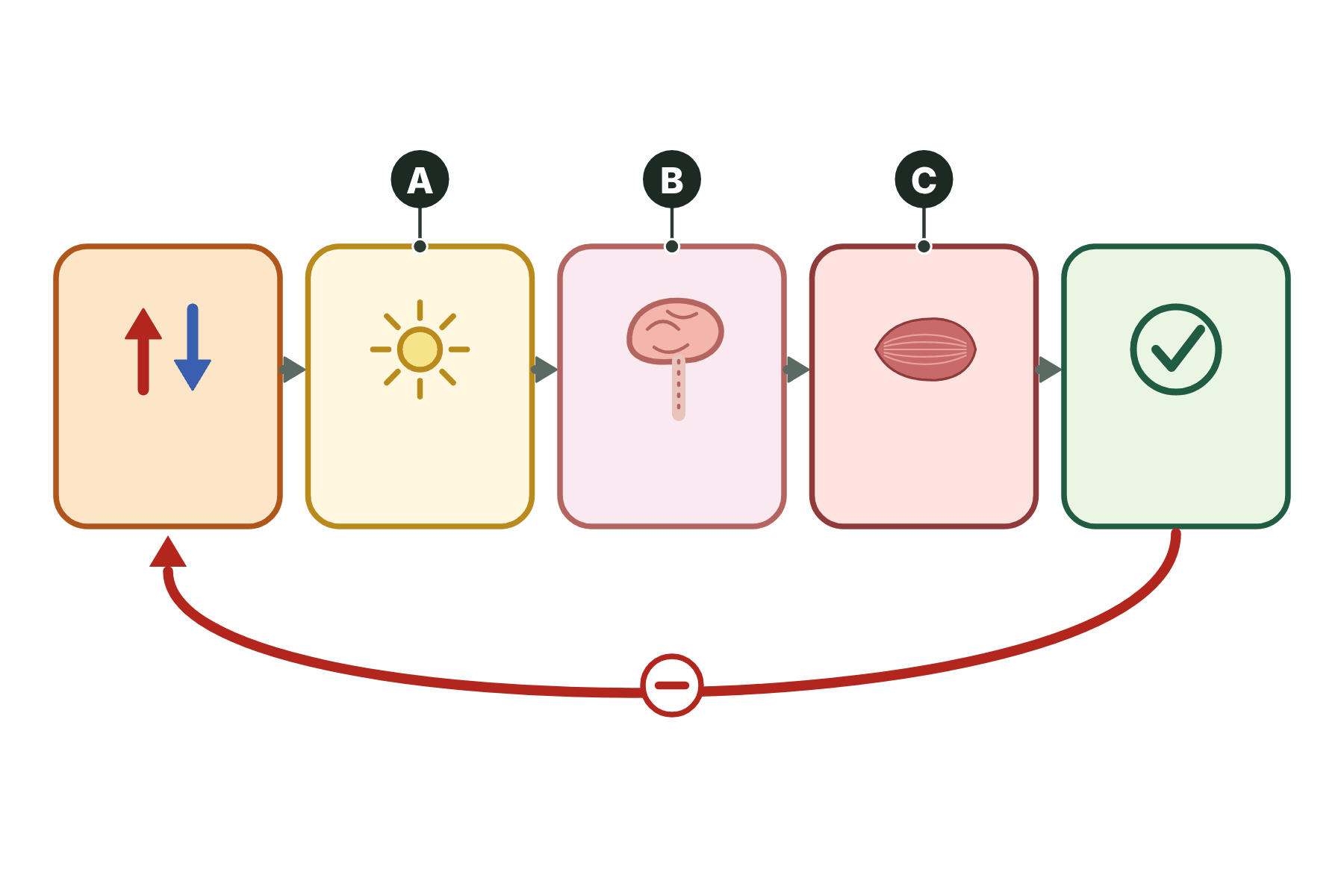
Figure 1 shows the parts of a control system. Name the parts shown at A, B and C.
Show answerHide answer
Model answer
A is the receptor. B is the coordination centre. C is the effector.
Mark scheme
- A: receptor — 1 mark
- B: coordination centre — 1 mark
- C: effector — 1 mark
-
3 Explain [3 marks]
Explain why it is important that body temperature stays at about 37 °C.
Show answerHide answer
Model answer
Enzymes control the metabolic reactions in cells, and they work best at an optimum temperature. If the temperature is too high the enzymes denature, and if it is too low the reactions are too slow.
Mark scheme
- Enzymes control metabolic reactions — 1 mark
- Too high: enzymes denature — 1 mark
- Too low: reactions too slow — 1 mark
-
4 Explain [3 marks]
Explain why the water content of the blood needs to be controlled.
Show answerHide answer
Model answer
If the water content is too high, osmosis moves water into the cells, which may swell and burst. If it is too low, water leaves the cells by osmosis and they shrink. Cells work properly only when the water content is correct.
Mark scheme
- Too high: water enters cells by osmosis — 1 mark
- Too low: water leaves cells — 1 mark
- Cells only work properly if the water content is correct — 1 mark
-
5 Describe [3 marks]
Describe the roles of the receptor, the coordination centre and the effector in a control system.
Show answerHide answer
Model answer
The receptor detects a change in the condition. The coordination centre receives the information and decides on the response. The effector carries out the response.
Mark scheme
- Receptor detects the change — 1 mark
- Coordination centre decides the response — 1 mark
- Effector carries out the response — 1 mark
-
6 Explain [3 marks]
Explain what is meant by negative feedback, using a named example.
Show answerHide answer
Model answer
In negative feedback a change in a condition causes a response that reverses the change. For example, if body temperature rises, sweating cools the body down, so the temperature returns to normal.
Mark scheme
- A change causes a response — 1 mark
- The response reverses the change — 1 mark
- A named example described — 1 mark
-
7 Compare [3 marks]
Compare nervous control with hormonal control of conditions in the body.
Show answerHide answer
Model answer
Nervous control uses nerve impulses but hormonal control uses hormones in the blood. Nervous control is faster. Hormonal control lasts longer.
Mark scheme
- Impulses against hormones — 1 mark
- Nervous is faster — 1 mark
- Hormonal effect lasts longer — 1 mark
Quick check
-
1
What is homeostasis?
Show answerHide answer
B: Keeping internal conditions constant
Homeostasis is the regulation of the internal conditions of a cell or organism to maintain optimum conditions for function.
-
2
What does a receptor do in a control system?
Show answerHide answer
A: Detects a change
A receptor detects a change.
-
3
Which of these is an effector?
Show answerHide answer
D: A sweat gland
Muscles and glands are effectors.
-
4
What does the response do in negative feedback?
Show answerHide answer
C: Reverses the change
In negative feedback the response reverses the change.
-
5
Why does the body need a constant temperature?
Show answerHide answer
B: Enzymes work best at an optimum temperature
Enzymes work best at an optimum temperature.
-
6
Which part of the body acts as a coordination centre for temperature?
Show answerHide answer
A: The brain
The brain, in the thermoregulatory centre, receives information about temperature and decides on the response.
-
7
About what temperature is the human body kept at?
Show answerHide answer
D: 37 °C
Body temperature is kept at about 37 °C.
-
8
Which of these is NOT controlled by homeostasis?
Show answerHide answer
C: Eye colour
Body temperature, blood glucose and water content are controlled. Eye colour is inherited and does not change in response to conditions.
Neurones and the Nervous System
Just this lesson-
1 State [2 marks]
State the two parts of the central nervous system.
Show answerHide answer
Model answer
The brain and the spinal cord.
Mark scheme
- Brain — 1 mark
- Spinal cord — 1 mark
-
2 Name [3 marks]
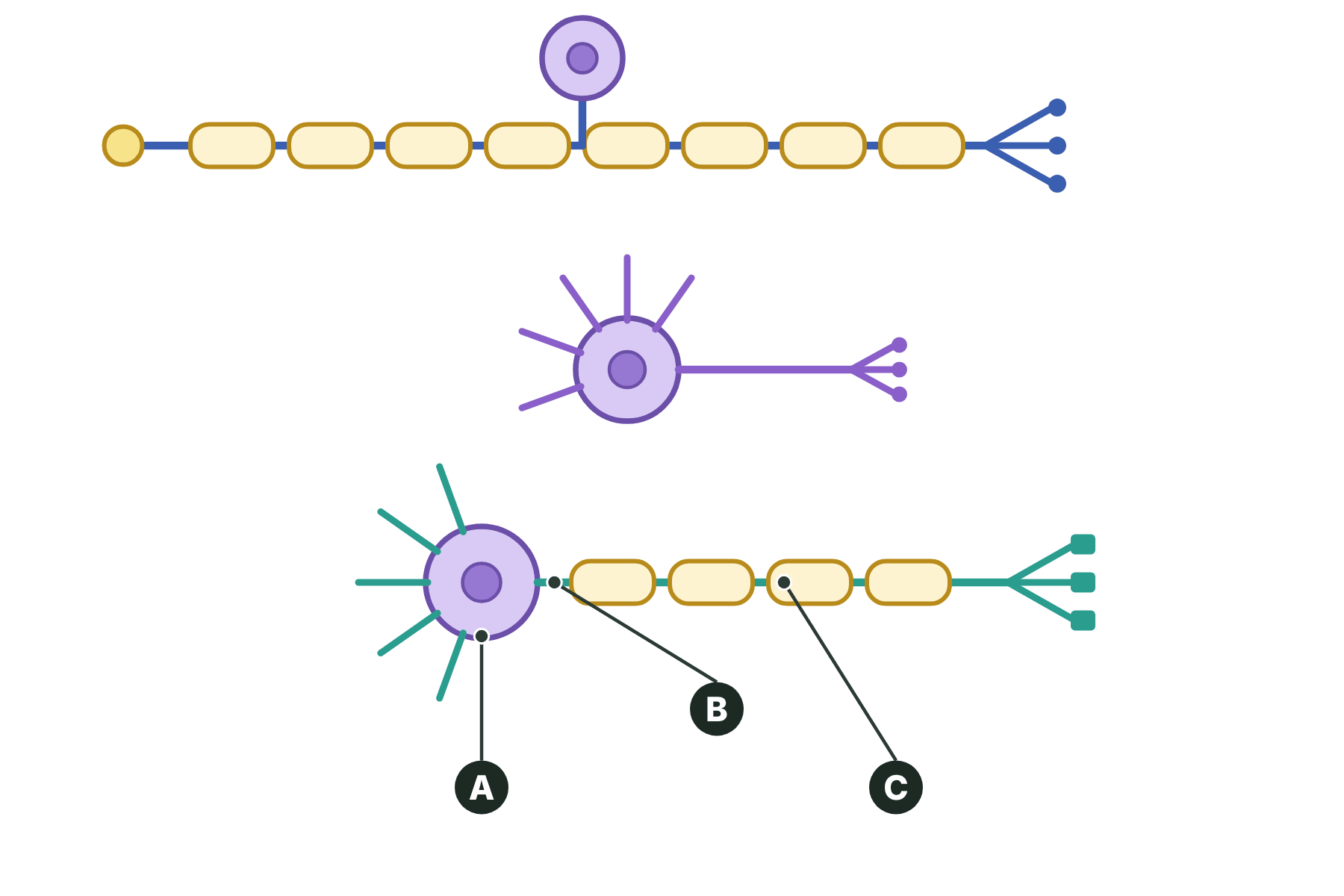
Figure 1 shows a motor neurone. Name the parts shown at A, B and C.
Show answerHide answer
Model answer
A is the cell body. B is the axon. C is the myelin sheath.
Mark scheme
- A: cell body — 1 mark
- B: axon — 1 mark
- C: myelin sheath — 1 mark
-
3 State [3 marks]
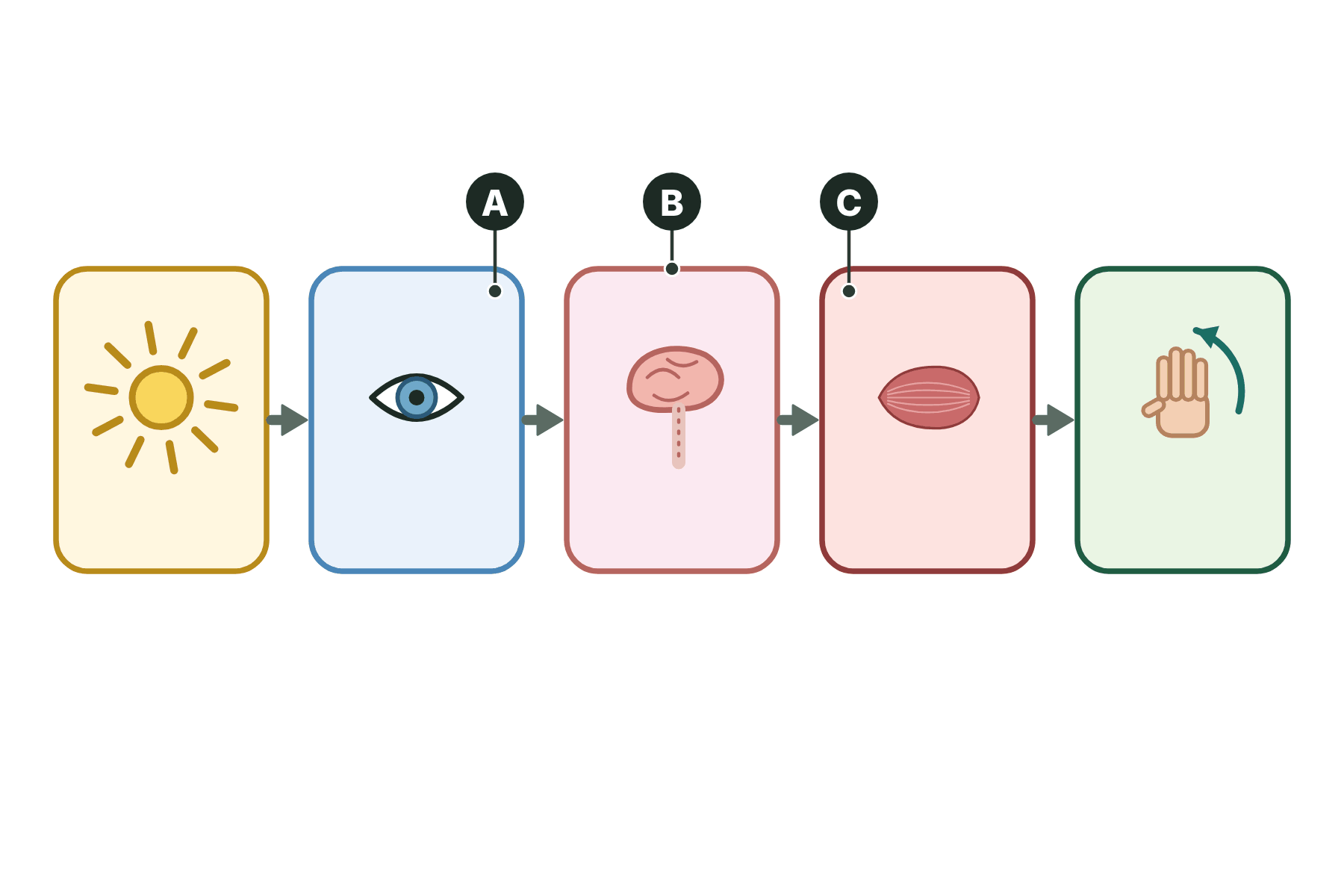
Figure 2 shows the path from a stimulus to a response. Name the parts shown at A, B and C.
Show answerHide answer
Model answer
A is a receptor. B is the central nervous system. C is an effector.
Mark scheme
- A: receptor — 1 mark
- B: central nervous system — 1 mark
- C: effector — 1 mark
-
4 Describe [3 marks]
Describe the functions of sensory neurones, relay neurones and motor neurones.
Show answerHide answer
Model answer
Sensory neurones carry impulses from receptors to the central nervous system. Relay neurones carry impulses inside the central nervous system. Motor neurones carry impulses from the central nervous system to effectors.
Mark scheme
- Sensory: receptor to the central nervous system — 1 mark
- Relay: within the central nervous system — 1 mark
- Motor: central nervous system to effectors — 1 mark
-
5 Explain [3 marks]
Explain how a nerve impulse crosses a synapse.
Show answerHide answer
Model answer
The impulse arrives at the nerve ending, which releases neurotransmitter. The neurotransmitter diffuses across the gap. It binds to receptors on the next neurone, which starts a new impulse.
Mark scheme
- Neurotransmitter released at the nerve ending — 1 mark
- Diffuses across the gap — 1 mark
- Binds to receptors on the next neurone to start an impulse — 1 mark
-
6 Explain [2 marks]
Explain why a myelin sheath is an advantage to a long neurone.
Show answerHide answer
Model answer
The myelin sheath insulates the axon. This makes the impulse travel much faster, so the response is quicker.
Mark scheme
- Insulates the axon — 1 mark
- Impulse travels faster — 1 mark
-
7 Explain [4 marks]
Explain how the nervous system produces a coordinated response.
Show answerHide answer
Model answer
Receptors of different types detect stimuli and send impulses. The central nervous system receives the impulses through many connections. It sends impulses along nerves, which reach all parts of the body, to the effectors. The effectors, muscles or glands, then carry out the response.
Mark scheme
- Different receptors detect stimuli — 1 mark
- Many links in the central nervous system — 1 mark
- Nerves reach all parts of the body — 1 mark
- Effectors carry out the response — 1 mark
Quick check
-
1
What is the job of a sensory neurone?
Show answerHide answer
B: To carry impulses from a receptor to the central nervous system
A sensory neurone carries impulses from a receptor to the central nervous system.
-
2
Which two structures make up the central nervous system?
Show answerHide answer
D: The brain and the spinal cord
The central nervous system is the brain and the spinal cord.
-
3
What is an effector?
Show answerHide answer
A: A muscle or a gland
Effectors are muscles and glands that carry out a response.
-
4
What is the function of the myelin sheath?
Show answerHide answer
C: To speed up the impulse
The myelin sheath insulates the axon and speeds up the impulse.
-
5
What is a synapse?
Show answerHide answer
B: A gap between two neurones
A synapse is the small gap between two neurones.
-
6
What crosses a synapse?
Show answerHide answer
D: Neurotransmitters
Neurotransmitter chemicals diffuse across the synapse.
-
7
Which cells detect a stimulus?
Show answerHide answer
A: Receptors
Receptors detect stimuli and start impulses.
-
8
Which of these carries impulses from the central nervous system to an effector?
Show answerHide answer
C: A motor neurone
Motor neurones carry impulses to effectors.
Reflex Arcs
Just this lesson-
1 State [1 mark]
State what a reflex action is.
Show answerHide answer
Model answer
A rapid, automatic response to a stimulus.
Mark scheme
- Rapid, automatic response — 1 mark
-
2 Name [3 marks]
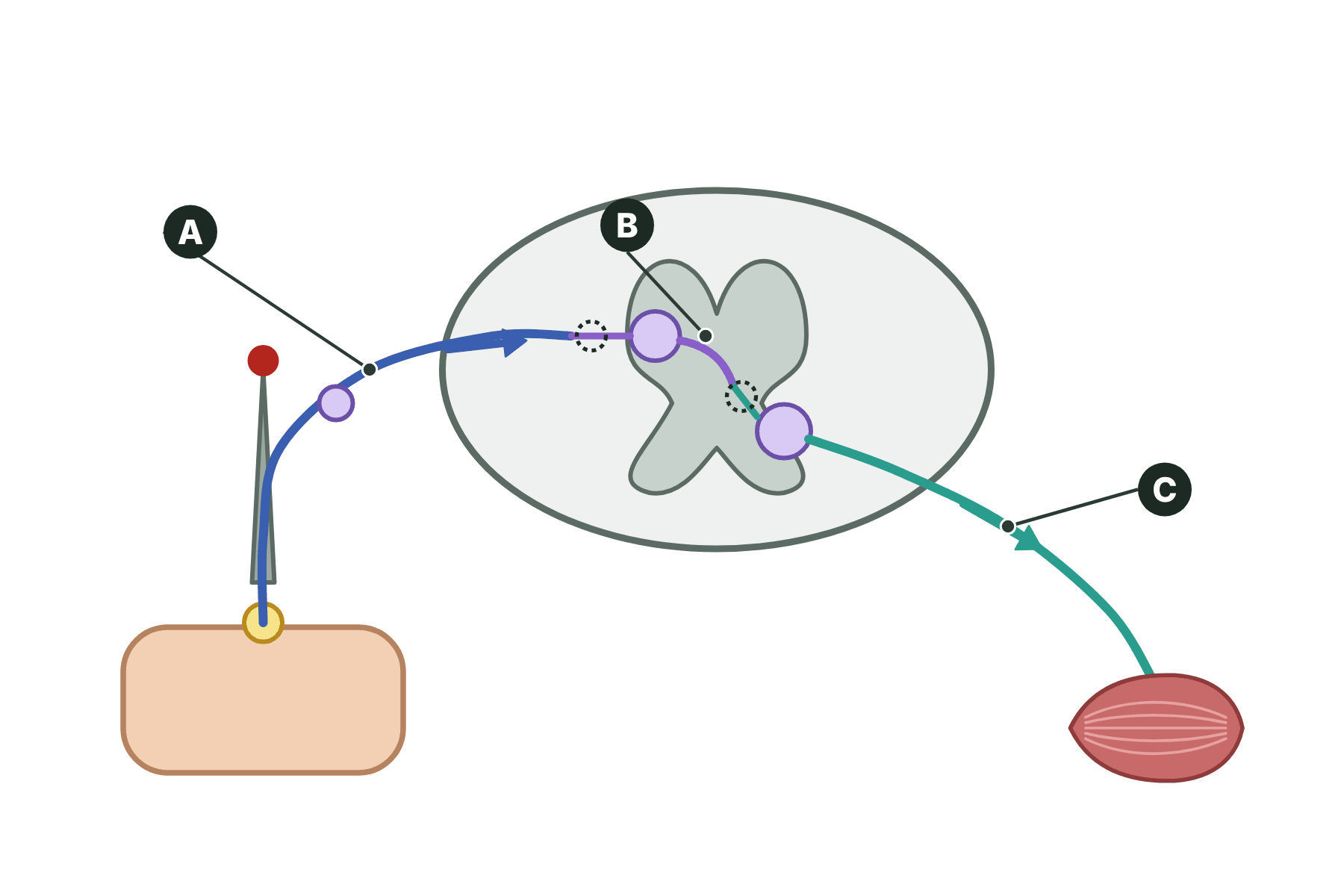
Figure 1 shows a reflex arc. Name the neurones shown at A, B and C.
Show answerHide answer
Model answer
A is the sensory neurone. B is the relay neurone. C is the motor neurone.
Mark scheme
- A: sensory neurone — 1 mark
- B: relay neurone — 1 mark
- C: motor neurone — 1 mark
-
3 Name [3 marks]
Figure 2 shows a synapse. Name the parts shown at A, B and C.
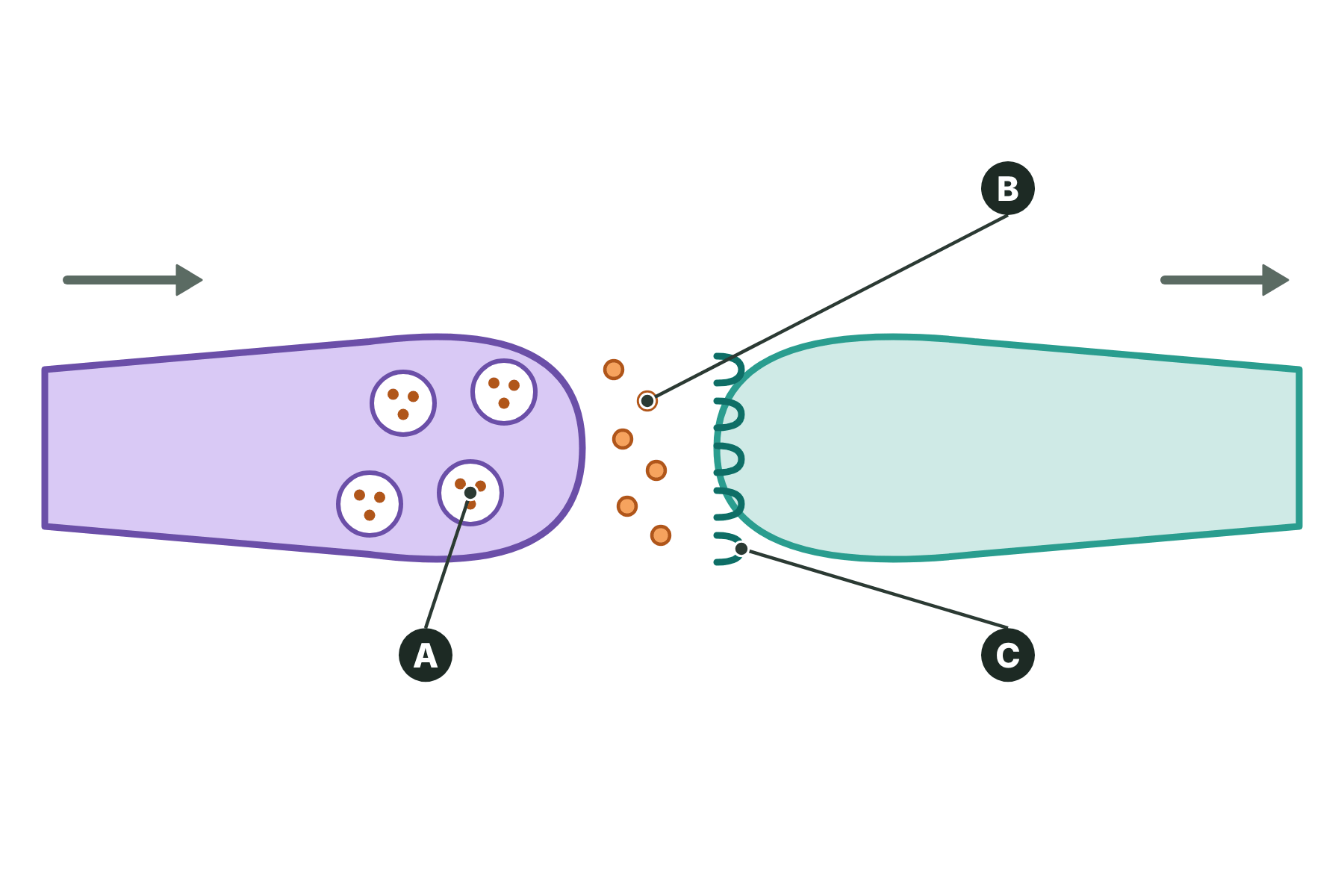
Show answerHide answer
Model answer
A is a vesicle (containing neurotransmitter). B is a neurotransmitter (molecule). C is a receptor.
Mark scheme
- A: vesicle — 1 mark
- B: neurotransmitter — 1 mark
- C: receptor — 1 mark
-
4 Describe [5 marks]
Describe the pathway taken by the impulse when a person touches a sharp pin and pulls their hand away.
Show answerHide answer
Model answer
The receptors in the skin detect the pin. An impulse passes along a sensory neurone to the spinal cord. A relay neurone passes it to a motor neurone. The motor neurone carries the impulse to a muscle in the arm, the effector. The muscle contracts and the hand is pulled away.
Mark scheme
- Receptor detects the stimulus — 1 mark
- Sensory neurone to the spinal cord — 1 mark
- Relay neurone — 1 mark
- Motor neurone to the effector — 1 mark
- Muscle contracts — 1 mark
-
5 Explain [3 marks]
Explain why a reflex action is faster than a voluntary action.
Show answerHide answer
Model answer
The reflex arc is a short pathway with few neurones and synapses. The impulse goes through the spinal cord without going to the brain. No conscious thought is needed, so the response is faster.
Mark scheme
- Short pathway with few neurones and synapses — 1 mark
- Does not go through the brain — 1 mark
- No conscious thought — 1 mark
-
6 Explain [3 marks]
Explain how the structure of a reflex arc is related to its function.
Show answerHide answer
Model answer
The sensory and motor neurones are long, so they can reach from the skin to the spinal cord and back to the muscle. The myelin sheath makes the impulse fast. The relay neurone in the spinal cord makes the pathway short, so the response is rapid and protects the body.
Mark scheme
- Long neurones reach receptors and effectors — 1 mark
- Myelin sheath speeds up the impulse — 1 mark
- Short pathway through the spinal cord gives a rapid response — 1 mark
-
7 Calculate [2 marks]
A student catches a dropped ruler at 12 cm, 15 cm and 18 cm. Calculate the mean distance. Give a unit.
Show answerHide answer
Model answer
15 cm
Mark scheme
- \(12 + 15 + 18 = 45\), then \(45 \div 3\) — 1 mark
- 15 cm — 1 mark
-
8 Describe [4 marks]
A student investigates the effect of caffeine on reaction time using the ruler drop test. Describe how the student should carry out the investigation.
Show answerHide answer
Model answer
A partner drops the ruler without warning and the student catches it, and the distance on the ruler is read. This is done with and without caffeine, or with different amounts of caffeine. Each test is repeated several times and a mean is calculated. Other variables, such as the hand used and the starting position, are kept the same.
Mark scheme
- Ruler dropped without warning and caught, distance measured — 1 mark
- Compare results with and without (or with different amounts of) caffeine — 1 mark
- Repeat and calculate a mean — 1 mark
- Control variables kept the same, such as the hand used — 1 mark
-
9 State [3 marks]
A student investigates the effect of a distraction on reaction time. State the independent variable, the dependent variable and one control variable.
Show answerHide answer
Model answer
The independent variable is the distraction. The dependent variable is the reaction time (the distance that the ruler falls). A control variable could be the hand used.
Mark scheme
- Independent variable: the distraction — 1 mark
- Dependent variable: reaction time or distance — 1 mark
- A control variable, such as the hand used — 1 mark
Quick check
-
1
In an investigation of the effect of caffeine on reaction time, which of these should be kept the same?
Show answerHide answer
C: The hand used to catch the ruler
The hand used is a control variable, so it must be kept the same. The caffeine is the factor that is changed and the reaction time is what is measured.
-
2
What is a reflex action?
Show answerHide answer
C: A rapid, automatic response to a stimulus
A reflex is a rapid, automatic response to a stimulus.
-
3
Where is the relay neurone in a reflex arc?
Show answerHide answer
A: In the spinal cord
The relay neurone is in the spinal cord.
-
4
Which of these is the correct order for a reflex arc?
Show answerHide answer
D: Receptor, sensory neurone, relay neurone, motor neurone, effector
The impulse passes from the receptor along a sensory neurone, relay neurone and motor neurone to the effector.
-
5
What crosses the gap at a synapse?
Show answerHide answer
B: Neurotransmitter
Neurotransmitter diffuses across the synapse.
-
6
Why is a reflex action so fast?
Show answerHide answer
C: The pathway is short
The pathway is short, with few neurones and synapses, and does not go through the brain.
-
7
Which is an example of a reflex action?
Show answerHide answer
B: Pulling a hand away from a hot object
Pulling a hand away from a hot object is a reflex.
-
8
In the ruler drop test, what does a smaller distance caught mean?
Show answerHide answer
D: A faster reaction
A shorter distance means the person reacted faster.
-
9
What does the effector in a reflex arc do?
Show answerHide answer
A: Produces the response
The effector, a muscle or gland, produces the response.
The Brain
Just this lesson-
1 State [1 mark]
State the part of the brain that controls the heart rate and breathing.
Show answerHide answer
Model answer
The medulla.
Mark scheme
- Medulla — 1 mark
-
2 Name [3 marks]
Figure 1 shows a section through the brain. Name the parts shown at A, B and C.
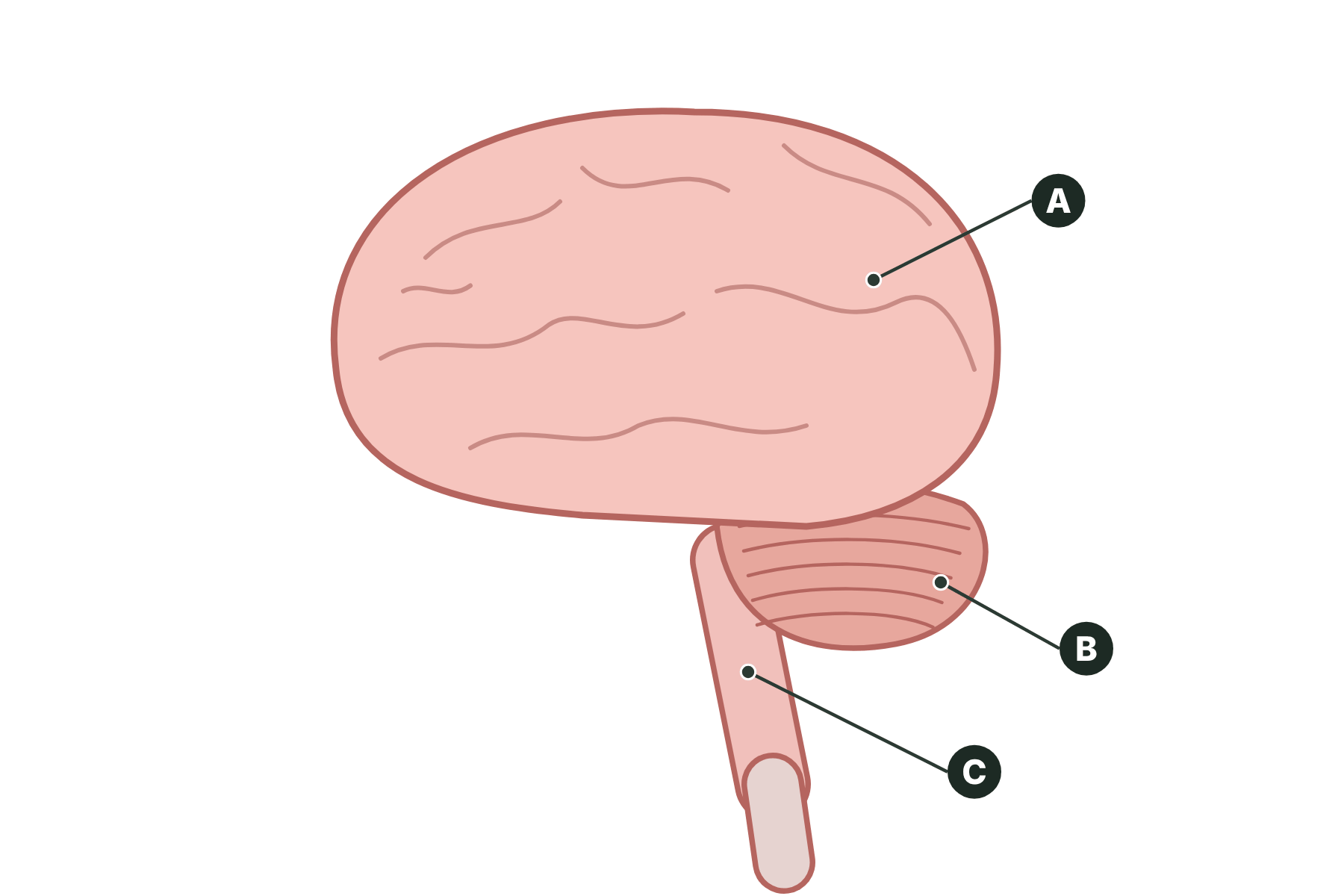
Show answerHide answer
Model answer
A is the cerebral cortex. B is the cerebellum. C is the medulla.
Mark scheme
- A: cerebral cortex — 1 mark
- B: cerebellum — 1 mark
- C: medulla — 1 mark
-
3 Describe [3 marks]
Describe the functions of the cerebral cortex, the cerebellum and the medulla.
Show answerHide answer
Model answer
The cerebral cortex controls consciousness, intelligence, memory and language. The cerebellum coordinates movement and balance. The medulla controls the heart rate and breathing.
Mark scheme
- Cerebral cortex: consciousness, intelligence, memory or language — 1 mark
- Cerebellum: coordination and balance — 1 mark
- Medulla: heart rate and breathing — 1 mark
-
4 Explain [3 marks]
A person has a stroke that damages their cerebellum. Suggest and explain one problem the person might have.
Show answerHide answer
Model answer
The person may have difficulty with coordination and balance. The cerebellum coordinates movement and keeps balance, so with damage their movements may be clumsy and they may fall over.
Mark scheme
- Problem with coordination or balance — 1 mark
- The cerebellum coordinates movement and balance — 1 mark
- Movements are clumsy / they may fall — 1 mark
-
5 Explain [3 marks]
Explain why it is difficult to investigate the functions of different parts of the brain.
Show answerHide answer
Model answer
The brain is very complex, with billions of connected neurones. It is protected inside the skull and hard to reach. There are also ethical issues in doing experiments on people or animals, so much of the evidence comes from case studies of damaged brains, where each injury is different.
Mark scheme
- The brain is complex — 1 mark
- It is hard to reach — 1 mark
- Ethical issues limit experiments — 1 mark
-
6 Explain [3 marks]
Explain why it is hard to treat a person who has damage to the brain or to the spinal cord.
Show answerHide answer
Model answer
Neurones in the brain and spinal cord have a very limited ability to repair themselves, so the damage is often irreversible. Some parts are difficult to access, and surgery can damage the surrounding tissue. A cut spinal cord stops impulses crossing the injury.
Mark scheme
- Limited ability to repair nervous tissue — 1 mark
- Damage may be irreversible / surrounding tissue damaged — 1 mark
- Difficult to access parts of the nervous system — 1 mark
-
7 Evaluate [4 marks]
A doctor studies a patient who has damage to one region of the brain and has lost the ability to speak. Evaluate how far this case study shows that this region controls speech.
Show answerHide answer
Model answer
It suggests that the region has a role in speech, because the function was lost when it was damaged. However, it is only one patient, and every injury is different. The damage may extend beyond the region, or other regions may be involved, so more evidence from other patients and from scans is needed.
Mark scheme
- It suggests a link between the region and speech — 1 mark
- Only one patient / every injury is different — 1 mark
- Damage may be wider or other regions involved — 1 mark
- More evidence needed, such as more patients or scans — 1 mark
-
8 Evaluate [3 marks]
A surgeon suggests removing a tumour that is pressing on part of a patient's brain. Evaluate the benefits and the risks of the operation.
Show answerHide answer
Model answer
The operation could save the patient's life and could restore functions that the tumour is affecting. However, the brain is delicate and hard to reach, and the operation could damage healthy tissue and cause a loss of other functions, such as movement or speech. The doctor and the patient have to weigh up the benefit against the risk.
Mark scheme
- Benefit: could save life or restore function — 1 mark
- Risk: damage to healthy tissue / loss of other functions — 1 mark
- A conclusion that weighs up benefit against risk — 1 mark
Quick check
-
1
Which part of the brain coordinates movement and balance?
Show answerHide answer
B: The cerebellum
The cerebellum coordinates movement and balance.
-
2
Which part of the brain controls breathing?
Show answerHide answer
C: The medulla
The medulla controls breathing and heart rate.
-
3
Which part of the brain is responsible for conscious thought and memory?
Show answerHide answer
B: The cerebral cortex
The cerebral cortex controls conscious thought, memory, language and voluntary movement.
-
4
Why is it hard to repair a damaged brain?
Show answerHide answer
A: Neurones repair poorly
Neurones in the brain and spinal cord have a very limited ability to repair themselves.
-
5
Which of these is a limitation of a case study of brain damage?
Show answerHide answer
D: Each injury is different
Every injury is different, and the damage is hard to measure exactly.
The Eye
Just this lesson-
1 State [2 marks]
State the function of the iris and the function of the retina.
Show answerHide answer
Model answer
The iris controls the amount of light entering the eye. The retina contains the receptor cells that detect light.
Mark scheme
- Iris controls the amount of light entering — 1 mark
- Retina contains the light receptor cells — 1 mark
-
2 Name [3 marks]
Figure 1 shows a section through the eye. Name the parts shown at A, B and C.
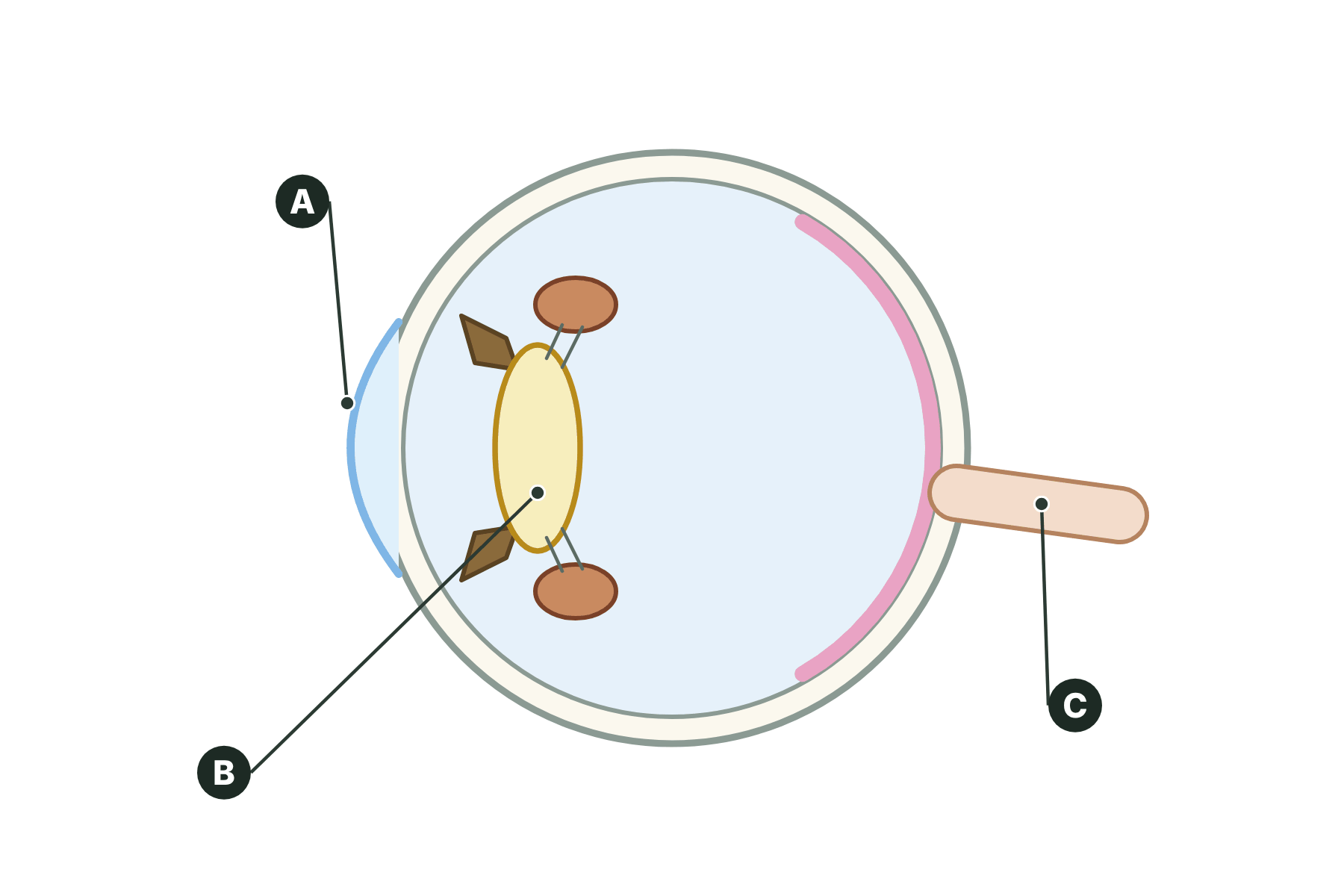
Show answerHide answer
Model answer
A is the cornea. B is the lens. C is the optic nerve.
Mark scheme
- A: cornea — 1 mark
- B: lens — 1 mark
- C: optic nerve — 1 mark
-
3 Explain [3 marks]
Explain how the pupil changes when a person moves from a dim room into bright sunlight.
Show answerHide answer
Model answer
The circular muscles of the iris contract and the radial muscles relax. The pupil gets smaller. This reduces the amount of light that enters, which protects the retina from damage.
Mark scheme
- Circular muscles contract and radial muscles relax — 1 mark
- Pupil gets smaller — 1 mark
- Less light enters, protecting the retina — 1 mark
-
4 Explain [4 marks]
Explain how the eye focuses on a near object.
Show answerHide answer
Model answer
The ciliary muscles contract. This slackens the suspensory ligaments. The lens becomes thicker and more curved. It refracts the light more, so that the light is focused on the retina.
Mark scheme
- Ciliary muscles contract — 1 mark
- Suspensory ligaments slacken — 1 mark
- Lens becomes thicker — 1 mark
- Light is focused on the retina — 1 mark
-
5 Explain [3 marks]
A person has myopia (short sight). Explain why distant objects look blurred and how the problem can be corrected.
Show answerHide answer
Model answer
The lens is too strong or the eyeball is too long, so the light from distant objects is focused in front of the retina. The image on the retina is blurred. A concave lens in spectacles spreads the light out so that it is focused on the retina.
Mark scheme
- Light focused in front of the retina — 1 mark
- Image on the retina is blurred — 1 mark
- Concave lens corrects it — 1 mark
-
6 Describe [3 marks]
Describe three ways in which a focusing problem in the eye can be overcome.
Show answerHide answer
Model answer
Wearing spectacles with the correct lenses, wearing contact lenses, laser eye surgery to reshape the cornea, or replacing the lens with an artificial one.
Mark scheme
- Any three of spectacles, contact lenses, laser surgery, replacement lens — 3 marks
-
7 Explain [3 marks]
A person has hyperopia (long sight). Explain why near objects look blurred and how a spectacle lens corrects the problem.
Show answerHide answer
Model answer
The lens is too weak or the eyeball is too short, so light from near objects is focused behind the retina and the image on the retina is blurred. A convex lens in spectacles refracts the light rays towards each other before they enter the eye, so that they are focused on the retina.
Mark scheme
- Light from near objects focuses behind the retina — 1 mark
- Image on the retina is blurred — 1 mark
- A convex lens refracts the light inwards so it focuses on the retina — 1 mark
-
8 Explain [3 marks]
Explain how the eye adapts when a person walks from bright sunlight into a dim room.
Show answerHide answer
Model answer
The radial muscles of the iris contract and the circular muscles relax, so the pupil gets larger. More light enters the eye. After a few minutes the rod cells become more sensitive, so the person can see in the dim light.
Mark scheme
- Radial muscles contract and circular muscles relax — 1 mark
- Pupil gets larger so more light enters — 1 mark
- Rod cells become more sensitive — 1 mark
Quick check
-
1
Which part of the eye controls the amount of light that enters?
Show answerHide answer
C: The iris
The iris changes the size of the pupil.
-
2
Which part of the eye contains the light receptor cells?
Show answerHide answer
A: The retina
The retina contains the rods and cones.
-
3
What happens to the pupil in bright light?
Show answerHide answer
D: It gets smaller
The circular muscles contract, so the pupil gets smaller.
-
4
When the eye looks at a near object, what happens to the lens?
Show answerHide answer
B: It becomes thicker
The ciliary muscles contract, the ligaments slacken and the lens becomes thicker.
-
5
Which lens corrects short-sightedness?
Show answerHide answer
C: A concave lens
A concave lens spreads the light before it enters the eye.
-
6
What are rod cells used for?
Show answerHide answer
A: Seeing in dim light
Rods are sensitive to dim light but do not detect colour.
-
7
What do the suspensory ligaments connect?
Show answerHide answer
B: The ciliary muscles to the lens
The suspensory ligaments connect the ciliary muscles to the lens.
Control of Body Temperature
Just this lesson-
1 State [1 mark]
State the part of the brain that monitors and controls body temperature.
Show answerHide answer
Model answer
The thermoregulatory centre.
Mark scheme
- Thermoregulatory centre — 1 mark
-
2 Name [3 marks]
Figure 1 shows how body temperature is controlled. Name the parts shown at A, B and C.
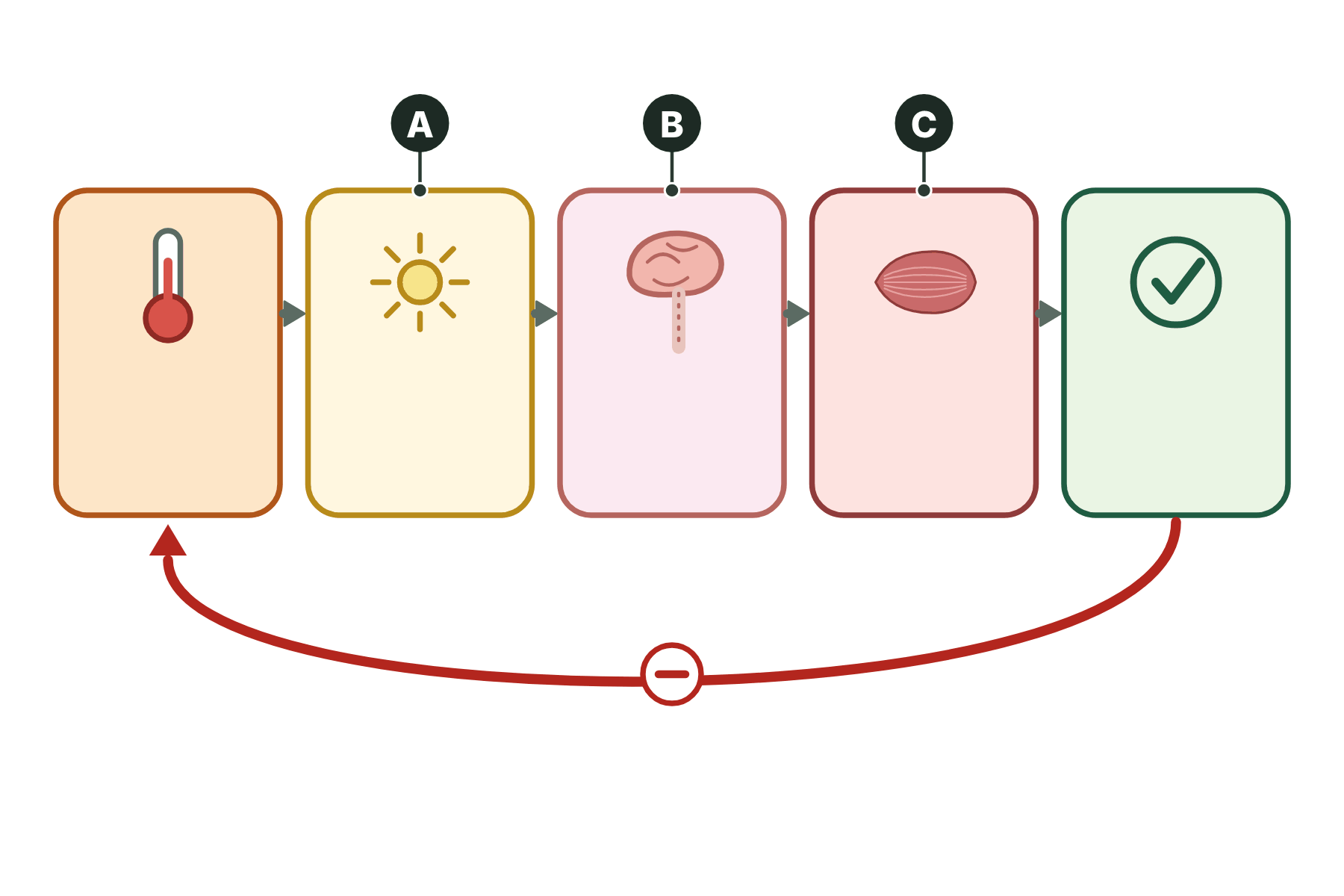
Show answerHide answer
Model answer
A is the (temperature) receptors. B is the thermoregulatory centre. C is the effectors.
Mark scheme
- A: receptors — 1 mark
- B: thermoregulatory centre — 1 mark
- C: effectors — 1 mark
-
3 Describe [3 marks]
Describe how sweating helps to cool the body.
Show answerHide answer
Model answer
The sweat glands produce sweat on the surface of the skin. The sweat evaporates. Evaporation takes energy from the skin, so energy is transferred away from the body.
Mark scheme
- Sweat is produced on the skin — 1 mark
- The sweat evaporates — 1 mark
- Evaporation takes energy from the skin / body — 1 mark
-
4 Describe [4 marks]
Describe how the body responds when the temperature of the surroundings falls.
Show answerHide answer
Model answer
Temperature receptors in the skin send impulses to the thermoregulatory centre, which also detects the cooler blood. The blood vessels in the skin constrict, so less energy is transferred to the environment. Sweating stops. The skeletal muscles shiver, which releases energy.
Mark scheme
- Receptors detect the fall / impulses to the thermoregulatory centre — 1 mark
- Blood vessels constrict — 1 mark
- Sweating stops — 1 mark
- Muscles shiver — 1 mark
-
5 Explain [4 marks]
Explain how vasodilation helps to lower body temperature on a hot day.
Show answerHide answer
Model answer
The thermoregulatory centre detects the high temperature. The blood vessels in the skin dilate. More blood flows close to the surface of the skin, so more energy is transferred from the blood to the environment. The body temperature falls.
Mark scheme
- The thermoregulatory centre detects the rise — 1 mark
- Blood vessels in the skin dilate — 1 mark
- More blood flows close to the skin surface — 1 mark
- More energy is transferred to the environment — 1 mark
-
6 Explain [4 marks]
A runner finishes a race on a hot day. Explain how the runner's body returns its temperature to normal.
Show answerHide answer
Model answer
The runner's muscles have released a lot of energy and the blood temperature has risen. The thermoregulatory centre detects this. Sweat is produced, and as it evaporates it takes energy from the skin. The blood vessels in the skin dilate, so more energy is transferred to the environment. The body temperature falls back to about 37 °C.
Mark scheme
- Detected by the thermoregulatory centre — 1 mark
- Sweat is produced and evaporates, taking energy from the skin — 1 mark
- Blood vessels dilate and more energy is transferred to the environment — 1 mark
- Temperature returns towards 37 °C — 1 mark
-
7 Explain [3 marks]
A student says that blood vessels move closer to the surface of the skin when the body is hot. Explain why the student is wrong and what really happens.
Show answerHide answer
Model answer
Blood vessels cannot move. When the body is hot the blood vessels in the skin dilate, which means they get wider. More blood flows near the surface of the skin, so more energy is transferred to the environment.
Mark scheme
- Blood vessels cannot move — 1 mark
- They dilate / get wider — 1 mark
- More blood flows near the skin surface, so more energy is transferred — 1 mark
Quick check
-
1
Which part of the brain monitors the temperature of the blood?
Show answerHide answer
C: The thermoregulatory centre
The thermoregulatory centre contains receptors that are sensitive to the temperature of the blood.
-
2
What happens to the blood vessels in the skin when the body is too hot?
Show answerHide answer
A: They dilate
They dilate, which is vasodilation.
-
3
What does shivering do?
Show answerHide answer
D: Releases energy from the muscles
Shivering is rapid contraction of the skeletal muscles, and respiration in the muscles releases energy.
-
4
Why does sweating cool the body?
Show answerHide answer
B: Evaporation takes energy from the skin
Evaporation of the sweat takes energy from the skin.
-
5
What is vasoconstriction?
Show answerHide answer
C: The narrowing of the blood vessels
Vasoconstriction is the narrowing of the blood vessels in the skin.
-
6
What happens to sweating when the body is too cold?
Show answerHide answer
D: It stops
The sweat glands stop producing sweat.
-
7
Why does the skin look pale when the body is cold?
Show answerHide answer
A: Less blood flows near the surface
The blood vessels constrict, so less blood flows near the surface of the skin.
-
8
Which of these best explains why a runner's face goes red?
Show answerHide answer
B: The blood vessels in the skin dilate
The blood vessels in the skin dilate, so more blood flows near the surface and more energy is transferred to the environment.