Exam questions · Biology · Cell Structure
Cell Specialisation and Differentiation
- 8 exam questions
- 22 marks
- 8 quick checks
-
1 Give [2 marks]
Give two ways in which a sperm cell is adapted to its function.
Show answerHide answer
Model answer
Any two from: a tail to swim; many mitochondria to release energy for swimming; an acrosome containing enzymes to digest the egg's outer layer.
Mark scheme
- Tail, to swim to the egg — 1 mark
- Many mitochondria, for energy — 1 mark
- Acrosome with enzymes to digest the egg — 1 mark (maximum 2 marks)
-
2 Name [3 marks]
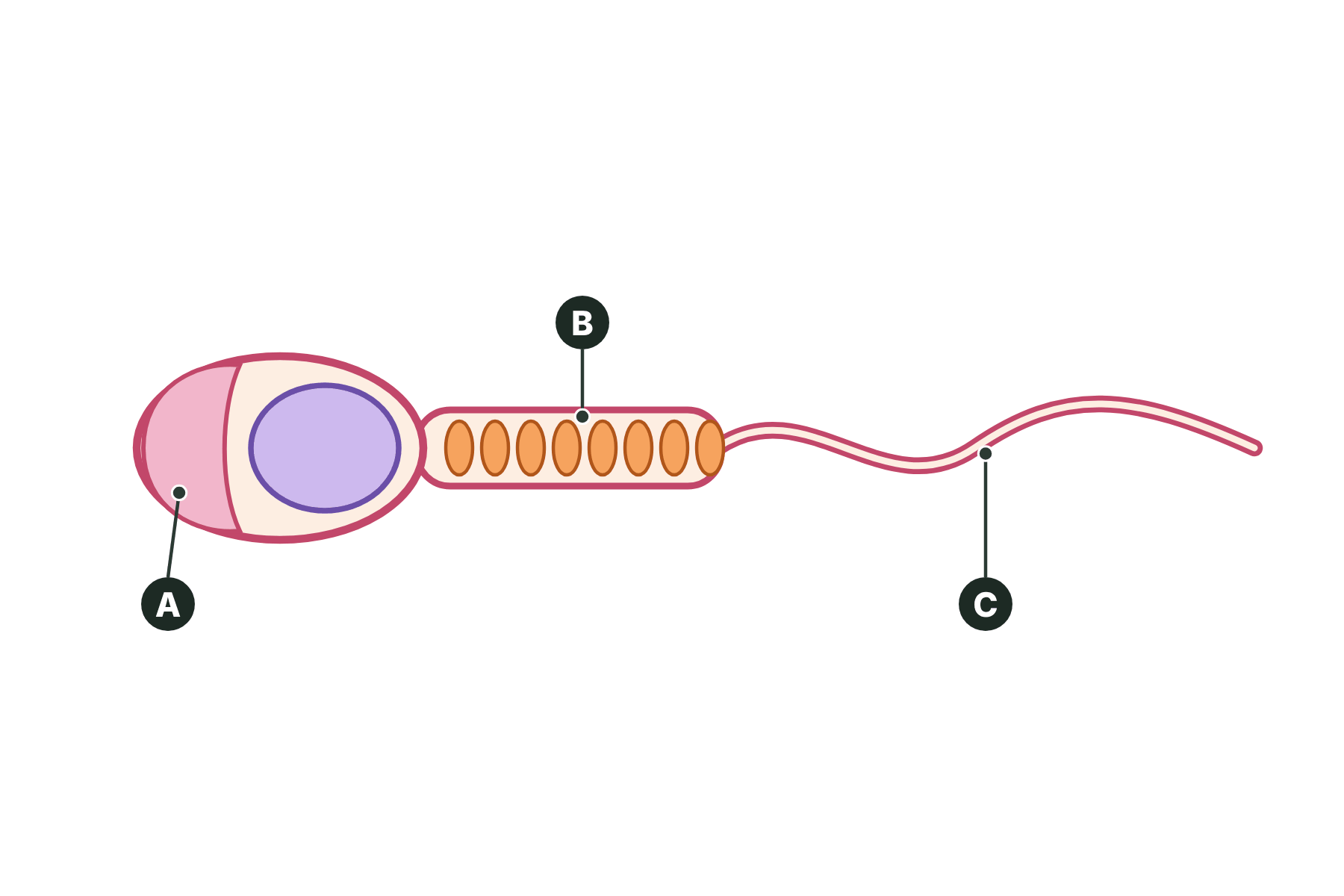
Figure 1 shows a sperm cell. Name the structures labelled A, B and C.
Show answerHide answer
Model answer
A is the acrosome. B is the mitochondria (the middle section). C is the tail.
Mark scheme
- A: acrosome — 1 mark
- B: mitochondria — 1 mark
- C: tail — 1 mark
-
3 Explain [2 marks]
Muscle cells contain many mitochondria. Explain why this adaptation helps them to do their job.
Show answerHide answer
Model answer
Muscle cells contract, and contraction needs energy. Mitochondria release that energy in respiration.
Mark scheme
- Mitochondria release energy / respiration — 1 mark
- Muscle cells need energy to contract — 1 mark
-
4 Describe [3 marks]
Describe how a root hair cell is adapted to its function.
Show answerHide answer
Model answer
The root hair cell has a long, thin projection, which gives a large surface area for absorbing water and mineral ions. It has a large permanent vacuole, which speeds up the movement of water into the cell. It has many mitochondria, which release energy for the active transport of mineral ions.
Mark scheme
- Long projection / root hair, giving a large surface area — 1 mark
- Large permanent vacuole speeds up water uptake — 1 mark
- Many mitochondria release energy for active transport — 1 mark
-
5 Describe [3 marks]
Describe how xylem vessels are adapted to carry water up a plant.
Show answerHide answer
Model answer
Xylem vessels are hollow tubes because the cells are dead and have no end walls, so water can flow through easily. Their walls are strengthened with rings of lignin, which stops them collapsing.
Mark scheme
- Hollow / no cytoplasm / no end walls — 1 mark
- Cells are dead — 1 mark
- Walls strengthened with lignin — 1 mark
-
6 Explain [4 marks]
Explain how the structure of a nerve cell is related to its function.
Show answerHide answer
Model answer
A nerve cell carries electrical impulses from one part of the body to another. The long axon allows the impulse to travel a long distance. The myelin sheath insulates the axon and speeds up the impulse. The branched dendrites and axon terminals connect the cell to many other nerve cells.
Mark scheme
- Function: carries electrical impulses — 1 mark
- Long axon carries impulses over long distances — 1 mark
- Myelin sheath insulates / speeds up the impulse — 1 mark
- Branched ends connect to other nerve cells — 1 mark
-
7 Explain [3 marks]
Explain why differentiation is important in a multicellular organism.
Show answerHide answer
Model answer
Differentiation produces cells with different structures. Each type of cell can carry out its own particular function efficiently, such as contracting or carrying impulses. Different types of cell working together makes it possible for a complex organism to survive.
Mark scheme
- Cells become specialised / have different structures — 1 mark
- Each can do a particular job efficiently — 1 mark
- Specialised cells work together to keep the organism alive — 1 mark
-
8 Compare [2 marks]
Compare differentiation in mature animals with differentiation in plants.
Show answerHide answer
Model answer
Most animal cells differentiate early on, and cell division in mature animals is mainly for repair and replacement. Many plant cells keep the ability to differentiate throughout life.
Mark scheme
- Most animal cells differentiate early / division for repair and replacement — 1 mark
- Many plant cells can differentiate throughout life — 1 mark
Quick check
-
1
What is differentiation?
Show answerHide answer
C: A cell changing to become specialised
Differentiation is the process by which a cell changes to become specialised for a particular job.
-
2
Which part of a sperm cell contains enzymes to digest the egg's outer layer?
Show answerHide answer
B: The acrosome
The acrosome at the front of the sperm head holds the digestive enzymes.
-
3
Why does a nerve cell have a long axon?
Show answerHide answer
A: To carry impulses over long distances
A long axon lets the cell carry electrical impulses from one part of the body to another.
-
4
Which cell contains special protein fibres that slide over each other?
Show answerHide answer
D: Muscle cell
Muscle cells contain protein fibres that slide together, shortening the cell so that it contracts.
-
5
How does the shape of a root hair cell help it?
Show answerHide answer
B: It gives a large surface area for absorption
The long projection increases the surface area, so more water and mineral ions can be absorbed.
-
6
Which tissue carries dissolved sugars around a plant?
Show answerHide answer
C: Phloem
Phloem carries dissolved sugars. Xylem carries water and mineral ions.
-
7
Why is xylem strengthened with lignin?
Show answerHide answer
A: To stop the tube collapsing
Lignin rings make the walls strong so the hollow tube does not collapse as water is pulled up.
-
8
Which of these is the correct order of organisation, smallest first?
Show answerHide answer
D: Cell, tissue, organ, organ system
Specialised cells form tissues, tissues form organs, and organs make up organ systems.