Exam questions · Biology
Cell Structure
- 38 exam questions
- 108 marks
- 40 quick checks
Eukaryotic and Prokaryotic Cells
Just this lesson-
1 Name [1 mark]
Name the type of cell that has no nucleus.
Show answerHide answer
Model answer
A prokaryotic cell, for example a bacterial cell.
Mark scheme
- Prokaryotic (cell) — 1 mark
-
2 Describe [2 marks]
Describe two differences between a bacterial cell and an animal cell.
Show answerHide answer
Model answer
Any two from: a bacterial cell has a cell wall but an animal cell does not; the DNA of a bacterial cell is a single loop in the cytoplasm but in an animal cell it is enclosed in a nucleus; a bacterial cell may have plasmids but an animal cell does not; a bacterial cell is much smaller than an animal cell.
Mark scheme
- Cell wall present in bacteria but not in animal cells — 1 mark
- DNA is a single loop (no nucleus) in bacteria, but enclosed in a nucleus in animal cells — 1 mark
- Plasmids in bacteria only — 1 mark
- Bacterial cell is smaller — 1 mark
-
3 Name [3 marks]
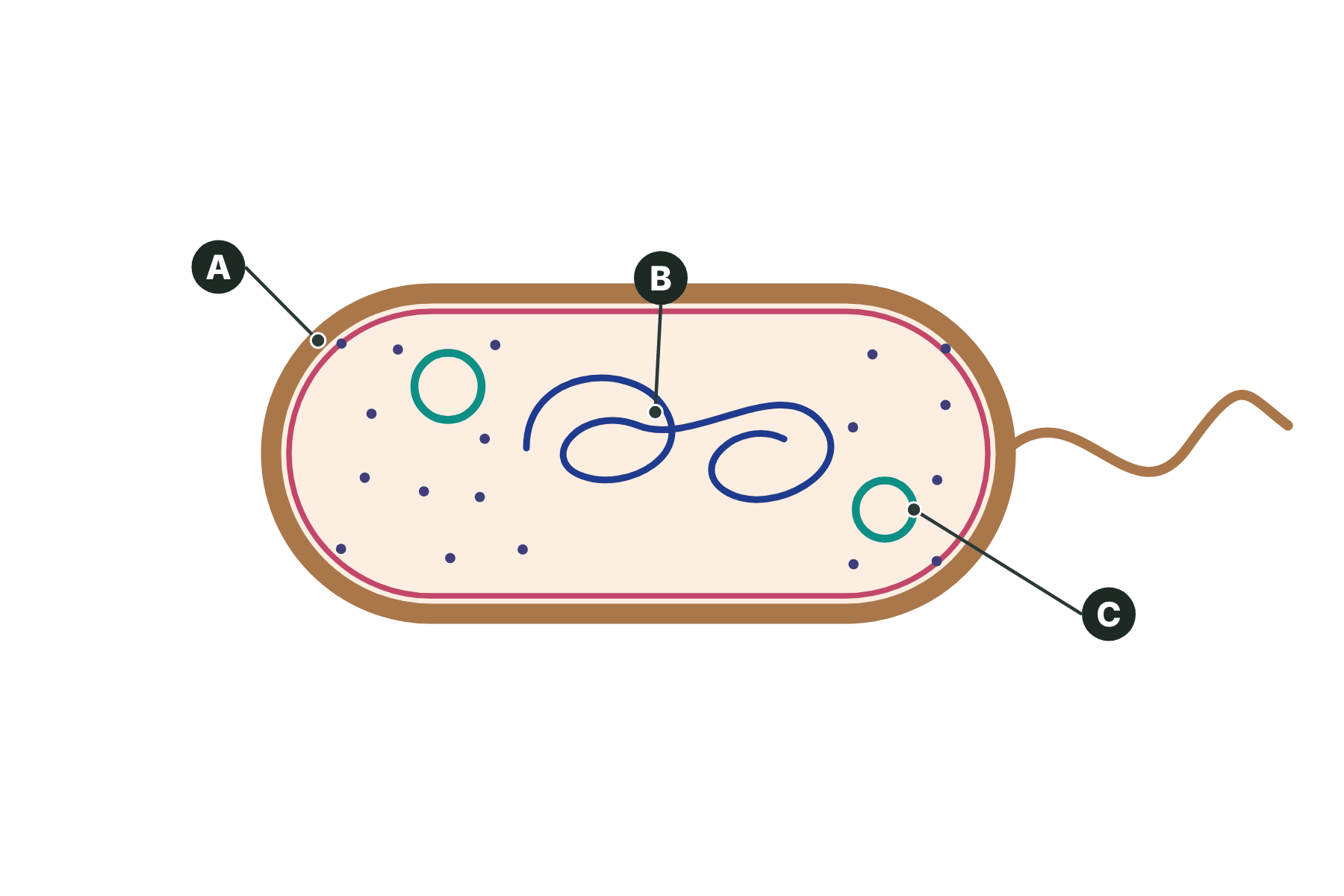
Figure 1 shows a bacterial cell. Name the structures labelled A, B and C.
Show answerHide answer
Model answer
A is the cell wall. B is the (single loop of) DNA. C is a plasmid.
Mark scheme
- A: cell wall — 1 mark
- B: DNA / single loop of DNA / genetic material — 1 mark
- C: plasmid — 1 mark
-
4 Calculate [2 marks]
A bacterial cell is 2 µm long. Calculate how many of these cells, laid end to end, would stretch 1 mm.
Show answerHide answer
Model answer
1 mm = 1000 µm. 1000 ÷ 2 = 500 cells.
Mark scheme
- Converts 1 mm to 1000 µm — 1 mark
- 1000 ÷ 2 = 500 — 1 mark
-
5 Calculate [2 marks]
The width of an animal cell is \(2 \times 10^{-5}\text{ m}\). The width of a bacterial cell is \(2 \times 10^{-6}\text{ m}\). Calculate how many times wider the animal cell is, and give the difference as an order of magnitude.
Show answerHide answer
Model answer
\(\dfrac{2 \times 10^{-5}}{2 \times 10^{-6}} = 10\). The animal cell is 10 times wider, which is one order of magnitude bigger.
Mark scheme
- Divides the two widths to give 10 — 1 mark
- One order of magnitude — 1 mark
-
6 Describe [4 marks]
Describe the structure of a bacterial cell.
Show answerHide answer
Model answer
A bacterial cell is a prokaryotic cell with no nucleus. Its genetic material is a single loop of DNA lying free in the cytoplasm, and it may also contain small rings of DNA called plasmids. The cytoplasm is surrounded by a cell membrane, and outside the membrane there is a cell wall.
Mark scheme
- Cytoplasm and cell membrane — 1 mark
- Cell wall (outside the membrane) — 1 mark
- Single loop of DNA, not in a nucleus — 1 mark
- Plasmids — 1 mark
-
7 Compare [6 marks]
Compare the structure of a bacterial cell with the structure of a plant cell.
Show answerHide answer
Model answer
Both cells have a cell membrane, cytoplasm, ribosomes and a cell wall. In a plant cell the wall is made of cellulose, but a bacterial wall is not. A plant cell has its DNA enclosed in a nucleus, whereas a bacterial cell has no nucleus and its DNA is a single loop in the cytoplasm. A plant cell has chloroplasts and a permanent vacuole, which a bacterial cell does not. A bacterial cell may have plasmids and a flagellum, which a plant cell does not. A bacterial cell is much smaller.
Mark scheme
- Both have a cell membrane, cytoplasm and a cell wall — 1 mark
- Plant cell DNA is in a nucleus; bacterial DNA is a loop in the cytoplasm — 1 mark
- Plant cells have chloroplasts — 1 mark
- Plant cells have a permanent vacuole — 1 mark
- Bacterial cells may have plasmids (and a flagellum) — 1 mark
- Bacterial cell is smaller / plant cell wall is cellulose — 1 mark
Quick check
-
1
Which type of cell has no nucleus?
Show answerHide answer
C: Bacterial cell
A prokaryotic cell, such as a bacterium, has no nucleus. Its DNA lies free in the cytoplasm.
-
2
What is a plasmid?
Show answerHide answer
B: A small ring of DNA in a bacterial cell
A plasmid is a small extra ring of DNA found in bacteria, separate from the main loop of DNA.
-
3
Which structure is found in both bacterial cells and plant cells?
Show answerHide answer
C: Cell wall
Both have a cell wall, although a plant cell wall is made of cellulose and a bacterial one is not. Neither the nucleus nor chloroplasts nor mitochondria are found in bacteria.
-
4
How is the genetic material arranged in a bacterial cell?
Show answerHide answer
A: As a single loop in the cytoplasm
Bacteria have a single loop of DNA in the cytoplasm, and sometimes plasmids too.
-
5
What is the value of 1 µm in metres?
Show answerHide answer
D: \(1 \times 10^{-6}\text{ m}\)
Micro means one millionth, so 1 µm is one millionth of a metre.
-
6
One cell is 1000 times wider than another. How many orders of magnitude bigger is it?
Show answerHide answer
C: 3
Each order of magnitude is a factor of 10, and \(1000 = 10^{3}\), so the difference is 3 orders of magnitude.
-
7
Which of these is the smallest?
Show answerHide answer
B: A virus
A virus is about 100 nm across, much smaller than a bacterium (about 2 µm), an animal cell or a plant cell.
-
8
Which organisms are made of prokaryotic cells?
Show answerHide answer
A: Bacteria
Bacteria are prokaryotes. Fungi, plants and animals are all made of eukaryotic cells.
Animal and Plant Cells
Just this lesson-
1 State [1 mark]
State the function of the nucleus.
Show answerHide answer
Model answer
It contains the genetic material (DNA) and controls the activities of the cell.
Mark scheme
- Contains DNA / controls the cell's activities — 1 mark
-
2 State [2 marks]
State two structures that are found in plant cells but not in animal cells.
Show answerHide answer
Model answer
Any two from: cell wall, chloroplasts, permanent vacuole.
Mark scheme
- Cell wall — 1 mark
- Chloroplasts — 1 mark
- Permanent vacuole — 1 mark (maximum 2 marks)
-
3 Name [4 marks]
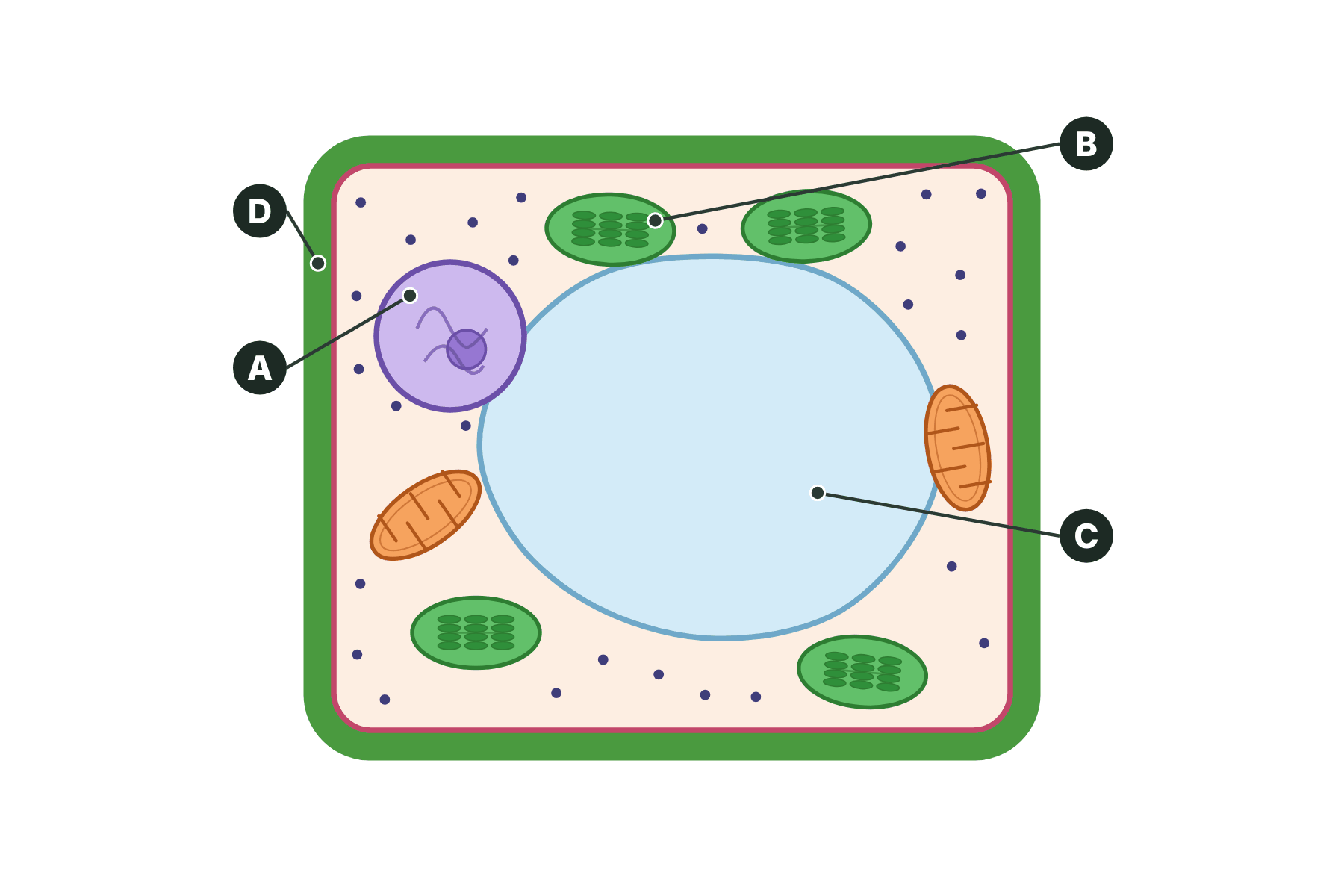
Figure 1 shows a plant cell. Name the structures labelled A, B, C and D.
Show answerHide answer
Model answer
A is the nucleus. B is a chloroplast. C is the (permanent) vacuole. D is the cell wall.
Mark scheme
- A: nucleus — 1 mark
- B: chloroplast — 1 mark
- C: (permanent) vacuole — 1 mark
- D: cell wall — 1 mark
-
4 Explain [2 marks]
Muscle cells contain many mitochondria. Explain why.
Show answerHide answer
Model answer
Mitochondria are where aerobic respiration takes place, which releases energy. Muscle cells contract, and contraction needs a lot of energy.
Mark scheme
- Mitochondria release energy in (aerobic) respiration — 1 mark
- Muscle cells need a lot of energy to contract — 1 mark
-
5 Explain [3 marks]
Palisade cells in a leaf contain many chloroplasts. Explain why.
Show answerHide answer
Model answer
Chloroplasts contain chlorophyll, which absorbs light. Light is needed for photosynthesis. Palisade cells carry out most of the leaf's photosynthesis, so more chloroplasts means more light absorbed and more glucose made.
Mark scheme
- Chloroplasts contain chlorophyll that absorbs light — 1 mark
- Light is needed for photosynthesis — 1 mark
- More chloroplasts means more photosynthesis / more glucose made — 1 mark
-
6 Describe [4 marks]
Describe the functions of the cell membrane, the cytoplasm, the cell wall and the ribosomes.
Show answerHide answer
Model answer
The cell membrane controls what passes into and out of the cell. Most chemical reactions take place in the cytoplasm. The cell wall (in plants) strengthens the cell and supports the plant. Ribosomes are where proteins are made.
Mark scheme
- Cell membrane controls what enters and leaves — 1 mark
- Cytoplasm is where chemical reactions happen — 1 mark
- Cell wall strengthens / supports — 1 mark
- Ribosomes make proteins — 1 mark
-
7 Compare [6 marks]
Compare the structure of an animal cell with the structure of a plant cell.
Show answerHide answer
Model answer
Both cells have a nucleus, cytoplasm, a cell membrane, mitochondria and ribosomes. A plant cell also has a cellulose cell wall, which gives it a fixed shape, but an animal cell has no cell wall. A plant cell often has chloroplasts, which absorb light for photosynthesis, but an animal cell has none. A plant cell has a large permanent vacuole filled with cell sap, whereas an animal cell does not.
Mark scheme
- Both have a nucleus, cytoplasm, cell membrane, mitochondria and ribosomes — 1 mark
- Plant cells have a cell wall; animal cells do not — 1 mark
- The plant cell wall is made of cellulose — 1 mark
- Plant cells have chloroplasts; animal cells do not — 1 mark
- Plant cells have a permanent vacuole; animal cells do not — 1 mark
- Links a structure to its function (for example chloroplasts absorb light for photosynthesis) — 1 mark
Quick check
-
1
Which structure is the site of aerobic respiration?
Show answerHide answer
B: Mitochondrion
Aerobic respiration takes place in the mitochondria, where energy is released from glucose.
-
2
Which structure makes proteins?
Show answerHide answer
C: Ribosome
Ribosomes join amino acids together to make proteins.
-
3
Which of these is found in a plant cell but not in an animal cell?
Show answerHide answer
D: Chloroplast
Chloroplasts are found only in plant cells (and some other organisms). Animal cells have a nucleus, mitochondria and a cell membrane.
-
4
What is the cell wall of a plant cell made from?
Show answerHide answer
A: Cellulose
Plant cell walls are made of cellulose, which is strong and rigid.
-
5
Why do root cells not have chloroplasts?
Show answerHide answer
C: There is no light underground for photosynthesis
Chloroplasts absorb light for photosynthesis, and there is no light underground.
-
6
What is the permanent vacuole filled with?
Show answerHide answer
B: Cell sap
The permanent vacuole contains cell sap, a solution of sugars and salts.
-
7
A cell needs to release a great deal of energy. Which structure would you expect it to contain a lot of?
Show answerHide answer
A: Mitochondria
Mitochondria release energy in aerobic respiration, so cells with a high energy demand have many of them.
-
8
Which statement about mitochondria is correct?
Show answerHide answer
D: They release energy by aerobic respiration
Mitochondria release energy from glucose in respiration. Energy cannot be made or destroyed, only transferred.
Microscopy and Magnification
Just this lesson-
1 State [1 mark]
State the formula used to calculate magnification.
Show answerHide answer
Model answer
Magnification = size of image ÷ size of real object.
Mark scheme
- Magnification = image size ÷ real size — 1 mark
-
2 Give [2 marks]
Give two advantages of using an electron microscope instead of a light microscope.
Show answerHide answer
Model answer
It has a higher magnification, and it has a higher resolution so more detail can be seen.
Mark scheme
- Higher magnification — 1 mark
- Higher resolution / shows more detail — 1 mark
-
3 Calculate [3 marks]
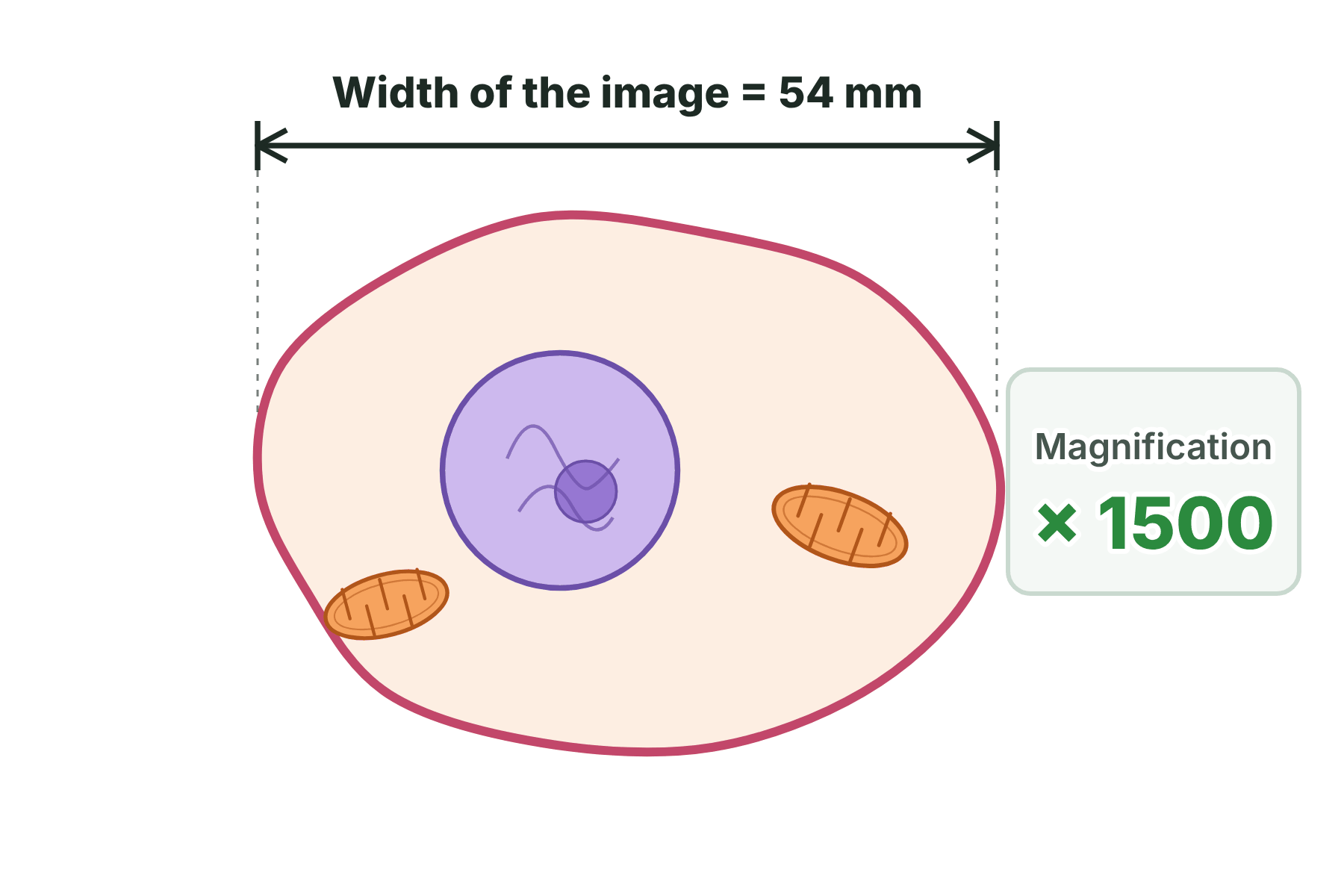
Figure 1 shows a drawing of a cell. The magnification is ×1500. Calculate the real width of the cell. Give your answer in micrometres.
Show answerHide answer
Model answer
real size = 54 ÷ 1500 = 0.036 mm. 0.036 mm × 1000 = 36 µm.
Mark scheme
- Uses real size = image size ÷ magnification — 1 mark
- 54 ÷ 1500 = 0.036 mm — 1 mark
- Converts to 36 µm — 1 mark
-
4 Calculate [2 marks]
A student looks at a slide using a ×10 eyepiece lens and a ×40 objective lens. Calculate the total magnification, and name the wheel the student should use to make the image sharp.
Show answerHide answer
Model answer
Total magnification = 10 × 40 = ×400. The student should use the fine focus wheel.
Mark scheme
- 10 × 40 = ×400 — 1 mark
- Fine focus wheel — 1 mark
-
5 Describe [4 marks]
Describe how to use a light microscope to look at a slide of onion cells.
Show answerHide answer
Model answer
Place the slide on the stage and secure it with the clips. Select the lowest power objective lens. Use the coarse focus wheel to bring the image roughly into focus, looking from the side first so the lens does not hit the slide. Then use the fine focus wheel to make the image sharp. Change to a higher power lens and refocus with the fine wheel if more detail is needed.
Mark scheme
- Slide on the stage, held by clips — 1 mark
- Start with the lowest power objective lens — 1 mark
- Coarse focus to find the image — 1 mark
- Fine focus to sharpen it — 1 mark
-
6 Explain [4 marks]
Explain how electron microscopy has increased our understanding of sub-cellular structures.
Show answerHide answer
Model answer
An electron microscope has a much higher magnification and resolving power than a light microscope. This means it can show structures that are too small to be seen with a light microscope, such as ribosomes, plasmids and the internal structure of mitochondria and chloroplasts. Scientists have used this detail to work out how the structures carry out their functions.
Mark scheme
- Electron microscopes have higher magnification — 1 mark
- Electron microscopes have higher resolution / resolving power — 1 mark
- Shows structures not visible with a light microscope, for example ribosomes or the inside of mitochondria — 1 mark
- Understanding of how structures work (their functions) has improved — 1 mark
-
7 Calculate [2 marks]
An electron micrograph shows a chloroplast that is 25 mm long. The real chloroplast is 5 µm long. Calculate the magnification. Give your answer in standard form.
Show answerHide answer
Model answer
25 mm = 25 000 µm. Magnification = 25 000 ÷ 5 = 5000, which is \(5 \times 10^{3}\).
Mark scheme
- Converts 25 mm to 25 000 µm and divides by 5 — 1 mark
- \(5 \times 10^{3}\) — 1 mark
-
8 Calculate [3 marks]
A ribosome is 25 nm across. In an electron micrograph the image of the ribosome is 5 mm across. Calculate the magnification. Give your answer in standard form.
Show answerHide answer
Model answer
5 mm = 5 000 000 nm. Magnification = 5 000 000 ÷ 25 = 200 000, which is \(2 \times 10^{5}\).
Mark scheme
- Converts 5 mm to 5 000 000 nm — 1 mark
- 5 000 000 ÷ 25 = 200 000 — 1 mark
- \(2 \times 10^{5}\) — 1 mark
Quick check
-
1
What does magnification tell you?
Show answerHide answer
B: How many times bigger the image is than the real object
Magnification is how many times bigger the image is than the real object.
-
2
Which microscope has the higher resolution?
Show answerHide answer
C: An electron microscope
An electron microscope has much higher resolving power than a light microscope, so it shows more detail.
-
3
A cell is 2 mm wide in a drawing. The real cell is 0.02 mm wide. What is the magnification?
Show answerHide answer
D: ×100
Magnification = image size ÷ real size = 2 ÷ 0.02 = 100, so ×100.
-
4
Which of these can a light microscope show?
Show answerHide answer
A: A chloroplast
A light microscope shows nuclei, cell walls and chloroplasts. Ribosomes and plasmids are too small and need an electron microscope.
-
5
Which lens should you use first when focusing a specimen?
Show answerHide answer
B: The lowest power objective lens
Start with the lowest power lens so that you can find the specimen in a wide field of view.
-
6
How many micrometres are there in 1 mm?
Show answerHide answer
C: 1000
Milli and micro differ by a factor of 1000, so 1 mm is 1000 µm.
-
7
A drawing shows a cell as 45 mm wide. The cell is really 15 µm wide. What is the magnification?
Show answerHide answer
D: ×3000
Convert 45 mm to 45 000 µm, then divide by 15 µm to get 3000.
-
8
An image is 6 mm wide and the magnification is ×200. What is the real width?
Show answerHide answer
B: 30 µm
Real size = image size ÷ magnification = 6 ÷ 200 = 0.03 mm, which is 30 µm.
Cell Specialisation and Differentiation
Just this lesson-
1 Give [2 marks]
Give two ways in which a sperm cell is adapted to its function.
Show answerHide answer
Model answer
Any two from: a tail to swim; many mitochondria to release energy for swimming; an acrosome containing enzymes to digest the egg's outer layer.
Mark scheme
- Tail, to swim to the egg — 1 mark
- Many mitochondria, for energy — 1 mark
- Acrosome with enzymes to digest the egg — 1 mark (maximum 2 marks)
-
2 Name [3 marks]
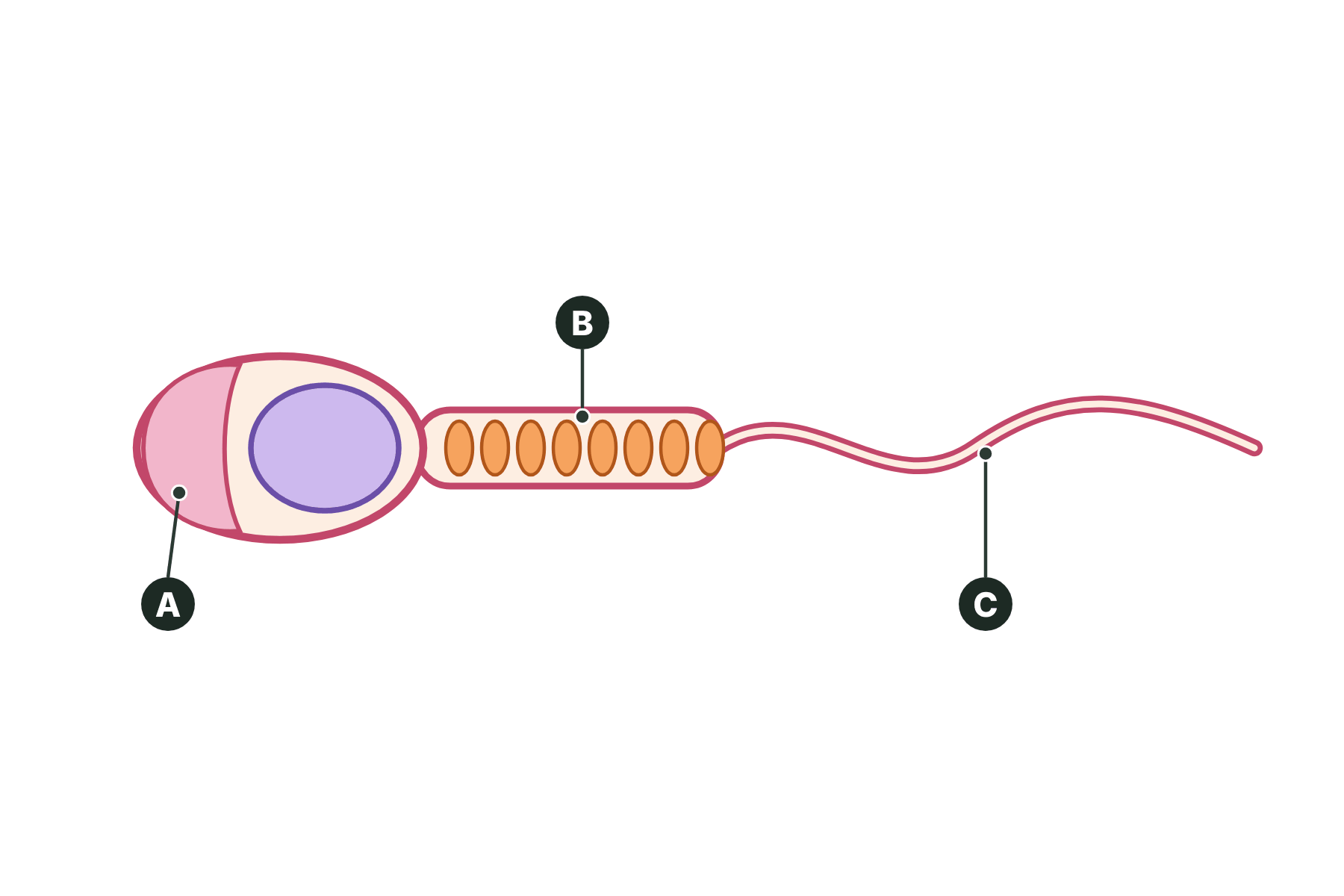
Figure 1 shows a sperm cell. Name the structures labelled A, B and C.
Show answerHide answer
Model answer
A is the acrosome. B is the mitochondria (the middle section). C is the tail.
Mark scheme
- A: acrosome — 1 mark
- B: mitochondria — 1 mark
- C: tail — 1 mark
-
3 Explain [2 marks]
Muscle cells contain many mitochondria. Explain why this adaptation helps them to do their job.
Show answerHide answer
Model answer
Muscle cells contract, and contraction needs energy. Mitochondria release that energy in respiration.
Mark scheme
- Mitochondria release energy / respiration — 1 mark
- Muscle cells need energy to contract — 1 mark
-
4 Describe [3 marks]
Describe how a root hair cell is adapted to its function.
Show answerHide answer
Model answer
The root hair cell has a long, thin projection, which gives a large surface area for absorbing water and mineral ions. It has a large permanent vacuole, which speeds up the movement of water into the cell. It has many mitochondria, which release energy for the active transport of mineral ions.
Mark scheme
- Long projection / root hair, giving a large surface area — 1 mark
- Large permanent vacuole speeds up water uptake — 1 mark
- Many mitochondria release energy for active transport — 1 mark
-
5 Describe [3 marks]
Describe how xylem vessels are adapted to carry water up a plant.
Show answerHide answer
Model answer
Xylem vessels are hollow tubes because the cells are dead and have no end walls, so water can flow through easily. Their walls are strengthened with rings of lignin, which stops them collapsing.
Mark scheme
- Hollow / no cytoplasm / no end walls — 1 mark
- Cells are dead — 1 mark
- Walls strengthened with lignin — 1 mark
-
6 Explain [4 marks]
Explain how the structure of a nerve cell is related to its function.
Show answerHide answer
Model answer
A nerve cell carries electrical impulses from one part of the body to another. The long axon allows the impulse to travel a long distance. The myelin sheath insulates the axon and speeds up the impulse. The branched dendrites and axon terminals connect the cell to many other nerve cells.
Mark scheme
- Function: carries electrical impulses — 1 mark
- Long axon carries impulses over long distances — 1 mark
- Myelin sheath insulates / speeds up the impulse — 1 mark
- Branched ends connect to other nerve cells — 1 mark
-
7 Explain [3 marks]
Explain why differentiation is important in a multicellular organism.
Show answerHide answer
Model answer
Differentiation produces cells with different structures. Each type of cell can carry out its own particular function efficiently, such as contracting or carrying impulses. Different types of cell working together makes it possible for a complex organism to survive.
Mark scheme
- Cells become specialised / have different structures — 1 mark
- Each can do a particular job efficiently — 1 mark
- Specialised cells work together to keep the organism alive — 1 mark
-
8 Compare [2 marks]
Compare differentiation in mature animals with differentiation in plants.
Show answerHide answer
Model answer
Most animal cells differentiate early on, and cell division in mature animals is mainly for repair and replacement. Many plant cells keep the ability to differentiate throughout life.
Mark scheme
- Most animal cells differentiate early / division for repair and replacement — 1 mark
- Many plant cells can differentiate throughout life — 1 mark
Quick check
-
1
What is differentiation?
Show answerHide answer
C: A cell changing to become specialised
Differentiation is the process by which a cell changes to become specialised for a particular job.
-
2
Which part of a sperm cell contains enzymes to digest the egg's outer layer?
Show answerHide answer
B: The acrosome
The acrosome at the front of the sperm head holds the digestive enzymes.
-
3
Why does a nerve cell have a long axon?
Show answerHide answer
A: To carry impulses over long distances
A long axon lets the cell carry electrical impulses from one part of the body to another.
-
4
Which cell contains special protein fibres that slide over each other?
Show answerHide answer
D: Muscle cell
Muscle cells contain protein fibres that slide together, shortening the cell so that it contracts.
-
5
How does the shape of a root hair cell help it?
Show answerHide answer
B: It gives a large surface area for absorption
The long projection increases the surface area, so more water and mineral ions can be absorbed.
-
6
Which tissue carries dissolved sugars around a plant?
Show answerHide answer
C: Phloem
Phloem carries dissolved sugars. Xylem carries water and mineral ions.
-
7
Why is xylem strengthened with lignin?
Show answerHide answer
A: To stop the tube collapsing
Lignin rings make the walls strong so the hollow tube does not collapse as water is pulled up.
-
8
Which of these is the correct order of organisation, smallest first?
Show answerHide answer
D: Cell, tissue, organ, organ system
Specialised cells form tissues, tissues form organs, and organs make up organ systems.
Culturing Microorganisms
Just this lesson-
1 Explain [2 marks]
Petri dishes and agar are sterilised before use. Explain why.
Show answerHide answer
Model answer
To kill any microorganisms that are already on them. If they were not sterilised, these microorganisms could grow and contaminate the culture.
Mark scheme
- Kill microorganisms already present — 1 mark
- Prevents contamination of the culture — 1 mark
-
2 Describe [4 marks]
Describe how to prepare an uncontaminated culture of bacteria on an agar plate.
Show answerHide answer
Model answer
Sterilise the Petri dish and the agar before use. Sterilise the inoculating loop by passing it through a flame. Use the loop to spread the bacteria over the agar, lifting the lid only as little as needed. Seal the lid with adhesive tape and incubate the dish upside down at no more than 25 °C.
Mark scheme
- Petri dish and agar sterilised first — 1 mark
- Inoculating loop passed through a flame — 1 mark
- Lid taped on to keep microorganisms out — 1 mark
- Incubated at 25 °C (or below), upside down — 1 mark
-
3 Explain [2 marks]
In school, cultures of bacteria are incubated at no more than 25 °C. Explain why.
Show answerHide answer
Model answer
At higher temperatures, such as 37 °C, harmful pathogens are more likely to grow. Keeping the temperature lower makes the culture safer.
Mark scheme
- At higher temperatures pathogens are more likely to grow — 1 mark
- This could harm humans / is a safety risk — 1 mark
-
4 Calculate [2 marks]
A bacterium divides every 20 minutes. Starting with one bacterium, calculate how many bacteria there will be after 2 hours.
Show answerHide answer
Model answer
2 hours = 120 minutes, which is 6 divisions. 2 to the power 6 = 64 bacteria.
Mark scheme
- 120 ÷ 20 = 6 divisions — 1 mark
- \(2^{6} = 64\) — 1 mark
-
5 Calculate [3 marks]
A culture contains 200 bacteria. The mean division time is 30 minutes. Calculate how many bacteria there will be after 6 hours. Give your answer in standard form to 3 significant figures.
Show answerHide answer
Model answer
6 hours = 360 minutes, which is 12 divisions. \(200 \times 2^{12} = 200 \times 4096 = 819\,200\), which is \(8.19 \times 10^{5}\).
Mark scheme
- 360 ÷ 30 = 12 divisions — 1 mark
- \(200 \times 2^{12} = 819\,200\) — 1 mark
- \(8.19 \times 10^{5}\) — 1 mark
-
6 Calculate [2 marks]
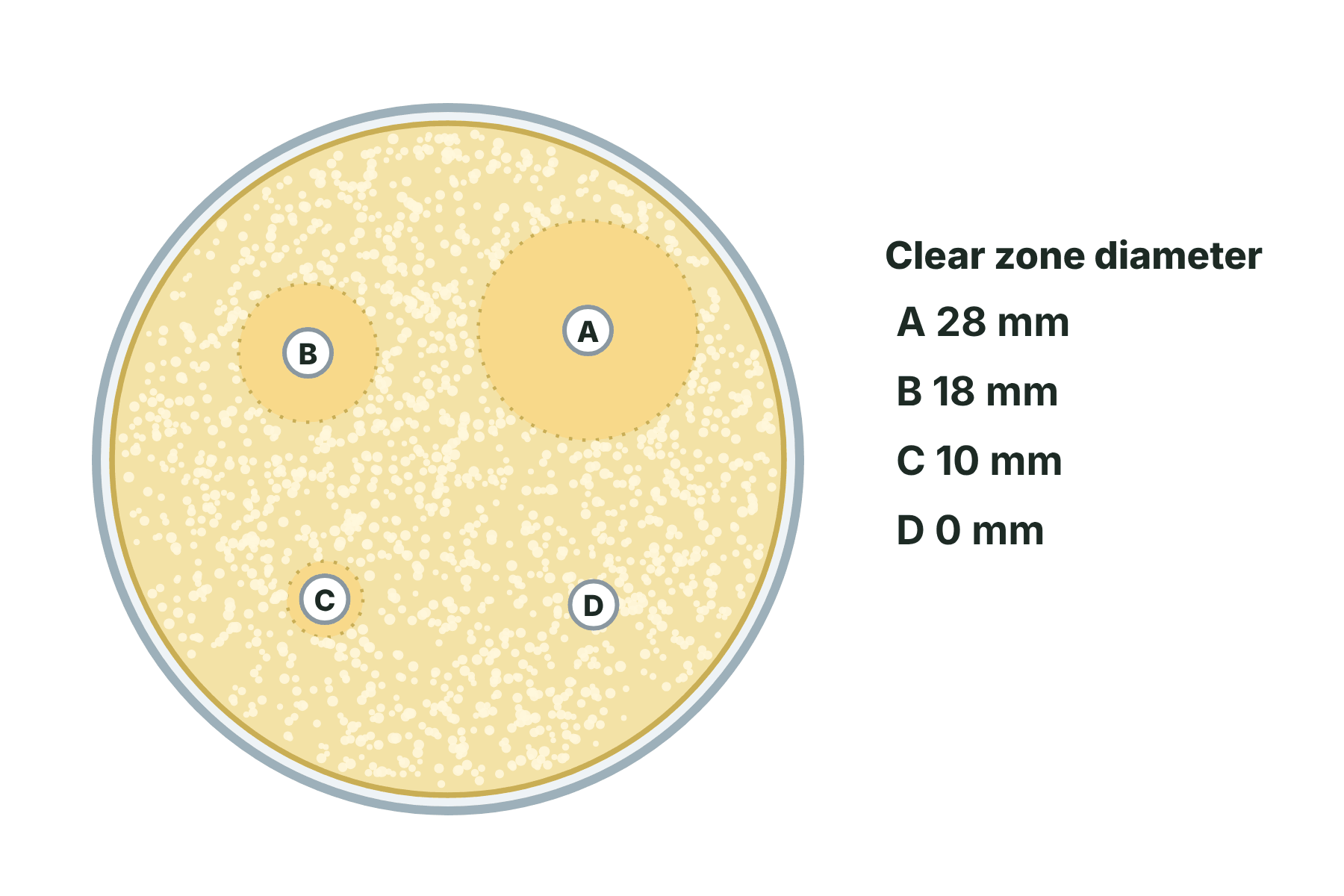
Figure 1 shows an agar plate with three antibiotic discs, A, B and C, and a control disc, D. The clear zone around disc A has a diameter of 28 mm. Calculate the cross-sectional area of this zone. Use the formula area = πr².
Show answerHide answer
Model answer
radius = 28 ÷ 2 = 14 mm. area = π × 14² = π × 196 = 616 mm² (to 3 significant figures).
Mark scheme
- Radius = 14 mm — 1 mark
- \(\pi \times 14^{2} = 616\text{ mm}^{2}\) — 1 mark
-
7 Explain [2 marks]
Use Figure 1 to state which antibiotic is the most effective at killing the bacteria, and explain how you can tell.
Show answerHide answer
Model answer
Antibiotic A is the most effective. It has the largest clear zone, which means it killed or stopped the growth of the most bacteria.
Mark scheme
- Antibiotic A — 1 mark
- Largest clear zone / killed the most bacteria — 1 mark
-
8 Describe [6 marks]
Describe how you would carry out an investigation to compare the effectiveness of three different antibiotics on the growth of bacteria.
Show answerHide answer
Model answer
Use aseptic technique to spread a lawn of bacteria over a sterile agar plate. Soak identical paper discs in each of the three antibiotics, and one in sterile water as a control. Place the discs, evenly spaced, on the agar, then tape the lid on and incubate the plate upside down at 25 °C for 48 hours. Measure the diameter of the clear zone around each disc with a ruler. The antibiotic with the largest clear zone is the most effective. To make it a fair test, use the same type and size of discs, the same concentration of antibiotic and the same incubation time and temperature.
Mark scheme
- Aseptic technique used to prepare the plate and spread the bacteria — 1 mark
- Discs soaked in each antibiotic, placed on the agar — 1 mark
- Control disc soaked in sterile water — 1 mark
- Incubated upside down at 25 °C or below, with the lid taped on — 1 mark
- Measures the diameter (or area) of the clear zones — 1 mark
- Largest zone means most effective, with a control variable to make it a fair test — 1 mark
Quick check
-
1
How do bacteria multiply?
Show answerHide answer
C: By binary fission
Bacteria multiply by binary fission, in which one cell splits into two identical cells.
-
2
Why is an inoculating loop passed through a flame?
Show answerHide answer
B: To kill microorganisms on it
The flame sterilises the loop by killing any microorganisms on it, so only the wanted bacteria are transferred.
-
3
Why is the lid of a Petri dish taped on?
Show answerHide answer
A: To stop microorganisms from the air getting in
The tape stops microorganisms from the air getting into the culture.
-
4
What is the highest temperature at which cultures are normally incubated in school?
Show answerHide answer
D: 25 °C
School cultures are kept at 25 °C or below, because higher temperatures make it more likely that harmful pathogens grow.
-
5
A bacterium divides every 20 minutes. How many bacteria are there after 1 hour, starting with one?
Show answerHide answer
C: 8
In 60 minutes there are 3 divisions, so \(1 \to 2 \to 4 \to 8\).
-
6
What does a large clear zone around an antibiotic disc show?
Show answerHide answer
B: The antibiotic is very effective
A clear zone is where bacteria have been killed or stopped from growing, so a larger zone means the antibiotic is more effective.
-
7
The clear zone around a disc has a radius of 10 mm. What is its area, to the nearest whole number?
Show answerHide answer
D: 314 mm²
Area = \(\pi r^{2} = \pi \times 10^{2} = 314\text{ mm}^{2}\) (to the nearest whole number).
-
8
A culture of 100 bacteria has a mean division time of 30 minutes. How many bacteria are there after 2 hours?
Show answerHide answer
B: 1600
2 hours is 120 minutes, which is 4 divisions, so \(100 \times 2^{4} = 1600\).