Exam questions · Biology · Human Impact on Ecosystems
Fish Farming, Introduced Species and Eutrophication
- 8 exam questions
- 26 marks
- 8 quick checks
-
1 State [1 mark]
State what is meant by a non-indigenous species.
Show answerHide answer
Model answer
A species that has been introduced into an area where it does not naturally live (is not native).
Mark scheme
- A species introduced to an area where it is not naturally found — 1 mark
-
2 Give [2 marks]
Fish farming has some benefits and some problems. Give one benefit and one problem of fish farming.
Show answerHide answer
Model answer
Benefit: a reliable source of protein, or it reduces overfishing of wild fish. Problem: waste pollutes the water, or parasites and disease spread to wild fish, or escaped fish breed with wild fish.
Mark scheme
- A benefit, such as protein supply or less overfishing — 1 mark
- A problem, such as pollution, disease spread or escapes — 1 mark
-
3 Explain [3 marks]
Explain how fish farming can reduce the biodiversity of the sea around the farm.
Show answerHide answer
Model answer
Uneaten food and faeces from the farm add nutrients to the water, which can cause eutrophication and use up the oxygen, so organisms in the water and on the seabed die. Parasites and diseases spread from the crowded farmed fish to wild fish and may kill them. Farmed fish that escape can compete with wild fish and breed with them, which reduces their genetic variation.
Mark scheme
- Waste adds nutrients and causes eutrophication or pollution — 1 mark
- Parasites or disease spread to wild fish — 1 mark
- Escaped fish compete or breed with wild fish — 1 mark
-
4 Explain [3 marks]
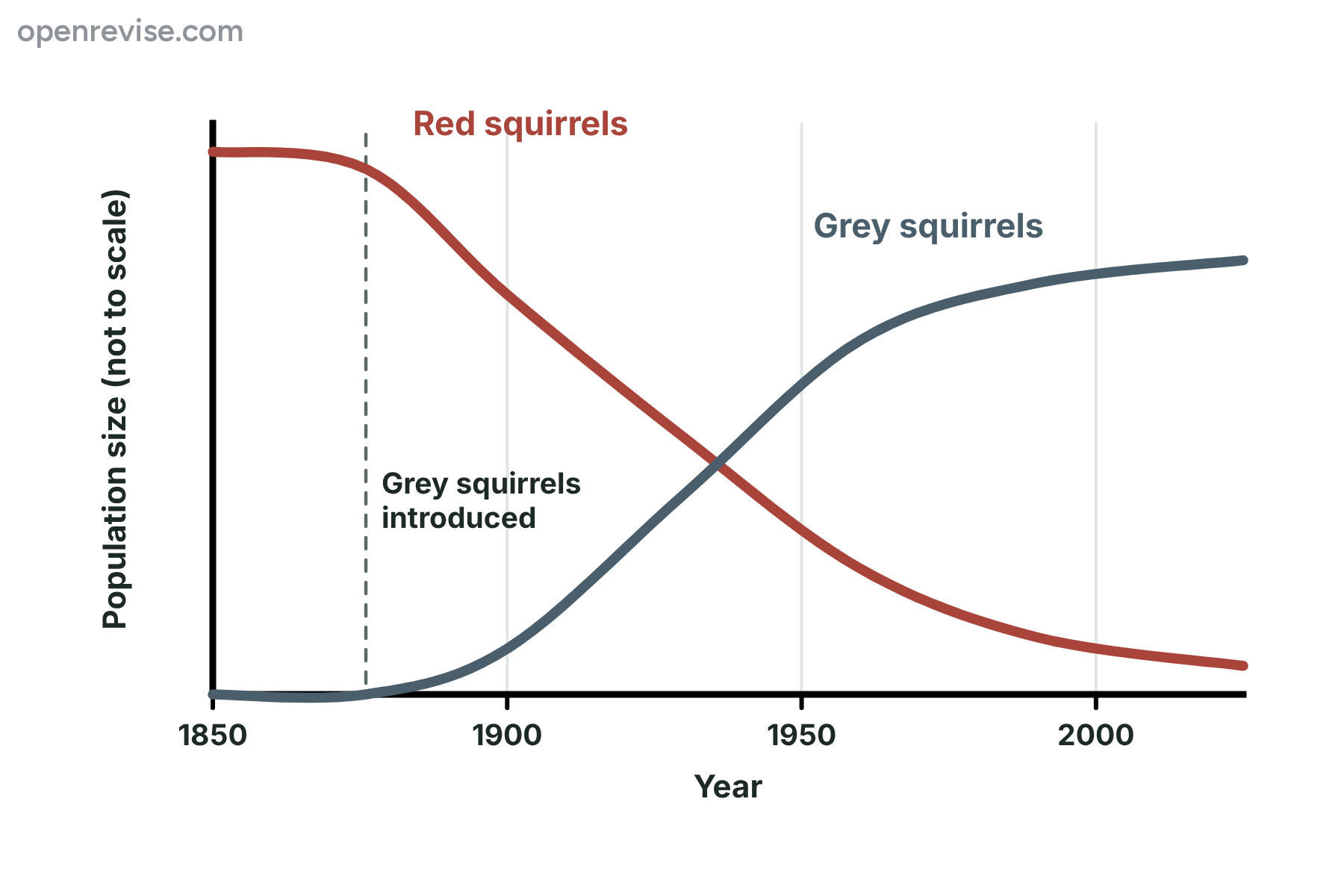
The graph shows the numbers of red squirrels and grey squirrels in Britain. Grey squirrels were introduced from North America. Explain why the number of red squirrels fell after the grey squirrels were introduced.
Show answerHide answer
Model answer
Grey squirrels and red squirrels compete for the same food, and the grey squirrels, which are bigger, are better at getting it, so the red squirrels have less to eat and fewer survive. Grey squirrels also carry squirrelpox virus, which does not harm them but kills red squirrels.
Mark scheme
- The two species compete for the same food (resources) — 1 mark
- The grey squirrels are better competitors, so the red squirrels get less food and decline — 1 mark
- Grey squirrels carry a disease (squirrelpox) that kills red squirrels — 1 mark
-
5 Complete [2 marks]
The sentences below describe the stages of eutrophication, but they are in the wrong order. A: Fish die. B: Bacteria use up the oxygen in the water. C: Fertiliser is washed into a pond. D: Plants die because light is blocked. E: Algae grow quickly and form a bloom. Write the letters in the correct order, starting with C.
Show answerHide answer
Model answer
C, E, D, B, A.
Mark scheme
- C, E, D in the correct order — 1 mark
- B, A at the end, in that order — 1 mark
-
6 Explain [5 marks]
Explain how the use of fertiliser on a farm can lead to the death of fish in a nearby pond.
Show answerHide answer
Model answer
Rain washes nitrates and phosphates from the fertiliser into the pond. The extra minerals make the algae grow and reproduce quickly, which forms an algal bloom on the surface. The algae block the light, so plants beneath them cannot photosynthesise and die. Bacteria decompose the dead plants and algae, and use up the oxygen in the water as they respire. The fish do not get enough oxygen for respiration, so they die.
Mark scheme
- Fertiliser (nitrates or phosphates) is washed into the pond — 1 mark
- Algae grow quickly (algal bloom) — 1 mark
- Light is blocked, so plants die — 1 mark
- Bacteria decompose the dead material and use up oxygen — 1 mark
- Fish die from lack of oxygen — 1 mark
-
7 Describe and explain [4 marks]
Source: Data from a lake over one year. March: algae 20 units, dissolved oxygen 11 mg per dm\(^3\). May: algae 85 units, oxygen 10 mg per dm\(^3\). July: algae 150 units, oxygen 8 mg per dm\(^3\). September: algae 40 units, oxygen 3 mg per dm\(^3\). Fertiliser was washed into the lake in April. Use the data to describe the changes in the lake and explain why the oxygen level was lowest in September.
Show answerHide answer
Model answer
The amount of algae rose from 20 units in March to a peak of 150 units in July, and then fell to 40 units in September, while the oxygen level fell steadily from 11 to 3 mg per dm\(^3\). The fertiliser made the algae grow quickly. The algae then died in late summer, and bacteria decomposed them, using up oxygen in respiration, so the oxygen level was lowest in September.
Mark scheme
- Algae increased to 150 units in July, then fell to 40 units — 1 mark
- Oxygen decreased from 11 to 3 mg per dm\(^3\) — 1 mark
- Fertiliser made the algae grow quickly, then they died — 1 mark
- Bacteria decomposed the dead algae and used up oxygen, so oxygen was lowest in September — 1 mark
-
8 Evaluate [6 marks]
A company wants to set up a large salmon farm in a sea loch where many wild fish live. Evaluate the positive and negative effects of fish farming on the ecosystem and on people.
Show answerHide answer
Model answer
The farm would provide a lot of protein for people and reduce the pressure of overfishing on wild salmon, so wild stocks could recover. It would also provide jobs in the area. However, the waste from the farm, uneaten food and faeces, would fall to the seabed and could cause eutrophication and harm the organisms on the seabed. The crowded farmed fish could spread parasites such as sea lice and disease to the wild fish, and any that escape could breed with wild salmon and reduce their genetic variation. Wild fish are also caught to make feed. Overall, a farm could be a good way to feed people if it is carefully managed, with a good flow of water to remove waste and nets that stop escapes, but in a loch with many wild fish the harm to biodiversity could outweigh the benefits.
Mark scheme
- A positive effect on people: protein supply or jobs — 1 mark
- A positive effect on the ecosystem: less overfishing of wild fish — 1 mark
- A negative effect: waste causing pollution or eutrophication — 1 mark
- A negative effect: parasites or disease spread to wild fish — 1 mark
- A negative effect: escapes breeding with wild fish, or wild fish caught for feed — 1 mark
- A reasoned judgement, such as it depends on how well the farm is managed — 1 mark
Quick check
-
1
Which of these is an example of a non-indigenous species in Britain?
Show answerHide answer
C: The grey squirrel
The grey squirrel was introduced from North America in the 1870s, whereas the red squirrel, badger and fox are native.
-
2
What is the first stage in eutrophication?
Show answerHide answer
A: Nitrates and phosphates enter the water
Fertiliser or sewage enters the water first, which provides the extra minerals for the algae.
-
3
Why do plants beneath an algal bloom die?
Show answerHide answer
D: Light cannot reach them for photosynthesis
The algae block the light, so the plants beneath cannot photosynthesise.
-
4
What uses up the oxygen in a eutrophic pond?
Show answerHide answer
B: The bacteria decomposing dead material
Bacteria that decompose the dead plants and algae respire and use up the oxygen.
-
5
Which is a benefit of fish farming?
Show answerHide answer
A: It reduces pressure on wild fish stocks
Farming fish gives a reliable food supply and means fewer wild fish need to be caught.
-
6
Why might escaped farmed salmon harm a wild salmon population?
Show answerHide answer
C: They breed with and compete with wild fish
Escaped fish can breed with wild fish and compete with them, which can reduce the wild population's genetic variation.
-
7
Why can a non-indigenous species spread quickly in a new place?
Show answerHide answer
D: It may have no natural predators or diseases
It often has no natural predators or diseases in its new home, so its population can grow fast.
-
8
Cane toads were introduced to Australia to control beetles. Why was this a problem?
Show answerHide answer
B: They poisoned native predators and did not control the beetle
The toads did not control the beetles, and their poisonous skin killed native animals that ate them.