Exam questions · Biology · Homeostasis
Homeostasis and Control Systems
- 7 exam questions
- 20 marks
- 8 quick checks
-
1 State [2 marks]
State two conditions of the internal environment that are controlled by homeostasis.
Show answerHide answer
Model answer
Any two of: body temperature, blood glucose concentration, water content.
Mark scheme
- Condition 1 — 1 mark
- Condition 2 — 1 mark
-
2 Name [3 marks]
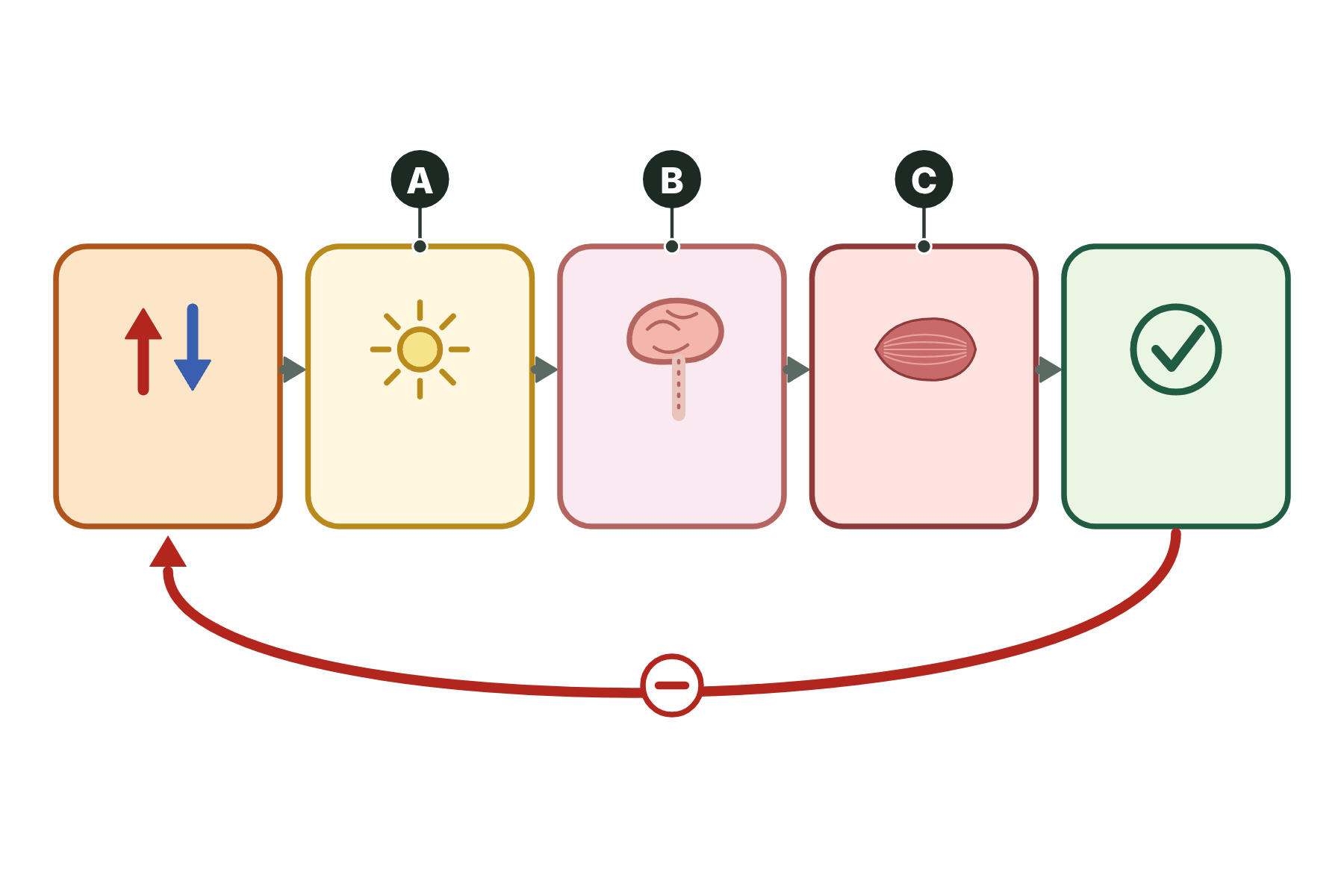
Figure 1 shows the parts of a control system. Name the parts shown at A, B and C.
Show answerHide answer
Model answer
A is the receptor. B is the coordination centre. C is the effector.
Mark scheme
- A: receptor — 1 mark
- B: coordination centre — 1 mark
- C: effector — 1 mark
-
3 Explain [3 marks]
Explain why it is important that body temperature stays at about 37 °C.
Show answerHide answer
Model answer
Enzymes control the metabolic reactions in cells, and they work best at an optimum temperature. If the temperature is too high the enzymes denature, and if it is too low the reactions are too slow.
Mark scheme
- Enzymes control metabolic reactions — 1 mark
- Too high: enzymes denature — 1 mark
- Too low: reactions too slow — 1 mark
-
4 Explain [3 marks]
Explain why the water content of the blood needs to be controlled.
Show answerHide answer
Model answer
If the water content is too high, osmosis moves water into the cells, which may swell and burst. If it is too low, water leaves the cells by osmosis and they shrink. Cells work properly only when the water content is correct.
Mark scheme
- Too high: water enters cells by osmosis — 1 mark
- Too low: water leaves cells — 1 mark
- Cells only work properly if the water content is correct — 1 mark
-
5 Describe [3 marks]
Describe the roles of the receptor, the coordination centre and the effector in a control system.
Show answerHide answer
Model answer
The receptor detects a change in the condition. The coordination centre receives the information and decides on the response. The effector carries out the response.
Mark scheme
- Receptor detects the change — 1 mark
- Coordination centre decides the response — 1 mark
- Effector carries out the response — 1 mark
-
6 Explain [3 marks]
Explain what is meant by negative feedback, using a named example.
Show answerHide answer
Model answer
In negative feedback a change in a condition causes a response that reverses the change. For example, if body temperature rises, sweating cools the body down, so the temperature returns to normal.
Mark scheme
- A change causes a response — 1 mark
- The response reverses the change — 1 mark
- A named example described — 1 mark
-
7 Compare [3 marks]
Compare nervous control with hormonal control of conditions in the body.
Show answerHide answer
Model answer
Nervous control uses nerve impulses but hormonal control uses hormones in the blood. Nervous control is faster. Hormonal control lasts longer.
Mark scheme
- Impulses against hormones — 1 mark
- Nervous is faster — 1 mark
- Hormonal effect lasts longer — 1 mark
Quick check
-
1
What is homeostasis?
Show answerHide answer
B: Keeping internal conditions constant
Homeostasis is the regulation of the internal conditions of the body to keep them constant.
-
2
What does a receptor do in a control system?
Show answerHide answer
A: Detects a change
A receptor detects a change.
-
3
Which of these is an effector?
Show answerHide answer
D: A sweat gland
Muscles and glands are effectors.
-
4
What does the response do in negative feedback?
Show answerHide answer
C: Reverses the change
In negative feedback the response reverses the change.
-
5
Why does the body need a constant temperature?
Show answerHide answer
B: Enzymes work best at an optimum temperature
Enzymes work best at an optimum temperature.
-
6
Which part of the body acts as a coordination centre for temperature?
Show answerHide answer
A: The brain
The brain, in the hypothalamus, receives information about temperature and decides on the response.
-
7
About what temperature is the human body kept at?
Show answerHide answer
D: 37 °C
Body temperature is kept at about 37 °C.
-
8
Which of these is NOT controlled by homeostasis?
Show answerHide answer
C: Eye colour
Body temperature, blood glucose and water content are controlled. Eye colour is inherited and does not change in response to conditions.