Exam questions · Biology
Homeostasis
- 29 exam questions
- 86 marks
- 32 quick checks
Homeostasis and Control Systems
Just this lesson-
1 State [2 marks]
State two conditions of the internal environment that are controlled by homeostasis.
Show answerHide answer
Model answer
Any two of: body temperature, blood glucose concentration, water content.
Mark scheme
- Condition 1 — 1 mark
- Condition 2 — 1 mark
-
2 Name [3 marks]
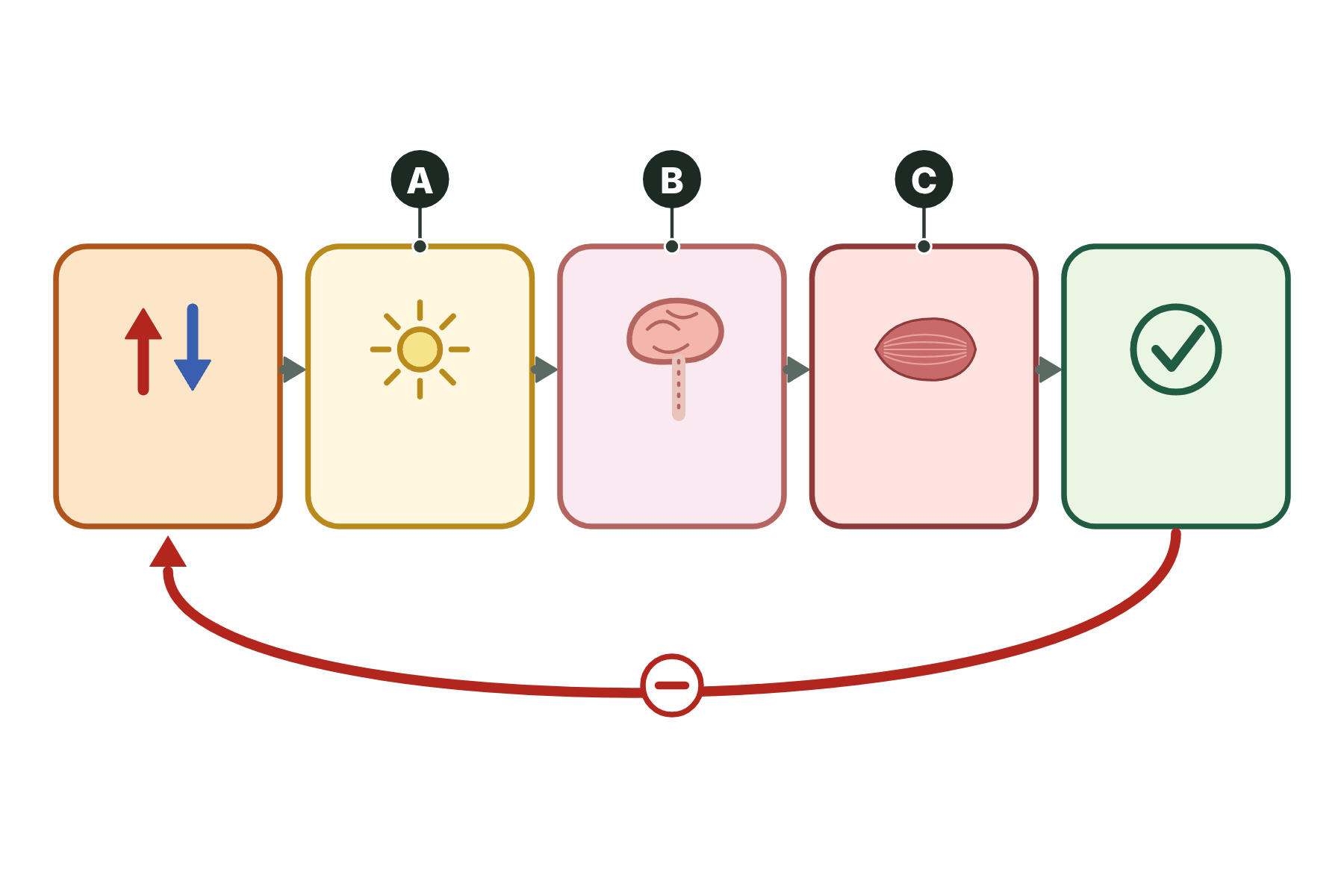
Figure 1 shows the parts of a control system. Name the parts shown at A, B and C.
Show answerHide answer
Model answer
A is the receptor. B is the coordination centre. C is the effector.
Mark scheme
- A: receptor — 1 mark
- B: coordination centre — 1 mark
- C: effector — 1 mark
-
3 Explain [3 marks]
Explain why it is important that body temperature stays at about 37 °C.
Show answerHide answer
Model answer
Enzymes control the metabolic reactions in cells, and they work best at an optimum temperature. If the temperature is too high the enzymes denature, and if it is too low the reactions are too slow.
Mark scheme
- Enzymes control metabolic reactions — 1 mark
- Too high: enzymes denature — 1 mark
- Too low: reactions too slow — 1 mark
-
4 Explain [3 marks]
Explain why the water content of the blood needs to be controlled.
Show answerHide answer
Model answer
If the water content is too high, osmosis moves water into the cells, which may swell and burst. If it is too low, water leaves the cells by osmosis and they shrink. Cells work properly only when the water content is correct.
Mark scheme
- Too high: water enters cells by osmosis — 1 mark
- Too low: water leaves cells — 1 mark
- Cells only work properly if the water content is correct — 1 mark
-
5 Describe [3 marks]
Describe the roles of the receptor, the coordination centre and the effector in a control system.
Show answerHide answer
Model answer
The receptor detects a change in the condition. The coordination centre receives the information and decides on the response. The effector carries out the response.
Mark scheme
- Receptor detects the change — 1 mark
- Coordination centre decides the response — 1 mark
- Effector carries out the response — 1 mark
-
6 Explain [3 marks]
Explain what is meant by negative feedback, using a named example.
Show answerHide answer
Model answer
In negative feedback a change in a condition causes a response that reverses the change. For example, if body temperature rises, sweating cools the body down, so the temperature returns to normal.
Mark scheme
- A change causes a response — 1 mark
- The response reverses the change — 1 mark
- A named example described — 1 mark
-
7 Compare [3 marks]
Compare nervous control with hormonal control of conditions in the body.
Show answerHide answer
Model answer
Nervous control uses nerve impulses but hormonal control uses hormones in the blood. Nervous control is faster. Hormonal control lasts longer.
Mark scheme
- Impulses against hormones — 1 mark
- Nervous is faster — 1 mark
- Hormonal effect lasts longer — 1 mark
Quick check
-
1
What is homeostasis?
Show answerHide answer
B: Keeping internal conditions constant
Homeostasis is the regulation of the internal conditions of the body to keep them constant.
-
2
What does a receptor do in a control system?
Show answerHide answer
A: Detects a change
A receptor detects a change.
-
3
Which of these is an effector?
Show answerHide answer
D: A sweat gland
Muscles and glands are effectors.
-
4
What does the response do in negative feedback?
Show answerHide answer
C: Reverses the change
In negative feedback the response reverses the change.
-
5
Why does the body need a constant temperature?
Show answerHide answer
B: Enzymes work best at an optimum temperature
Enzymes work best at an optimum temperature.
-
6
Which part of the body acts as a coordination centre for temperature?
Show answerHide answer
A: The brain
The brain, in the hypothalamus, receives information about temperature and decides on the response.
-
7
About what temperature is the human body kept at?
Show answerHide answer
D: 37 °C
Body temperature is kept at about 37 °C.
-
8
Which of these is NOT controlled by homeostasis?
Show answerHide answer
C: Eye colour
Body temperature, blood glucose and water content are controlled. Eye colour is inherited and does not change in response to conditions.
Temperature Control and the Skin
Just this lesson-
1 State [1 mark]
State the part of the brain that acts as the coordination centre for temperature control.
Show answerHide answer
Model answer
The hypothalamus.
Mark scheme
- Hypothalamus — 1 mark
-
2 Name [3 marks]
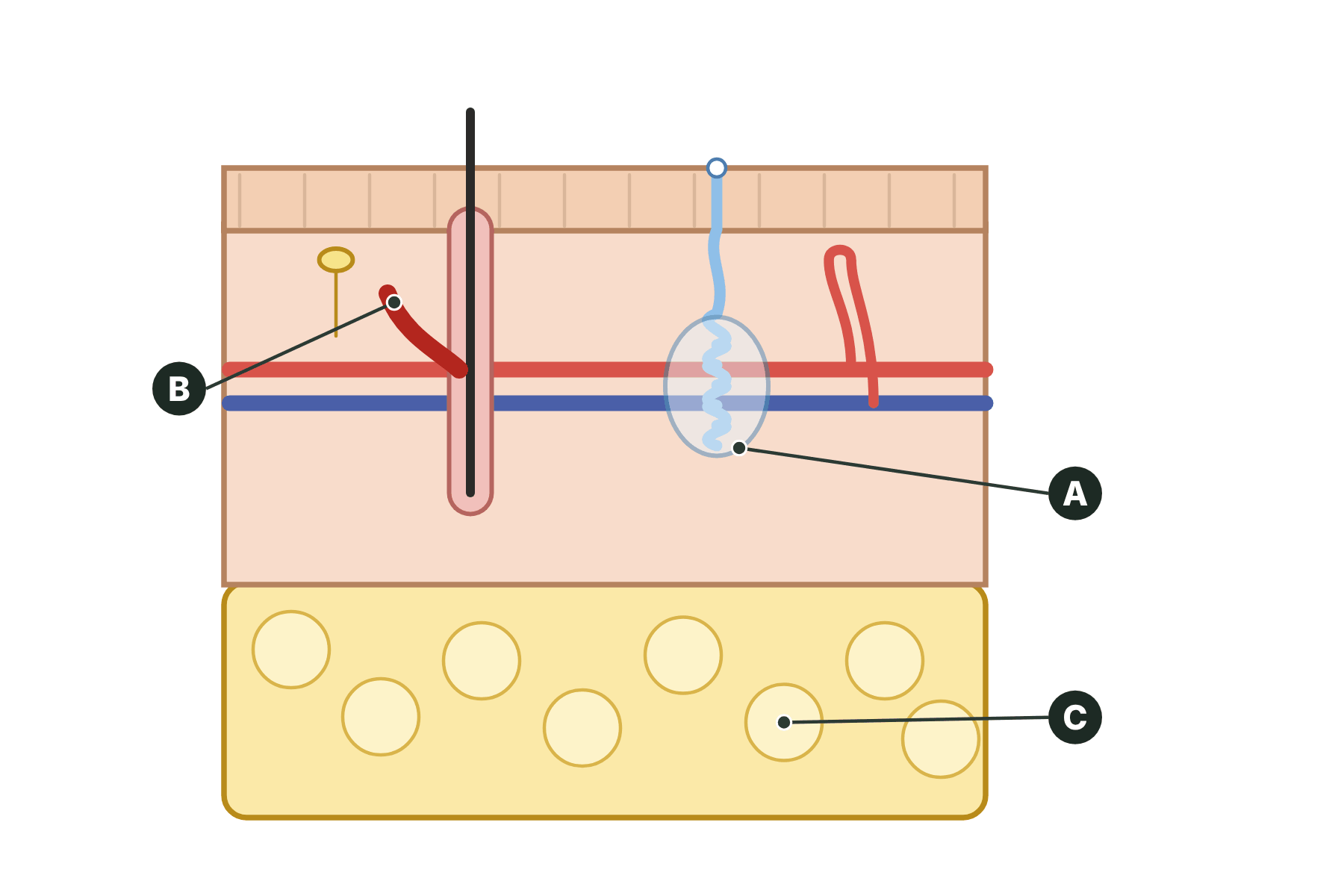
Figure 1 shows a section through the skin. Name the parts shown at A, B and C.
Show answerHide answer
Model answer
A is a sweat gland. B is a hair erector muscle. C is the fat layer.
Mark scheme
- A: sweat gland — 1 mark
- B: hair erector muscle — 1 mark
- C: fat layer — 1 mark
-
3 Explain [3 marks]
Explain how sweating helps to cool the body.
Show answerHide answer
Model answer
The sweat glands release sweat onto the surface of the skin. The sweat evaporates. Evaporation takes heat energy from the skin and the body, so the body cools.
Mark scheme
- Sweat is released onto the skin — 1 mark
- It evaporates — 1 mark
- Evaporation takes heat from the body — 1 mark
-
4 Explain [4 marks]
Explain how vasodilation helps to lower body temperature on a hot day.
Show answerHide answer
Model answer
The hypothalamus detects the high temperature. The blood vessels near the surface of the skin widen. More blood flows near the surface, so more heat is transferred from the blood to the surroundings. The body temperature falls.
Mark scheme
- Hypothalamus detects the rise — 1 mark
- Blood vessels near the surface widen — 1 mark
- More blood flows near the surface — 1 mark
- More heat is lost to the surroundings — 1 mark
-
5 Describe [4 marks]
Describe how the body responds when the temperature of the surroundings falls.
Show answerHide answer
Model answer
Receptors in the skin and the hypothalamus detect the fall. The muscles shiver, which releases heat from respiration. The blood vessels near the surface of the skin narrow, so less heat is lost. The hairs stand up and trap a layer of air, and sweating stops.
Mark scheme
- Receptors detect the fall in temperature — 1 mark
- Shivering releases heat — 1 mark
- Blood vessels narrow — 1 mark
- Hairs stand up / sweating stops — 1 mark
-
6 Explain [3 marks]
Explain why temperature control is an example of negative feedback.
Show answerHide answer
Model answer
If the body temperature changes, receptors detect the change and the effectors respond. The response reverses the change, for example cooling the body when it is too hot. The temperature returns to normal.
Mark scheme
- Change detected by receptors — 1 mark
- The effectors respond — 1 mark
- The response reverses the change — 1 mark
-
7 Explain [2 marks]
A student says that hairs standing up is not an effective way for humans to keep warm. Explain why the student is correct.
Show answerHide answer
Model answer
Hairs standing up trap a layer of air that insulates the skin. Humans have very little body hair, so only a very thin layer of air is trapped.
Mark scheme
- Trapped air insulates — 1 mark
- Humans have little body hair — 1 mark
Quick check
-
1
Which part of the brain monitors the temperature of the blood?
Show answerHide answer
C: The hypothalamus
The hypothalamus monitors blood temperature.
-
2
What happens to the blood vessels near the skin surface when you are too hot?
Show answerHide answer
A: They widen
They widen, which is vasodilation.
-
3
What does shivering do?
Show answerHide answer
D: Releases heat from respiration
Shivering makes muscles contract and release heat from respiration.
-
4
Why does sweating cool the body?
Show answerHide answer
B: Evaporation takes heat from the skin
Evaporation of sweat takes heat from the skin.
-
5
What is vasoconstriction?
Show answerHide answer
C: The narrowing of blood vessels
Vasoconstriction is the narrowing of blood vessels near the skin surface.
-
6
What do the hairs do when it is cold?
Show answerHide answer
D: Stand up
The hair erector muscles contract, so the hairs stand up and trap air.
-
7
Why does skin look pale when it is cold?
Show answerHide answer
A: Less blood flows near the surface
Less blood flows near the surface, because the vessels narrow.
-
8
At about what temperature does the body control its core temperature?
Show answerHide answer
B: 37 °C
The body controls its core temperature at about 37 °C.
Blood Glucose and Diabetes
Just this lesson-
1 State [2 marks]
State the organ that releases insulin and the organ that stores glycogen.
Show answerHide answer
Model answer
The pancreas releases insulin. The liver stores glycogen.
Mark scheme
- Pancreas — 1 mark
- Liver — 1 mark
-
2 Name [3 marks]
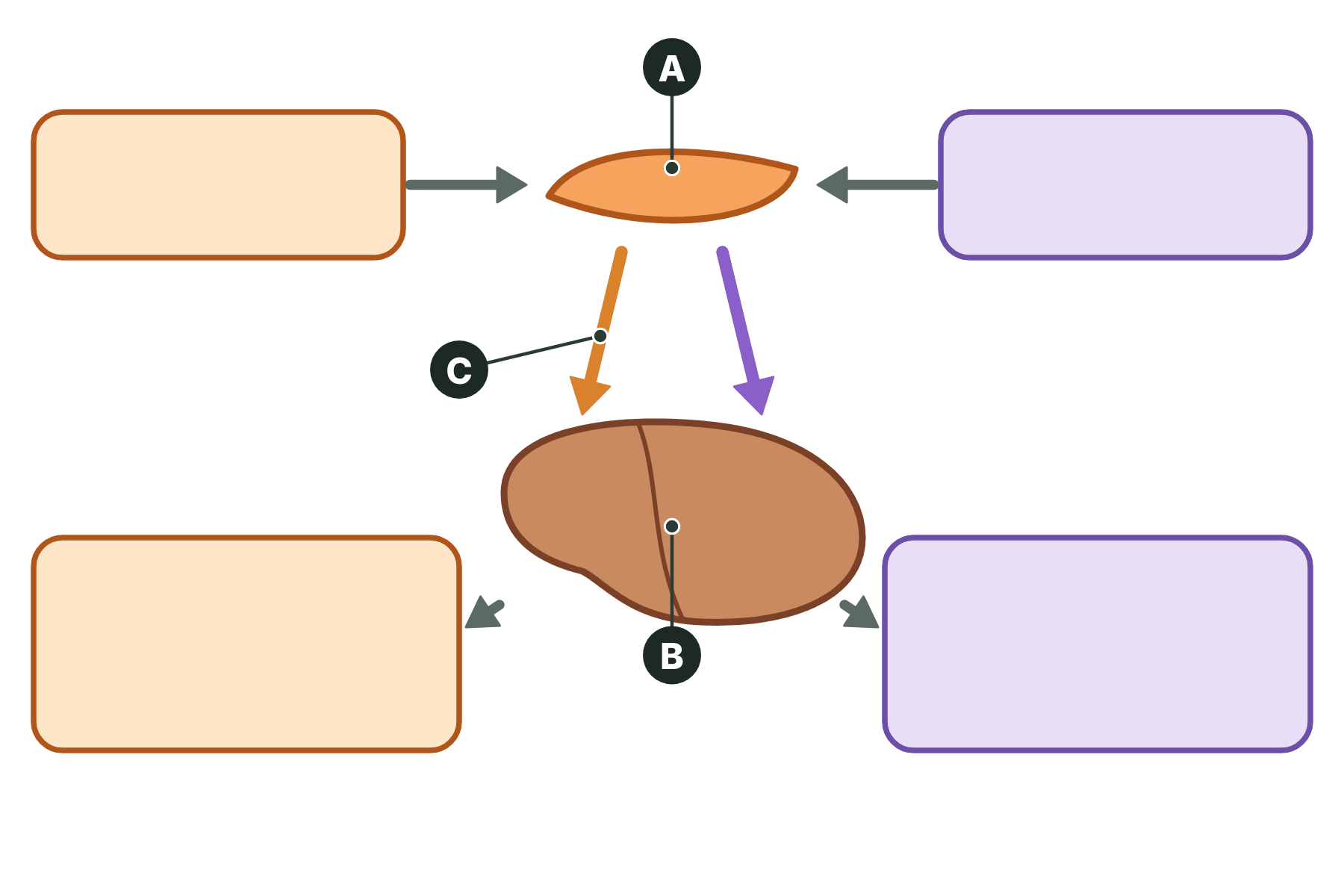
Figure 1 shows how the blood glucose concentration is controlled. Name the parts shown at A, B and C.
Show answerHide answer
Model answer
A is the pancreas. B is the liver. C is a hormone, insulin (or glucagon).
Mark scheme
- A: pancreas — 1 mark
- B: liver — 1 mark
- C: insulin — 1 mark
-
3 Explain [4 marks]
Explain how the body responds when the blood glucose concentration rises after a meal.
Show answerHide answer
Model answer
The pancreas detects the rise in blood glucose. The pancreas releases insulin into the blood. The insulin makes the liver take up glucose and convert it to glycogen. The blood glucose concentration falls back to normal.
Mark scheme
- Pancreas detects the rise — 1 mark
- Insulin released — 1 mark
- Liver takes up glucose and stores it as glycogen — 1 mark
- Blood glucose falls — 1 mark
-
4 Compare [3 marks]
Compare type 1 diabetes with type 2 diabetes.
Show answerHide answer
Model answer
In type 1 diabetes the pancreas does not make enough insulin, but in type 2 diabetes the cells stop responding to insulin. Type 1 is treated with insulin injections, but type 2 is treated with diet and exercise. Type 2 is linked to obesity.
Mark scheme
- Type 1: not enough insulin; type 2: cells do not respond — 1 mark
- Type 1: insulin injections; type 2: diet and exercise — 1 mark
- Type 2 linked to obesity — 1 mark
-
5 Describe [3 marks]
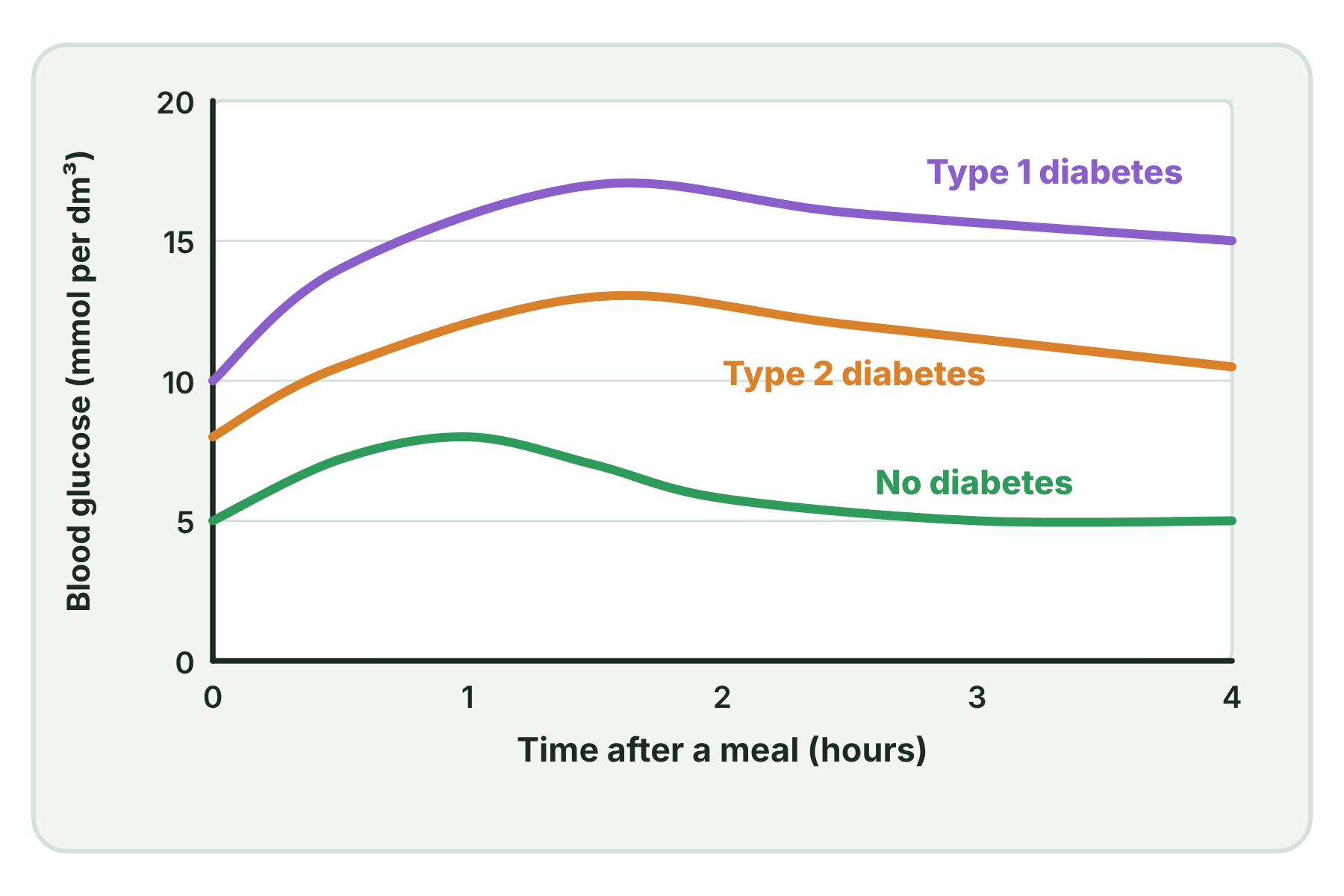
Figure 2 shows the blood glucose concentration of a person without diabetes and of two people with diabetes after a meal. Describe the differences between the person without diabetes and the person with type 1 diabetes.
Show answerHide answer
Model answer
The person without diabetes starts at about 5 and rises to about 8, then returns to about 5 within 3 hours. The person with type 1 starts higher, at about 10, rises to about 17 and stays above 14. The concentration does not return to normal.
Mark scheme
- Without diabetes: peak about 8 — 1 mark
- Without diabetes returns to about 5 — 1 mark
- Type 1 starts higher, peaks higher and stays high — 1 mark
-
6 Explain [3 marks]
Explain why a person with type 1 diabetes needs to inject insulin but a person with type 2 diabetes may not.
Show answerHide answer
Model answer
In type 1 diabetes the pancreas does not make enough insulin, so it must be injected. In type 2 diabetes the pancreas makes insulin but the cells do not respond to it. Diet and exercise can make cells respond better, so injections may not be needed.
Mark scheme
- Type 1: pancreas does not make enough insulin — 1 mark
- Type 2: cells do not respond to insulin — 1 mark
- Diet and exercise can help in type 2 — 1 mark
-
7 Explain [4 marks]
Explain how insulin and glucagon work together to keep the blood glucose concentration constant.
Show answerHide answer
Model answer
When the blood glucose is too high the pancreas releases insulin, which makes the liver store glucose as glycogen, so the concentration falls. When the blood glucose is too low the pancreas releases glucagon, which makes the liver convert glycogen to glucose, so the concentration rises. They have opposite effects, so this is negative feedback.
Mark scheme
- High glucose: insulin, liver stores glycogen, concentration falls — 1 mark
- Low glucose: glucagon, liver releases glucose, concentration rises — 1 mark
- Opposite effects — 1 mark
- Negative feedback keeps the concentration constant — 1 mark
Quick check
-
1
Which hormone lowers the blood glucose concentration?
Show answerHide answer
B: Insulin
Insulin lowers the blood glucose concentration.
-
2
In which form does the liver store glucose?
Show answerHide answer
D: Glycogen
The liver stores glucose as glycogen.
-
3
Which organ makes insulin?
Show answerHide answer
A: The pancreas
The pancreas makes insulin.
-
4
What is the cause of type 1 diabetes?
Show answerHide answer
C: The pancreas does not make enough insulin
In type 1 diabetes the pancreas does not make enough insulin.
-
5
Which type of diabetes is linked to obesity?
Show answerHide answer
B: Type 2
Type 2 diabetes is linked to obesity and lack of exercise.
-
6
How is type 1 diabetes usually treated?
Show answerHide answer
D: With insulin injections
Type 1 diabetes is treated with insulin injections.
-
7
What does glucagon make the liver do?
Show answerHide answer
A: Release glucose
Glucagon makes the liver convert glycogen to glucose.
-
8
When is glucagon released?
Show answerHide answer
C: When blood glucose is too low
Glucagon is released when the blood glucose concentration is too low.
The Kidneys and Water Balance
Just this lesson-
1 State [2 marks]
State two substances that are removed from the blood by the kidneys.
Show answerHide answer
Model answer
Any two of: urea, excess water, excess mineral ions.
Mark scheme
- Substance 1 — 1 mark
- Substance 2 — 1 mark
-
2 Name [3 marks]
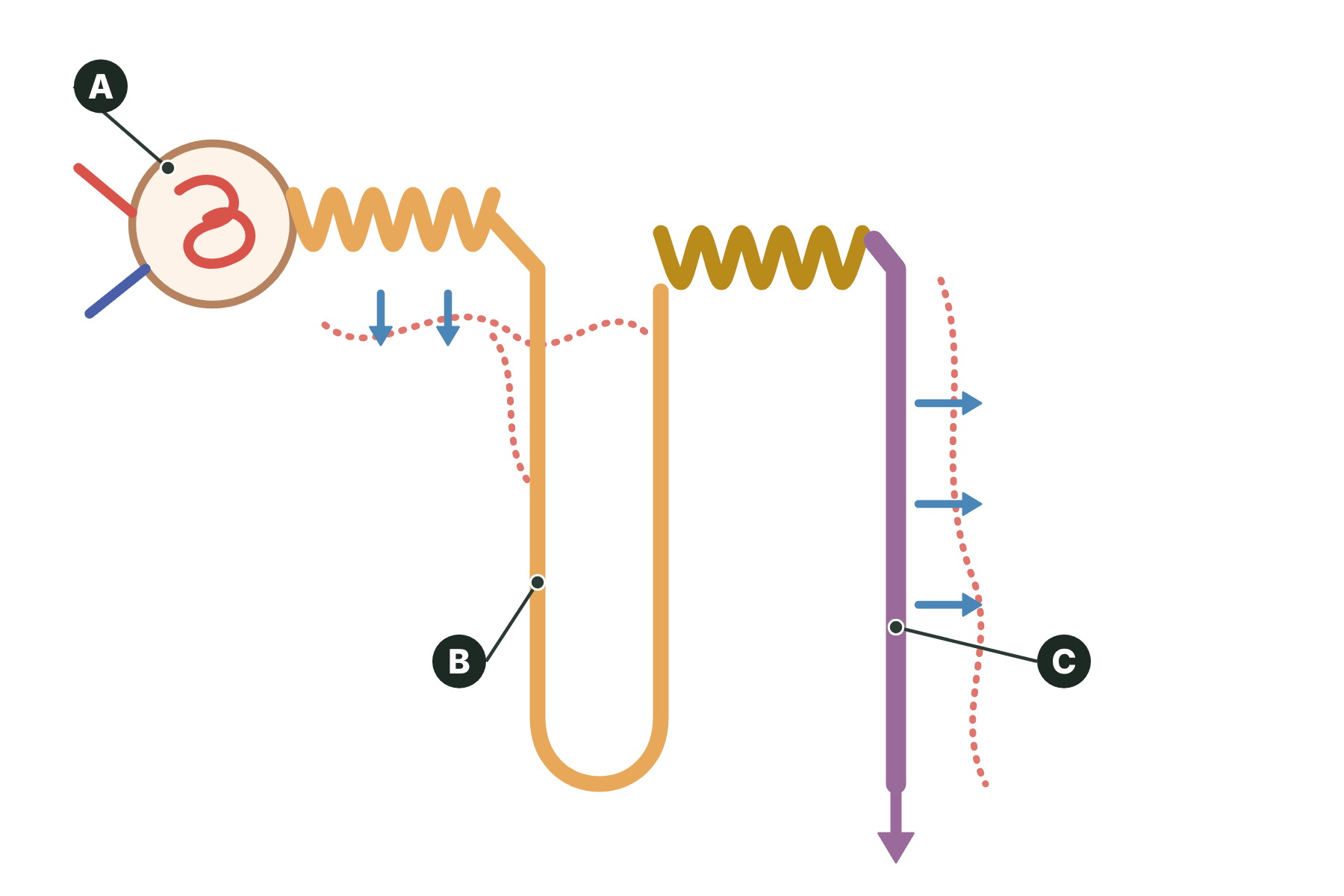
Figure 1 shows a nephron. Name the parts shown at A, B and C.
Show answerHide answer
Model answer
A is the Bowman's capsule. B is the loop of Henle. C is the collecting duct.
Mark scheme
- A: Bowman's capsule — 1 mark
- B: loop of Henle — 1 mark
- C: collecting duct — 1 mark
-
3 Name [3 marks]
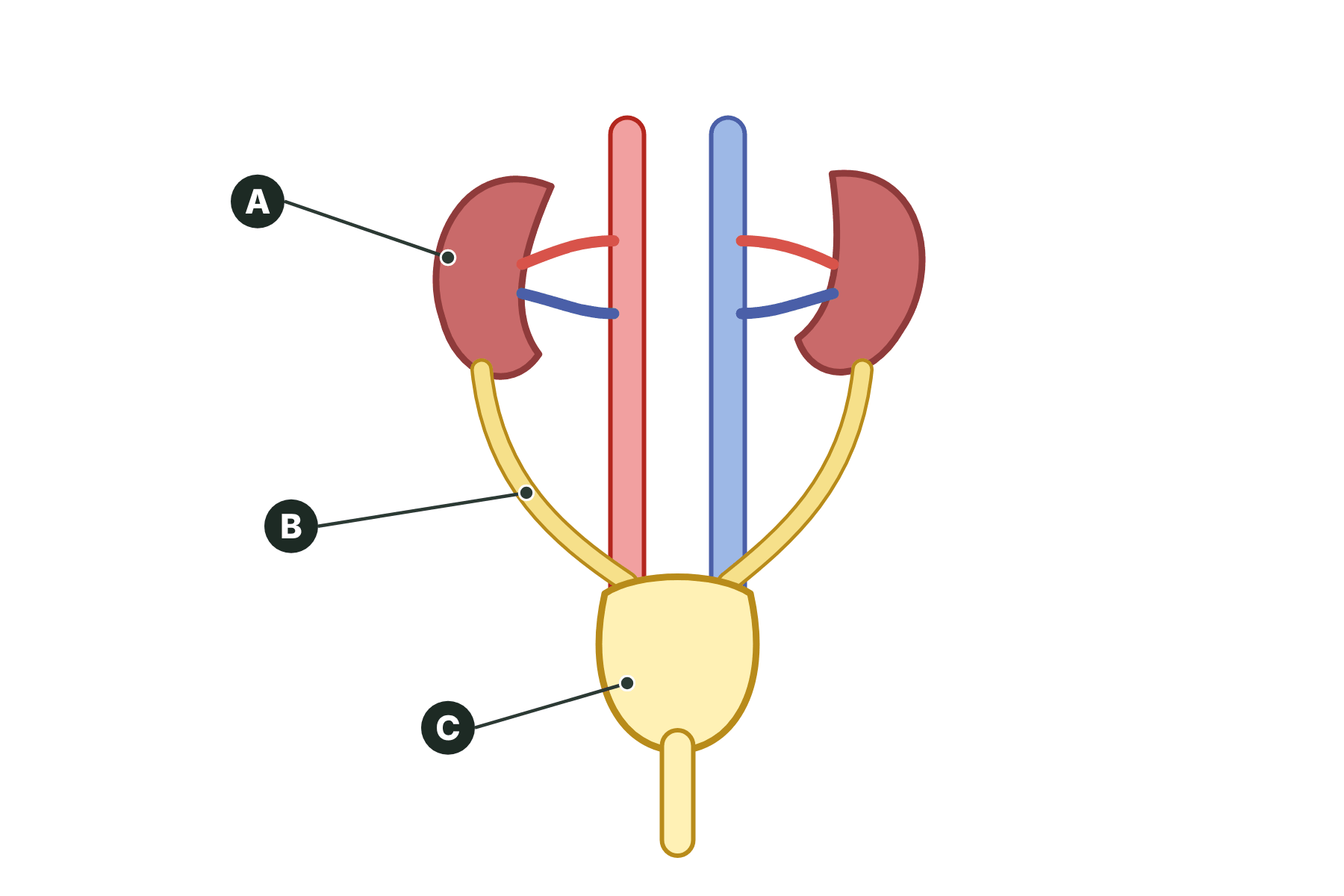
Figure 2 shows the urinary system. Name the parts shown at A, B and C.
Show answerHide answer
Model answer
A is a kidney. B is a ureter. C is the bladder.
Mark scheme
- A: kidney — 1 mark
- B: ureter — 1 mark
- C: bladder — 1 mark
-
4 Explain [3 marks]
Explain why the water content of the blood must be controlled.
Show answerHide answer
Model answer
If the blood is too dilute, water enters the cells by osmosis and they may swell and burst. If it is too concentrated, water leaves the cells by osmosis and they shrink. The cells can only work normally if the water content is right.
Mark scheme
- Too dilute: cells gain water and may burst — 1 mark
- Too concentrated: cells lose water and shrink — 1 mark
- Cells only work normally with the right water content — 1 mark
-
5 Describe [4 marks]
Describe how urine is made in a nephron.
Show answerHide answer
Model answer
Blood is filtered under high pressure in the glomerulus, and water, glucose, urea and ions pass into the Bowman's capsule. Blood cells and proteins stay in the blood. In the tubule all the glucose and some water and ions are reabsorbed into the blood. The urea, excess water and excess ions are left and form the urine.
Mark scheme
- Filtration under high pressure — 1 mark
- Blood cells and proteins are not filtered — 1 mark
- All glucose and some water and ions reabsorbed — 1 mark
- Urea and excess water and ions leave as urine — 1 mark
-
6 Explain [2 marks]
Explain why there is no glucose in the urine of a healthy person.
Show answerHide answer
Model answer
All of the glucose is reabsorbed into the blood from the tubule by active transport, so none is left in the urine.
Mark scheme
- All glucose is reabsorbed — 1 mark
- By active transport — 1 mark
-
7 Explain [4 marks]
Explain how ADH changes the volume of urine produced when a person has not had a drink for many hours.
Show answerHide answer
Model answer
The blood becomes more concentrated, and the hypothalamus detects this. The pituitary gland releases more ADH. ADH makes the walls of the collecting ducts more permeable to water, so more water is reabsorbed into the blood. A small volume of concentrated urine is produced.
Mark scheme
- Blood more concentrated, detected — 1 mark
- More ADH released from the pituitary — 1 mark
- Collecting duct more permeable, more water reabsorbed — 1 mark
- Small volume of concentrated urine — 1 mark
-
8 Explain [3 marks]
A person eats a very salty meal. Explain how their body responds to bring the blood back to normal.
Show answerHide answer
Model answer
The blood becomes more concentrated. More ADH is released, so more water is reabsorbed and a small volume of concentrated urine is made. The person feels thirsty and drinks, which dilutes the blood.
Mark scheme
- Blood becomes more concentrated — 1 mark
- More ADH, more water reabsorbed, concentrated urine — 1 mark
- Thirst makes the person drink — 1 mark
Quick check
-
1
What substance is removed from the blood by the kidneys?
Show answerHide answer
C: Urea
The kidneys remove urea, excess water and excess ions.
-
2
What carries urine from the kidney to the bladder?
Show answerHide answer
A: The ureter
The ureter carries urine from the kidney to the bladder.
-
3
In which structure is blood filtered?
Show answerHide answer
D: The glomerulus and Bowman's capsule
Filtration takes place in the glomerulus and the Bowman's capsule.
-
4
Which substance is all reabsorbed into the blood in the tubule?
Show answerHide answer
B: Glucose
All the glucose is reabsorbed.
-
5
What happens to an animal cell in a dilute solution?
Show answerHide answer
A: It swells and may burst
Water enters by osmosis and the cell swells, and may burst.
-
6
Where is urea made?
Show answerHide answer
C: In the liver
Urea is made in the liver from excess amino acids.
-
7
What does ADH do to the collecting duct?
Show answerHide answer
B: Makes it more permeable to water
ADH makes the collecting duct more permeable to water.
-
8
When is more ADH released?
Show answerHide answer
D: When the blood is too concentrated
More ADH is released when the blood is too concentrated.