Exam questions · Biology
Photosynthesis
- 23 exam questions
- 62 marks
- 26 quick checks
The Photosynthetic Reaction
Just this lesson-
1 State [1 mark]
Name the two products of photosynthesis.
Show answerHide answer
Model answer
Glucose and oxygen.
Mark scheme
- Glucose and oxygen — 1 mark
-
2 Name [3 marks]
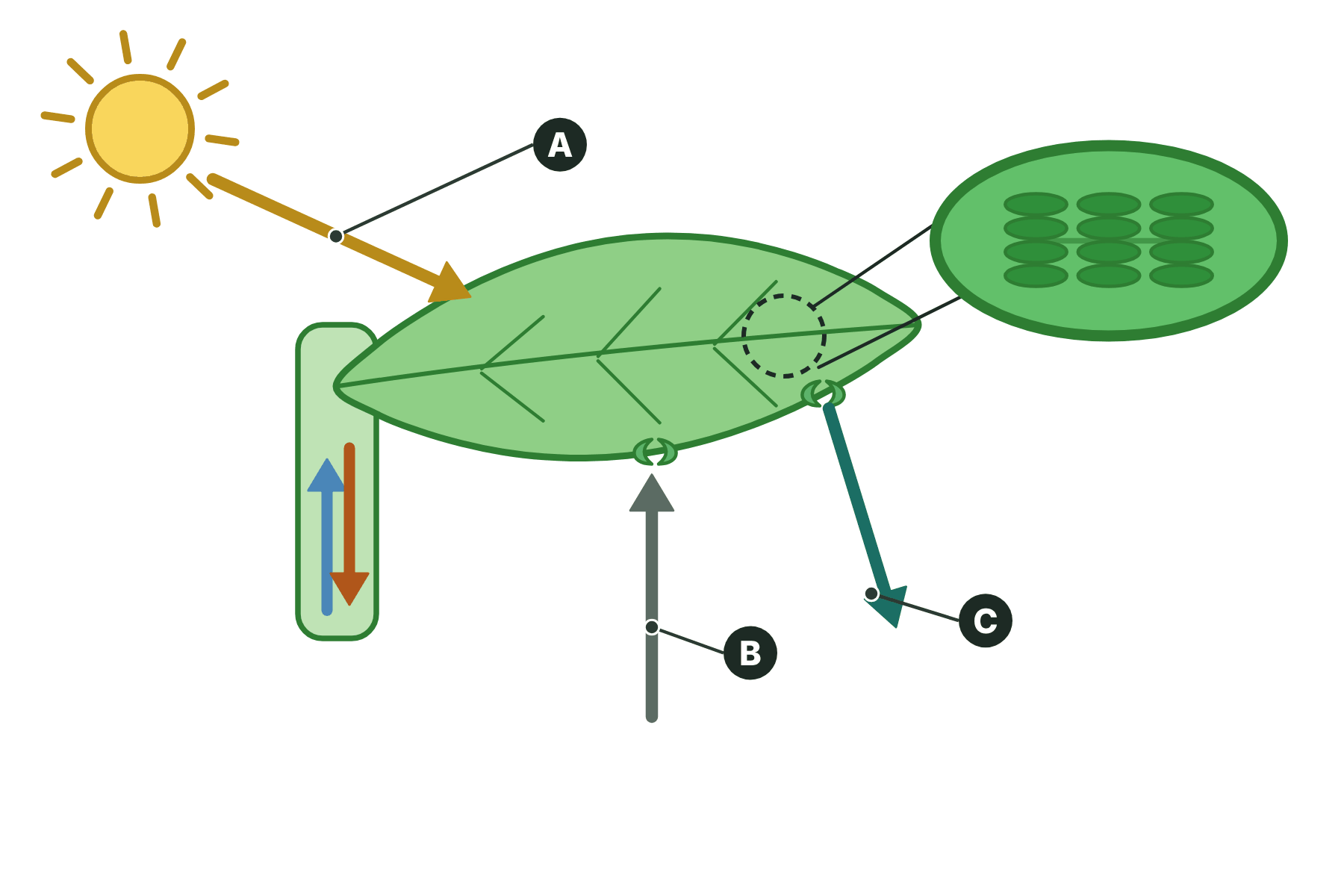
Figure 1 shows the substances involved in photosynthesis. Name the substances or energy shown at A, B and C.
Show answerHide answer
Model answer
A is light (energy). B is carbon dioxide. C is oxygen.
Mark scheme
- A: light — 1 mark
- B: carbon dioxide — 1 mark
- C: oxygen — 1 mark
-
3 Write [2 marks]
Write the word equation for photosynthesis.
Show answerHide answer
Model answer
Carbon dioxide + water makes glucose + oxygen (in the presence of light).
Mark scheme
- Carbon dioxide + water as reactants — 1 mark
- Glucose + oxygen as products — 1 mark
-
4 Explain [2 marks]
Explain why photosynthesis is an endothermic reaction.
Show answerHide answer
Model answer
It takes in energy from the surroundings. The energy is transferred from the environment to the chloroplasts by light.
Mark scheme
- Takes in energy — 1 mark
- From light, absorbed by the chloroplasts — 1 mark
-
5 Describe [3 marks]
Describe how a leaf is adapted to absorb carbon dioxide and light for photosynthesis.
Show answerHide answer
Model answer
The leaf is broad and flat, which gives a large surface area for light. The palisade cells contain many chloroplasts with chlorophyll to absorb light. Stomata let carbon dioxide diffuse in, and there are air spaces inside the leaf, so it reaches the cells.
Mark scheme
- Large surface area — 1 mark
- Chloroplasts and chlorophyll absorb light — 1 mark
- Stomata and air spaces for carbon dioxide — 1 mark
-
6 Describe [4 marks]
Describe how you would test a leaf for starch.
Show answerHide answer
Model answer
Dip the leaf in boiling water to kill it. Heat it in hot ethanol in a water bath to remove the chlorophyll. Rinse it in warm water. Add iodine solution. If starch is present, the iodine turns from orange-brown to blue-black.
Mark scheme
- Boiling water to kill the leaf — 1 mark
- Hot ethanol to remove chlorophyll — 1 mark
- Add iodine solution — 1 mark
- Blue-black means starch is present — 1 mark
-
7 Explain [4 marks]
Explain why plants are important to nearly all other living things.
Show answerHide answer
Model answer
Plants make their own food by photosynthesis, so they are producers. The glucose they make, and the substances made from it, form the food that animals eat. Plants also release oxygen as a product, which animals use for aerobic respiration.
Mark scheme
- Plants are producers — 1 mark
- Make glucose / food by photosynthesis — 1 mark
- Animals eat plants or things that eat plants — 1 mark
- Release oxygen used in respiration — 1 mark
-
8 Explain [3 marks]
Explain why photosynthetic organisms are important for life on Earth.
Show answerHide answer
Model answer
They are producers that make organic compounds, including glucose, from carbon dioxide and water, using light energy. These compounds make up their biomass, which is the food for other organisms in the food chain. They also release oxygen.
Mark scheme
- They make organic compounds by photosynthesis — 1 mark
- Their biomass is the food for other organisms — 1 mark
- They release oxygen — 1 mark
-
9 Describe [3 marks]
Describe the two stages of photosynthesis.
Show answerHide answer
Model answer
In the first stage chlorophyll absorbs light energy, which is used to split water into hydrogen and oxygen. In the second stage the hydrogen is used to fix carbon dioxide. This makes glucose.
Mark scheme
- Light energy absorbed, used to split water — 1 mark
- Hydrogen used to fix carbon dioxide — 1 mark
- To make glucose — 1 mark
Quick check
-
1
Which gas is a reactant in photosynthesis?
Show answerHide answer
B: Carbon dioxide
Carbon dioxide is taken in and used to make glucose.
-
2
Which substance is made by photosynthesis?
Show answerHide answer
C: Glucose
Glucose and oxygen are the products of photosynthesis.
-
3
What type of reaction is photosynthesis?
Show answerHide answer
D: Endothermic
Photosynthesis takes in energy from the surroundings, so it is endothermic.
-
4
Where does photosynthesis take place?
Show answerHide answer
A: In the chloroplasts
Photosynthesis takes place in the chloroplasts.
-
5
Which pigment absorbs light for photosynthesis?
Show answerHide answer
B: Chlorophyll
Chlorophyll absorbs light energy.
-
6
How does water reach the leaf?
Show answerHide answer
C: Through the xylem
Water is taken up by the roots and carried up the xylem.
-
7
What colour does iodine turn in the presence of starch?
Show answerHide answer
D: Blue-black
Starch turns iodine from orange-brown to blue-black.
-
8
Which of these is the symbol equation for photosynthesis?
Show answerHide answer
A: 6CO₂ + 6H₂O → C₆H₁₂O₆ + 6O₂
Photosynthesis makes glucose and oxygen from carbon dioxide and water.
-
9
What happens to water in the first stage of photosynthesis?
Show answerHide answer
C: It is split into hydrogen and oxygen
Light energy is used to split water into hydrogen and oxygen.
-
10
What is biomass?
Show answerHide answer
A: The mass of living material
Biomass is the mass of living material.
Rate of Photosynthesis and Limiting Factors
Just this lesson-
1 State [1 mark]
Name two factors that can limit the rate of photosynthesis.
Show answerHide answer
Model answer
Any two of: light intensity, carbon dioxide concentration, temperature, amount of chlorophyll.
Mark scheme
- Two factors named — 1 mark
-
2 Explain [3 marks]
Explain why the rate of photosynthesis falls when the temperature rises above about 45 °C.
Show answerHide answer
Model answer
Photosynthesis is controlled by enzymes. At high temperatures the enzymes are denatured, because their shape changes, so they can no longer catalyse the reactions. The rate therefore falls.
Mark scheme
- Controlled by enzymes — 1 mark
- Enzymes are denatured at high temperatures — 1 mark
- So the rate falls — 1 mark
-
3 Calculate [2 marks]
A plant produces 36 cm³ of oxygen in 6 minutes. Calculate the rate of photosynthesis in cm³ of oxygen per minute.
Show answerHide answer
Model answer
36 ÷ 6 = 6 cm³ per minute.
Mark scheme
- 36 ÷ 6 — 1 mark
- 6 cm³ per minute — 1 mark
-
4 Explain [3 marks]
The rate of photosynthesis in a plant rises as the carbon dioxide concentration rises, then levels off. Explain why the graph levels off.
Show answerHide answer
Model answer
At first carbon dioxide is the limiting factor, so more carbon dioxide gives a higher rate. When the graph levels off, carbon dioxide is no longer limiting. Another factor, such as light intensity or temperature, is now limiting the rate.
Mark scheme
- Carbon dioxide limiting at first — 1 mark
- No longer limiting on the flat part — 1 mark
- Another factor is now limiting — 1 mark
-
5 Explain [3 marks]
A plant has pale leaves because it is short of magnesium ions. Explain why its rate of photosynthesis is lower than that of a healthy plant.
Show answerHide answer
Model answer
Magnesium ions are needed to make chlorophyll. The pale leaves have less chlorophyll, so they absorb less light. There is less energy for photosynthesis, so the rate is lower.
Mark scheme
- Magnesium needed for chlorophyll — 1 mark
- Less light absorbed — 1 mark
- Less energy so lower rate — 1 mark
-
6 Explain [3 marks]
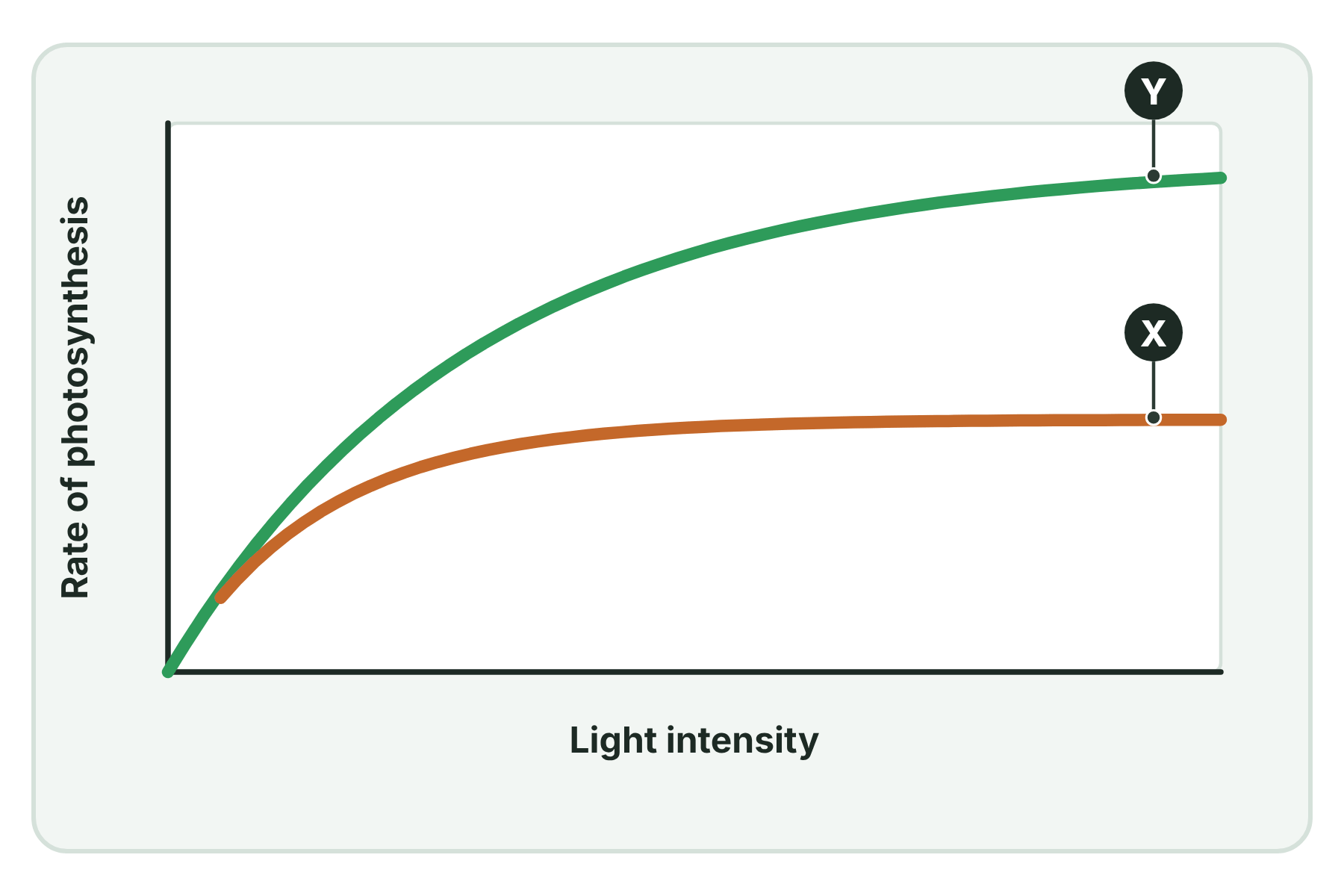
Figure 1 shows the rate of photosynthesis at different light intensities for line X at a low carbon dioxide concentration, and line Y at a higher carbon dioxide concentration. Explain why the two lines are the same at low light intensities but different at high light intensities.
Show answerHide answer
Model answer
At low light intensities, light is the limiting factor for both, so the rate is the same whatever the carbon dioxide concentration. At high light intensities, light is no longer limiting. At the lower carbon dioxide concentration, carbon dioxide is limiting so line X levels off, but at the higher carbon dioxide concentration the rate can keep rising, so line Y is higher.
Mark scheme
- Light limiting at low intensity for both — 1 mark
- Light no longer limiting at high intensity — 1 mark
- Carbon dioxide limits line X — 1 mark
-
7 Evaluate [4 marks]
A grower is deciding whether to add extra carbon dioxide to a greenhouse. Evaluate whether this is cost effective.
Show answerHide answer
Model answer
Adding carbon dioxide will only increase the rate of photosynthesis if carbon dioxide is the limiting factor. If light or temperature is limiting, the extra carbon dioxide will not increase the rate and the money is wasted. If it is limiting, the extra crop that is grown has to be worth more than the cost of the carbon dioxide. The grower should use data to check what is limiting before deciding.
Mark scheme
- Only worthwhile if CO₂ is limiting — 1 mark
- Wasted if another factor is limiting — 1 mark
- Compare the cost with the value of the extra crop — 1 mark
- Use data / conclusion — 1 mark
Quick check
-
1
Which factor provides the energy for photosynthesis?
Show answerHide answer
C: Light
Light energy is absorbed by chlorophyll and used to make glucose.
-
2
Why does a very high temperature slow photosynthesis?
Show answerHide answer
B: The enzymes are denatured
The enzymes are denatured at high temperatures.
-
3
What does the flat part of a rate graph show?
Show answerHide answer
D: Another factor is limiting
The factor on the x axis is no longer limiting, because another factor is.
-
4
Which of these is a limiting factor for photosynthesis?
Show answerHide answer
A: Carbon dioxide concentration
Carbon dioxide concentration can limit the rate.
-
5
What is the rate if 40 cm³ of oxygen is produced in 5 minutes?
Show answerHide answer
B: 8 cm³ per minute
40 ÷ 5 = 8 cm³ per minute.
-
6
Why do plants short of magnesium photosynthesise more slowly?
Show answerHide answer
C: They make less chlorophyll
They make less chlorophyll, so absorb less light.
-
7
(Higher tier) Why might a grower not add extra heat to a greenhouse on a hot, sunny day?
Show answerHide answer
A: Temperature may not be limiting
Temperature may not be the limiting factor, so extra heat would be a waste of money.
-
8
(Higher tier) What can happen to a plateau on a graph if the limiting factor is increased?
Show answerHide answer
D: It rises
Raising the limiting factor raises the plateau until another factor limits.
Investigating Light Intensity and Photosynthesis
Just this lesson-
1 State [1 mark]
State the gas that is collected from the pondweed.
Show answerHide answer
Model answer
Oxygen.
Mark scheme
- Oxygen — 1 mark
-
2 Name [3 marks]
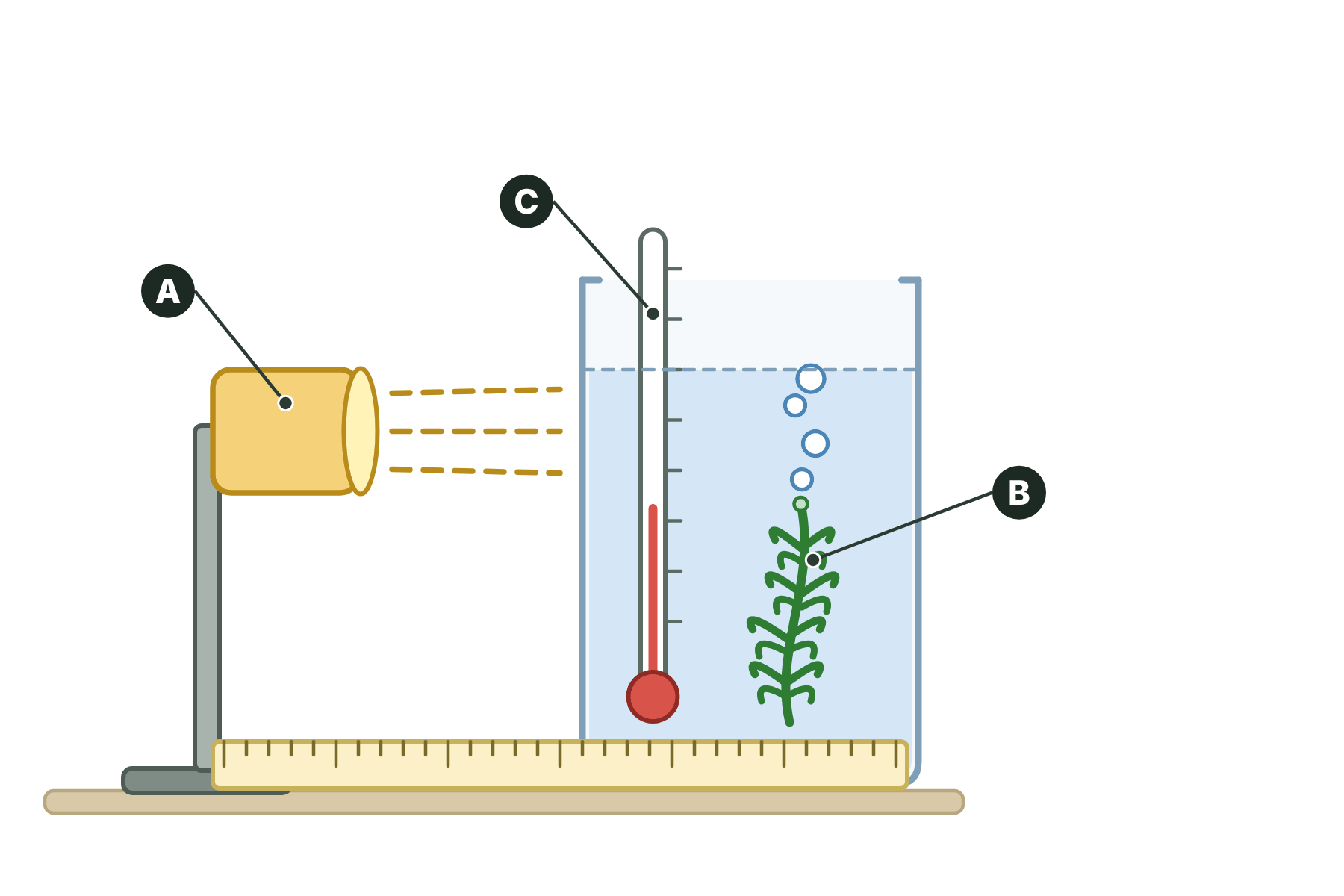
Figure 1 shows the apparatus used to investigate photosynthesis. Name the parts labelled A, B and C.
Show answerHide answer
Model answer
A is the lamp (light source). B is the pondweed. C is the thermometer.
Mark scheme
- A: lamp — 1 mark
- B: pondweed — 1 mark
- C: thermometer — 1 mark
-
3 Explain [2 marks]
Explain why sodium hydrogencarbonate is added to the water in the investigation.
Show answerHide answer
Model answer
It provides carbon dioxide, which is a reactant in photosynthesis. This stops carbon dioxide being the limiting factor, so only light intensity affects the rate.
Mark scheme
- Provides carbon dioxide — 1 mark
- So that carbon dioxide is not limiting — 1 mark
-
4 Calculate [3 marks]
A student counts 24, 27 and 21 bubbles per minute at a distance of 15 cm. Calculate the mean number of bubbles per minute.
Show answerHide answer
Model answer
(24 + 27 + 21) ÷ 3 = 72 ÷ 3 = 24 bubbles per minute.
Mark scheme
- Adds the three values to give 72 — 1 mark
- Divides by 3 — 1 mark
- 24 bubbles per minute — 1 mark
-
5 Describe [3 marks]
Describe how the results will change as the lamp is moved further from the pondweed, and explain the change.
Show answerHide answer
Model answer
The number of bubbles per minute will decrease. The light intensity falls as the lamp moves away. Light is the limiting factor, so there is less energy for photosynthesis and the rate decreases.
Mark scheme
- Fewer bubbles per minute — 1 mark
- Light intensity decreases — 1 mark
- Less energy for photosynthesis — 1 mark
-
6 Suggest [3 marks]
Suggest why a student's results are more reliable if they use a gas syringe to collect the oxygen rather than counting the bubbles.
Show answerHide answer
Model answer
The bubbles may be different sizes, so counting them is not an accurate measure of the amount of gas. A gas syringe measures the volume of the oxygen directly, so the results are more accurate and so more reliable.
Mark scheme
- Bubbles different sizes — 1 mark
- Syringe measures volume directly — 1 mark
- More accurate results — 1 mark
-
7 Calculate [3 marks]
A lamp is moved from 20 cm to 60 cm from a plant. Use the inverse square law to calculate how many times smaller the light intensity becomes.
Show answerHide answer
Model answer
The distance is multiplied by 3. The light intensity is proportional to 1 ÷ d², so it changes by a factor of 1 ÷ 3² = 1 ÷ 9. The light intensity is nine times smaller.
Mark scheme
- Distance multiplied by 3 — 1 mark
- Uses 1 ÷ d² (squares 3) — 1 mark
- Nine times smaller — 1 mark
Quick check
-
1
What are the bubbles that rise from pondweed?
Show answerHide answer
C: Oxygen
Pondweed releases oxygen as a product of photosynthesis.
-
2
What is the independent variable when the lamp is moved?
Show answerHide answer
A: The distance of the lamp
The distance of the lamp from the pondweed is changed.
-
3
Why is a heat shield placed between the lamp and the beaker?
Show answerHide answer
B: To stop the temperature changing
It stops the temperature of the water changing, which would also affect the rate.
-
4
What does the number of bubbles per minute measure?
Show answerHide answer
D: The rate of photosynthesis
The rate of bubble release shows the rate of photosynthesis.
-
5
What happens to the rate as the lamp is moved further away?
Show answerHide answer
A: It decreases
Light intensity falls, so the rate of photosynthesis falls.
-
6
What is the mean of 10, 14 and 12?
Show answerHide answer
C: 12
(10 + 14 + 12) ÷ 3 = 36 ÷ 3 = 12.
-
7
(Higher tier) What happens to light intensity when the distance from the lamp is doubled?
Show answerHide answer
B: It falls to one quarter
By the inverse square law, the light intensity falls to one quarter.
-
8
(Higher tier) Light intensity is proportional to which of these?
Show answerHide answer
D: 1 ÷ d²
Light intensity is proportional to 1 divided by the square of the distance.