Exam questions · Biology · Photosynthesis
Investigating Light Intensity and Photosynthesis
- 7 exam questions
- 18 marks
- 8 quick checks
-
1 State [1 mark]
State the gas that is collected from the pondweed.
Show answerHide answer
Model answer
Oxygen.
Mark scheme
- Oxygen — 1 mark
-
2 Name [3 marks]
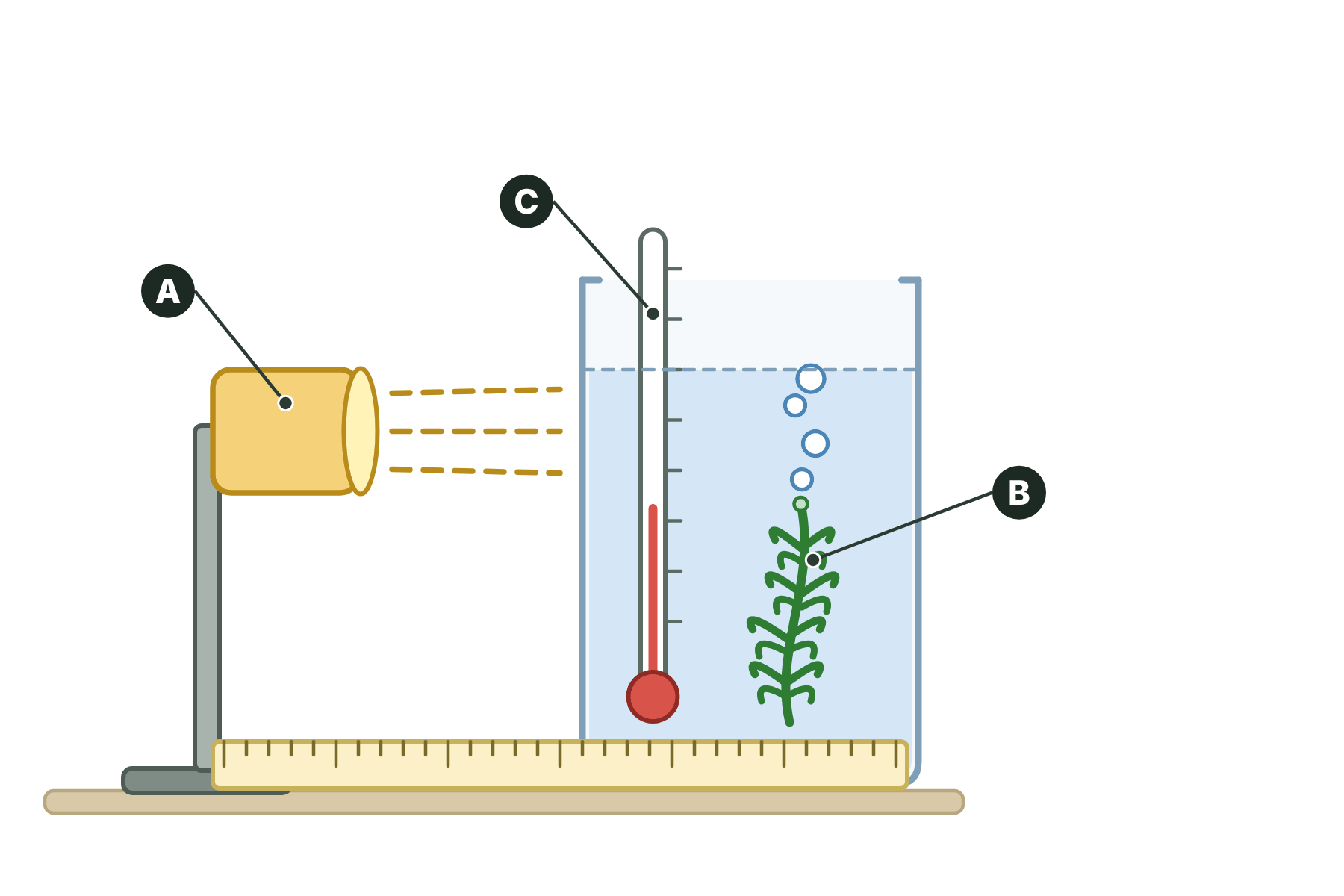
Figure 1 shows the apparatus used to investigate photosynthesis. Name the parts labelled A, B and C.
Show answerHide answer
Model answer
A is the lamp (light source). B is the pondweed. C is the thermometer.
Mark scheme
- A: lamp — 1 mark
- B: pondweed — 1 mark
- C: thermometer — 1 mark
-
3 Explain [2 marks]
Explain why sodium hydrogencarbonate is added to the water in the investigation.
Show answerHide answer
Model answer
It provides carbon dioxide, which is a reactant in photosynthesis. This stops carbon dioxide being the limiting factor, so only light intensity affects the rate.
Mark scheme
- Provides carbon dioxide — 1 mark
- So that carbon dioxide is not limiting — 1 mark
-
4 Calculate [3 marks]
A student counts 24, 27 and 21 bubbles per minute at a distance of 15 cm. Calculate the mean number of bubbles per minute.
Show answerHide answer
Model answer
(24 + 27 + 21) ÷ 3 = 72 ÷ 3 = 24 bubbles per minute.
Mark scheme
- Adds the three values to give 72 — 1 mark
- Divides by 3 — 1 mark
- 24 bubbles per minute — 1 mark
-
5 Describe [3 marks]
Describe how the results will change as the lamp is moved further from the pondweed, and explain the change.
Show answerHide answer
Model answer
The number of bubbles per minute will decrease. The light intensity falls as the lamp moves away. Light is the limiting factor, so there is less energy for photosynthesis and the rate decreases.
Mark scheme
- Fewer bubbles per minute — 1 mark
- Light intensity decreases — 1 mark
- Less energy for photosynthesis — 1 mark
-
6 Suggest [3 marks]
Suggest why a student's results are more reliable if they use a gas syringe to collect the oxygen rather than counting the bubbles.
Show answerHide answer
Model answer
The bubbles may be different sizes, so counting them is not an accurate measure of the amount of gas. A gas syringe measures the volume of the oxygen directly, so the results are more accurate and so more reliable.
Mark scheme
- Bubbles different sizes — 1 mark
- Syringe measures volume directly — 1 mark
- More accurate results — 1 mark
-
7 Calculate [3 marks]
A lamp is moved from 20 cm to 60 cm from a plant. Use the inverse square law to calculate how many times smaller the light intensity becomes.
Show answerHide answer
Model answer
The distance is multiplied by 3. The light intensity is proportional to 1 ÷ d², so it changes by a factor of 1 ÷ 3² = 1 ÷ 9. The light intensity is nine times smaller.
Mark scheme
- Distance multiplied by 3 — 1 mark
- Uses 1 ÷ d² (squares 3) — 1 mark
- Nine times smaller — 1 mark
Quick check
-
1
What are the bubbles that rise from pondweed?
Show answerHide answer
C: Oxygen
Pondweed releases oxygen as a product of photosynthesis.
-
2
What is the independent variable when the lamp is moved?
Show answerHide answer
A: The distance of the lamp
The distance of the lamp from the pondweed is changed.
-
3
Why is a heat shield placed between the lamp and the beaker?
Show answerHide answer
B: To stop the temperature changing
It stops the temperature of the water changing, which would also affect the rate.
-
4
What does the number of bubbles per minute measure?
Show answerHide answer
D: The rate of photosynthesis
The rate of bubble release shows the rate of photosynthesis.
-
5
What happens to the rate as the lamp is moved further away?
Show answerHide answer
A: It decreases
Light intensity falls, so the rate of photosynthesis falls.
-
6
What is the mean of 10, 14 and 12?
Show answerHide answer
C: 12
(10 + 14 + 12) ÷ 3 = 36 ÷ 3 = 12.
-
7
(Higher tier) What happens to light intensity when the distance from the lamp is doubled?
Show answerHide answer
B: It falls to one quarter
By the inverse square law, the light intensity falls to one quarter.
-
8
(Higher tier) Light intensity is proportional to which of these?
Show answerHide answer
D: 1 ÷ d²
Light intensity is proportional to 1 divided by the square of the distance.