Exam questions · Biology · Digestion and Enzymes
Food Tests
- 10 exam questions
- 28 marks
- 10 quick checks
-
1 Name [1 mark]
Name the reagent used to test for starch.
Show answerHide answer
Model answer
Iodine solution.
Mark scheme
- Iodine (solution) — 1 mark
-
2 State [2 marks]
State the colour change that shows that starch is present in a food sample.
Show answerHide answer
Model answer
Orange-brown to blue-black.
Mark scheme
- Starts orange-brown / yellow-brown — 1 mark
- Changes to blue-black — 1 mark
-
3 Interpret [4 marks]
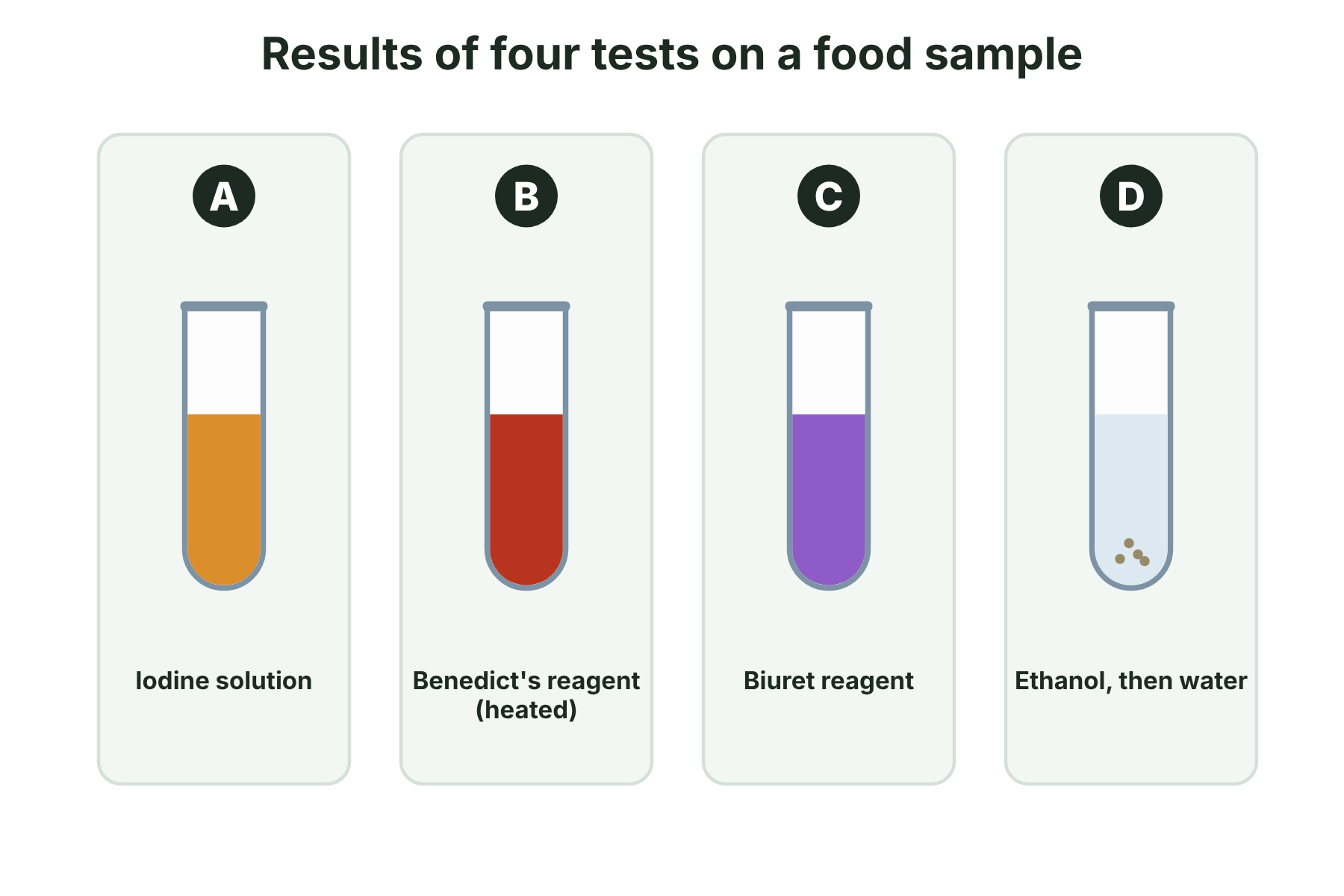
Figure 1 shows four tests on a sample of food. Tube A contains iodine solution, tube B contains Benedict's reagent after heating, tube C contains Biuret reagent, and in tube D the food was shaken with ethanol and poured into water. Use Figure 1 to say whether the sample contains starch, sugar, protein and lipid.
Show answerHide answer
Model answer
Starch is not present, because the iodine stayed orange-brown. Sugar is present, because Benedict's turned brick red. Protein is present, because Biuret turned purple. Lipid is not present, because the liquid stayed clear.
Mark scheme
- Starch absent: iodine stayed orange-brown — 1 mark
- Sugar present: Benedict's brick red — 1 mark
- Protein present: Biuret purple — 1 mark
- Lipid absent: no cloudy emulsion — 1 mark
-
4 Describe [3 marks]
Describe how you would test a food sample for sugar.
Show answerHide answer
Model answer
Add Benedict's reagent to the sample and heat it in a water bath. If sugar is present, the blue colour changes to green, yellow, orange or brick red.
Mark scheme
- Add Benedict's reagent — 1 mark
- Heat in a (hot) water bath — 1 mark
- Blue changes to green / yellow / orange / brick red if sugar is present — 1 mark
-
5 Suggest [2 marks]
A student heats a test tube containing Benedict's reagent in a hot water bath, and not in a Bunsen burner flame. Suggest two reasons for this.
Show answerHide answer
Model answer
The liquid cannot boil over or spit out of the tube, so there is less risk of burns. The temperature is more even and easier to control.
Mark scheme
- Less risk of the liquid boiling over / spitting / burns — 1 mark
- More even / controlled temperature — 1 mark
-
6 Describe [3 marks]
Describe how you would test a food for lipids, and what you would see if the result is positive.
Show answerHide answer
Model answer
Shake the food with ethanol and pour the liquid into a test tube of water. If lipid is present, a cloudy white emulsion forms.
Mark scheme
- Shake the food with ethanol — 1 mark
- Pour into water — 1 mark
- A cloudy white emulsion forms if lipid is present — 1 mark
-
7 Explain [2 marks]
A student also tests some distilled water with iodine solution. Explain why.
Show answerHide answer
Model answer
Distilled water contains no starch, so it acts as a control. It shows what a negative result looks like, so the student can tell that a colour change in the food sample is a real result.
Mark scheme
- It is a control / shows a negative result — 1 mark
- To compare with the food sample / so a colour change can be recognised — 1 mark
-
8 Interpret [3 marks]
Food X gave these results: the iodine solution turned blue-black, Benedict's reagent stayed blue after heating, Biuret reagent stayed blue, and the emulsion test stayed clear. Say what food X contains and does not contain.
Show answerHide answer
Model answer
Food X contains starch. It does not contain sugar, protein or lipid.
Mark scheme
- Contains starch — 1 mark
- No sugar (Benedict's stayed blue) — 1 mark
- No protein (Biuret stayed blue) and no lipid (stayed clear) — 1 mark
-
9 Describe [2 marks]
Describe two safety precautions that should be taken when doing the food tests.
Show answerHide answer
Model answer
Wear eye protection (goggles). Use a hot water bath instead of a flame, and keep the ethanol away from flames.
Mark scheme
- Wear goggles / eye protection — 1 mark
- Use a water bath / keep ethanol away from flames / hold hot tubes with a holder — 1 mark
-
10 Describe [6 marks]
A student has three foods, P, Q and R. Describe how the student could use Benedict's reagent to find out which food contains the most sugar.
Show answerHide answer
Model answer
Prepare a solution of each food in the same way. Put the same volume of each sample in a test tube and add the same volume of Benedict's reagent. Heat all the tubes in the same hot water bath for the same length of time. Compare the colours. The food that goes closest to brick red contains the most sugar. Test distilled water as a control and repeat to check the results.
Mark scheme
- Prepare a solution of each food in the same way — 1 mark
- Same volume of each sample and of Benedict's reagent — 1 mark
- Heat in a water bath for the same time and temperature — 1 mark
- Compare the colours — 1 mark
- Closest to brick red = most sugar — 1 mark
- Control with distilled water / repeat the test — 1 mark
Quick check
-
1
Which reagent turns purple when protein is present?
Show answerHide answer
C: Biuret reagent
Biuret reagent changes from blue to purple when protein is present.
-
2
A food is tested with iodine solution and the solution turns blue-black. What does the food contain?
Show answerHide answer
A: Starch
Iodine turns blue-black when starch is present.
-
3
What must be done after adding Benedict's reagent to a sample?
Show answerHide answer
D: Heat it in a water bath
The mixture must be heated in a water bath. Without heating, the colour change will not happen.
-
4
In Benedict's test, a sample turns brick red. What does this show?
Show answerHide answer
B: There is a large amount of sugar
Brick red is the last colour in the series from blue, and it shows a large amount of sugar.
-
5
What is the positive result for the emulsion test for lipids?
Show answerHide answer
C: A cloudy white emulsion
If lipid is present, the ethanol mixture forms a cloudy white emulsion when it is poured into water.
-
6
Why is the lipid test done with ethanol?
Show answerHide answer
A: Lipids dissolve in ethanol
Lipids dissolve in ethanol, but not in water, so the ethanol carries them into solution.
-
7
Why should a student use a water bath instead of a flame to heat Benedict's reagent?
Show answerHide answer
D: The liquid is less likely to boil over
The liquid is less likely to boil over, and the temperature is more even and safer.
-
8
A food gives no colour change with any of the four tests. What can you conclude?
Show answerHide answer
B: It contains none of the four groups tested for
All four tests were negative, so the food contains none of starch, sugar, protein or lipid.
-
9
Why is it useful to test a food that you know contains starch with iodine solution?
Show answerHide answer
A: It shows what a positive result looks like
It is a positive control, which shows what a positive result looks like for comparison.
-
10
These tests are qualitative. What does this mean?
Show answerHide answer
C: They show whether a substance is present, not exactly how much
Qualitative tests show whether a substance is present, but they do not measure exactly how much there is.