Exam questions · Biology · Transport in Cells
Surface Area to Volume Ratio and Exchange Surfaces
- 10 exam questions
- 31 marks
- 10 quick checks
-
1 Name [1 mark]
Name the tiny air sacs in the lungs where gas exchange takes place.
Show answerHide answer
Model answer
Alveoli.
Mark scheme
- Alveoli — 1 mark
-
2 Calculate [3 marks]
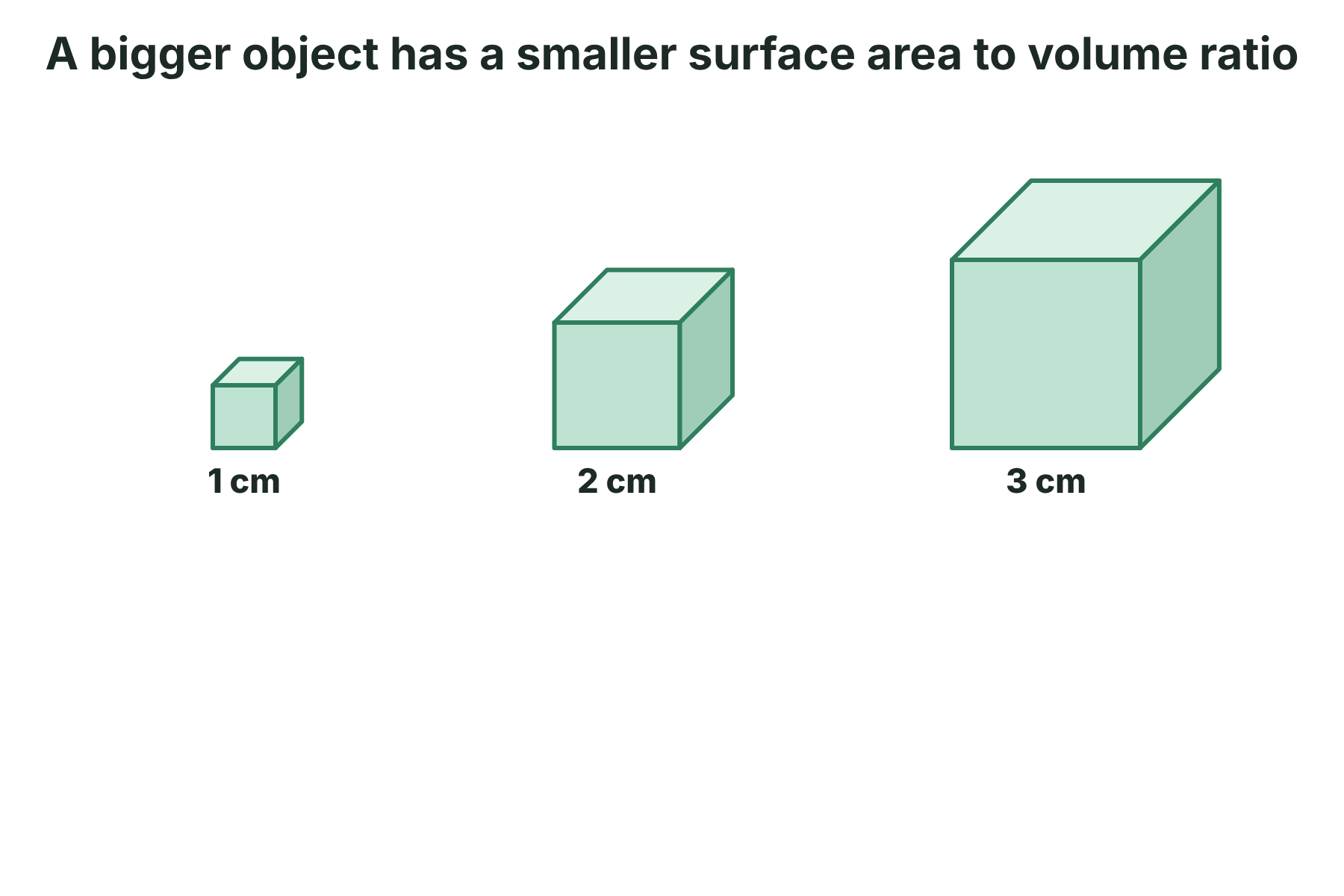
Figure 1 shows three cubes. Calculate the surface area to volume ratio of the cube with 2 cm sides. Show your working.
Show answerHide answer
Model answer
Surface area = 6 × 2 × 2 = 24 cm². Volume = 2 × 2 × 2 = 8 cm³. Ratio = 24 ÷ 8 = 3, so 3 : 1.
Mark scheme
- Surface area = 24 cm² — 1 mark
- Volume = 8 cm³ — 1 mark
- 24 ÷ 8 = 3 : 1 — 1 mark
-
3 Explain [2 marks]
Explain why a single-celled organism can get all the oxygen it needs by diffusion across its cell membrane.
Show answerHide answer
Model answer
A single-celled organism has a large surface area to volume ratio. So oxygen can diffuse across the membrane fast enough to meet the needs of the whole cell.
Mark scheme
- Large surface area to volume ratio — 1 mark
- So enough oxygen can diffuse in to meet the needs of the cell — 1 mark
-
4 Explain [3 marks]
Explain why a large multicellular organism needs exchange surfaces and a transport system.
Show answerHide answer
Model answer
A large organism has a small surface area to volume ratio. So diffusion across its outer surface would be too slow to supply the cells in the middle. Exchange surfaces increase the area for exchange, and a transport system carries substances to and from every cell.
Mark scheme
- Small surface area to volume ratio — 1 mark
- Diffusion from the outside is too slow for cells in the middle — 1 mark
- Exchange surface and transport system get substances to all cells — 1 mark
-
5 State [4 marks]
State four features that make an exchange surface effective.
Show answerHide answer
Model answer
A large surface area; a thin membrane (short diffusion path); (in animals) an efficient blood supply; (in animals, for gas exchange) being ventilated.
Mark scheme
- Large surface area — 1 mark
- Thin membrane / short diffusion path — 1 mark
- Efficient blood supply — 1 mark
- Ventilation — 1 mark
-
6 Describe [3 marks]
Describe how the villi in the small intestine are adapted for absorbing digested food.
Show answerHide answer
Model answer
Villi give the small intestine a large surface area. Each has a wall that is one cell thick, giving a short diffusion path. Each has a network of capillaries, which carries absorbed food away and keeps the concentration gradient steep.
Mark scheme
- Large surface area — 1 mark
- Thin wall / short diffusion path — 1 mark
- Good blood supply (capillaries) — 1 mark
-
7 Describe [3 marks]
Describe how the gills of a fish are adapted for gas exchange.
Show answerHide answer
Model answer
The gills are made of many thin filaments, which give a large surface area and a short diffusion path. They have a good blood supply. Water flows over them all the time, which ventilates them and keeps the gradient steep.
Mark scheme
- Many filaments give a large surface area — 1 mark
- Thin surface and a good blood supply — 1 mark
- Water flowing over them (ventilation) — 1 mark
-
8 Describe [3 marks]
Describe how a leaf is adapted for the exchange of gases.
Show answerHide answer
Model answer
The leaf is flat, which gives a large surface area, and thin, which gives a short diffusion path. It has stomata in the surface and air spaces inside, so carbon dioxide can diffuse in and oxygen can diffuse out.
Mark scheme
- Flat, with a large surface area — 1 mark
- Thin, with a short diffusion path — 1 mark
- Stomata and air spaces — 1 mark
-
9 Calculate [3 marks]
A block of tissue measures 1 cm by 2 cm by 3 cm. Calculate its surface area to volume ratio, in the form x : 1.
Show answerHide answer
Model answer
Surface area = 2 × (1×2 + 1×3 + 2×3) = 2 × 11 = 22 cm². Volume = 1 × 2 × 3 = 6 cm³. Ratio = 22 ÷ 6 = 3.7, so 3.7 : 1.
Mark scheme
- Surface area = 22 cm² — 1 mark
- Volume = 6 cm³ — 1 mark
- 22 ÷ 6 = 3.7 : 1 — 1 mark
-
10 Explain [6 marks]
Use ideas about surface area to volume ratio to explain why a single-celled organism does not need an exchange organ, but a large animal does.
Show answerHide answer
Model answer
A single-celled organism has a large surface area to volume ratio. Every part of the cell is close to the surface, so oxygen and food can diffuse in, and waste can diffuse out, fast enough to meet its needs. A large animal has a much smaller surface area to volume ratio. The cells in the middle are a long way from the surface, so diffusion across the outside would be too slow. It therefore has exchange organs such as lungs, which have a large surface area, thin walls and a good blood supply, and a transport system, the blood, to carry oxygen to the cells.
Mark scheme
- Single cell: large surface area to volume ratio — 1 mark
- So diffusion across its surface is fast enough — 1 mark
- Large animal: small surface area to volume ratio — 1 mark
- Cells in the middle are too far from the surface for diffusion alone — 1 mark
- Exchange surface with a large area, thin walls, blood supply — 1 mark
- Transport system carries substances to the cells — 1 mark
Quick check
-
1
What is the surface area of a cube with sides of 1 cm?
Show answerHide answer
B: 6 cm²
A cube has 6 faces, each 1 cm × 1 cm, so the surface area is 6 cm².
-
2
As an object gets bigger, what happens to its surface area to volume ratio?
Show answerHide answer
C: It decreases
Volume increases faster than surface area, so the ratio falls.
-
3
A cube has a surface area of 24 cm² and a volume of 8 cm³. What is its ratio?
Show answerHide answer
A: 3 : 1
24 ÷ 8 = 3, so the ratio is 3 : 1.
-
4
Why do large animals need a transport system?
Show answerHide answer
D: Diffusion alone is too slow to reach all their cells
They have a small surface area to volume ratio, so diffusion alone is too slow to supply all the cells. The blood carries substances around.
-
5
Which is NOT a feature of an effective exchange surface?
Show answerHide answer
C: A thick membrane
Exchange surfaces are thin, to give a short diffusion path. A thick membrane would slow diffusion down.
-
6
What are villi?
Show answerHide answer
B: Folds in the small intestine lining
Villi are finger-like folds in the lining of the small intestine that give a large surface area for absorption.
-
7
How are the gills of a fish ventilated?
Show answerHide answer
A: Water flows over them
Water flows over the gills all the time, which brings fresh oxygen and keeps the gradient steep.
-
8
Why do root hair cells have a long thin extension?
Show answerHide answer
D: To increase the surface area for taking up water and ions
The extension increases the surface area, so more water and mineral ions can be taken up from the soil.
-
9
Where does gas exchange take place in the lungs?
Show answerHide answer
B: In the alveoli
Oxygen and carbon dioxide are exchanged across the thin walls of the alveoli.
-
10
One cube has sides of 4 cm. Another has sides of 2 cm. Which statement is correct?
Show answerHide answer
C: The 2 cm cube has the larger ratio
The 2 cm cube has the larger ratio (3 : 1 compared with 1.5 : 1), because the smaller an object, the larger its surface area compared with its volume.