Flashcards · Biology · Transport in Cells
Surface Area to Volume Ratio and Exchange Surfaces
-
What is surface area to volume ratio?
The surface area of an object divided by its volume.
-
What happens to the ratio as an object gets bigger?
It gets smaller.
-
What is the surface area of a cube with 2 cm sides?
24 cm², because \(6 \times 2 \times 2\).
-
What is the volume of a cube with 3 cm sides?
27 cm³, because \(3 \times 3 \times 3\).
-
What is the surface area to volume ratio of a 3 cm cube?
2 : 1, from 54 ÷ 27.
-
Why can a single-celled organism exchange materials by diffusion across its surface?
It has a large surface area to volume ratio, so substances reach the whole cell fast enough.
-
Why can't a large organism rely on diffusion across its outer surface?
Its surface area to volume ratio is small, so substances would take too long to reach the cells in the middle.
-
What two things do large organisms have to solve this problem?
Exchange surfaces and a transport system.
-
Name the four features of an effective exchange surface.
A large surface area, a thin membrane, an efficient blood supply (animals) and ventilation (animals, for gas exchange).
-
Why does a thin membrane help?
It gives a short diffusion path.
-
Why does a good blood supply help?
It carries substances away, keeping the concentration gradient steep.
-
Why does ventilation help?
It keeps the concentration of the gas high on the outside, keeping the gradient steep.
-
What are villi?
Finger-like folds in the lining of the small intestine that give a large surface area.
-
What are alveoli?
The tiny air sacs in the lungs where oxygen and carbon dioxide are exchanged.
-
How are the lungs ventilated?
By breathing.
-
How are the gills of a fish ventilated?
Water flows over them all the time.
-
How are root hair cells adapted?
They have a long thin extension, which gives a large surface area.
-
How are leaves adapted for gas exchange?
They are flat and thin, with air spaces inside and stomata in the surface.
-
What are stomata?
Tiny pores in the leaf surface that let carbon dioxide in and oxygen out.
-
Which exchange surfaces are not supplied with blood?
Those of plants: the roots and the leaves.
-
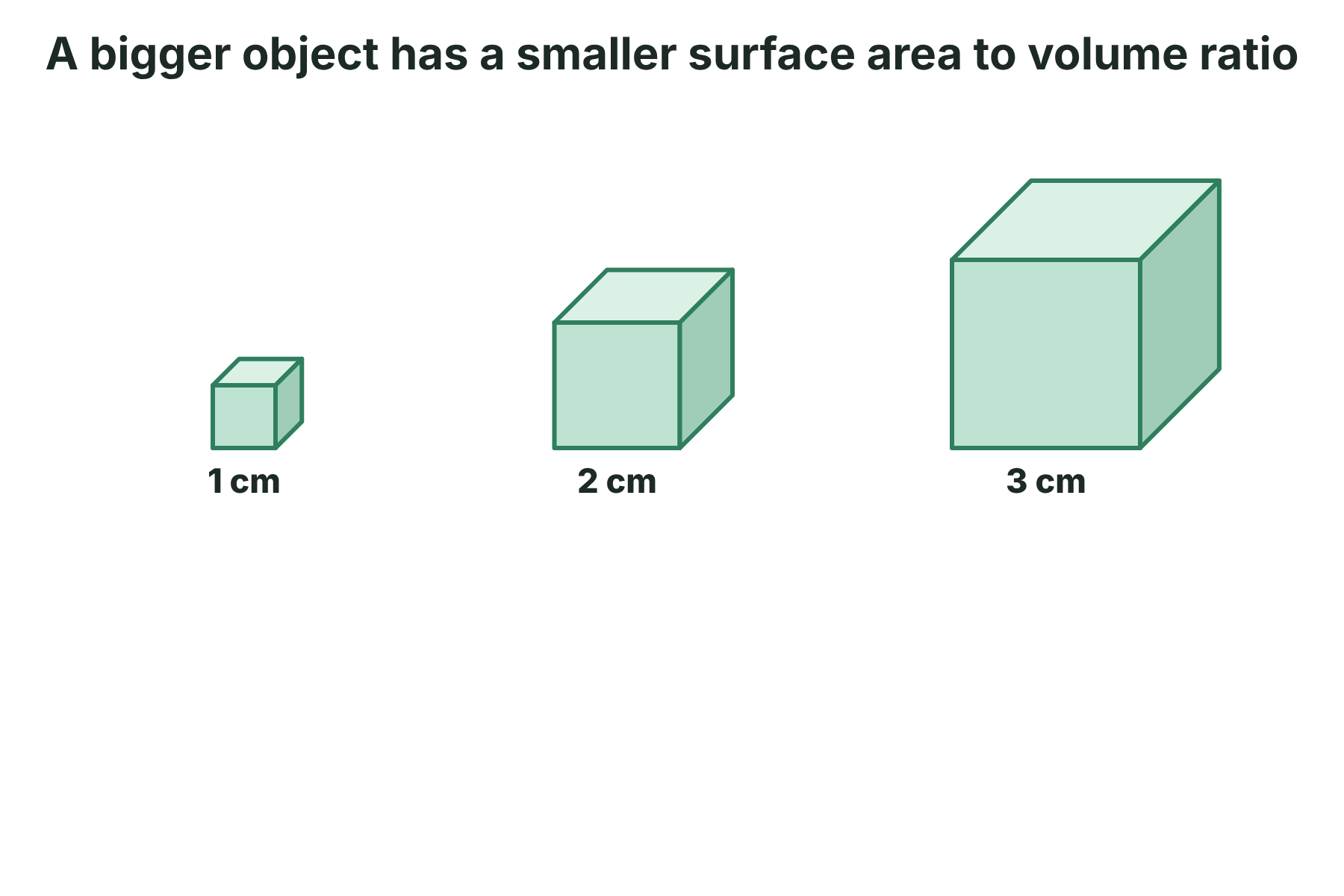 Work out the surface area to volume ratio of each cube.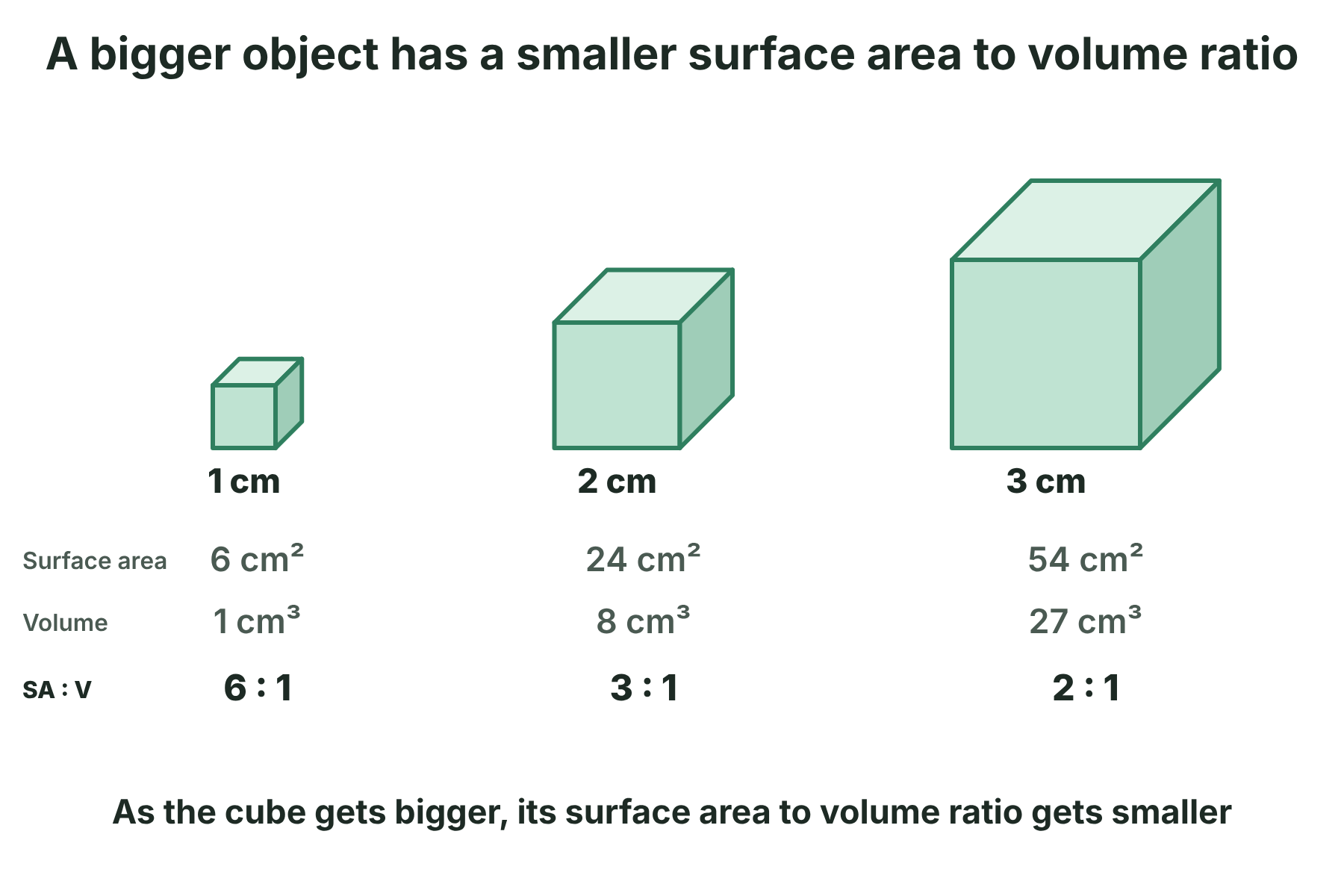
1 cm: 6 cm² ÷ 1 cm³ = 6 : 1. 2 cm: 24 ÷ 8 = 3 : 1. 3 cm: 54 ÷ 27 = 2 : 1. The bigger the cube, the smaller the ratio.
-
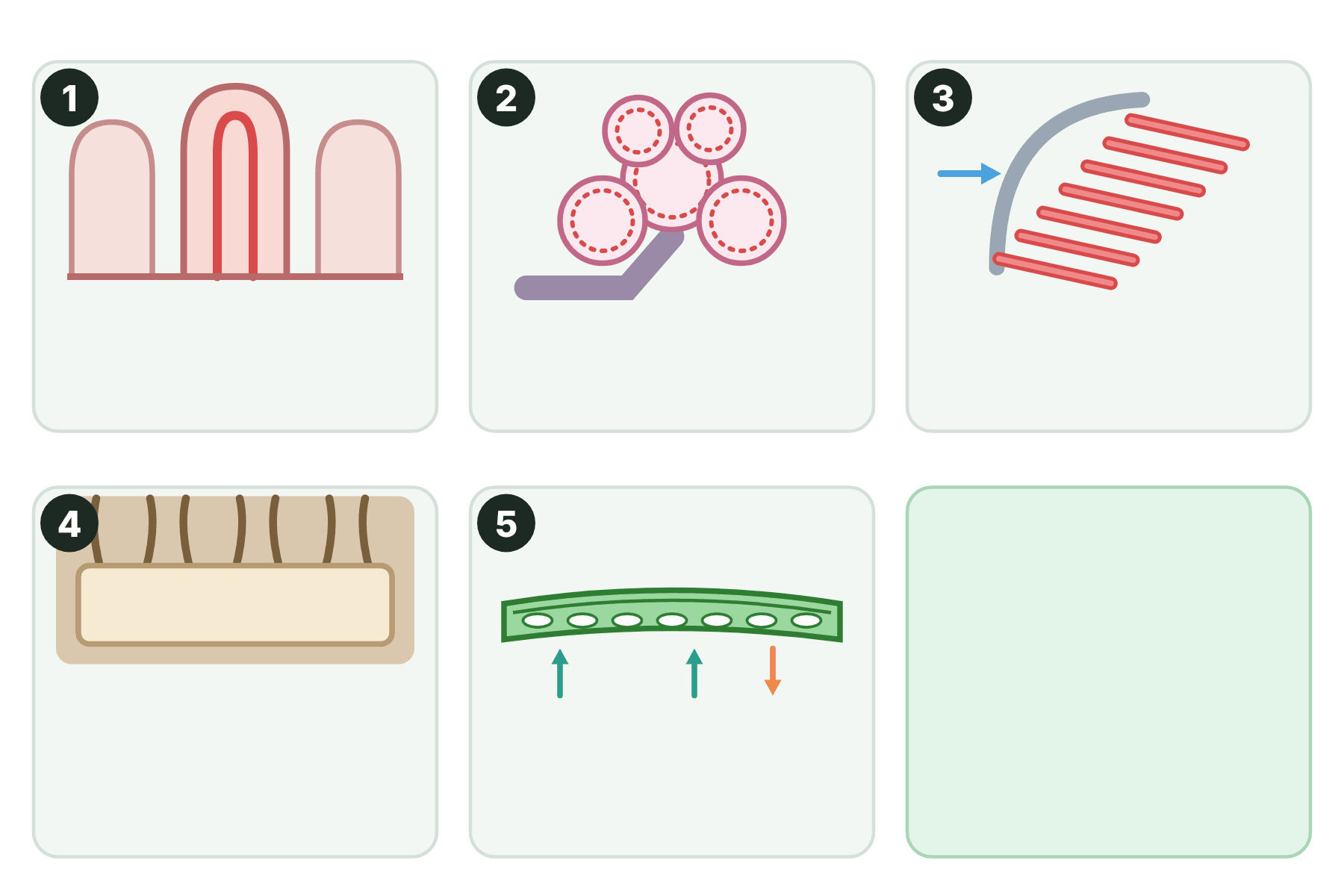 Describe how each of these exchange surfaces is adapted.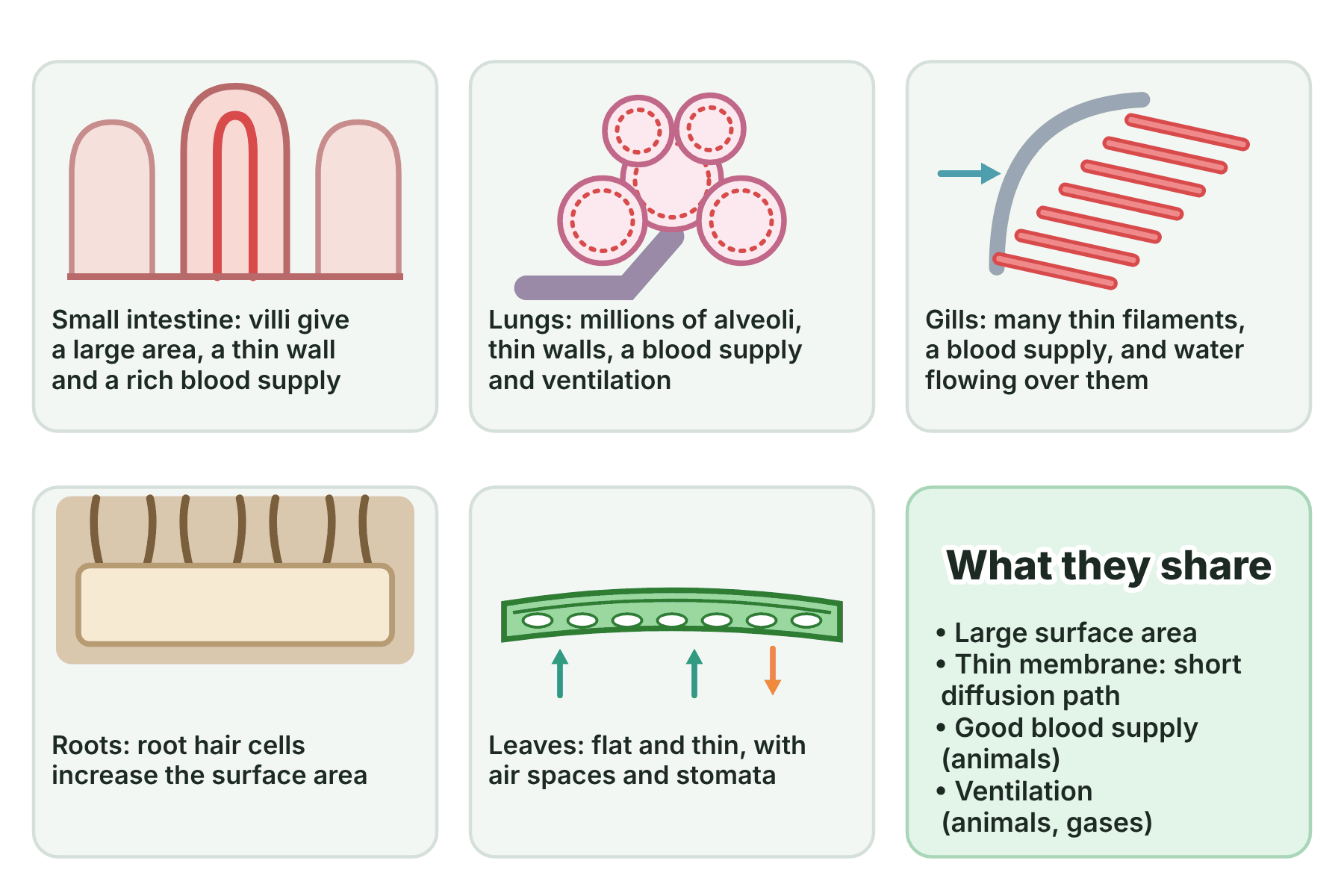
-
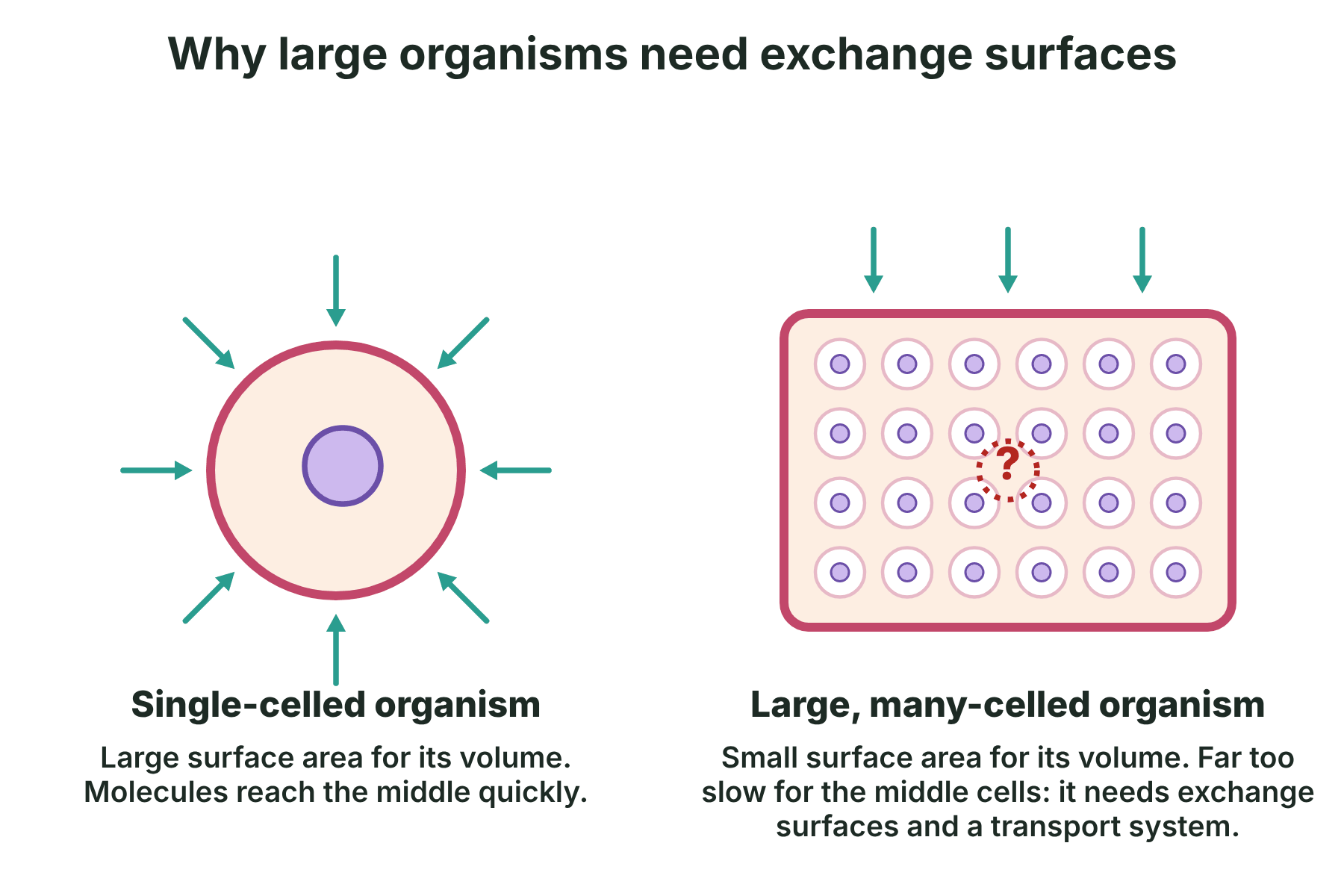 Why do the middle cells of a large organism need an exchange surface and a transport system?
 Its surface area to volume ratio is small, so diffusion from the outside would be too slow to reach them. Exchange surfaces and a transport system get substances to every cell.