Exam questions · Maths
Geometry and Measures
- 31 exam questions
- 99 marks
- 45 quick checks
Angles in Parallel Lines and Polygons
Just this lesson-
1 Work out [2 marks]
Three angles of a quadrilateral are \(85^\circ\), \(100^\circ\) and \(70^\circ\). Work out the fourth angle.
Show answerHide answer
Model answer
The angles in a quadrilateral add up to \(360^\circ\). \(85 + 100 + 70 = 255\), and \(360 - 255 = 105^\circ\).
Mark scheme
- \(85 + 100 + 70 = 255\) — M1
- \(105^\circ\) — A1
-
2 Work out [3 marks]
In triangle \(PQR\), angle \(P = 48^\circ\) and angle \(Q\) is twice the size of angle \(R\). Work out the size of angle \(Q\).
Show answerHide answer
Model answer
Angles \(Q\) and \(R\) add up to \(180 - 48 = 132^\circ\). Let angle \(R = r\), so \(3r = 132\) and \(r = 44^\circ\). Angle \(Q = 2 \times 44 = 88^\circ\).
Mark scheme
- \(180 - 48 = 132\) — M1
- \(132 \div 3 = 44\) — M1
- \(88^\circ\) — A1
-
3 Work out [4 marks]
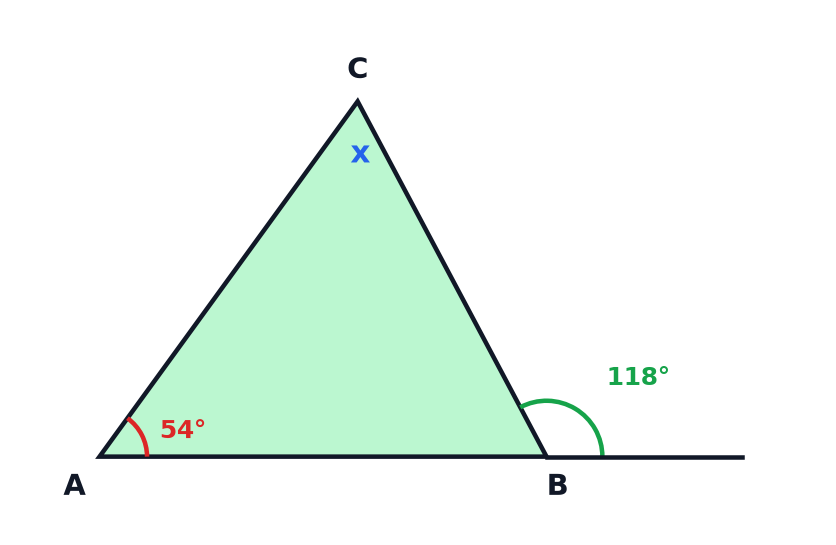
The diagram shows triangle \(ABC\). \(AB\) is extended to a point on a straight line. (a) Work out the size of angle \(x\). Give a reason for your answer. [3 marks] (b) Work out the size of angle \(ABC\). [1 mark]
Show answerHide answer
Model answer
(a) The exterior angle of a triangle equals the sum of the two interior opposite angles, so \(x = 118 - 54 = 64^\circ\). (b) Angles on a straight line add up to \(180^\circ\), so angle \(ABC = 180 - 118 = 62^\circ\).
Mark scheme
- (a) \(118 - 54\) — M1
- (a) \(64^\circ\) — A1
- (a) Exterior angle equals the sum of the two opposite interior angles — Q1
- (b) \(62^\circ\) — B1
-
4 Work out [3 marks]
Each interior angle of a regular polygon is \(150^\circ\). Work out the number of sides of the polygon.
Show answerHide answer
Model answer
The exterior angle is \(180 - 150 = 30^\circ\), and \(360 \div 30 = 12\) sides.
Mark scheme
- \(180 - 150 = 30\) — M1
- \(360 \div 30\) — M1
- 12 — A1
-
5 Work out [3 marks]
A regular hexagon and a square are joined along a common side. The shapes do not overlap. Work out the size of the angle at one end of the common side that is outside both shapes.
Show answerHide answer
Model answer
The interior angle of a regular hexagon is \(120^\circ\) and of a square is \(90^\circ\). Angles around a point add up to \(360^\circ\), so the angle is \(360 - 120 - 90 = 150^\circ\).
Mark scheme
- \(120^\circ\) or \(90^\circ\) found — M1
- \(360 - 120 - 90\) — M1
- \(150^\circ\) — A1
-
6 Work out [3 marks]
The interior angle of a regular polygon is 5 times the size of its exterior angle. Work out the number of sides of the polygon.
Show answerHide answer
Model answer
The interior and exterior angles add up to \(180^\circ\), so \(6 \times\) exterior \(= 180\) and the exterior angle is \(30^\circ\). Then \(360 \div 30 = 12\) sides.
Mark scheme
- Interior \(+\) exterior \(= 180\) — M1
- Exterior angle \(= 30^\circ\) — M1
- 12 — A1
Quick check
-
1
Three angles on a straight line are \(47^\circ\), \(68^\circ\) and \(x\). What is \(x\)?
Show answerHide answer
B: \(65^\circ\)
Angles on a straight line add up to \(180^\circ\). \(180 - 47 - 68 = 65\).
-
2
Three angles of a quadrilateral are \(80^\circ\), \(95^\circ\) and \(110^\circ\). What is the fourth angle?
Show answerHide answer
A: \(75^\circ\)
The angles of a quadrilateral add up to \(360^\circ\). \(80 + 95 + 110 = 285\) and \(360 - 285 = 75\).
-
3
Which type of angles are equal and form a Z shape between parallel lines?
Show answerHide answer
D: Alternate angles
Alternate angles are on opposite sides of the transversal, and make a Z shape.
-
4
Two co-interior angles lie between parallel lines. One is \(72^\circ\). What is the other?
Show answerHide answer
C: \(108^\circ\)
Co-interior angles add up to \(180^\circ\), so \(180 - 72 = 108\).
-
5
What is the sum of the interior angles of a hexagon?
Show answerHide answer
B: \(720^\circ\)
A hexagon has 6 sides, so the sum is \((6 - 2) \times 180 = 720\).
-
6
What is each exterior angle of a regular octagon?
Show answerHide answer
A: \(45^\circ\)
\(360 \div 8 = 45\). The interior angle is \(135^\circ\).
-
7
Each exterior angle of a regular polygon is \(24^\circ\). How many sides does it have?
Show answerHide answer
D: 15
\(360 \div 24 = 15\). The number 156 is the interior angle.
-
8
An exterior angle of a triangle is \(118^\circ\). One of the interior opposite angles is \(54^\circ\). What is the other interior opposite angle?
Show answerHide answer
C: \(64^\circ\)
The exterior angle equals the sum of the two interior opposite angles, so \(118 - 54 = 64\).
-
9
The angles of a triangle are \(x\), \(2x + 10\) and \(3x - 10\) degrees. What is the size of the largest angle?
Show answerHide answer
B: \(80^\circ\)
\(6x = 180\), so \(x = 30\). The angles are \(30^\circ\), \(70^\circ\) and \(80^\circ\).
Area, Perimeter and Circles
Just this lesson-
1 Work out [5 marks]
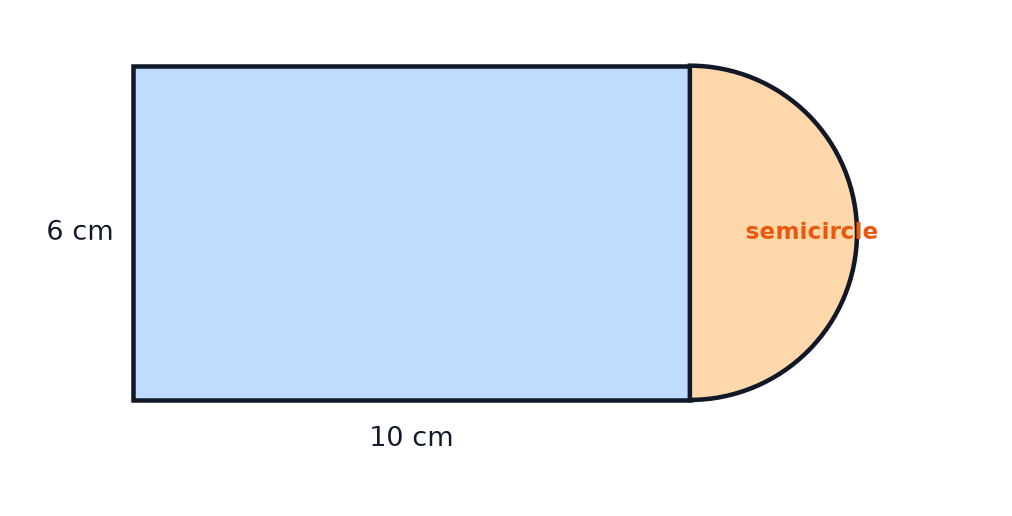
The diagram shows a rectangle with a semicircle attached to one side. Give your answers in terms of \(\pi\). (a) Work out the area of the shape. [3 marks] (b) Work out the perimeter of the shape. [2 marks]
Show answerHide answer
Model answer
(a) The rectangle has area \(10 \times 6 = 60\) cm\(^2\). The semicircle has radius 3 cm, so its area is \(\dfrac{1}{2} \times \pi \times 3^2 = 4.5\pi\) cm\(^2\). The total is \(60 + 4.5\pi\) cm\(^2\). (b) The curved edge is \(\dfrac{1}{2} \times \pi \times 6 = 3\pi\), and the straight edges are \(10 + 10 + 6 = 26\). The perimeter is \(26 + 3\pi\) cm.
Mark scheme
- (a) \(60\) found — M1
- (a) \(\dfrac{1}{2} \times \pi \times 3^2\) or \(4.5\pi\) — M1
- (a) \(60 + 4.5\pi\) — A1
- (b) \(3\pi\) or \(26\) found — M1
- (b) \(26 + 3\pi\) — A1
-
2 Work out [2 marks]
A parallelogram has a base of 12 cm, a slanted side of 8 cm and a perpendicular height of 7 cm. Work out the area of the parallelogram.
Show answerHide answer
Model answer
Area \(=\) base \(\times\) perpendicular height \(= 12 \times 7 = 84\) cm\(^2\). The slanted side is not needed.
Mark scheme
- \(12 \times 7\) — M1
- 84 cm\(^2\) — A1
-
3 Work out [4 marks]
A rectangle is 14 cm by 9 cm. A smaller rectangle measuring 6 cm by 4 cm is cut out of one corner. (a) Work out the area of the shape that is left. [2 marks] (b) Show that the perimeter of the shape is 46 cm. [2 marks]
Show answerHide answer
Model answer
(a) \(14 \times 9 - 6 \times 4 = 126 - 24 = 102\) cm\(^2\). (b) Cutting a rectangle out of a corner does not change the perimeter, because the two new edges replace two edges of the same total length: \(2 \times (14 + 9) = 46\) cm.
Mark scheme
- (a) \(14 \times 9 - 6 \times 4\) — M1
- (a) 102 — A1
- (b) \(14 + 9 + 14 + 9\) or the shape's edges added — M1
- (b) 46 with a reason or full working — Q1
-
4 Work out [3 marks]
The circumference of a circle is \(20\pi\) cm. Work out the area of the circle. Give your answer in terms of \(\pi\).
Show answerHide answer
Model answer
\(2\pi r = 20\pi\), so \(r = 10\) cm. The area is \(\pi \times 10^2 = 100\pi\) cm\(^2\).
Mark scheme
- \(2\pi r = 20\pi\) or \(r = 10\) — M1
- \(\pi \times 10^2\) — M1
- \(100\pi\) cm\(^2\) — A1
-
5 Work out [3 marks]
A circular pond has a radius of 4 m. A path 1 m wide goes all the way round the pond. Work out the area of the path. Give your answer in terms of \(\pi\).
Show answerHide answer
Model answer
The pond and path together have radius 5 m, so their area is \(\pi \times 25 = 25\pi\). The pond has area \(\pi \times 16 = 16\pi\). The path is \(25\pi - 16\pi = 9\pi\) m\(^2\).
Mark scheme
- \(\pi \times 5^2\) or \(\pi \times 4^2\) — M1
- \(25\pi - 16\pi\) — M1
- \(9\pi\) m\(^2\) — A1
-
6 Work out [4 marks]
A sector of a circle has radius 10 cm and angle \(72^\circ\). Give your answers in terms of \(\pi\). (a) Work out the length of the arc. [2 marks] (b) Work out the perimeter of the sector. [2 marks]
Show answerHide answer
Model answer
(a) \(\dfrac{72}{360} = \dfrac{1}{5}\), and the circumference is \(2\pi \times 10 = 20\pi\), so the arc is \(4\pi\) cm. (b) The perimeter is the arc plus two radii: \(4\pi + 10 + 10 = 20 + 4\pi\) cm.
Mark scheme
- (a) \(\dfrac{72}{360} \times 20\pi\) — M1
- (a) \(4\pi\) — A1
- (b) \(4\pi + 10 + 10\) — M1
- (b) \(20 + 4\pi\) — A1
Quick check
-
1
A triangle has base 10 cm and perpendicular height 6 cm. What is its area?
Show answerHide answer
C: 30 cm\(^2\)
\(\dfrac{1}{2} \times 10 \times 6 = 30\) cm\(^2\).
-
2
A trapezium has parallel sides of 7 cm and 13 cm, and a height of 6 cm. What is its area?
Show answerHide answer
B: 60 cm\(^2\)
\(\dfrac{1}{2}(7 + 13) \times 6 = 60\). Forgetting the half gives 120.
-
3
A parallelogram has base 9 cm, slanted side 5 cm and perpendicular height 4 cm. What is its area?
Show answerHide answer
A: 36 cm\(^2\)
\(\text{base} \times \text{perpendicular height} = 9 \times 4 = 36\). The slanted side is not used.
-
4
A circle has radius 5 cm. What is its area, in terms of \(\pi\)?
Show answerHide answer
D: \(25\pi\) cm\(^2\)
\(\pi r^2 = \pi \times 25 = 25\pi\).
-
5
A circle has diameter 14 cm. What is its circumference, in terms of \(\pi\)?
Show answerHide answer
C: \(14\pi\) cm
\(C = \pi d = 14\pi\).
-
6
A circle has diameter 10 cm. What is its area, in terms of \(\pi\)?
Show answerHide answer
B: \(25\pi\) cm\(^2\)
The radius is \(10 \div 2 = 5\), so \(A = \pi \times 5^2 = 25\pi\). Using 10 as the radius gives \(100\pi\).
-
7
A rectangle measures 12 cm by 7 cm. A rectangle 5 cm by 3 cm is cut from one corner. What is the area of the remaining shape?
Show answerHide answer
A: 69 cm\(^2\)
\(12 \times 7 = 84\) and \(5 \times 3 = 15\), so \(84 - 15 = 69\).
-
8
A sector has radius 9 cm and angle \(80^\circ\). What is its area, in terms of \(\pi\)?
Show answerHide answer
D: \(18\pi\) cm\(^2\)
\(\dfrac{80}{360} \times \pi \times 81 = \dfrac{2}{9} \times 81\pi = 18\pi\).
-
9
A sector has radius 6 cm and angle \(60^\circ\). What is the length of its arc, in terms of \(\pi\)?
Show answerHide answer
C: \(2\pi\) cm
\(\dfrac{60}{360} \times 2 \times \pi \times 6 = \dfrac{1}{6} \times 12\pi = 2\pi\).
Volume and Surface Area
Just this lesson-
1 Work out [5 marks]
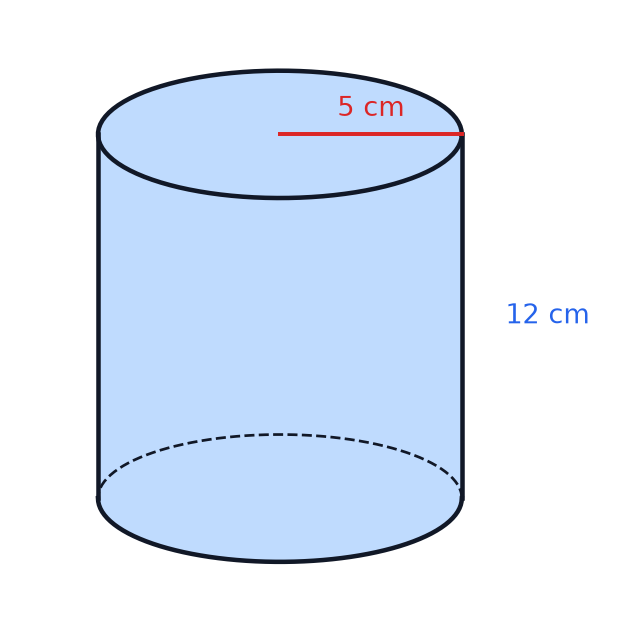
The diagram shows a cylinder. Give your answers in terms of \(\pi\). (a) Work out the volume of the cylinder. [2 marks] (b) Work out the total surface area of the cylinder. [3 marks]
Show answerHide answer
Model answer
(a) \(\pi \times 5^2 \times 12 = 300\pi\) cm\(^3\). (b) The curved surface is \(2 \times \pi \times 5 \times 12 = 120\pi\) and the two circles are \(2 \times \pi \times 5^2 = 50\pi\). The total is \(170\pi\) cm\(^2\).
Mark scheme
- (a) \(\pi \times 5^2 \times 12\) — M1
- (a) \(300\pi\) — A1
- (b) \(2\pi \times 5 \times 12\) or \(120\pi\) — M1
- (b) \(2 \times \pi \times 5^2\) or \(50\pi\) — M1
- (b) \(170\pi\) — A1
-
2 Work out [2 marks]
A cuboid measures 7 cm by 4 cm by 5 cm. Work out the volume of the cuboid.
Show answerHide answer
Model answer
\(7 \times 4 \times 5 = 140\) cm\(^3\).
Mark scheme
- \(7 \times 4 \times 5\) — M1
- 140 cm\(^3\) — A1
-
3 Work out [2 marks]
A prism has a cross-section of area 18 cm\(^2\) and a volume of 270 cm\(^3\). Work out the length of the prism.
Show answerHide answer
Model answer
Volume \(=\) area \(\times\) length, so the length is \(270 \div 18 = 15\) cm.
Mark scheme
- \(270 \div 18\) — M1
- 15 cm — A1
-
4 Work out [3 marks]
The total surface area of a cube is 150 cm\(^2\). Work out the volume of the cube.
Show answerHide answer
Model answer
A cube has 6 faces, so one face is \(150 \div 6 = 25\) cm\(^2\). The side is \(\sqrt{25} = 5\) cm and the volume is \(5^3 = 125\) cm\(^3\).
Mark scheme
- \(150 \div 6 = 25\) — M1
- Side \(= 5\) — M1
- 125 cm\(^3\) — A1
-
5 Work out [3 marks]
A solid metal cylinder has radius 2 cm and height 5 cm. The density of the metal is 8 g/cm\(^3\). Work out the mass of the cylinder. Give your answer in terms of \(\pi\).
Show answerHide answer
Model answer
The volume is \(\pi \times 2^2 \times 5 = 20\pi\) cm\(^3\). Mass \(=\) density \(\times\) volume \(= 8 \times 20\pi = 160\pi\) g.
Mark scheme
- \(\pi \times 2^2 \times 5\) or \(20\pi\) — M1
- \(8 \times 20\pi\) — M1
- \(160\pi\) g — A1
-
6 Work out [4 marks]
A cone has radius 9 cm and vertical height 12 cm. Give your answers in terms of \(\pi\). (a) Work out the volume of the cone. [2 marks] (b) The slant height of the cone is 15 cm. Work out the curved surface area of the cone. [2 marks]
Show answerHide answer
Model answer
(a) \(\dfrac{1}{3} \times \pi \times 9^2 \times 12 = \dfrac{1}{3} \times 972\pi = 324\pi\) cm\(^3\). (b) The curved surface area is \(\pi r l = \pi \times 9 \times 15 = 135\pi\) cm\(^2\).
Mark scheme
- (a) \(\dfrac{1}{3} \times \pi \times 9^2 \times 12\) — M1
- (a) \(324\pi\) — A1
- (b) \(\pi \times 9 \times 15\) — M1
- (b) \(135\pi\) — A1
Quick check
-
1
A cuboid measures 8 cm by 5 cm by 3 cm. What is its volume?
Show answerHide answer
D: 120 cm\(^3\)
\(8 \times 5 \times 3 = 120\) cm\(^3\).
-
2
The cross-section of a prism has area 12 cm\(^2\). The prism is 15 cm long. What is its volume?
Show answerHide answer
C: 180 cm\(^3\)
Volume \(=\) area of cross-section \(\times\) length \(= 12 \times 15 = 180\).
-
3
A cylinder has radius 3 cm and height 10 cm. What is its volume, in terms of \(\pi\)?
Show answerHide answer
B: \(90\pi\) cm\(^3\)
\(\pi r^2 h = \pi \times 9 \times 10 = 90\pi\).
-
4
A cylinder has radius 3 cm and height 10 cm. What is its curved surface area, in terms of \(\pi\)?
Show answerHide answer
A: \(60\pi\) cm\(^2\)
\(2\pi r h = 2 \times \pi \times 3 \times 10 = 60\pi\).
-
5
What is the total surface area of a cube with side 4 cm?
Show answerHide answer
D: 96 cm\(^2\)
A cube has 6 faces, each of area \(4 \times 4 = 16\). So \(6 \times 16 = 96\).
-
6
A tank holds 2500 cm\(^3\) of water. How many litres is this?
Show answerHide answer
C: 2.5 litres
\(1000\text{ cm}^3 = 1\) litre, so \(2500 \div 1000 = 2.5\).
-
7
A cylinder has radius 2 cm and height 7 cm. What is its volume, in terms of \(\pi\)?
Show answerHide answer
B: \(28\pi\) cm\(^3\)
\(\pi \times 2^2 \times 7 = 28\pi\). Using the diameter instead of the radius would give \(98\pi\).
-
8
A sphere has radius 3 cm. What is its volume, in terms of \(\pi\)?
Show answerHide answer
A: \(36\pi\) cm\(^3\)
\(\dfrac{4}{3}\pi r^3 = \dfrac{4}{3} \times \pi \times 27 = 36\pi\).
-
9
A cone has radius 3 cm and vertical height 4 cm. What is its volume, in terms of \(\pi\)?
Show answerHide answer
D: \(12\pi\) cm\(^3\)
\(\dfrac{1}{3}\pi r^2 h = \dfrac{1}{3} \times \pi \times 9 \times 4 = 12\pi\). Using the slant height 5 gives \(15\pi\), which is wrong.
Pythagoras' Theorem
Just this lesson-
1 Work out [4 marks]
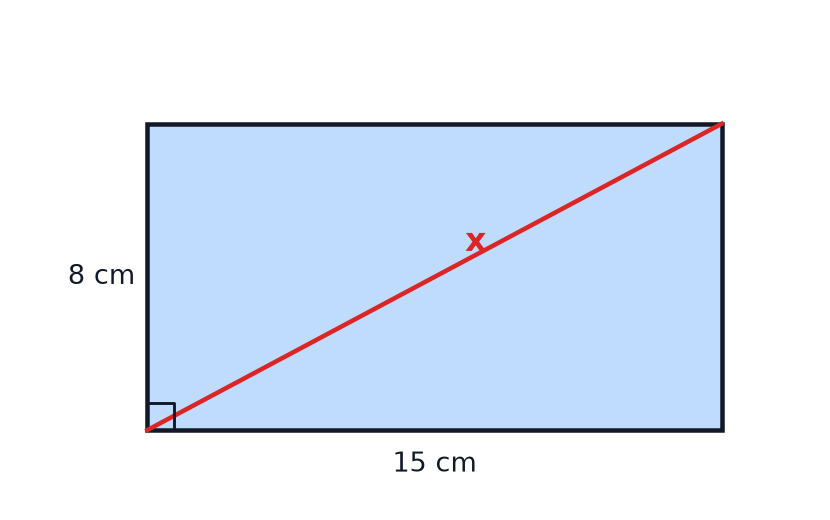
The diagram shows a rectangle. (a) Work out the length of the diagonal, \(x\). [3 marks] (b) Work out the area of the rectangle. [1 mark]
Show answerHide answer
Model answer
(a) \(x^2 = 15^2 + 8^2 = 225 + 64 = 289\), so \(x = 17\) cm. (b) \(15 \times 8 = 120\) cm\(^2\).
Mark scheme
- (a) \(15^2 + 8^2\) — M1
- (a) \(289\) — M1
- (a) 17 cm — A1
- (b) 120 cm\(^2\) — B1
-
2 Work out [3 marks]
A right-angled triangle has shorter sides of length 10 cm and 24 cm. Work out the length of the hypotenuse.
Show answerHide answer
Model answer
\(10^2 + 24^2 = 100 + 576 = 676\), and \(\sqrt{676} = 26\) cm.
Mark scheme
- \(10^2 + 24^2\) — M1
- 676 — M1
- 26 cm — A1
-
3 Work out [3 marks]
A right-angled triangle has a hypotenuse of 17 cm and one shorter side of 8 cm. Work out the length of the other shorter side.
Show answerHide answer
Model answer
\(17^2 - 8^2 = 289 - 64 = 225\), and \(\sqrt{225} = 15\) cm.
Mark scheme
- \(17^2 - 8^2\) — M1
- 225 — M1
- 15 cm — A1
-
4 Work out [3 marks]
A boat sails 12 km north and then 5 km east. Work out the distance of the boat from its starting point.
Show answerHide answer
Model answer
The path makes a right-angled triangle, so the distance is \(\sqrt{12^2 + 5^2} = \sqrt{144 + 25} = \sqrt{169} = 13\) km.
Mark scheme
- \(12^2 + 5^2\) — M1
- 169 — M1
- 13 km — A1
-
5 Work out [3 marks]
A triangle has sides of length 10 cm, 24 cm and 26 cm. Is the triangle right-angled? You must show your working.
Show answerHide answer
Model answer
\(10^2 + 24^2 = 100 + 576 = 676\) and \(26^2 = 676\). The squares match, so the triangle is right-angled.
Mark scheme
- \(10^2 + 24^2 = 676\) — M1
- \(26^2 = 676\) — M1
- Yes, with the two values compared — Q1
-
6 Work out [4 marks]
A cuboid measures 3 cm by 4 cm by 12 cm. Work out the length of the longest straight line that can be drawn inside the cuboid, from one corner to the opposite corner.
Show answerHide answer
Model answer
The diagonal of the 3 by 4 face is \(\sqrt{9 + 16} = 5\) cm. Then the space diagonal is \(\sqrt{5^2 + 12^2} = \sqrt{169} = 13\) cm.
Mark scheme
- \(3^2 + 4^2 = 25\) or 5 found — M1
- \(5^2 + 12^2\) or \(3^2 + 4^2 + 12^2\) — M1
- 169 — A1
- 13 cm — A1
Quick check
-
1
A right-angled triangle has shorter sides of 9 cm and 12 cm. What is the hypotenuse?
Show answerHide answer
A: 15 cm
\(9^2 + 12^2 = 81 + 144 = 225\), and \(\sqrt{225} = 15\).
-
2
A right-angled triangle has hypotenuse 13 cm and one shorter side 5 cm. What is the other shorter side?
Show answerHide answer
D: 12 cm
\(13^2 - 5^2 = 169 - 25 = 144\), and \(\sqrt{144} = 12\).
-
3
Which set of lengths makes a right-angled triangle?
Show answerHide answer
C: 6 cm, 8 cm, 10 cm
\(6^2 + 8^2 = 36 + 64 = 100 = 10^2\). The other sets do not satisfy \(a^2 + b^2 = c^2\).
-
4
Which side of a right-angled triangle is the hypotenuse?
Show answerHide answer
B: The longest side, opposite the right angle
The hypotenuse is always the longest side, and it is opposite the right angle.
-
5
A rectangle is 15 cm long and 8 cm wide. How long is its diagonal?
Show answerHide answer
A: 17 cm
\(15^2 + 8^2 = 225 + 64 = 289\), and \(\sqrt{289} = 17\).
-
6
A ladder 6.5 m long leans against a wall. Its foot is 2.5 m from the wall. How high up the wall does it reach?
Show answerHide answer
D: 6 m
\(6.5^2 - 2.5^2 = 42.25 - 6.25 = 36\), and \(\sqrt{36} = 6\).
-
7
An isosceles triangle has base 10 cm and equal sides of 13 cm. What is its height?
Show answerHide answer
C: 12 cm
The height splits the base into two lots of 5 cm. \(13^2 - 5^2 = 144\), so the height is 12 cm.
-
8
A right-angled triangle has shorter sides of 2 cm and 4 cm. What is the hypotenuse?
Show answerHide answer
B: \(2\sqrt{5}\) cm
\(2^2 + 4^2 = 20\), and \(\sqrt{20} = \sqrt{4 \times 5} = 2\sqrt{5}\).
-
9
What is the distance between the points \((1, 2)\) and \((7, 10)\)?
Show answerHide answer
A: 10
The horizontal difference is 6 and the vertical difference is 8, so the distance is \(\sqrt{6^2 + 8^2} = \sqrt{100} = 10\).
Trigonometry in Right-Angled Triangles
Just this lesson-
1 Work out [4 marks]
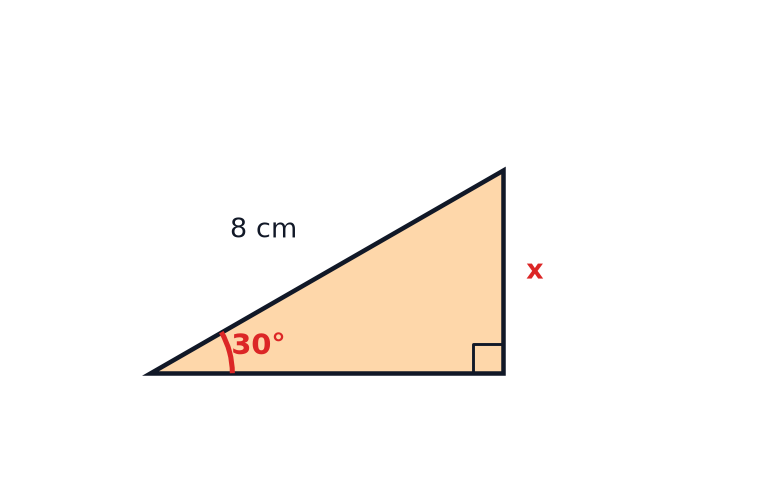
The diagram shows a right-angled triangle. (a) Work out the value of \(x\). [3 marks] (b) Write down the size of the third angle of the triangle. [1 mark]
Show answerHide answer
Model answer
(a) \(\sin 30^\circ = \dfrac{x}{8}\) and \(\sin 30^\circ = \dfrac{1}{2}\), so \(x = 4\) cm. (b) \(180 - 90 - 30 = 60^\circ\).
Mark scheme
- (a) \(\sin 30^\circ = \dfrac{x}{8}\) — M1
- (a) \(\dfrac{1}{2} = \dfrac{x}{8}\) — M1
- (a) 4 — A1
- (b) \(60^\circ\) — B1
-
2 Write down [2 marks]
(a) Write down the exact value of \(\cos 60^\circ\). [1 mark] (b) Write down the exact value of \(\sin 90^\circ\). [1 mark]
Show answerHide answer
Model answer
(a) \(\cos 60^\circ = \dfrac{1}{2}\). (b) \(\sin 90^\circ = 1\).
Mark scheme
- (a) \(\dfrac{1}{2}\) — B1
- (b) 1 — B1
-
3 Work out [2 marks]
In a right-angled triangle, \(\sin\theta = \dfrac{3}{5}\) and the hypotenuse is 20 cm. Work out the length of the side opposite angle \(\theta\).
Show answerHide answer
Model answer
\(\dfrac{x}{20} = \dfrac{3}{5}\), so \(x = \dfrac{3}{5} \times 20 = 12\) cm.
Mark scheme
- \(\dfrac{3}{5} \times 20\) — M1
- 12 cm — A1
-
4 Work out [3 marks]
A ramp is 6 m long and makes an angle of \(30^\circ\) with the horizontal ground. Work out the height of the top of the ramp above the ground.
Show answerHide answer
Model answer
The height is opposite the \(30^\circ\) angle and the ramp is the hypotenuse, so \(\sin 30^\circ = \dfrac{h}{6}\). Then \(h = \dfrac{1}{2} \times 6 = 3\) m.
Mark scheme
- \(\sin 30^\circ = \dfrac{h}{6}\) — M1
- \(\dfrac{1}{2} \times 6\) — M1
- 3 m — A1
-
5 Work out [3 marks]
In a right-angled triangle, the side opposite angle \(\theta\) is 6 cm and the hypotenuse is 12 cm. Work out the size of angle \(\theta\).
Show answerHide answer
Model answer
\(\sin\theta = \dfrac{6}{12} = \dfrac{1}{2}\), so \(\theta = 30^\circ\).
Mark scheme
- \(\sin\theta = \dfrac{6}{12}\) — M1
- \(\dfrac{1}{2}\) — M1
- \(30^\circ\) — A1
-
6 Work out [4 marks]
A right-angled triangle has an angle of \(60^\circ\) and a hypotenuse of 10 cm. (a) Work out the length of the side adjacent to the \(60^\circ\) angle. [2 marks] (b) Work out the length of the side opposite the \(60^\circ\) angle. Give your answer in the form \(a\sqrt{3}\). [2 marks]
Show answerHide answer
Model answer
(a) \(\cos 60^\circ = \dfrac{x}{10}\), so \(x = \dfrac{1}{2} \times 10 = 5\) cm. (b) \(\sin 60^\circ = \dfrac{y}{10}\), so \(y = \dfrac{\sqrt{3}}{2} \times 10 = 5\sqrt{3}\) cm.
Mark scheme
- (a) \(\cos 60^\circ = \dfrac{1}{2}\) used — M1
- (a) 5 — A1
- (b) \(\sin 60^\circ = \dfrac{\sqrt{3}}{2}\) used — M1
- (b) \(5\sqrt{3}\) — A1
-
7 Work out [3 marks]
A right-angled triangle has an angle of \(30^\circ\) and an adjacent side of 6 cm. \(\tan 30^\circ = \dfrac{\sqrt{3}}{3}\). Work out the length of the side opposite the \(30^\circ\) angle. Give your answer in the form \(a\sqrt{3}\).
Show answerHide answer
Model answer
\(\tan 30^\circ = \dfrac{x}{6}\), so \(x = 6 \times \dfrac{\sqrt{3}}{3} = 2\sqrt{3}\) cm.
Mark scheme
- \(\tan 30^\circ = \dfrac{x}{6}\) — M1
- \(6 \times \dfrac{\sqrt{3}}{3}\) — M1
- \(2\sqrt{3}\) cm — A1
Quick check
-
1
What is the formula for \(\sin\theta\) in a right-angled triangle?
Show answerHide answer
B: \(\dfrac{\text{Opposite}}{\text{Hypotenuse}}\)
SOH: sine is opposite over hypotenuse.
-
2
Which ratio links the opposite side and the adjacent side?
Show answerHide answer
A: Tangent
TOA: tangent is opposite over adjacent.
-
3
What is the exact value of \(\sin 30^\circ\)?
Show answerHide answer
D: \(\dfrac{1}{2}\)
This is one of the exact values you must learn: \(\sin 30^\circ = \dfrac{1}{2}\).
-
4
What is the exact value of \(\tan 45^\circ\)?
Show answerHide answer
C: 1
At \(45^\circ\) the opposite and adjacent sides are equal, so \(\tan 45^\circ = 1\).
-
5
A right-angled triangle has a hypotenuse of 8 cm and an angle of \(30^\circ\). What is the length of the side opposite the \(30^\circ\) angle?
Show answerHide answer
B: 4 cm
\(\sin 30^\circ = \dfrac{x}{8}\), so \(x = \dfrac{1}{2} \times 8 = 4\).
-
6
A right-angled triangle has opposite side 5 cm and adjacent side 5 cm. What is the angle?
Show answerHide answer
A: \(45^\circ\)
\(\tan\theta = \dfrac{5}{5} = 1\), so \(\theta = 45^\circ\).
-
7
In a right-angled triangle, \(\sin\theta = \dfrac{5}{13}\) and the hypotenuse is 39 cm. What is the opposite side?
Show answerHide answer
D: 15 cm
\(x = \dfrac{5}{13} \times 39 = 5 \times 3 = 15\).
-
8
A right-angled triangle has an angle of \(60^\circ\) and an adjacent side of 5 cm. What is the opposite side? (\(\tan 60^\circ = \sqrt{3}\))
Show answerHide answer
C: \(5\sqrt{3}\) cm
\(\tan 60^\circ = \dfrac{x}{5}\), so \(x = 5\sqrt{3}\).
-
9
A right-angled triangle has an angle of \(45^\circ\) and a hypotenuse of 10 cm. What is the opposite side?
Show answerHide answer
B: \(5\sqrt{2}\) cm
\(x = 10 \sin 45^\circ = 10 \times \dfrac{\sqrt{2}}{2} = 5\sqrt{2}\).