Exam questions · Maths · Geometry and Measures
Area, Perimeter and Circles
- 6 exam questions
- 21 marks
- 9 quick checks
-
1 Work out [5 marks]
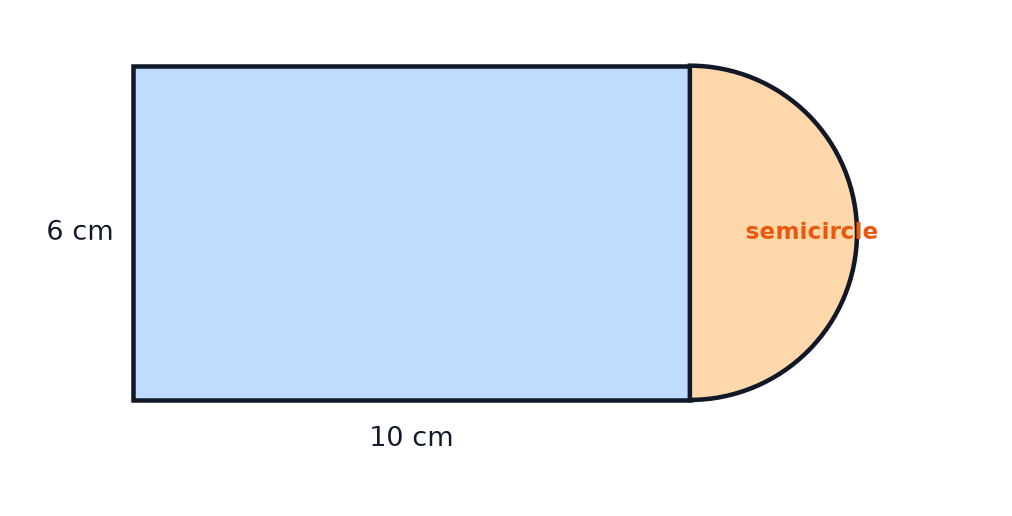
The diagram shows a rectangle with a semicircle attached to one side. Give your answers in terms of \(\pi\). (a) Work out the area of the shape. [3 marks] (b) Work out the perimeter of the shape. [2 marks]
Show answerHide answer
Model answer
(a) The rectangle has area \(10 \times 6 = 60\) cm\(^2\). The semicircle has radius 3 cm, so its area is \(\dfrac{1}{2} \times \pi \times 3^2 = 4.5\pi\) cm\(^2\). The total is \(60 + 4.5\pi\) cm\(^2\). (b) The curved edge is \(\dfrac{1}{2} \times \pi \times 6 = 3\pi\), and the straight edges are \(10 + 10 + 6 = 26\). The perimeter is \(26 + 3\pi\) cm.
Mark scheme
- (a) \(60\) found — M1
- (a) \(\dfrac{1}{2} \times \pi \times 3^2\) or \(4.5\pi\) — M1
- (a) \(60 + 4.5\pi\) — A1
- (b) \(3\pi\) or \(26\) found — M1
- (b) \(26 + 3\pi\) — A1
-
2 Work out [2 marks]
A parallelogram has a base of 12 cm, a slanted side of 8 cm and a perpendicular height of 7 cm. Work out the area of the parallelogram.
Show answerHide answer
Model answer
Area \(=\) base \(\times\) perpendicular height \(= 12 \times 7 = 84\) cm\(^2\). The slanted side is not needed.
Mark scheme
- \(12 \times 7\) — M1
- 84 cm\(^2\) — A1
-
3 Work out [4 marks]
A rectangle is 14 cm by 9 cm. A smaller rectangle measuring 6 cm by 4 cm is cut out of one corner. (a) Work out the area of the shape that is left. [2 marks] (b) Show that the perimeter of the shape is 46 cm. [2 marks]
Show answerHide answer
Model answer
(a) \(14 \times 9 - 6 \times 4 = 126 - 24 = 102\) cm\(^2\). (b) Cutting a rectangle out of a corner does not change the perimeter, because the two new edges replace two edges of the same total length: \(2 \times (14 + 9) = 46\) cm.
Mark scheme
- (a) \(14 \times 9 - 6 \times 4\) — M1
- (a) 102 — A1
- (b) \(14 + 9 + 14 + 9\) or the shape's edges added — M1
- (b) 46 with a reason or full working — Q1
-
4 Work out [3 marks]
The circumference of a circle is \(20\pi\) cm. Work out the area of the circle. Give your answer in terms of \(\pi\).
Show answerHide answer
Model answer
\(2\pi r = 20\pi\), so \(r = 10\) cm. The area is \(\pi \times 10^2 = 100\pi\) cm\(^2\).
Mark scheme
- \(2\pi r = 20\pi\) or \(r = 10\) — M1
- \(\pi \times 10^2\) — M1
- \(100\pi\) cm\(^2\) — A1
-
5 Work out [3 marks]
A circular pond has a radius of 4 m. A path 1 m wide goes all the way round the pond. Work out the area of the path. Give your answer in terms of \(\pi\).
Show answerHide answer
Model answer
The pond and path together have radius 5 m, so their area is \(\pi \times 25 = 25\pi\). The pond has area \(\pi \times 16 = 16\pi\). The path is \(25\pi - 16\pi = 9\pi\) m\(^2\).
Mark scheme
- \(\pi \times 5^2\) or \(\pi \times 4^2\) — M1
- \(25\pi - 16\pi\) — M1
- \(9\pi\) m\(^2\) — A1
-
6 Work out [4 marks]
A sector of a circle has radius 10 cm and angle \(72^\circ\). Give your answers in terms of \(\pi\). (a) Work out the length of the arc. [2 marks] (b) Work out the perimeter of the sector. [2 marks]
Show answerHide answer
Model answer
(a) \(\dfrac{72}{360} = \dfrac{1}{5}\), and the circumference is \(2\pi \times 10 = 20\pi\), so the arc is \(4\pi\) cm. (b) The perimeter is the arc plus two radii: \(4\pi + 10 + 10 = 20 + 4\pi\) cm.
Mark scheme
- (a) \(\dfrac{72}{360} \times 20\pi\) — M1
- (a) \(4\pi\) — A1
- (b) \(4\pi + 10 + 10\) — M1
- (b) \(20 + 4\pi\) — A1
Quick check
-
1
A triangle has base 10 cm and perpendicular height 6 cm. What is its area?
Show answerHide answer
C: 30 cm\(^2\)
\(\dfrac{1}{2} \times 10 \times 6 = 30\) cm\(^2\).
-
2
A trapezium has parallel sides of 7 cm and 13 cm, and a height of 6 cm. What is its area?
Show answerHide answer
B: 60 cm\(^2\)
\(\dfrac{1}{2}(7 + 13) \times 6 = 60\). Forgetting the half gives 120.
-
3
A parallelogram has base 9 cm, slanted side 5 cm and perpendicular height 4 cm. What is its area?
Show answerHide answer
A: 36 cm\(^2\)
\(\text{base} \times \text{perpendicular height} = 9 \times 4 = 36\). The slanted side is not used.
-
4
A circle has radius 5 cm. What is its area, in terms of \(\pi\)?
Show answerHide answer
D: \(25\pi\) cm\(^2\)
\(\pi r^2 = \pi \times 25 = 25\pi\).
-
5
A circle has diameter 14 cm. What is its circumference, in terms of \(\pi\)?
Show answerHide answer
C: \(14\pi\) cm
\(C = \pi d = 14\pi\).
-
6
A circle has diameter 10 cm. What is its area, in terms of \(\pi\)?
Show answerHide answer
B: \(25\pi\) cm\(^2\)
The radius is \(10 \div 2 = 5\), so \(A = \pi \times 5^2 = 25\pi\). Using 10 as the radius gives \(100\pi\).
-
7
A rectangle measures 12 cm by 7 cm. A rectangle 5 cm by 3 cm is cut from one corner. What is the area of the remaining shape?
Show answerHide answer
A: 69 cm\(^2\)
\(12 \times 7 = 84\) and \(5 \times 3 = 15\), so \(84 - 15 = 69\).
-
8
A sector has radius 9 cm and angle \(80^\circ\). What is its area, in terms of \(\pi\)?
Show answerHide answer
D: \(18\pi\) cm\(^2\)
\(\dfrac{80}{360} \times \pi \times 81 = \dfrac{2}{9} \times 81\pi = 18\pi\).
-
9
A sector has radius 6 cm and angle \(60^\circ\). What is the length of its arc, in terms of \(\pi\)?
Show answerHide answer
C: \(2\pi\) cm
\(\dfrac{60}{360} \times 2 \times \pi \times 6 = \dfrac{1}{6} \times 12\pi = 2\pi\).