Exam questions · Maths · Graphs
Equations of Straight Lines
- 6 exam questions
- 21 marks
- 9 quick checks
-
1 Work out [2 marks]
\(A\) is the point \((2, 6)\) and \(B\) is the point \((8, 10)\). Find the coordinates of the midpoint of \(AB\).
Show answerHide answer
Model answer
\(\left(\dfrac{2 + 8}{2}, \dfrac{6 + 10}{2}\right) = (5, 8)\).
Mark scheme
- One coordinate correct — M1
- \((5, 8)\) — A1
-
2 Work out [6 marks]
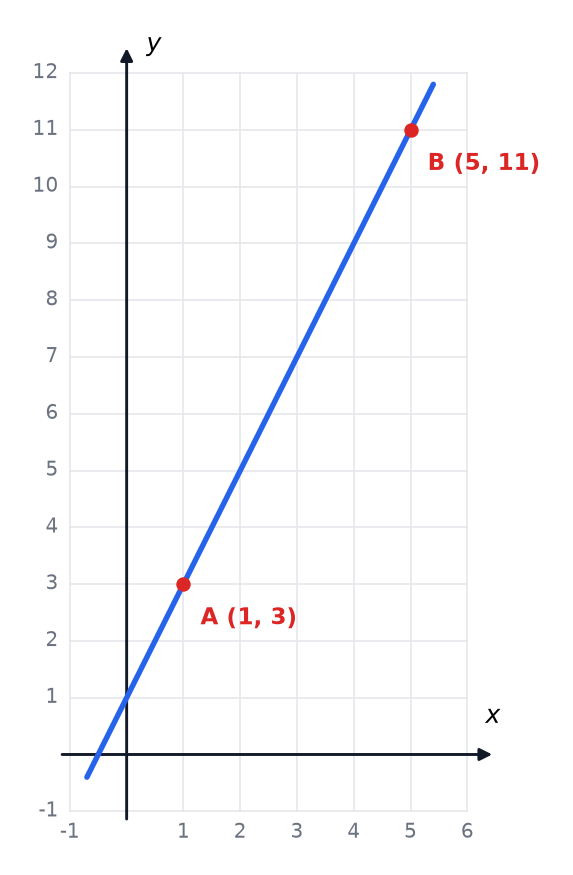
The diagram shows a straight line through the points \(A\) and \(B\). (a) Work out the gradient of the line. (2 marks) (b) Find an equation of the line. (2 marks) (c) Work out the coordinates of the midpoint of \(AB\). (2 marks)
Show answerHide answer
Model answer
(a) \(\dfrac{11 - 3}{5 - 1} = 2\). (b) \(y = 2x + c\) with \((1, 3)\) gives \(3 = 2 + c\), so \(c = 1\) and \(y = 2x + 1\). (c) \(\left(\dfrac{1 + 5}{2}, \dfrac{3 + 11}{2}\right) = (3, 7)\).
Mark scheme
- (a) \(\dfrac{11 - 3}{5 - 1}\) — M1
- (a) 2 — A1
- (b) \(y = 2x + c\) and a point substituted — M1
- (b) \(y = 2x + 1\) — A1
- (c) One coordinate correct — M1
- (c) \((3, 7)\) — A1
-
3 Find [3 marks]
Find an equation of the line that is parallel to \(y = 3x - 1\) and passes through the point \((2, 9)\).
Show answerHide answer
Model answer
The gradient is 3, so \(y = 3x + c\). Substituting \((2, 9)\) gives \(9 = 6 + c\), so \(c = 3\) and \(y = 3x + 3\).
Mark scheme
- \(y = 3x + c\) or gradient 3 stated — M1
- \(9 = 3 \times 2 + c\) — M1
- \(y = 3x + 3\) — A1
-
4 Work out [3 marks]
A line has equation \(3x + 2y = 12\). (a) Work out the gradient of the line. (2 marks) (b) Does the point \((2, 3)\) lie on the line? You must show your working. (1 mark)
Show answerHide answer
Model answer
(a) Rearrange to \(2y = -3x + 12\), so \(y = -\dfrac{3}{2}x + 6\). The gradient is \(-\dfrac{3}{2}\). (b) \(3 \times 2 + 2 \times 3 = 12\), so yes.
Mark scheme
- (a) \(2y = -3x + 12\) or \(y = \ldots\) — M1
- (a) \(-\dfrac{3}{2}\) — A1
- (b) Yes, with \(6 + 6 = 12\) — B1
-
5 Find [3 marks]
Line \(L_1\) has equation \(y = 2x + 3\). Line \(L_2\) is perpendicular to \(L_1\) and passes through the point \((4, 1)\). Find an equation of \(L_2\).
Show answerHide answer
Model answer
The gradient of \(L_2\) is \(-\dfrac{1}{2}\). Then \(1 = -\dfrac{1}{2} \times 4 + c\), so \(c = 3\) and \(y = -\dfrac{1}{2}x + 3\).
Mark scheme
- Gradient \(-\dfrac{1}{2}\) seen — M1
- \(1 = -\dfrac{1}{2} \times 4 + c\) — M1
- \(y = -\dfrac{1}{2}x + 3\) — A1
-
6 Work out [4 marks]
\(A\) is the point \((-2, 1)\) and \(B\) is the point \((6, 7)\). (a) Find the coordinates of the midpoint of \(AB\). (2 marks) (b) Work out the length of \(AB\). (2 marks)
Show answerHide answer
Model answer
(a) \(\left(\dfrac{-2 + 6}{2}, \dfrac{1 + 7}{2}\right) = (2, 4)\). (b) The differences are 8 and 6, so \(AB = \sqrt{8^2 + 6^2} = \sqrt{100} = 10\).
Mark scheme
- (a) One coordinate correct — M1
- (a) \((2, 4)\) — A1
- (b) \(\sqrt{8^2 + 6^2}\) — M1
- (b) 10 — A1
Quick check
-
1
What is the equation of the line through \((2, 1)\) and \((6, 9)\)?
Show answerHide answer
C: \(y = 2x - 3\)
The gradient is \(\dfrac{8}{4} = 2\). Then \(1 = 2 \times 2 + c\) gives \(c = -3\).
-
2
What is the midpoint of \((2, 1)\) and \((6, 9)\)?
Show answerHide answer
B: \((4, 5)\)
\(\left(\dfrac{2 + 6}{2}, \dfrac{1 + 9}{2}\right) = (4, 5)\).
-
3
A line is parallel to \(y = 5x - 2\). What is its gradient?
Show answerHide answer
A: \(5\)
Parallel lines have equal gradients.
-
4
A line has gradient 3 and passes through \((2, 9)\). What is its equation?
Show answerHide answer
D: \(y = 3x + 3\)
\(9 = 3 \times 2 + c\) gives \(c = 3\).
-
5
What is the gradient of the line \(2y - 4x = 6\)?
Show answerHide answer
C: \(2\)
Rearranged, \(2y = 4x + 6\), so \(y = 2x + 3\).
-
6
What is the midpoint of \((0, 4)\) and \((6, 10)\)?
Show answerHide answer
B: \((3, 7)\)
\(\left(\dfrac{0 + 6}{2}, \dfrac{4 + 10}{2}\right) = (3, 7)\).
-
7
Where does the line \(3x + 2y = 12\) cross the axes?
Show answerHide answer
A: \((0, 6)\) and \((4, 0)\)
Put \(x = 0\) to get \(y = 6\), and \(y = 0\) to get \(x = 4\).
-
8
What is the gradient of a line perpendicular to a line with gradient 4?
Show answerHide answer
D: \(-\dfrac{1}{4}\)
Perpendicular gradients multiply to \(-1\), so the new gradient is \(-\dfrac{1}{4}\).
-
9
What is the equation of the line perpendicular to \(y = 2x + 3\) through \((4, 1)\)?
Show answerHide answer
C: \(y = -\dfrac{1}{2}x + 3\)
The gradient is \(-\dfrac{1}{2}\). Then \(1 = -2 + c\), so \(c = 3\).