Exam questions · Maths
Graphs
- 30 exam questions
- 97 marks
- 45 quick checks
Straight-Line Graphs
Just this lesson-
1 Write down [2 marks]
(a) Write down the gradient of the line with equation \(y = 4x + 7\). (1 mark) (b) Write down the coordinates of the point where this line crosses the \(y\)-axis. (1 mark)
Show answerHide answer
Model answer
(a) The gradient is the number multiplying \(x\), which is 4. (b) The line crosses the \(y\)-axis where \(x = 0\), at \((0, 7)\).
Mark scheme
- (a) 4 — B1
- (b) \((0, 7)\) — B1
-
2 Complete [3 marks]
(a) Complete the table of values for \(y = 3x - 2\) for \(x = -1, 0, 1, 2, 3\). (2 marks) (b) Does the point \((5, 12)\) lie on the line \(y = 3x - 2\)? You must give a reason for your answer. (1 mark)
Show answerHide answer
Model answer
(a) The values are \(-5, -2, 1, 4, 7\). (b) When \(x = 5\), \(y = 3 \times 5 - 2 = 13\), not 12, so the point does not lie on the line.
Mark scheme
- (a) At least three correct values — M1
- (a) \(-5, -2, 1, 4, 7\) — A1
- (b) No, with \(3 \times 5 - 2 = 13\) or equivalent — C1
-
3 Work out [4 marks]
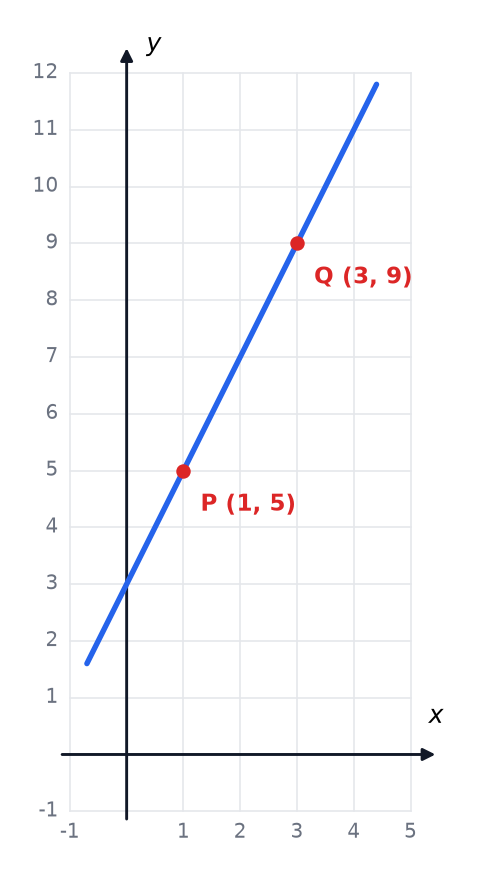
The diagram shows a straight line. The points \(P\) and \(Q\) are on the line. (a) Work out the gradient of the line. (2 marks) (b) Write down the equation of the line. (2 marks)
Show answerHide answer
Model answer
(a) The gradient is \(\dfrac{9 - 5}{3 - 1} = \dfrac{4}{2} = 2\). (b) The line crosses the \(y\)-axis at 3, so the equation is \(y = 2x + 3\).
Mark scheme
- (a) \(\dfrac{9 - 5}{3 - 1}\) — M1
- (a) 2 — A1
- (b) \(y = 2x + c\) or \(y = mx + 3\) — M1
- (b) \(y = 2x + 3\) — A1
-
4 Work out [3 marks]
A line \(L\) has equation \(y = 5 - 2x\). (a) Write down the gradient of \(L\). (1 mark) (b) Work out the coordinates of the point where \(L\) crosses the \(x\)-axis. (2 marks)
Show answerHide answer
Model answer
(a) Written as \(y = -2x + 5\), the gradient is \(-2\). (b) On the \(x\)-axis \(y = 0\), so \(0 = 5 - 2x\) and \(x = 2.5\). The point is \((2.5, 0)\).
Mark scheme
- (a) \(-2\) — B1
- (b) \(y = 0\) used, or \(5 - 2x = 0\) — M1
- (b) \((2.5, 0)\) — A1
-
5 Work out [2 marks]
Work out the gradient of the straight line that passes through \((-2, 3)\) and \((4, -9)\).
Show answerHide answer
Model answer
\(\dfrac{-9 - 3}{4 - (-2)} = \dfrac{-12}{6} = -2\).
Mark scheme
- \(\dfrac{-9 - 3}{4 - (-2)}\) or \(\dfrac{-12}{6}\) — M1
- \(-2\) — A1
-
6 Show that [4 marks]
Line \(L_1\) has equation \(y = 2x + 3\). Line \(L_2\) passes through \((0, -1)\) and \((4, 7)\). (a) Show that \(L_1\) and \(L_2\) are parallel. (3 marks) (b) Does the point \((3, 9)\) lie on \(L_1\)? (1 mark)
Show answerHide answer
Model answer
(a) The gradient of \(L_2\) is \(\dfrac{7 - (-1)}{4 - 0} = \dfrac{8}{4} = 2\). This is the same as the gradient of \(L_1\), so the lines are parallel. (b) \(2 \times 3 + 3 = 9\), so yes.
Mark scheme
- (a) \(\dfrac{7 - (-1)}{4 - 0}\) — M1
- (a) Gradient of \(L_2\) is 2 — A1
- (a) States that equal gradients mean the lines are parallel — C1
- (b) Yes, because \(2 \times 3 + 3 = 9\) — B1
Quick check
-
1
What is the equation of the \(x\)-axis?
Show answerHide answer
B: \(y = 0\)
Every point on the \(x\)-axis has \(y = 0\).
-
2
Which point is on the line \(y = 3x - 2\)?
Show answerHide answer
A: \((4, 10)\)
Put in the coordinates: \(3 \times 4 - 2 = 10\), so \((4, 10)\) fits.
-
3
Work out the gradient of the line through \((1, 7)\) and \((4, 1)\).
Show answerHide answer
D: \(-2\)
\(\dfrac{1 - 7}{4 - 1} = \dfrac{-6}{3} = -2\).
-
4
Which line is parallel to \(y = 3x + 1\)?
Show answerHide answer
C: \(y = 3x - 5\)
Parallel lines have the same gradient, 3.
-
5
What is the equation of the vertical line through 4 on the \(x\)-axis?
Show answerHide answer
B: \(x = 4\)
Every point on the line has \(x = 4\).
-
6
What is the gradient of the line \(y = 5 - 3x\)?
Show answerHide answer
A: \(-3\)
Written as \(y = -3x + 5\), the number multiplying \(x\) is \(-3\).
-
7
What is the value of \(y\) on the line \(y = 2x - 1\) when \(x = -1\)?
Show answerHide answer
D: \(-3\)
\(2 \times (-1) - 1 = -2 - 1 = -3\).
-
8
Where does the line \(y = 3x + 2\) cross the \(y\)-axis?
Show answerHide answer
C: \((0, 2)\)
The number on its own, 2, is the \(y\)-intercept.
-
9
Work out the gradient of the line through \((-2, 3)\) and \((4, -9)\).
Show answerHide answer
B: \(-2\)
\(\dfrac{-9 - 3}{4 - (-2)} = \dfrac{-12}{6} = -2\).
Equations of Straight Lines
Just this lesson-
1 Work out [2 marks]
\(A\) is the point \((2, 6)\) and \(B\) is the point \((8, 10)\). Find the coordinates of the midpoint of \(AB\).
Show answerHide answer
Model answer
\(\left(\dfrac{2 + 8}{2}, \dfrac{6 + 10}{2}\right) = (5, 8)\).
Mark scheme
- One coordinate correct — M1
- \((5, 8)\) — A1
-
2 Work out [6 marks]
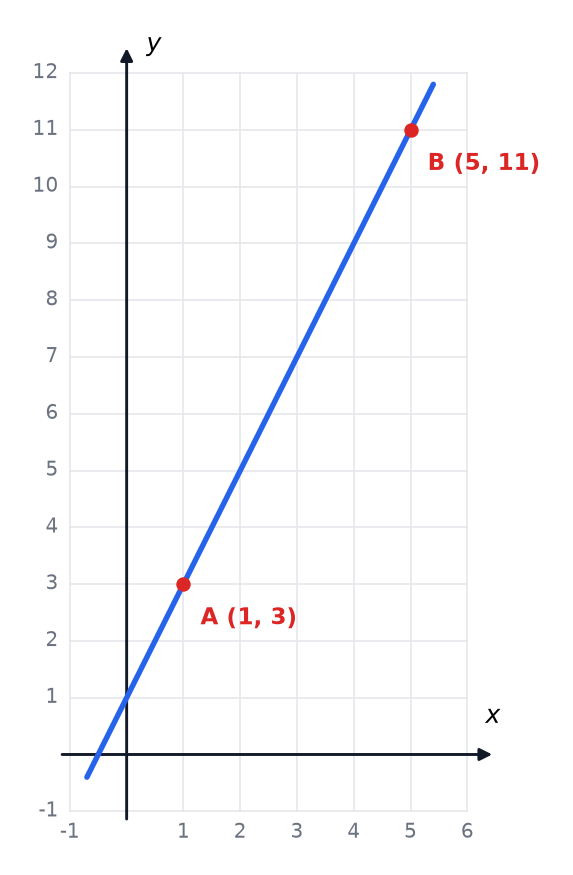
The diagram shows a straight line through the points \(A\) and \(B\). (a) Work out the gradient of the line. (2 marks) (b) Find an equation of the line. (2 marks) (c) Work out the coordinates of the midpoint of \(AB\). (2 marks)
Show answerHide answer
Model answer
(a) \(\dfrac{11 - 3}{5 - 1} = 2\). (b) \(y = 2x + c\) with \((1, 3)\) gives \(3 = 2 + c\), so \(c = 1\) and \(y = 2x + 1\). (c) \(\left(\dfrac{1 + 5}{2}, \dfrac{3 + 11}{2}\right) = (3, 7)\).
Mark scheme
- (a) \(\dfrac{11 - 3}{5 - 1}\) — M1
- (a) 2 — A1
- (b) \(y = 2x + c\) and a point substituted — M1
- (b) \(y = 2x + 1\) — A1
- (c) One coordinate correct — M1
- (c) \((3, 7)\) — A1
-
3 Find [3 marks]
Find an equation of the line that is parallel to \(y = 3x - 1\) and passes through the point \((2, 9)\).
Show answerHide answer
Model answer
The gradient is 3, so \(y = 3x + c\). Substituting \((2, 9)\) gives \(9 = 6 + c\), so \(c = 3\) and \(y = 3x + 3\).
Mark scheme
- \(y = 3x + c\) or gradient 3 stated — M1
- \(9 = 3 \times 2 + c\) — M1
- \(y = 3x + 3\) — A1
-
4 Work out [3 marks]
A line has equation \(3x + 2y = 12\). (a) Work out the gradient of the line. (2 marks) (b) Does the point \((2, 3)\) lie on the line? You must show your working. (1 mark)
Show answerHide answer
Model answer
(a) Rearrange to \(2y = -3x + 12\), so \(y = -\dfrac{3}{2}x + 6\). The gradient is \(-\dfrac{3}{2}\). (b) \(3 \times 2 + 2 \times 3 = 12\), so yes.
Mark scheme
- (a) \(2y = -3x + 12\) or \(y = \ldots\) — M1
- (a) \(-\dfrac{3}{2}\) — A1
- (b) Yes, with \(6 + 6 = 12\) — B1
-
5 Find [3 marks]
Line \(L_1\) has equation \(y = 2x + 3\). Line \(L_2\) is perpendicular to \(L_1\) and passes through the point \((4, 1)\). Find an equation of \(L_2\).
Show answerHide answer
Model answer
The gradient of \(L_2\) is \(-\dfrac{1}{2}\). Then \(1 = -\dfrac{1}{2} \times 4 + c\), so \(c = 3\) and \(y = -\dfrac{1}{2}x + 3\).
Mark scheme
- Gradient \(-\dfrac{1}{2}\) seen — M1
- \(1 = -\dfrac{1}{2} \times 4 + c\) — M1
- \(y = -\dfrac{1}{2}x + 3\) — A1
-
6 Work out [4 marks]
\(A\) is the point \((-2, 1)\) and \(B\) is the point \((6, 7)\). (a) Find the coordinates of the midpoint of \(AB\). (2 marks) (b) Work out the length of \(AB\). (2 marks)
Show answerHide answer
Model answer
(a) \(\left(\dfrac{-2 + 6}{2}, \dfrac{1 + 7}{2}\right) = (2, 4)\). (b) The differences are 8 and 6, so \(AB = \sqrt{8^2 + 6^2} = \sqrt{100} = 10\).
Mark scheme
- (a) One coordinate correct — M1
- (a) \((2, 4)\) — A1
- (b) \(\sqrt{8^2 + 6^2}\) — M1
- (b) 10 — A1
Quick check
-
1
What is the equation of the line through \((2, 1)\) and \((6, 9)\)?
Show answerHide answer
C: \(y = 2x - 3\)
The gradient is \(\dfrac{8}{4} = 2\). Then \(1 = 2 \times 2 + c\) gives \(c = -3\).
-
2
What is the midpoint of \((2, 1)\) and \((6, 9)\)?
Show answerHide answer
B: \((4, 5)\)
\(\left(\dfrac{2 + 6}{2}, \dfrac{1 + 9}{2}\right) = (4, 5)\).
-
3
A line is parallel to \(y = 5x - 2\). What is its gradient?
Show answerHide answer
A: \(5\)
Parallel lines have equal gradients.
-
4
A line has gradient 3 and passes through \((2, 9)\). What is its equation?
Show answerHide answer
D: \(y = 3x + 3\)
\(9 = 3 \times 2 + c\) gives \(c = 3\).
-
5
What is the gradient of the line \(2y - 4x = 6\)?
Show answerHide answer
C: \(2\)
Rearranged, \(2y = 4x + 6\), so \(y = 2x + 3\).
-
6
What is the midpoint of \((0, 4)\) and \((6, 10)\)?
Show answerHide answer
B: \((3, 7)\)
\(\left(\dfrac{0 + 6}{2}, \dfrac{4 + 10}{2}\right) = (3, 7)\).
-
7
Where does the line \(3x + 2y = 12\) cross the axes?
Show answerHide answer
A: \((0, 6)\) and \((4, 0)\)
Put \(x = 0\) to get \(y = 6\), and \(y = 0\) to get \(x = 4\).
-
8
What is the gradient of a line perpendicular to a line with gradient 4?
Show answerHide answer
D: \(-\dfrac{1}{4}\)
Perpendicular gradients multiply to \(-1\), so the new gradient is \(-\dfrac{1}{4}\).
-
9
What is the equation of the line perpendicular to \(y = 2x + 3\) through \((4, 1)\)?
Show answerHide answer
C: \(y = -\dfrac{1}{2}x + 3\)
The gradient is \(-\dfrac{1}{2}\). Then \(1 = -2 + c\), so \(c = 3\).
Quadratic Graphs
Just this lesson-
1 Complete [3 marks]
(a) Complete the table of values for \(y = x^2 - 3x\). \(x = -1, 0, 1, 2, 3, 4\) (2 marks) (b) Write down the equation of the line of symmetry of the graph. (1 mark)
Show answerHide answer
Model answer
(a) The values are \(4, 0, -2, -2, 0, 4\). (b) The line of symmetry is halfway between \(x = 0\) and \(x = 3\), so \(x = 1.5\).
Mark scheme
- (a) At least three correct values — M1
- (a) \(4, 0, -2, -2, 0, 4\) — A1
- (b) \(x = 1.5\) — B1
-
2 Write down [4 marks]
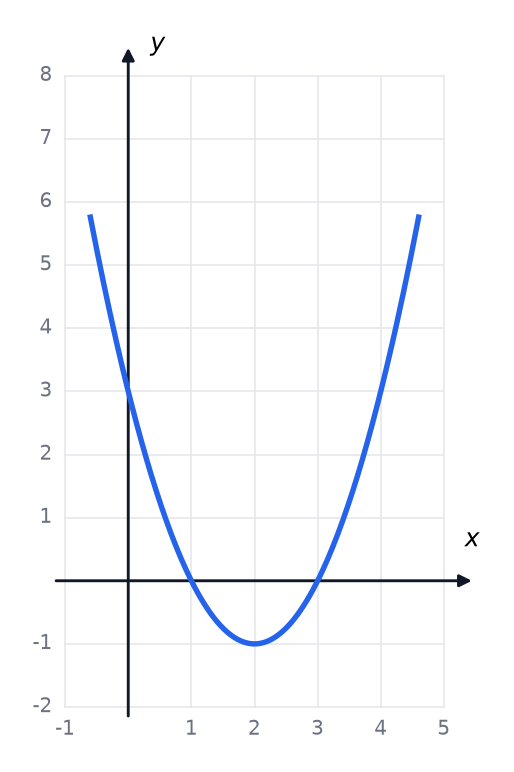
The diagram shows the graph of \(y = x^2 - 4x + 3\). (a) Write down the coordinates of the turning point. (1 mark) (b) Use the graph to solve \(x^2 - 4x + 3 = 0\). (2 marks) (c) Write down the equation of the line of symmetry of the graph. (1 mark)
Show answerHide answer
Model answer
(a) The lowest point is \((2, -1)\). (b) The curve crosses the \(x\)-axis at \(x = 1\) and \(x = 3\). (c) The line of symmetry goes through the turning point, so \(x = 2\).
Mark scheme
- (a) \((2, -1)\) — B1
- (b) One of \(x = 1\) or \(x = 3\) — M1
- (b) \(x = 1\) and \(x = 3\) — A1
- (c) \(x = 2\) — B1
-
3 Work out [3 marks]
(a) Write down the \(y\)-intercept of the graph of \(y = x^2 + 5x - 6\). (1 mark) (b) Solve \(x^2 + 5x - 6 = 0\) to find where the graph crosses the \(x\)-axis. (2 marks)
Show answerHide answer
Model answer
(a) Put \(x = 0\): \(y = -6\). (b) \(x^2 + 5x - 6 = (x + 6)(x - 1) = 0\), so \(x = -6\) and \(x = 1\).
Mark scheme
- (a) \(-6\) — B1
- (b) \((x + 6)(x - 1)\) — M1
- (b) \(x = -6\) and \(x = 1\) — A1
-
4 Work out [3 marks]
A curve has equation \(y = x^2 - 6x + 5\). (a) Work out the coordinates of the points where the curve crosses the \(x\)-axis. (2 marks) (b) Write down the equation of the line of symmetry of the curve. (1 mark)
Show answerHide answer
Model answer
(a) \(x^2 - 6x + 5 = (x - 1)(x - 5) = 0\), so the points are \((1, 0)\) and \((5, 0)\). (b) The line of symmetry is halfway between them: \(x = 3\).
Mark scheme
- (a) \((x - 1)(x - 5)\) — M1
- (a) \((1, 0)\) and \((5, 0)\) — A1
- (b) \(x = 3\) — B1
-
5 Work out [4 marks]
(a) Write \(x^2 - 8x + 7\) in the form \((x - a)^2 - b\). (2 marks) (b) Write down the coordinates of the turning point of the graph of \(y = x^2 - 8x + 7\). (1 mark) (c) Write down the equation of its line of symmetry. (1 mark)
Show answerHide answer
Model answer
(a) \(x^2 - 8x + 7 = (x - 4)^2 - 16 + 7 = (x - 4)^2 - 9\). (b) The turning point is \((4, -9)\). (c) The line of symmetry is \(x = 4\).
Mark scheme
- (a) \((x - 4)^2\) seen — M1
- (a) \((x - 4)^2 - 9\) — A1
- (b) \((4, -9)\) — B1
- (c) \(x = 4\) — B1
-
6 Work out [3 marks]
The equation of a curve is \(y = 4x - x^2\). Work out the coordinates of the maximum point of the curve.
Show answerHide answer
Model answer
The curve crosses the \(x\)-axis where \(x(4 - x) = 0\), at \(x = 0\) and \(x = 4\). The maximum is halfway between, at \(x = 2\), and \(y = 8 - 4 = 4\). The point is \((2, 4)\).
Mark scheme
- Roots 0 and 4 found, or \(x = 2\) seen — M1
- \(y = 4 \times 2 - 2^2\) — M1
- \((2, 4)\) — A1
Quick check
-
1
What is the shape of the graph of a quadratic equation?
Show answerHide answer
D: A parabola, a smooth U or upside-down U
Quadratic graphs are parabolas.
-
2
What are the roots of a graph?
Show answerHide answer
C: The \(x\)-values where the curve crosses the \(x\)-axis
At the roots \(y = 0\), so the curve meets the \(x\)-axis.
-
3
Work out \(y\) when \(x = -2\) on \(y = x^2 - 2x - 3\).
Show answerHide answer
B: \(5\)
\((-2)^2 - 2 \times (-2) - 3 = 4 + 4 - 3 = 5\).
-
4
What is the \(y\)-intercept of \(y = x^2 + 4x - 7\)?
Show answerHide answer
A: \(-7\)
Put \(x = 0\): \(y = -7\).
-
5
The graph of \(y = x^2 - 2x - 3\) crosses the \(x\)-axis at \(-1\) and 3. What are the solutions of \(x^2 - 2x - 3 = 0\)?
Show answerHide answer
D: \(x = -1\) and \(x = 3\)
The solutions are the \(x\)-values where \(y = 0\).
-
6
A parabola crosses the \(x\)-axis at \(x = 1\) and \(x = 5\). What is its line of symmetry?
Show answerHide answer
C: \(x = 3\)
The line of symmetry is halfway between the roots: \(\dfrac{1 + 5}{2} = 3\).
-
7
The curve \(y = x^2 - 4x + 3\) crosses the \(x\)-axis at 1 and 3. What are the coordinates of its turning point?
Show answerHide answer
B: \((2, -1)\)
\(x = 2\) is halfway between the roots. Then \(y = 4 - 8 + 3 = -1\).
-
8
Which line do you draw on the graph of \(y = x^2 - 2x - 3\) to solve \(x^2 - 2x - 3 = 2\)?
Show answerHide answer
A: \(y = 2\)
Solutions are where the curve meets the horizontal line \(y = 2\).
-
9
What are the coordinates of the turning point of \(y = (x - 3)^2 - 4\)?
Show answerHide answer
D: \((3, -4)\)
In \(y = (x - a)^2 + b\) the turning point is \((a, b)\).
Cubic, Reciprocal and Other Graphs
Just this lesson-
1 Match [3 marks]
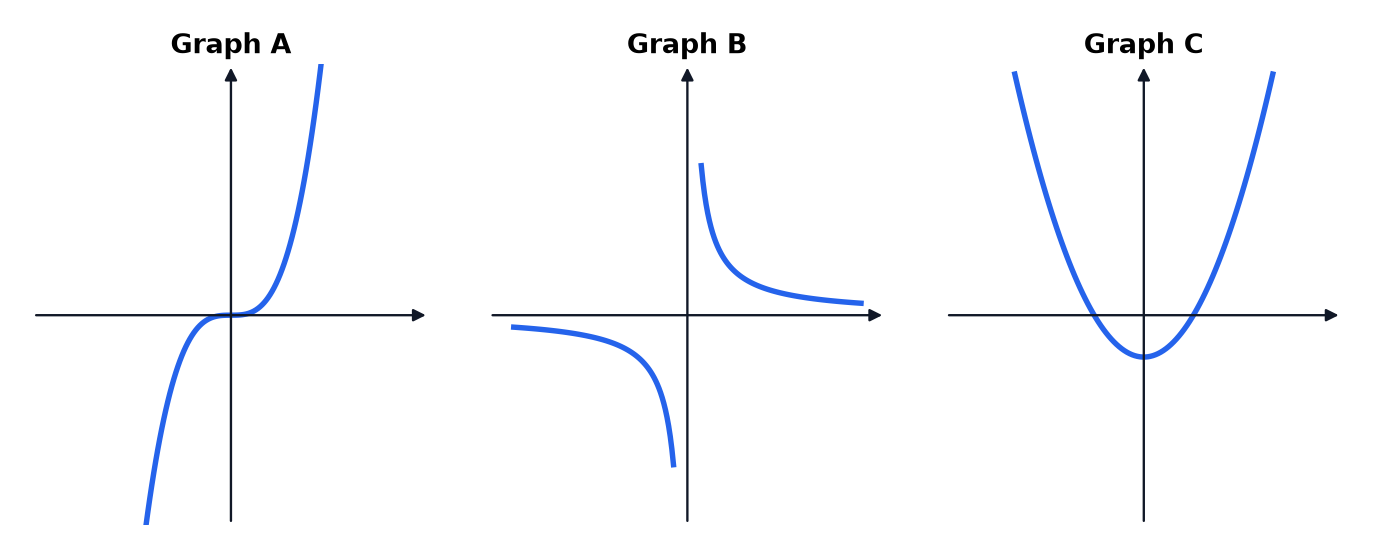
Here are three graphs, \(A\), \(B\) and \(C\). The three equations are \(y = \dfrac{1}{x}\), \(y = x^3\) and \(y = x^2 - 1\). Match each equation to the correct graph.
Show answerHide answer
Model answer
Graph \(A\) is an S-shaped curve through the origin, so it is \(y = x^3\). Graph \(B\) has two branches, so it is \(y = \dfrac{1}{x}\). Graph \(C\) is a U shape with its lowest point at \((0, -1)\), so it is \(y = x^2 - 1\).
Mark scheme
- \(A\) is \(y = x^3\) — B1
- \(B\) is \(y = \dfrac{1}{x}\) — B1
- \(C\) is \(y = x^2 - 1\) — B1
-
2 Complete [2 marks]
Complete the table of values for \(y = x^3\). \(x = -2, -1, 0, 1, 2\)
Show answerHide answer
Model answer
The values are \(-8, -1, 0, 1, 8\).
Mark scheme
- At least three correct values — M1
- \(-8, -1, 0, 1, 8\) — A1
-
3 Complete [3 marks]
(a) Complete the table of values for \(y = \dfrac{8}{x}\). \(x = 1, 2, 4, 8, -2, -4\) (2 marks) (b) Explain why there is no point on the graph with \(x = 0\). (1 mark)
Show answerHide answer
Model answer
(a) The values are \(8, 4, 2, 1, -4, -2\). (b) You cannot divide by zero, so \(\dfrac{8}{0}\) has no value.
Mark scheme
- (a) At least four correct values — M1
- (a) \(8, 4, 2, 1, -4, -2\) — A1
- (b) You cannot divide by zero — C1
-
4 Complete [3 marks]
(a) Complete the table of values for \(y = 2^x\). \(x = -1, 0, 1, 2, 3\) (2 marks) (b) Write down the coordinates of the point where the graph of \(y = 2^x\) crosses the \(y\)-axis. (1 mark)
Show answerHide answer
Model answer
(a) The values are \(\dfrac{1}{2}, 1, 2, 4, 8\). (b) When \(x = 0\), \(y = 2^0 = 1\), so the point is \((0, 1)\).
Mark scheme
- (a) At least three correct values — M1
- (a) \(\dfrac{1}{2}, 1, 2, 4, 8\) — A1
- (b) \((0, 1)\) — B1
-
5 Work out [2 marks]
Work out the value of \(y\) when \(x = -3\) for \(y = x^3 - x\).
Show answerHide answer
Model answer
\((-3)^3 - (-3) = -27 + 3 = -24\).
Mark scheme
- \((-3)^3 = -27\) — M1
- \(-24\) — A1
-
6 Show that [3 marks]
(a) Write down the equation of the circle with centre \((0, 0)\) and radius 6. (1 mark) (b) Show that the point \((4, 5)\) lies on the circle \(x^2 + y^2 = 41\). (2 marks)
Show answerHide answer
Model answer
(a) \(x^2 + y^2 = 36\). (b) \(4^2 + 5^2 = 16 + 25 = 41\), so the point lies on the circle.
Mark scheme
- (a) \(x^2 + y^2 = 36\) — B1
- (b) \(4^2 + 5^2\) or \(16 + 25\) — M1
- (b) 41 with a conclusion — C1
Quick check
-
1
What shape is the graph of \(y = x^3\)?
Show answerHide answer
A: An S-shaped curve through the origin
Cubic graphs have an S shape.
-
2
What is special about the graph of \(y = \dfrac{1}{x}\)?
Show answerHide answer
D: It has two branches and never touches either axis
You cannot divide by 0, and \(\dfrac{1}{x}\) is never 0.
-
3
Where does the graph of \(y = 3^x\) cross the \(y\)-axis?
Show answerHide answer
C: \((0, 1)\)
\(3^0 = 1\).
-
4
What is the value of \(x^3\) when \(x = -3\)?
Show answerHide answer
B: \(-27\)
\((-3) \times (-3) \times (-3) = -27\).
-
5
Which of these equations gives a cubic graph?
Show answerHide answer
A: \(y = x^3 + 1\)
A cubic has \(x^3\) as its highest power.
-
6
Work out \(y\) when \(x = 2\) on \(y = x^3 - 3x\).
Show answerHide answer
D: \(2\)
\(8 - 6 = 2\).
-
7
What is \(2^3\)?
Show answerHide answer
C: \(8\)
\(2 \times 2 \times 2 = 8\).
-
8
What shape is the graph of \(y = -x^2\)?
Show answerHide answer
B: An upside-down U
A negative \(x^2\) term turns the parabola upside down.
-
9
What is the radius of the circle \(x^2 + y^2 = 36\)?
Show answerHide answer
A: \(6\)
The radius is \(\sqrt{36} = 6\).
Real-Life Graphs
Just this lesson-
1 Work out [6 marks]
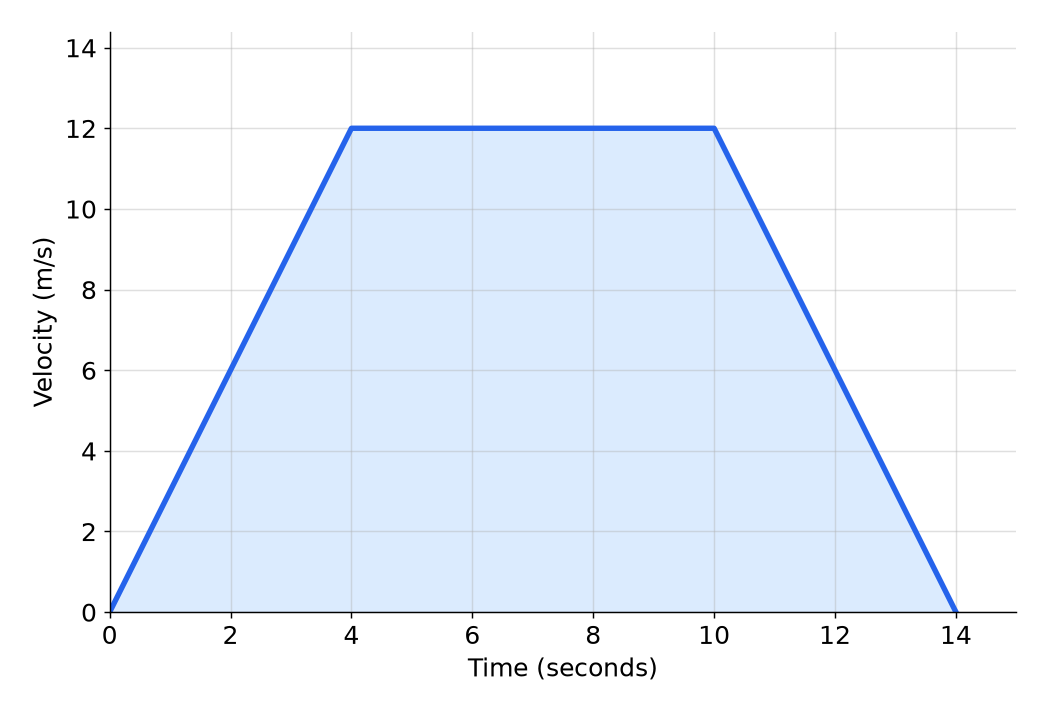
The graph shows the velocity of a cyclist during a 14 second journey. (a) Work out the acceleration of the cyclist in the first 4 seconds. (2 marks) (b) Work out the distance travelled in the first 4 seconds. (2 marks) (c) Work out the total distance travelled in the 14 seconds. (2 marks)
Show answerHide answer
Model answer
(a) Acceleration \(= \dfrac{12}{4} = 3\) m/s\(^2\). (b) The distance is the area of the triangle, \(\dfrac{1}{2} \times 4 \times 12 = 24\) m. (c) The shape is a trapezium with parallel sides 14 and 6 and height 12, so the area is \(\dfrac{1}{2}(14 + 6) \times 12 = 120\) m.
Mark scheme
- (a) \(\dfrac{12}{4}\) — M1
- (a) 3 m/s\(^2\) — A1
- (b) \(\dfrac{1}{2} \times 4 \times 12\) — M1
- (b) 24 m — A1
- (c) \(\dfrac{1}{2}(14 + 6) \times 12\) or the areas of the three parts added — M1
- (c) 120 m — A1
-
2 Work out [3 marks]
A taxi company charges \(\pounds 4\) plus \(\pounds 3\) for each kilometre. (a) Work out the cost of a journey of 6 km. (1 mark) (b) Write a formula for the cost, \(C\) pounds, of a journey of \(d\) kilometres. (2 marks)
Show answerHide answer
Model answer
(a) \(4 + 3 \times 6 = \pounds 22\). (b) \(C = 3d + 4\).
Mark scheme
- (a) \(\pounds 22\) — B1
- (b) \(3d\) seen or \(C = \ldots + 4\) — M1
- (b) \(C = 3d + 4\) — A1
-
3 Work out [3 marks]
A water tank contains 20 litres of water. Water is added at a steady rate of 5 litres each minute. The graph of the volume \(V\) litres against time \(t\) minutes is a straight line. (a) Work out the volume of water in the tank after 12 minutes. (2 marks) (b) What does the gradient of the graph represent? (1 mark)
Show answerHide answer
Model answer
(a) \(V = 5t + 20\), so after 12 minutes \(V = 5 \times 12 + 20 = 80\) litres. (b) The gradient, 5, is the rate at which water is added, in litres per minute.
Mark scheme
- (a) \(5 \times 12 + 20\) — M1
- (a) 80 litres — A1
- (b) The rate of filling, 5 litres per minute — C1
-
4 Work out [4 marks]
A train starts from rest. It speeds up at a steady rate until it reaches 30 m/s after 15 seconds. It then slows down at a steady rate and stops 10 seconds later. (a) Work out the acceleration of the train in the first 15 seconds. (1 mark) (b) Work out the total distance travelled by the train. (3 marks)
Show answerHide answer
Model answer
(a) \(\dfrac{30}{15} = 2\) m/s\(^2\). (b) The velocity-time graph is a triangle with base \(15 + 10 = 25\) seconds and height 30 m/s, so the distance is \(\dfrac{1}{2} \times 25 \times 30 = 375\) m.
Mark scheme
- (a) 2 m/s\(^2\) — B1
- (b) Base 25 seen, or the areas of two triangles — M1
- (b) \(\dfrac{1}{2} \times 25 \times 30\) — M1
- (b) 375 m — A1
-
5 Explain [2 marks]
Water is poured at a steady rate into a vase. The vase is narrow at the bottom and gets wider towards the top. Describe how the graph of the depth of water against time changes as the vase fills.
Show answerHide answer
Model answer
At first the water is in a narrow part, so the depth rises quickly and the graph is steep. As the vase gets wider, the depth rises more slowly, so the graph gets less steep and flattens.
Mark scheme
- The graph starts steep — C1
- and gets less steep, or flatter, as the vase fills — C1
-
6 Work out [4 marks]
A car moves so that its distance \(s\) metres from a point after \(t\) seconds is given by \(s = 5t^2\). (a) Complete the table for \(t = 0, 1, 2, 3, 4\). (2 marks) (b) By finding the distance travelled between \(t = 1\) and \(t = 3\), estimate the speed of the car at \(t = 2\). (2 marks)
Show answerHide answer
Model answer
(a) The values are \(0, 5, 20, 45, 80\). (b) Between \(t = 1\) and \(t = 3\) the car travels \(45 - 5 = 40\) m in 2 seconds, so the speed is about \(\dfrac{40}{2} = 20\) m/s.
Mark scheme
- (a) At least three correct values — M1
- (a) \(0, 5, 20, 45, 80\) — A1
- (b) \(\dfrac{45 - 5}{3 - 1}\) — M1
- (b) 20 m/s — A1
Quick check
-
1
On a conversion graph, 5 miles is about 8 km. About how many kilometres is 30 miles?
Show answerHide answer
B: 48 km
30 miles is 6 lots of 5 miles, so \(6 \times 8 = 48\) km.
-
2
What does the gradient of a velocity-time graph show?
Show answerHide answer
A: Acceleration
Gradient is change in velocity divided by time, which is acceleration.
-
3
What does the area under a velocity-time graph show?
Show answerHide answer
D: Distance travelled
Velocity multiplied by time gives distance.
-
4
A car speeds up from 0 to 12 m/s in 4 seconds. What is its acceleration?
Show answerHide answer
C: 3 m/s\(^2\)
\(\dfrac{12}{4} = 3\).
-
5
A taxi costs \(\pounds 3\) plus \(\pounds 2\) for each kilometre. What is the cost of a 7 km journey?
Show answerHide answer
B: \(\pounds 17\)
\(3 + 2 \times 7 = 17\).
-
6
On a graph of taxi cost against distance, what does the \(y\)-intercept mean?
Show answerHide answer
A: The fixed starting charge
The intercept is the cost for 0 km.
-
7
A container gets wider towards the top and is filled at a steady rate. What happens to the depth-time graph?
Show answerHide answer
D: It rises more and more slowly, so it flattens
The wider the container, the more slowly the depth rises.
-
8
A velocity-time graph is a triangle that rises from 0 to 8 m/s in 5 seconds. What distance does it show?
Show answerHide answer
C: 20 m
Area \(= \dfrac{1}{2} \times 5 \times 8 = 20\).
-
9
How can you estimate the speed at one moment from a curved distance-time graph?
Show answerHide answer
B: Draw a tangent and find its gradient
The gradient of the tangent is the rate of change at that point.