Exam questions · Maths · Graphs
Quadratic Graphs
- 6 exam questions
- 20 marks
- 9 quick checks
-
1 Complete [3 marks]
(a) Complete the table of values for \(y = x^2 - 3x\). \(x = -1, 0, 1, 2, 3, 4\) (2 marks) (b) Write down the equation of the line of symmetry of the graph. (1 mark)
Show answerHide answer
Model answer
(a) The values are \(4, 0, -2, -2, 0, 4\). (b) The line of symmetry is halfway between \(x = 0\) and \(x = 3\), so \(x = 1.5\).
Mark scheme
- (a) At least three correct values — M1
- (a) \(4, 0, -2, -2, 0, 4\) — A1
- (b) \(x = 1.5\) — B1
-
2 Write down [4 marks]
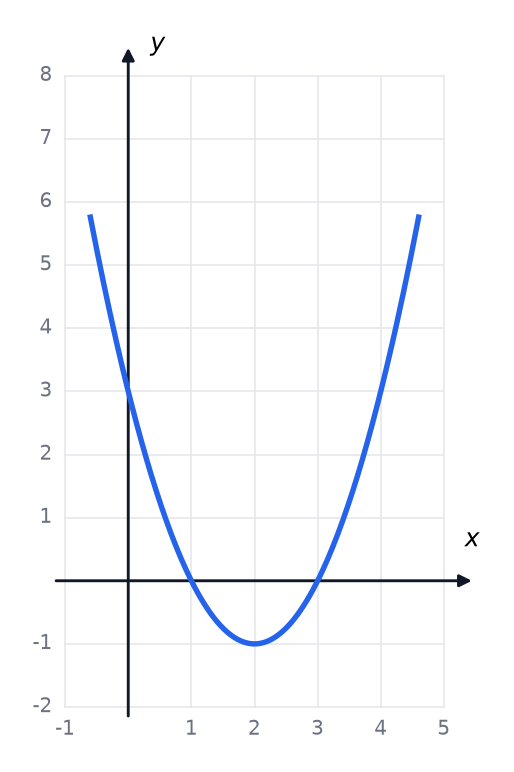
The diagram shows the graph of \(y = x^2 - 4x + 3\). (a) Write down the coordinates of the turning point. (1 mark) (b) Use the graph to solve \(x^2 - 4x + 3 = 0\). (2 marks) (c) Write down the equation of the line of symmetry of the graph. (1 mark)
Show answerHide answer
Model answer
(a) The lowest point is \((2, -1)\). (b) The curve crosses the \(x\)-axis at \(x = 1\) and \(x = 3\). (c) The line of symmetry goes through the turning point, so \(x = 2\).
Mark scheme
- (a) \((2, -1)\) — B1
- (b) One of \(x = 1\) or \(x = 3\) — M1
- (b) \(x = 1\) and \(x = 3\) — A1
- (c) \(x = 2\) — B1
-
3 Work out [3 marks]
(a) Write down the \(y\)-intercept of the graph of \(y = x^2 + 5x - 6\). (1 mark) (b) Solve \(x^2 + 5x - 6 = 0\) to find where the graph crosses the \(x\)-axis. (2 marks)
Show answerHide answer
Model answer
(a) Put \(x = 0\): \(y = -6\). (b) \(x^2 + 5x - 6 = (x + 6)(x - 1) = 0\), so \(x = -6\) and \(x = 1\).
Mark scheme
- (a) \(-6\) — B1
- (b) \((x + 6)(x - 1)\) — M1
- (b) \(x = -6\) and \(x = 1\) — A1
-
4 Work out [3 marks]
A curve has equation \(y = x^2 - 6x + 5\). (a) Work out the coordinates of the points where the curve crosses the \(x\)-axis. (2 marks) (b) Write down the equation of the line of symmetry of the curve. (1 mark)
Show answerHide answer
Model answer
(a) \(x^2 - 6x + 5 = (x - 1)(x - 5) = 0\), so the points are \((1, 0)\) and \((5, 0)\). (b) The line of symmetry is halfway between them: \(x = 3\).
Mark scheme
- (a) \((x - 1)(x - 5)\) — M1
- (a) \((1, 0)\) and \((5, 0)\) — A1
- (b) \(x = 3\) — B1
-
5 Work out [4 marks]
(a) Write \(x^2 - 8x + 7\) in the form \((x - a)^2 - b\). (2 marks) (b) Write down the coordinates of the turning point of the graph of \(y = x^2 - 8x + 7\). (1 mark) (c) Write down the equation of its line of symmetry. (1 mark)
Show answerHide answer
Model answer
(a) \(x^2 - 8x + 7 = (x - 4)^2 - 16 + 7 = (x - 4)^2 - 9\). (b) The turning point is \((4, -9)\). (c) The line of symmetry is \(x = 4\).
Mark scheme
- (a) \((x - 4)^2\) seen — M1
- (a) \((x - 4)^2 - 9\) — A1
- (b) \((4, -9)\) — B1
- (c) \(x = 4\) — B1
-
6 Work out [3 marks]
The equation of a curve is \(y = 4x - x^2\). Work out the coordinates of the maximum point of the curve.
Show answerHide answer
Model answer
The curve crosses the \(x\)-axis where \(x(4 - x) = 0\), at \(x = 0\) and \(x = 4\). The maximum is halfway between, at \(x = 2\), and \(y = 8 - 4 = 4\). The point is \((2, 4)\).
Mark scheme
- Roots 0 and 4 found, or \(x = 2\) seen — M1
- \(y = 4 \times 2 - 2^2\) — M1
- \((2, 4)\) — A1
Quick check
-
1
What is the shape of the graph of a quadratic equation?
Show answerHide answer
D: A parabola, a smooth U or upside-down U
Quadratic graphs are parabolas.
-
2
What are the roots of a graph?
Show answerHide answer
C: The \(x\)-values where the curve crosses the \(x\)-axis
At the roots \(y = 0\), so the curve meets the \(x\)-axis.
-
3
Work out \(y\) when \(x = -2\) on \(y = x^2 - 2x - 3\).
Show answerHide answer
B: \(5\)
\((-2)^2 - 2 \times (-2) - 3 = 4 + 4 - 3 = 5\).
-
4
What is the \(y\)-intercept of \(y = x^2 + 4x - 7\)?
Show answerHide answer
A: \(-7\)
Put \(x = 0\): \(y = -7\).
-
5
The graph of \(y = x^2 - 2x - 3\) crosses the \(x\)-axis at \(-1\) and 3. What are the solutions of \(x^2 - 2x - 3 = 0\)?
Show answerHide answer
D: \(x = -1\) and \(x = 3\)
The solutions are the \(x\)-values where \(y = 0\).
-
6
A parabola crosses the \(x\)-axis at \(x = 1\) and \(x = 5\). What is its line of symmetry?
Show answerHide answer
C: \(x = 3\)
The line of symmetry is halfway between the roots: \(\dfrac{1 + 5}{2} = 3\).
-
7
The curve \(y = x^2 - 4x + 3\) crosses the \(x\)-axis at 1 and 3. What are the coordinates of its turning point?
Show answerHide answer
B: \((2, -1)\)
\(x = 2\) is halfway between the roots. Then \(y = 4 - 8 + 3 = -1\).
-
8
Which line do you draw on the graph of \(y = x^2 - 2x - 3\) to solve \(x^2 - 2x - 3 = 2\)?
Show answerHide answer
A: \(y = 2\)
Solutions are where the curve meets the horizontal line \(y = 2\).
-
9
What are the coordinates of the turning point of \(y = (x - 3)^2 - 4\)?
Show answerHide answer
D: \((3, -4)\)
In \(y = (x - a)^2 + b\) the turning point is \((a, b)\).