Exam questions · Maths · Number Without a Calculator
Fractions
- 7 exam questions
- 21 marks
- 10 quick checks
-
1 Work out [2 marks]
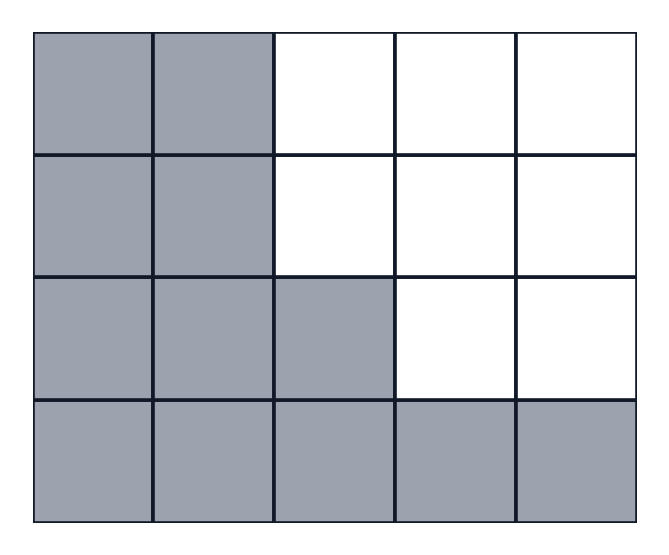
What fraction of the shape is shaded? Give your answer in its simplest form.
Show answerHide answer
Model answer
There are 20 equal squares and 12 are shaded, so the fraction is \(\dfrac{12}{20}\). Dividing the top and bottom by 4 gives \(\dfrac{3}{5}\).
Mark scheme
- \(\dfrac{12}{20}\) or 12 shaded out of 20 — M1
- \(\dfrac{3}{5}\) — A1
-
2 Work out [3 marks]
Work out \(\dfrac{3}{4} + \dfrac{5}{6}\). Give your answer as a mixed number.
Show answerHide answer
Model answer
A common denominator is 12: \(\dfrac{9}{12} + \dfrac{10}{12} = \dfrac{19}{12} = 1\dfrac{7}{12}\).
Mark scheme
- A common denominator of 12 (or a multiple of 12) — M1
- \(\dfrac{9}{12} + \dfrac{10}{12}\) or \(\dfrac{19}{12}\) — M1
- \(1\dfrac{7}{12}\) — A1
-
3 Work out [3 marks]
Work out \(4\dfrac{1}{5} - 2\dfrac{3}{4}\). Give your answer as a mixed number.
Show answerHide answer
Model answer
\(4\dfrac{1}{5} = \dfrac{21}{5} = \dfrac{84}{20}\) and \(2\dfrac{3}{4} = \dfrac{11}{4} = \dfrac{55}{20}\). So \(\dfrac{84}{20} - \dfrac{55}{20} = \dfrac{29}{20} = 1\dfrac{9}{20}\).
Mark scheme
- Converts to improper fractions or to a common denominator of 20 — M1
- \(\dfrac{84}{20} - \dfrac{55}{20}\) or equivalent — M1
- \(1\dfrac{9}{20}\) — A1
-
4 Work out [3 marks]
Work out \(2\dfrac{1}{4} \times 1\dfrac{1}{3}\). Give your answer as a mixed number or integer.
Show answerHide answer
Model answer
\(2\dfrac{1}{4} = \dfrac{9}{4}\) and \(1\dfrac{1}{3} = \dfrac{4}{3}\). Then \(\dfrac{9}{4} \times \dfrac{4}{3} = \dfrac{36}{12} = 3\).
Mark scheme
- Converts both mixed numbers to improper fractions — M1
- \(\dfrac{9}{4} \times \dfrac{4}{3}\) or \(\dfrac{36}{12}\) — M1
- 3 — A1
-
5 Work out [3 marks]
Work out \(\dfrac{5}{8} \div \dfrac{3}{4}\). Give your answer in its simplest form.
Show answerHide answer
Model answer
\(\dfrac{5}{8} \div \dfrac{3}{4} = \dfrac{5}{8} \times \dfrac{4}{3} = \dfrac{20}{24} = \dfrac{5}{6}\).
Mark scheme
- Inverts the second fraction: \(\dfrac{5}{8} \times \dfrac{4}{3}\) — M1
- \(\dfrac{20}{24}\) — M1
- \(\dfrac{5}{6}\) — A1
-
6 Work out [4 marks]
Priya earns \(\pounds 480\) one week. She spends \(\dfrac{3}{8}\) of it on rent. She spends \(\dfrac{1}{4}\) of the money she has left on food. How much does she have left after paying for rent and food?
Show answerHide answer
Model answer
Rent: \(\dfrac{3}{8} \times 480 = 60 \times 3 = \pounds 180\). Left after rent: \(480 - 180 = \pounds 300\). Food: \(\dfrac{1}{4} \times 300 = \pounds 75\). Left: \(300 - 75 = \pounds 225\).
Mark scheme
- \(\dfrac{3}{8} \times 480 = 180\) — M1
- \(480 - 180 = 300\) — M1
- \(\dfrac{1}{4} \times 300 = 75\) — M1
- \(\pounds 225\) — A1
-
7 Show that [3 marks]
Show that \(1\dfrac{2}{5} \div \dfrac{7}{10} = 2\)
Show answerHide answer
Model answer
\(1\dfrac{2}{5} = \dfrac{7}{5}\), so \(\dfrac{7}{5} \div \dfrac{7}{10} = \dfrac{7}{5} \times \dfrac{10}{7} = \dfrac{70}{35} = 2\), as required.
Mark scheme
- Converts \(1\dfrac{2}{5}\) to \(\dfrac{7}{5}\) — M1
- Inverts to give \(\dfrac{7}{5} \times \dfrac{10}{7}\) — M1
- Cancels or evaluates \(\dfrac{70}{35}\) and states the result is 2 — C1
Quick check
-
1
\(\dfrac{3}{5}\) of a number is 36. What is the number?
Show answerHide answer
A: 60
\(36 \div 3 = 12\) is one fifth, so the whole number is \(12 \times 5 = 60\).
-
2
What fraction of 2 hours is 35 minutes? Give your answer in its simplest form.
Show answerHide answer
D: \(\dfrac{7}{24}\)
Convert to minutes: \(\dfrac{35}{120} = \dfrac{7}{24}\).
-
3
Work out \(\dfrac{1}{2} + \dfrac{1}{3}\).
Show answerHide answer
A: \(\dfrac{5}{6}\)
Use a common denominator of 6: \(\dfrac{3}{6} + \dfrac{2}{6} = \dfrac{5}{6}\).
-
4
What is \(\dfrac{3}{5}\) of 40?
Show answerHide answer
B: 24
\(40 \div 5 = 8\), then \(8 \times 3 = 24\).
-
5
Work out \(\dfrac{2}{3} \div 4\).
Show answerHide answer
C: \(\dfrac{1}{6}\)
Dividing by 4 is multiplying by \(\dfrac{1}{4}\): \(\dfrac{2}{3} \times \dfrac{1}{4} = \dfrac{2}{12} = \dfrac{1}{6}\).
-
6
Write \(3\dfrac{2}{5}\) as an improper fraction.
Show answerHide answer
C: \(\dfrac{17}{5}\)
\(3 \times 5 + 2 = 17\), so the fraction is \(\dfrac{17}{5}\).
-
7
Which fraction is equal to \(\dfrac{18}{24}\)?
Show answerHide answer
D: \(\dfrac{3}{4}\)
The HCF of 18 and 24 is 6, and dividing both by 6 gives \(\dfrac{3}{4}\).
-
8
Work out \(\dfrac{3}{4} \times \dfrac{2}{9}\).
Show answerHide answer
D: \(\dfrac{1}{6}\)
Multiply across and simplify: \(\dfrac{6}{36} = \dfrac{1}{6}\).
-
9
What is the reciprocal of \(\dfrac{5}{7}\)?
Show answerHide answer
B: \(\dfrac{7}{5}\)
The reciprocal is the fraction turned upside down, which is \(\dfrac{7}{5}\).
-
10
Which of these fractions is the largest?
Show answerHide answer
A: \(\dfrac{2}{3}\)
As decimals they are 0.625, 0.667, 0.583 and 0.6, so \(\dfrac{2}{3}\) is the largest.