Exam questions · Maths
Number Without a Calculator
- 34 exam questions
- 97 marks
- 48 quick checks
Place Value, Negatives and the Four Operations
Just this lesson-
1 Write [2 marks]
Write these numbers in order of size. Start with the smallest. \(0.45\) \(0.405\) \(0.54\) \(0.045\)
Show answerHide answer
Model answer
\(0.045,\ 0.405,\ 0.45,\ 0.54\). Writing every number to three decimal places (0.450, 0.405, 0.540, 0.045) makes the comparison easy.
Mark scheme
- At least three of the numbers in the correct order, or all four written to 3 decimal places — M1
- \(0.045, 0.405, 0.45, 0.54\) — A1
-
2 Work out [3 marks]
Work out \(346 \times 27\). You must show all your working.
Show answerHide answer
Model answer
\(346 \times 20 = 6920\) and \(346 \times 7 = 2422\), so \(346 \times 27 = 6920 + 2422 = 9342\).
Mark scheme
- A complete method with at most one arithmetic error, such as \(346\times20\) and \(346\times7\), or a grid — M1
- Adds their partial products — M1
- 9342 — A1
-
3 Work out [2 marks]
Work out \(8.4 \div 0.07\).
Show answerHide answer
Model answer
Multiply both numbers by 100 so the divisor is a whole number: \(840 \div 7 = 120\).
Mark scheme
- Converts to a whole-number division such as \(840 \div 7\) — M1
- 120 — A1
-
4 Work out [3 marks]
At midnight the temperature in Oslo was \(-7^\circ\text{C}\). By noon the temperature had risen by 12 degrees. (a) Work out the temperature at noon. (1 mark) At 6 pm the temperature had fallen by 11 degrees from its value at noon. (b) Work out the temperature at 6 pm. (2 marks)
Show answerHide answer
Model answer
(a) \(-7 + 12 = 5^\circ\text{C}\). (b) \(5 - 11 = -6^\circ\text{C}\).
Mark scheme
- (a) \(5^\circ\text{C}\) — B1
- (b) Subtracts 11 from their noon temperature — M1
- \(-6^\circ\text{C}\) — A1 (follow through from (a))
-
5 Work out [3 marks]
Work out \((-3)^2 - 4 \times (-2) + 6 \div (-3)\).
Show answerHide answer
Model answer
\((-3)^2 = 9\), \(-4 \times (-2) = +8\) and \(6 \div (-3) = -2\), so the total is \(9 + 8 - 2 = 15\).
Mark scheme
- \((-3)^2 = 9\) — M1
- At least one of \(-4 \times (-2) = 8\) or \(6 \div (-3) = -2\) — M1
- 15 — A1
-
6 Show that [3 marks]
Show that \(4.5 \times 0.8 + 2.4 \div 0.6 = 7.6\)
Show answerHide answer
Model answer
\(4.5 \times 0.8 = 3.6\) because \(45 \times 8 = 360\) with two decimal places. \(2.4 \div 0.6 = 24 \div 6 = 4\). Then \(3.6 + 4 = 7.6\), as required.
Mark scheme
- \(4.5 \times 0.8 = 3.6\) — M1
- \(2.4 \div 0.6 = 4\) — M1
- \(3.6 + 4 = 7.6\) with the conclusion stated — C1
-
7 Work out [5 marks]
Hassan buys 15 boxes of pencils. Each box contains 24 pencils and costs \(\pounds 4.80\). (a) Work out the total number of pencils. (2 marks) (b) Work out the total cost of the 15 boxes. (3 marks)
Show answerHide answer
Model answer
(a) \(15 \times 24 = 360\) pencils. (b) \(15 \times 4.80 = 10 \times 4.80 + 5 \times 4.80 = 48 + 24 = \pounds 72\).
Mark scheme
- (a) \(15 \times 24\) or equivalent — M1
- (a) 360 — A1
- (b) A complete method, such as \(10 \times 4.80\) and \(5 \times 4.80\), or \(15 \times 480\) — M1
- (b) Evaluates and gives a consistent decimal point — M1
- (b) \(\pounds 72\) — A1
Quick check
-
1
Estimate \(38 \times 21\) by rounding each number to 1 significant figure.
Show answerHide answer
D: 800
\(38 \approx 40\) and \(21 \approx 20\), so the estimate is \(40 \times 20 = 800\).
-
2
Tickets cost £8.50 each. How many tickets can be bought with £60?
Show answerHide answer
A: 7
\(8.50 \times 7 = 59.50\), which fits, and \(8.50 \times 8 = 68\), which does not.
-
3
What is the value of the digit 7 in the number 4.073?
Show answerHide answer
B: 7 hundredths
The 7 is in the second column after the decimal point, so it is worth 7 hundredths.
-
4
Which of these decimals is the largest?
Show answerHide answer
B: 0.809
Writing each to 3 decimal places gives 0.800, 0.750, 0.809 and 0.098, so 0.809 is largest.
-
5
What is 6.4 ÷ 100?
Show answerHide answer
A: 0.064
Dividing by 100 moves every digit two columns to the right, giving 0.064.
-
6
Work out \(-3 - (-7)\).
Show answerHide answer
B: \(4\)
Subtracting a negative is the same as adding: \(-3 + 7 = 4\).
-
7
Work out \((-6) \times 3 \div (-2)\).
Show answerHide answer
C: \(9\)
\((-6)\times 3 = -18\), then \(-18 \div (-2) = 9\) because the signs are the same.
-
8
Work out \(2 + 3 \times 4^2\).
Show answerHide answer
C: \(50\)
Indices first: \(4^2 = 16\). Then multiply: \(3 \times 16 = 48\). Then add: \(2 + 48 = 50\).
-
9
Work out \(0.3 \times 0.2\).
Show answerHide answer
A: 0.06
\(3 \times 2 = 6\) and there are 2 decimal places in total, so the answer is 0.06.
Factors, Multiples and Primes
Just this lesson-
1 List [2 marks]
List all the factors of 36.
Show answerHide answer
Model answer
\(1, 2, 3, 4, 6, 9, 12, 18, 36\). They come in pairs: \(1 \times 36\), \(2 \times 18\), \(3 \times 12\), \(4 \times 9\) and \(6 \times 6\).
Mark scheme
- At least 5 correct factors with no more than one incorrect extra — M1
- All nine factors and no others — A1
-
2 Write down [2 marks]
Here is a list of numbers. \(15\) \(21\) \(23\) \(27\) \(35\) \(41\) \(51\) From the list, write down all the prime numbers.
Show answerHide answer
Model answer
\(23\) and \(41\). \(51 = 3 \times 17\), so it is not prime, and the other numbers all have a factor other than 1 and themselves.
Mark scheme
- Either 23 or 41 with no more than one incorrect extra — B1
- Both 23 and 41 and no others — B1
-
3 Work out [3 marks]
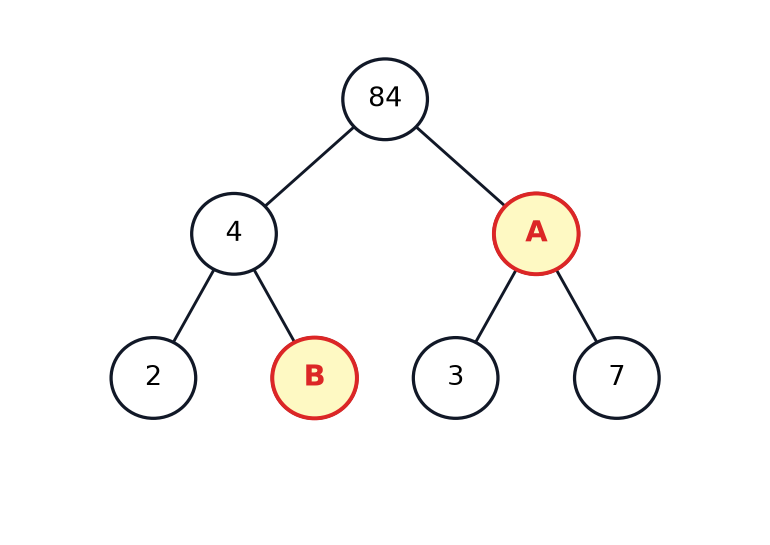
Here is part of a factor tree for 84. The circled letters A and B stand for missing numbers. (a) Work out the value of A and the value of B. (2 marks) (b) Write 84 as a product of its prime factors. Give your answer in index form. (1 mark)
Show answerHide answer
Model answer
(a) \(A = 84 \div 4 = 21\) and \(B = 4 \div 2 = 2\). (b) \(84 = 2 \times 2 \times 3 \times 7 = 2^2 \times 3 \times 7\).
Mark scheme
- A = 21 — B1
- B = 2 — B1
- \(2^2 \times 3 \times 7\) — B1
-
4 Express [3 marks]
Express 540 as a product of its prime factors. Give your answer in index form.
Show answerHide answer
Model answer
\(540 = 54 \times 10 = 2 \times 27 \times 2 \times 5\), so \(540 = 2^2 \times 3^3 \times 5\).
Mark scheme
- Starts a correct factor tree or repeated division, with at least two correct stages — M1
- \(2 \times 2 \times 3 \times 3 \times 3 \times 5\), or a product of primes with at most one error — M1
- \(2^2 \times 3^3 \times 5\) — A1
-
5 Find [6 marks]
(a) Express 48 as a product of its prime factors. (2 marks) Given that \(84 = 2^2 \times 3 \times 7\), (b) find the highest common factor (HCF) of 48 and 84. (2 marks) (c) find the lowest common multiple (LCM) of 48 and 84. (2 marks)
Show answerHide answer
Model answer
(a) \(48 = 2 \times 2 \times 2 \times 2 \times 3 = 2^4 \times 3\). (b) The common primes are \(2^2\) and 3, so the HCF is \(4 \times 3 = 12\). (c) Take the highest power of every prime: \(2^4 \times 3 \times 7 = 16 \times 21 = 336\).
Mark scheme
- (a) Correct method to factorise 48 — M1
- (a) \(2^4 \times 3\) — A1
- (b) Identifies the common factors \(2^2\) and 3, or \(2 \times 2 \times 3\) — M1
- (b) 12 — A1
- (c) \(2^4 \times 3 \times 7\) or a correct list of multiples — M1
- (c) 336 — A1
-
6 Work out [3 marks]
Tom visits his grandmother every 6 days. Lisa visits her every 8 days. They both visited on 1 June. On what date will they next both visit their grandmother?
Show answerHide answer
Model answer
The days they both visit are common multiples of 6 and 8. The multiples of 6 are 6, 12, 18, 24 and those of 8 are 8, 16, 24, so the LCM is 24. 24 days after 1 June is 25 June.
Mark scheme
- A list of at least three multiples of each number, or the prime factors of both — M1
- 24 — A1
- 25 June — C1
Quick check
-
1
What is the smallest whole number that 72 must be multiplied by to give a square number?
Show answerHide answer
A: 2
\(72 = 2^3 \times 3^2\). The index of 2 is odd, so multiply by 2 to get \(144 = 12^2\).
-
2
A teacher has 48 red pens and 72 blue pens. What is the greatest number of identical packs that she can make using all of the pens?
Show answerHide answer
D: 24
The answer is the HCF of 48 and 72, which is 24.
-
3
Which of these numbers is prime?
Show answerHide answer
C: 59
59 has no factors other than 1 and 59. 51 = 3 × 17, 57 = 3 × 19 and 63 = 7 × 9.
-
4
What is the highest common factor (HCF) of 18 and 30?
Show answerHide answer
A: 6
The common factors are 1, 2, 3 and 6, and the highest of these is 6.
-
5
What is the lowest common multiple (LCM) of 6 and 8?
Show answerHide answer
C: 24
Multiples of 8 are 8, 16, 24 and 24 is the first one that is also a multiple of 6.
-
6
Which of these is 72 written as a product of its prime factors?
Show answerHide answer
C: \(2^3 \times 3^2\)
72 = 8 × 9 = 2 × 2 × 2 × 3 × 3 = \(2^3 \times 3^2\).
-
7
How many factors does 20 have?
Show answerHide answer
C: 6
The factors are 1, 2, 4, 5, 10 and 20, which makes six.
-
8
Which of these numbers is divisible by 9?
Show answerHide answer
C: 4527
The digits of 4527 add up to 18, which is a multiple of 9.
-
9
Two lights flash every 8 seconds and every 12 seconds. They flash together now. After how many seconds will they next flash together?
Show answerHide answer
D: 24
The LCM of 8 and 12 is 24, so they next flash together after 24 seconds.
Fractions
Just this lesson-
1 Work out [2 marks]
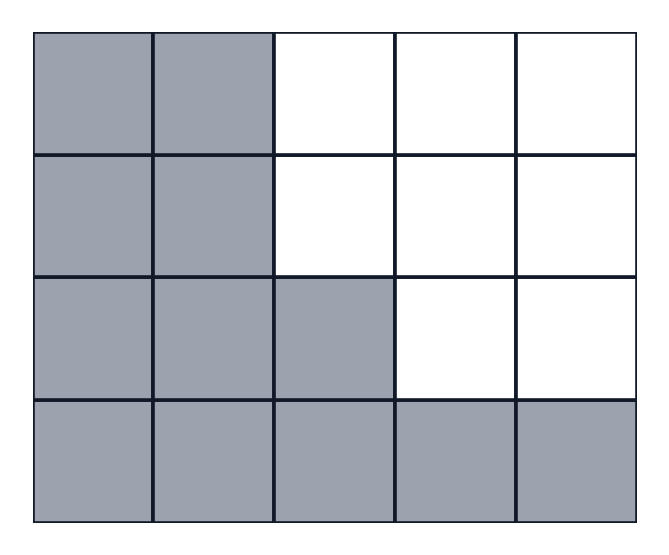
What fraction of the shape is shaded? Give your answer in its simplest form.
Show answerHide answer
Model answer
There are 20 equal squares and 12 are shaded, so the fraction is \(\dfrac{12}{20}\). Dividing the top and bottom by 4 gives \(\dfrac{3}{5}\).
Mark scheme
- \(\dfrac{12}{20}\) or 12 shaded out of 20 — M1
- \(\dfrac{3}{5}\) — A1
-
2 Work out [3 marks]
Work out \(\dfrac{3}{4} + \dfrac{5}{6}\). Give your answer as a mixed number.
Show answerHide answer
Model answer
A common denominator is 12: \(\dfrac{9}{12} + \dfrac{10}{12} = \dfrac{19}{12} = 1\dfrac{7}{12}\).
Mark scheme
- A common denominator of 12 (or a multiple of 12) — M1
- \(\dfrac{9}{12} + \dfrac{10}{12}\) or \(\dfrac{19}{12}\) — M1
- \(1\dfrac{7}{12}\) — A1
-
3 Work out [3 marks]
Work out \(4\dfrac{1}{5} - 2\dfrac{3}{4}\). Give your answer as a mixed number.
Show answerHide answer
Model answer
\(4\dfrac{1}{5} = \dfrac{21}{5} = \dfrac{84}{20}\) and \(2\dfrac{3}{4} = \dfrac{11}{4} = \dfrac{55}{20}\). So \(\dfrac{84}{20} - \dfrac{55}{20} = \dfrac{29}{20} = 1\dfrac{9}{20}\).
Mark scheme
- Converts to improper fractions or to a common denominator of 20 — M1
- \(\dfrac{84}{20} - \dfrac{55}{20}\) or equivalent — M1
- \(1\dfrac{9}{20}\) — A1
-
4 Work out [3 marks]
Work out \(2\dfrac{1}{4} \times 1\dfrac{1}{3}\). Give your answer as a mixed number or integer.
Show answerHide answer
Model answer
\(2\dfrac{1}{4} = \dfrac{9}{4}\) and \(1\dfrac{1}{3} = \dfrac{4}{3}\). Then \(\dfrac{9}{4} \times \dfrac{4}{3} = \dfrac{36}{12} = 3\).
Mark scheme
- Converts both mixed numbers to improper fractions — M1
- \(\dfrac{9}{4} \times \dfrac{4}{3}\) or \(\dfrac{36}{12}\) — M1
- 3 — A1
-
5 Work out [3 marks]
Work out \(\dfrac{5}{8} \div \dfrac{3}{4}\). Give your answer in its simplest form.
Show answerHide answer
Model answer
\(\dfrac{5}{8} \div \dfrac{3}{4} = \dfrac{5}{8} \times \dfrac{4}{3} = \dfrac{20}{24} = \dfrac{5}{6}\).
Mark scheme
- Inverts the second fraction: \(\dfrac{5}{8} \times \dfrac{4}{3}\) — M1
- \(\dfrac{20}{24}\) — M1
- \(\dfrac{5}{6}\) — A1
-
6 Work out [4 marks]
Priya earns \(\pounds 480\) one week. She spends \(\dfrac{3}{8}\) of it on rent. She spends \(\dfrac{1}{4}\) of the money she has left on food. How much does she have left after paying for rent and food?
Show answerHide answer
Model answer
Rent: \(\dfrac{3}{8} \times 480 = 60 \times 3 = \pounds 180\). Left after rent: \(480 - 180 = \pounds 300\). Food: \(\dfrac{1}{4} \times 300 = \pounds 75\). Left: \(300 - 75 = \pounds 225\).
Mark scheme
- \(\dfrac{3}{8} \times 480 = 180\) — M1
- \(480 - 180 = 300\) — M1
- \(\dfrac{1}{4} \times 300 = 75\) — M1
- \(\pounds 225\) — A1
-
7 Show that [3 marks]
Show that \(1\dfrac{2}{5} \div \dfrac{7}{10} = 2\)
Show answerHide answer
Model answer
\(1\dfrac{2}{5} = \dfrac{7}{5}\), so \(\dfrac{7}{5} \div \dfrac{7}{10} = \dfrac{7}{5} \times \dfrac{10}{7} = \dfrac{70}{35} = 2\), as required.
Mark scheme
- Converts \(1\dfrac{2}{5}\) to \(\dfrac{7}{5}\) — M1
- Inverts to give \(\dfrac{7}{5} \times \dfrac{10}{7}\) — M1
- Cancels or evaluates \(\dfrac{70}{35}\) and states the result is 2 — C1
Quick check
-
1
\(\dfrac{3}{5}\) of a number is 36. What is the number?
Show answerHide answer
A: 60
\(36 \div 3 = 12\) is one fifth, so the whole number is \(12 \times 5 = 60\).
-
2
What fraction of 2 hours is 35 minutes? Give your answer in its simplest form.
Show answerHide answer
D: \(\dfrac{7}{24}\)
Convert to minutes: \(\dfrac{35}{120} = \dfrac{7}{24}\).
-
3
Work out \(\dfrac{1}{2} + \dfrac{1}{3}\).
Show answerHide answer
A: \(\dfrac{5}{6}\)
Use a common denominator of 6: \(\dfrac{3}{6} + \dfrac{2}{6} = \dfrac{5}{6}\).
-
4
What is \(\dfrac{3}{5}\) of 40?
Show answerHide answer
B: 24
\(40 \div 5 = 8\), then \(8 \times 3 = 24\).
-
5
Work out \(\dfrac{2}{3} \div 4\).
Show answerHide answer
C: \(\dfrac{1}{6}\)
Dividing by 4 is multiplying by \(\dfrac{1}{4}\): \(\dfrac{2}{3} \times \dfrac{1}{4} = \dfrac{2}{12} = \dfrac{1}{6}\).
-
6
Write \(3\dfrac{2}{5}\) as an improper fraction.
Show answerHide answer
C: \(\dfrac{17}{5}\)
\(3 \times 5 + 2 = 17\), so the fraction is \(\dfrac{17}{5}\).
-
7
Which fraction is equal to \(\dfrac{18}{24}\)?
Show answerHide answer
D: \(\dfrac{3}{4}\)
The HCF of 18 and 24 is 6, and dividing both by 6 gives \(\dfrac{3}{4}\).
-
8
Work out \(\dfrac{3}{4} \times \dfrac{2}{9}\).
Show answerHide answer
D: \(\dfrac{1}{6}\)
Multiply across and simplify: \(\dfrac{6}{36} = \dfrac{1}{6}\).
-
9
What is the reciprocal of \(\dfrac{5}{7}\)?
Show answerHide answer
B: \(\dfrac{7}{5}\)
The reciprocal is the fraction turned upside down, which is \(\dfrac{7}{5}\).
-
10
Which of these fractions is the largest?
Show answerHide answer
A: \(\dfrac{2}{3}\)
As decimals they are 0.625, 0.667, 0.583 and 0.6, so \(\dfrac{2}{3}\) is the largest.
Fractions, Decimals and Percentages
Just this lesson-
1 Write [2 marks]
Write \(28\%\) as a fraction in its simplest form.
Show answerHide answer
Model answer
\(28\% = \dfrac{28}{100}\). Dividing the top and bottom by 4 gives \(\dfrac{7}{25}\).
Mark scheme
- \(\dfrac{28}{100}\) — M1
- \(\dfrac{7}{25}\) — A1
-
2 Work out [3 marks]
Work out \(17.5\%\) of \(\pounds 360\).
Show answerHide answer
Model answer
\(10\% = 36\), \(5\% = 18\) and \(2.5\% = 9\), so \(17.5\% = 36 + 18 + 9 = \pounds 63\).
Mark scheme
- Finds 10% (\(\pounds 36\)) or 5% (\(\pounds 18\)) — M1
- Finds 2.5% (\(\pounds 9\)) and adds the parts — M1
- \(\pounds 63\) — A1
-
3 Write [2 marks]
Write these numbers in order of size. Start with the smallest. \(0.6\) \(\dfrac{5}{8}\) \(62\%\)
Show answerHide answer
Model answer
\(\dfrac{5}{8} = 0.625\) and \(62\% = 0.62\). The order is \(0.6,\ 62\%,\ \dfrac{5}{8}\).
Mark scheme
- Converts at least two of the numbers to the same form — M1
- \(0.6,\ 62\%,\ \dfrac{5}{8}\) — A1
-
4 Work out [3 marks]
A laptop costs \(\pounds 650\) before VAT. VAT at \(20\%\) is added. Work out the total cost of the laptop.
Show answerHide answer
Model answer
\(20\% = 2 \times 10\% = 2 \times 65 = \pounds 130\), so the total is \(650 + 130 = \pounds 780\).
Mark scheme
- Finds 10% (\(\pounds 65\)) or 20% (\(\pounds 130\)) — M1
- \(650 + 130\) or \(650 \times 1.2\) — M1
- \(\pounds 780\) — A1
-
5 Work out [3 marks]
In a sale, the normal price of a bike is reduced by \(30\%\). The sale price is \(\pounds 56\). Work out the normal price of the bike.
Show answerHide answer
Model answer
The sale price is \(100\% - 30\% = 70\%\) of the normal price. \(70\% = 56\), so \(10\% = 56 \div 7 = 8\) and \(100\% = 8 \times 10 = \pounds 80\).
Mark scheme
- Recognises that £56 is 70% of the normal price — M1
- \(56 \div 7 = 8\) (10%) or \(56 \div 0.7\) — M1
- \(\pounds 80\) — A1
-
6 Work out [3 marks]
Raj bought a car for \(\pounds 6000\). A year later its value was \(\pounds 4800\). Work out the percentage decrease in the value of the car.
Show answerHide answer
Model answer
The decrease is \(6000 - 4800 = \pounds 1200\). As a fraction of the original value this is \(\dfrac{1200}{6000} = \dfrac{1}{5}\), which is \(20\%\).
Mark scheme
- \(6000 - 4800 = 1200\) — M1
- \(\dfrac{1200}{6000} \times 100\) or \(\dfrac{1200}{6000}\) — M1
- 20% — A1
-
7 Work out [4 marks]
Two shops sell the same camera. Shop A: normal price \(\pounds 320\), sale price is \(15\%\) off. Shop B: normal price \(\pounds 340\), sale price is \(25\%\) off. Which shop has the cheaper sale price? You must show your working.
Show answerHide answer
Model answer
Shop A: \(10\% = 32\) and \(5\% = 16\), so \(15\% = 48\) and the sale price is \(320 - 48 = \pounds 272\). Shop B: \(25\% = \dfrac{1}{4} \times 340 = 85\), so the sale price is \(340 - 85 = \pounds 255\). Shop B is cheaper.
Mark scheme
- Finds 15% of 320 (\(\pounds 48\)) or 25% of 340 (\(\pounds 85\)) — M1
- Subtracts to get \(\pounds 272\) or \(\pounds 255\) — M1
- Both sale prices correct — A1
- States that Shop B is cheaper, consistent with their prices — C1
Quick check
-
1
Which of these fractions is a recurring decimal?
Show answerHide answer
B: \(\dfrac{1}{6}\)
6 has the prime factor 3, so \(\dfrac{1}{6} = 0.1\dot{6}\) recurs. The others have denominators with only the prime factors 2 and 5.
-
2
£500 is invested for 4 years at 3% simple interest per year. How much interest is earned in total?
Show answerHide answer
C: £60
3% of £500 is £15 a year, and \(15 \times 4 = £60\).
-
3
Write 0.035 as a percentage.
Show answerHide answer
B: 3.5%
Multiply by 100: \(0.035 \times 100 = 3.5\%\).
-
4
Write \(\dfrac{3}{8}\) as a percentage.
Show answerHide answer
D: 37.5%
\(3 \div 8 = 0.375\), and \(0.375 \times 100 = 37.5\%\).
-
5
What is 15% of 60?
Show answerHide answer
C: 9
10% is 6 and 5% is 3, so 15% is 9.
-
6
What is the multiplier for a decrease of 8%?
Show answerHide answer
B: 0.92
100% − 8% = 92%, which is 0.92.
-
7
Increase £60 by 25%.
Show answerHide answer
B: £75
25% of 60 is 15, and 60 + 15 = 75.
-
8
After a 20% decrease, a price is £48. What was the original price?
Show answerHide answer
B: £60
The sale price is 80% of the original, so the original is 48 ÷ 0.8 = £60.
-
9
A price rises from 40 to 50. What is the percentage increase?
Show answerHide answer
A: 25%
The change is 10, and \(\dfrac{10}{40} \times 100 = 25\%\). It is divided by the original, not the new price.
-
10
Write 12.5% as a fraction in its simplest form.
Show answerHide answer
A: \(\dfrac{1}{8}\)
\(12.5\% = \dfrac{12.5}{100} = \dfrac{1}{8}\).
Powers, Roots and Indices
Just this lesson-
1 Work out [2 marks]
Work out the value of (a) \(4^3\) (1 mark) (b) \(\sqrt{121}\) (1 mark)
Show answerHide answer
Model answer
(a) \(4 \times 4 \times 4 = 64\). (b) \(\sqrt{121} = 11\) because \(11 \times 11 = 121\).
Mark scheme
- (a) 64 — B1
- (b) 11 — B1
-
2 Simplify [2 marks]
Simplify (a) \(7^4 \times 7^5\) (1 mark) (b) \(3^{10} \div 3^4\) (1 mark)
Show answerHide answer
Model answer
(a) Add the indices: \(7^{4+5} = 7^9\). (b) Subtract the indices: \(3^{10-4} = 3^6\).
Mark scheme
- (a) \(7^9\) — B1
- (b) \(3^6\) — B1
-
3 Work out [3 marks]
(a) Write down the value of \(9^0\). (1 mark) (b) Work out the value of \(5^{-2}\). (2 marks)
Show answerHide answer
Model answer
(a) Any non-zero number to the power 0 is 1, so \(9^0 = 1\). (b) \(5^{-2} = \dfrac{1}{5^2} = \dfrac{1}{25}\).
Mark scheme
- (a) 1 — B1
- (b) \(\dfrac{1}{5^2}\) or \(\dfrac{1}{25}\) — M1
- (b) \(\dfrac{1}{25}\) or 0.04 — A1
-
4 Work out [2 marks]
Work out the value of \(\dfrac{3^5 \times 3^{-2}}{3}\).
Show answerHide answer
Model answer
The top is \(3^{5-2} = 3^3\). Then \(3^3 \div 3^1 = 3^2 = 9\).
Mark scheme
- \(3^3\) for the numerator, or a power of 3 with at most one index error — M1
- 9 — A1
-
5 Simplify [2 marks]
Simplify fully \((2p^3q)^4\).
Show answerHide answer
Model answer
Raise every part to the power 4: \(2^4 \times (p^3)^4 \times q^4 = 16p^{12}q^4\).
Mark scheme
- Any two of \(16\), \(p^{12}\), \(q^4\) correct — M1
- \(16p^{12}q^4\) — A1
-
6 Work out [3 marks]
(a) Work out the value of \(49^{\frac{1}{2}}\). (1 mark) (b) Work out the value of \(8^{-\frac{2}{3}}\). (2 marks)
Show answerHide answer
Model answer
(a) A power of one half means the square root, so \(49^{\frac{1}{2}} = 7\). (b) \(8^{-\frac{2}{3}} = \dfrac{1}{8^{\frac{2}{3}}} = \dfrac{1}{(\sqrt[3]{8})^2} = \dfrac{1}{2^2} = \dfrac{1}{4}\).
Mark scheme
- (a) 7 — B1
- (b) \(\dfrac{1}{8^{2/3}}\) or \(\sqrt[3]{8} = 2\) — M1
- (b) \(\dfrac{1}{4}\) or 0.25 — A1
-
7 Write [2 marks]
Write \(\dfrac{1}{32}\) as a power of 2.
Show answerHide answer
Model answer
\(32 = 2^5\), so \(\dfrac{1}{32} = \dfrac{1}{2^5} = 2^{-5}\).
Mark scheme
- \(32 = 2^5\) or \(\dfrac{1}{2^5}\) — M1
- \(2^{-5}\) — A1
Quick check
-
1
Between which two whole numbers does \(\sqrt{40}\) lie?
Show answerHide answer
A: 6 and 7
\(6^2 = 36\) and \(7^2 = 49\), and 40 is between 36 and 49.
-
2
Write \(16 \times 8\) as a single power of 2.
Show answerHide answer
D: \(2^7\)
\(16 = 2^4\) and \(8 = 2^3\), so \(2^4 \times 2^3 = 2^7\).
-
3
What is the value of \(\sqrt{196}\)?
Show answerHide answer
B: 14
14 × 14 = 196.
-
4
What is the value of \(4^3\)?
Show answerHide answer
C: 64
\(4 \times 4 \times 4 = 64\), not \(4 \times 3 = 12\).
-
5
Simplify \(a^5 \times a^3\).
Show answerHide answer
C: \(a^8\)
Add the indices when multiplying: \(a^{5+3} = a^8\).
-
6
Simplify \((3^2)^4\).
Show answerHide answer
A: \(3^8\)
For a power of a power, multiply the indices: \(3^{2 \times 4} = 3^8\).
-
7
What is the value of \(5^{-2}\)?
Show answerHide answer
B: \(\dfrac{1}{25}\)
A negative index means a reciprocal: \(5^{-2} = \dfrac{1}{5^2} = \dfrac{1}{25}\).
-
8
What is the value of \(7^0\)?
Show answerHide answer
A: 1
Any non-zero number to the power 0 is 1.
-
9
Simplify \(2^6 \div 2^{-2}\).
Show answerHide answer
C: \(2^8\)
Subtract the indices: \(6 - (-2) = 8\), so the answer is \(2^8\).
-
10
What is the value of \(8^{\frac{1}{3}}\)?
Show answerHide answer
D: 2
A power of one third means the cube root, and \(2 \times 2 \times 2 = 8\).