Exam questions · Maths · Functions, Sequences and Rates of Change
Functions and Function Notation
- 6 exam questions
- 22 marks
- 9 quick checks
-
1 Calculate [3 marks]
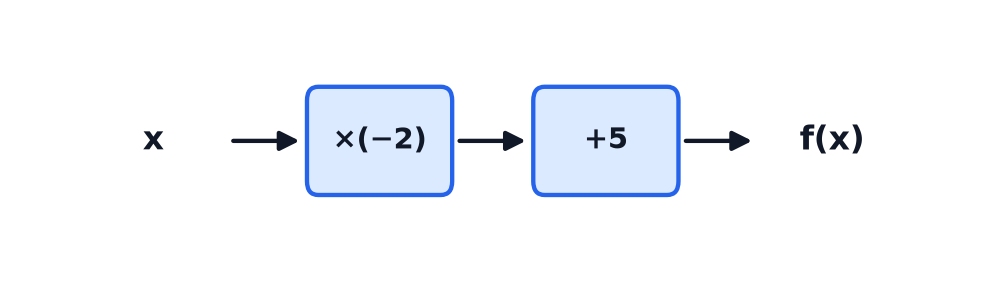
The diagram shows a function machine for \(f\). (a) Write down an expression for \(f(x)\). [1 mark] (b) Calculate \(f(3)\). [1 mark] (c) Solve \(f(x) = 11\). [1 mark]
Show answerHide answer
Model answer
(a) \(f(x) = 5 - 2x\). (b) \(f(3) = 5 - 6 = -1\). (c) \(5 - 2x = 11\), so \(-2x = 6\) and \(x = -3\).
Mark scheme
- (a) \(-2x + 5\) or \(5 - 2x\) — B1
- (b) \(-1\) — B1
- (c) \(-3\) — B1
-
2 Calculate [4 marks]
\(f(x) = x^2\) and \(g(x) = x + 2\) (a) Calculate \(fg(3)\). [1 mark] (b) Solve \(fg(x) = gf(x)\). [3 marks]
Show answerHide answer
Model answer
(a) \(g(3) = 5\), so \(fg(3) = f(5) = 25\). (b) \(fg(x) = (x + 2)^2\) and \(gf(x) = x^2 + 2\). So \((x + 2)^2 = x^2 + 2\), which gives \(x^2 + 4x + 4 = x^2 + 2\), so \(4x = -2\) and \(x = -\dfrac{1}{2}\).
Mark scheme
- (a) \(25\) — B1
- (b) \(fg(x) = (x + 2)^2\) and \(gf(x) = x^2 + 2\) — M1
- (b) \(x^2 + 4x + 4 = x^2 + 2\) — M1
- (b) \(-\dfrac{1}{2}\) — A1
-
3 Find [3 marks]
\(f(x) = \dfrac{x - 1}{4}\) (a) Find \(f^{-1}(x)\). [2 marks] (b) Calculate \(f^{-1}(3)\). [1 mark]
Show answerHide answer
Model answer
(a) \(y = \dfrac{x - 1}{4}\), so \(4y = x - 1\) and \(x = 4y + 1\). So \(f^{-1}(x) = 4x + 1\). (b) \(f^{-1}(3) = 4 \times 3 + 1 = 13\).
Mark scheme
- (a) \(4y = x - 1\) or equivalent — M1
- (a) \(f^{-1}(x) = 4x + 1\) — A1
- (b) \(13\) — B1
-
4 Solve [4 marks]
\(f(x) = 5x - 4\) (a) Find \(f^{-1}(x)\). [2 marks] (b) Solve \(f^{-1}(x) = f(x)\). [2 marks]
Show answerHide answer
Model answer
(a) \(f^{-1}(x) = \dfrac{x + 4}{5}\). (b) \(\dfrac{x + 4}{5} = 5x - 4\), so \(x + 4 = 25x - 20\), \(24 = 24x\) and \(x = 1\).
Mark scheme
- (a) \(x = \dfrac{y + 4}{5}\) or equivalent — M1
- (a) \(f^{-1}(x) = \dfrac{x + 4}{5}\) — A1
- (b) \(\dfrac{x + 4}{5} = 5x - 4\) — M1
- (b) \(1\) — A1
-
5 Find [4 marks]
\(f(x) = \dfrac{5}{x - 3}\) where \(x \ne 3\) (a) Find \(f^{-1}(x)\). [3 marks] (b) Explain why \(f^{-1}(0)\) cannot be calculated. [1 mark]
Show answerHide answer
Model answer
(a) \(y(x - 3) = 5\), so \(x - 3 = \dfrac{5}{y}\) and \(x = \dfrac{5}{y} + 3\). So \(f^{-1}(x) = \dfrac{5}{x} + 3\). (b) \(\dfrac{5}{0}\) is not defined, because you cannot divide by zero.
Mark scheme
- (a) \(y(x - 3) = 5\) — M1
- (a) \(x = \dfrac{5}{y} + 3\) — M1
- (a) \(f^{-1}(x) = \dfrac{5}{x} + 3\) — A1
- (b) You cannot divide by zero — B1
-
6 Calculate [4 marks]
\(f(x) = 4x - 1\) and \(g(x) = ax + 3\), where \(a\) is a constant. \(fg(x) = gf(x)\). Calculate the value of \(a\). [4 marks]
Show answerHide answer
Model answer
\(fg(x) = 4(ax + 3) - 1 = 4ax + 11\) and \(gf(x) = a(4x - 1) + 3 = 4ax - a + 3\). So \(11 = -a + 3\), which gives \(a = -8\).
Mark scheme
- \(fg(x) = 4ax + 11\) — M1
- \(gf(x) = 4ax - a + 3\) — M1
- \(11 = -a + 3\) — M1
- \(-8\) — A1
Quick check
-
1
\(f(x) = 3x - 5\). What is \(f(4)\)?
Show answerHide answer
B: 7
\(3 \times 4 - 5 = 7\).
-
2
\(f(x) = 2x + 1\). What is \(f(-3)\)?
Show answerHide answer
A: \(-5\)
\(2 \times (-3) + 1 = -5\).
-
3
\(f(x) = x^2 + 1\) and \(g(x) = 2x\). What is \(fg(2)\)?
Show answerHide answer
D: 17
\(g(2) = 4\), then \(f(4) = 16 + 1 = 17\).
-
4
\(f(x) = x + 3\) and \(g(x) = x^2\). What is \(gf(x)\)?
Show answerHide answer
C: \((x + 3)^2\)
\(gf(x) = g(f(x)) = (x + 3)^2\).
-
5
\(f(x) = 2x + 1\). What is \(ff(x)\)?
Show answerHide answer
B: \(4x + 3\)
\(ff(x) = 2(2x + 1) + 1 = 4x + 3\).
-
6
What is the inverse of \(f(x) = x + 7\)?
Show answerHide answer
A: \(f^{-1}(x) = x - 7\)
The inverse reverses the rule, so you subtract 7.
-
7
What is the inverse of \(f(x) = 3x - 5\)?
Show answerHide answer
D: \(\dfrac{x + 5}{3}\)
\(y = 3x - 5\) gives \(x = \dfrac{y + 5}{3}\).
-
8
\(f(x) = 5x - 4\). Solve \(f^{-1}(x) = f(x)\).
Show answerHide answer
C: \(x = 1\)
\(f^{-1}(x) = \dfrac{x + 4}{5}\), so \(\dfrac{x + 4}{5} = 5x - 4\), which gives \(24x = 24\).
-
9
\(f(x) = 2x - 1\) and \(g(x) = ax + 3\), and \(fg(x) = gf(x)\). What is \(a\)?
Show answerHide answer
B: \(a = -2\)
\(fg(x) = 2(ax + 3) - 1 = 2ax + 5\) and \(gf(x) = a(2x - 1) + 3 = 2ax - a + 3\), so \(5 = 3 - a\) and \(a = -2\).