Exam questions · Maths
Functions, Sequences and Rates of Change
- 30 exam questions
- 94 marks
- 45 quick checks
Functions and Function Notation
Just this lesson-
1 Calculate [3 marks]
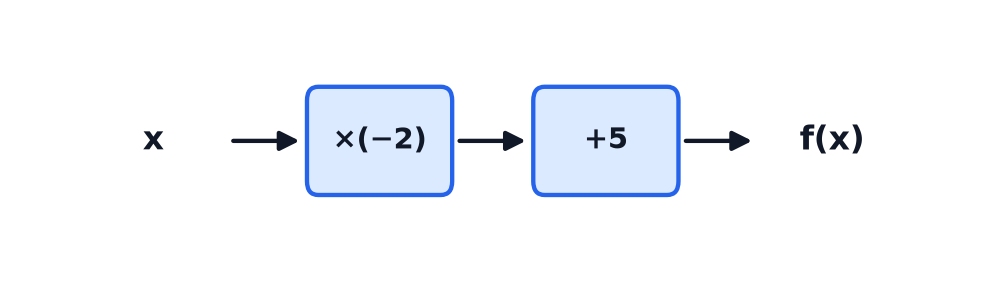
The diagram shows a function machine for \(f\). (a) Write down an expression for \(f(x)\). [1 mark] (b) Calculate \(f(3)\). [1 mark] (c) Solve \(f(x) = 11\). [1 mark]
Show answerHide answer
Model answer
(a) \(f(x) = 5 - 2x\). (b) \(f(3) = 5 - 6 = -1\). (c) \(5 - 2x = 11\), so \(-2x = 6\) and \(x = -3\).
Mark scheme
- (a) \(-2x + 5\) or \(5 - 2x\) — B1
- (b) \(-1\) — B1
- (c) \(-3\) — B1
-
2 Calculate [4 marks]
\(f(x) = x^2\) and \(g(x) = x + 2\) (a) Calculate \(fg(3)\). [1 mark] (b) Solve \(fg(x) = gf(x)\). [3 marks]
Show answerHide answer
Model answer
(a) \(g(3) = 5\), so \(fg(3) = f(5) = 25\). (b) \(fg(x) = (x + 2)^2\) and \(gf(x) = x^2 + 2\). So \((x + 2)^2 = x^2 + 2\), which gives \(x^2 + 4x + 4 = x^2 + 2\), so \(4x = -2\) and \(x = -\dfrac{1}{2}\).
Mark scheme
- (a) \(25\) — B1
- (b) \(fg(x) = (x + 2)^2\) and \(gf(x) = x^2 + 2\) — M1
- (b) \(x^2 + 4x + 4 = x^2 + 2\) — M1
- (b) \(-\dfrac{1}{2}\) — A1
-
3 Find [3 marks]
\(f(x) = \dfrac{x - 1}{4}\) (a) Find \(f^{-1}(x)\). [2 marks] (b) Calculate \(f^{-1}(3)\). [1 mark]
Show answerHide answer
Model answer
(a) \(y = \dfrac{x - 1}{4}\), so \(4y = x - 1\) and \(x = 4y + 1\). So \(f^{-1}(x) = 4x + 1\). (b) \(f^{-1}(3) = 4 \times 3 + 1 = 13\).
Mark scheme
- (a) \(4y = x - 1\) or equivalent — M1
- (a) \(f^{-1}(x) = 4x + 1\) — A1
- (b) \(13\) — B1
-
4 Solve [4 marks]
\(f(x) = 5x - 4\) (a) Find \(f^{-1}(x)\). [2 marks] (b) Solve \(f^{-1}(x) = f(x)\). [2 marks]
Show answerHide answer
Model answer
(a) \(f^{-1}(x) = \dfrac{x + 4}{5}\). (b) \(\dfrac{x + 4}{5} = 5x - 4\), so \(x + 4 = 25x - 20\), \(24 = 24x\) and \(x = 1\).
Mark scheme
- (a) \(x = \dfrac{y + 4}{5}\) or equivalent — M1
- (a) \(f^{-1}(x) = \dfrac{x + 4}{5}\) — A1
- (b) \(\dfrac{x + 4}{5} = 5x - 4\) — M1
- (b) \(1\) — A1
-
5 Find [4 marks]
\(f(x) = \dfrac{5}{x - 3}\) where \(x \ne 3\) (a) Find \(f^{-1}(x)\). [3 marks] (b) Explain why \(f^{-1}(0)\) cannot be calculated. [1 mark]
Show answerHide answer
Model answer
(a) \(y(x - 3) = 5\), so \(x - 3 = \dfrac{5}{y}\) and \(x = \dfrac{5}{y} + 3\). So \(f^{-1}(x) = \dfrac{5}{x} + 3\). (b) \(\dfrac{5}{0}\) is not defined, because you cannot divide by zero.
Mark scheme
- (a) \(y(x - 3) = 5\) — M1
- (a) \(x = \dfrac{5}{y} + 3\) — M1
- (a) \(f^{-1}(x) = \dfrac{5}{x} + 3\) — A1
- (b) You cannot divide by zero — B1
-
6 Calculate [4 marks]
\(f(x) = 4x - 1\) and \(g(x) = ax + 3\), where \(a\) is a constant. \(fg(x) = gf(x)\). Calculate the value of \(a\). [4 marks]
Show answerHide answer
Model answer
\(fg(x) = 4(ax + 3) - 1 = 4ax + 11\) and \(gf(x) = a(4x - 1) + 3 = 4ax - a + 3\). So \(11 = -a + 3\), which gives \(a = -8\).
Mark scheme
- \(fg(x) = 4ax + 11\) — M1
- \(gf(x) = 4ax - a + 3\) — M1
- \(11 = -a + 3\) — M1
- \(-8\) — A1
Quick check
-
1
\(f(x) = 3x - 5\). What is \(f(4)\)?
Show answerHide answer
B: 7
\(3 \times 4 - 5 = 7\).
-
2
\(f(x) = 2x + 1\). What is \(f(-3)\)?
Show answerHide answer
A: \(-5\)
\(2 \times (-3) + 1 = -5\).
-
3
\(f(x) = x^2 + 1\) and \(g(x) = 2x\). What is \(fg(2)\)?
Show answerHide answer
D: 17
\(g(2) = 4\), then \(f(4) = 16 + 1 = 17\).
-
4
\(f(x) = x + 3\) and \(g(x) = x^2\). What is \(gf(x)\)?
Show answerHide answer
C: \((x + 3)^2\)
\(gf(x) = g(f(x)) = (x + 3)^2\).
-
5
\(f(x) = 2x + 1\). What is \(ff(x)\)?
Show answerHide answer
B: \(4x + 3\)
\(ff(x) = 2(2x + 1) + 1 = 4x + 3\).
-
6
What is the inverse of \(f(x) = x + 7\)?
Show answerHide answer
A: \(f^{-1}(x) = x - 7\)
The inverse reverses the rule, so you subtract 7.
-
7
What is the inverse of \(f(x) = 3x - 5\)?
Show answerHide answer
D: \(\dfrac{x + 5}{3}\)
\(y = 3x - 5\) gives \(x = \dfrac{y + 5}{3}\).
-
8
\(f(x) = 5x - 4\). Solve \(f^{-1}(x) = f(x)\).
Show answerHide answer
C: \(x = 1\)
\(f^{-1}(x) = \dfrac{x + 4}{5}\), so \(\dfrac{x + 4}{5} = 5x - 4\), which gives \(24x = 24\).
-
9
\(f(x) = 2x - 1\) and \(g(x) = ax + 3\), and \(fg(x) = gf(x)\). What is \(a\)?
Show answerHide answer
B: \(a = -2\)
\(fg(x) = 2(ax + 3) - 1 = 2ax + 5\) and \(gf(x) = a(2x - 1) + 3 = 2ax - a + 3\), so \(5 = 3 - a\) and \(a = -2\).
Geometric and Special Sequences
Just this lesson-
1 Calculate [3 marks]
Here are the first four terms of a geometric sequence: \(800, 400, 200, 100\) (a) Write down the common ratio. [1 mark] (b) Write down the next two terms. [2 marks]
Show answerHide answer
Model answer
(a) \(400 \div 800 = \dfrac{1}{2}\). (b) \(100 \div 2 = 50\) and \(50 \div 2 = 25\).
Mark scheme
- (a) \(\dfrac{1}{2}\) or \(0.5\) — B1
- (b) \(50\) — B1
- (b) \(25\) — B1
-
2 Calculate [2 marks]
The first two terms of a sequence are 1 and 4. Each term after that is the sum of the two terms before it. Calculate the 6th term. [2 marks]
Show answerHide answer
Model answer
The terms are \(1, 4, 5, 9, 14, 23\), so the 6th term is 23.
Mark scheme
- Continues the sequence, \(5, 9, 14\) — M1
- \(23\) — A1
-
3 Calculate [2 marks]
The first term of a geometric sequence is 2 and the common ratio is \(-3\). Calculate the 4th term. [2 marks]
Show answerHide answer
Model answer
\(2, -6, 18, -54\), so the 4th term is \(-54\).
Mark scheme
- \(2 \times (-3)^3\) or \(2, -6, 18\) — M1
- \(-54\) — A1
-
4 Calculate [3 marks]
The 2nd term of a geometric sequence is 20 and the 5th term is 2.5. Calculate the first term. [3 marks]
Show answerHide answer
Model answer
There are 3 steps from the 2nd to the 5th term, so \(r^3 = \dfrac{2.5}{20} = \dfrac{1}{8}\) and \(r = \dfrac{1}{2}\). The first term is \(20 \div \dfrac{1}{2} = 40\).
Mark scheme
- \(r^3 = \dfrac{2.5}{20} = \dfrac{1}{8}\) — M1
- \(r = \dfrac{1}{2}\) — A1
- \(40\) — A1
-
5 Calculate [3 marks]
The first three terms of a geometric sequence are \(5, 5\sqrt{5}, 25\). Calculate the 4th term. [3 marks]
Show answerHide answer
Model answer
The common ratio is \(\sqrt{5}\). The 4th term is \(25 \times \sqrt{5} = 25\sqrt{5}\).
Mark scheme
- Common ratio \(\sqrt{5}\) — B1
- \(25 \times \sqrt{5}\) — M1
- \(25\sqrt{5}\) — A1
-
6 Calculate [3 marks]
\(3, x, 48\) are three consecutive terms of a geometric sequence. All the terms are positive. Calculate the value of \(x\). [3 marks]
Show answerHide answer
Model answer
\(\dfrac{x}{3} = \dfrac{48}{x}\), so \(x^2 = 144\) and \(x = 12\).
Mark scheme
- \(\dfrac{x}{3} = \dfrac{48}{x}\) — M1
- \(x^2 = 144\) — M1
- \(12\) — A1
Quick check
-
1
What is the common ratio of \(3, 12, 48, 192\)?
Show answerHide answer
C: 4
\(12 \div 3 = 4\).
-
2
What is the next term of \(2, 6, 18, 54\)?
Show answerHide answer
B: 162
Multiply by 3: \(54 \times 3 = 162\).
-
3
What is the next term in the Fibonacci-type sequence \(3, 5, 8, 13\)?
Show answerHide answer
A: 21
\(8 + 13 = 21\).
-
4
What is the common ratio of \(80, 40, 20, 10\)?
Show answerHide answer
D: \(\dfrac{1}{2}\)
\(40 \div 80 = \dfrac{1}{2}\).
-
5
What is the 5th term of the geometric sequence \(2, 6, 18, \ldots\)?
Show answerHide answer
C: 162
\(2 \times 3^4 = 162\).
-
6
Which of these sequences is geometric?
Show answerHide answer
B: \(1, 3, 9, 27\)
Each term is multiplied by 3.
-
7
The 2nd term of a geometric sequence is 6 and the 5th term is 48. What is the common ratio?
Show answerHide answer
A: 2
\(r^3 = \dfrac{48}{6} = 8\), so \(r = 2\).
-
8
What is the common ratio of \(2, 2\sqrt{3}, 6, 6\sqrt{3}\)?
Show answerHide answer
D: \(\sqrt{3}\)
\(\dfrac{2\sqrt{3}}{2} = \sqrt{3}\).
-
9
A geometric sequence has first term 3 and common ratio 2. What is the \(n\)th term?
Show answerHide answer
C: \(3 \times 2^{n-1}\)
The \(n\)th term is \(ar^{n-1}\).
Iteration
Just this lesson-
1 Calculate [2 marks]
\(x_{n+1} = 4 - \dfrac{3}{x_n}\) and \(x_0 = 6\). Calculate \(x_1\) and \(x_2\). Give \(x_2\) as a fraction. [2 marks]
Show answerHide answer
Model answer
\(x_1 = 4 - \dfrac{3}{6} = 3.5\) and \(x_2 = 4 - \dfrac{3}{3.5} = 4 - \dfrac{6}{7} = \dfrac{22}{7}\).
Mark scheme
- \(x_1 = 3.5\) — B1
- \(x_2 = \dfrac{22}{7}\) — B1
-
2 Show that [2 marks]
Show that the equation \(x^2 - 4x + 3 = 0\) can be rearranged to give \(x = 4 - \dfrac{3}{x}\). [2 marks]
Show answerHide answer
Model answer
Divide every term by \(x\): \(x - 4 + \dfrac{3}{x} = 0\). Then \(x = 4 - \dfrac{3}{x}\).
Mark scheme
- Divides by \(x\), giving \(x - 4 + \dfrac{3}{x} = 0\) — M1
- \(x = 4 - \dfrac{3}{x}\) — B1
-
3 Calculate [4 marks]
\(x_{n+1} = 3 + \dfrac{10}{x_n}\). The values \(x_n\) tend to a positive limit \(a\). Show that \(a^2 - 3a - 10 = 0\), and calculate the value of \(a\). [4 marks]
Show answerHide answer
Model answer
At the limit, \(a = 3 + \dfrac{10}{a}\), so \(a^2 = 3a + 10\) and \(a^2 - 3a - 10 = 0\). Then \((a - 5)(a + 2) = 0\), and \(a\) is positive, so \(a = 5\).
Mark scheme
- \(a = 3 + \dfrac{10}{a}\) — M1
- \(a^2 - 3a - 10 = 0\) — M1
- \((a - 5)(a + 2) = 0\) — M1
- \(5\) — A1
-
4 Show that [4 marks]
\(f(x) = x^3 - x - 1\) (a) Show that the equation \(f(x) = 0\) has a root between 1 and 2. [2 marks] (b) Find this root to 1 decimal place. Show your working. [2 marks]
Show answerHide answer
Model answer
(a) \(f(1) = -1\) and \(f(2) = 5\). The sign changes, so there is a root between 1 and 2. (b) \(f(1.3) = -0.103\) and \(f(1.4) = 0.344\), and \(f(1.35) = 0.110\ldots\), which is positive, so the root is between 1.3 and 1.35, which is 1.3 to 1 decimal place.
Mark scheme
- (a) \(f(1) = -1\) and \(f(2) = 5\) — M1
- (a) A change of sign, so there is a root — B1
- (b) \(f(1.3) < 0\), \(f(1.4) > 0\) and a test of 1.35 — M1
- (b) \(1.3\) — A1
-
5 Find [4 marks]
Use trial and improvement to find the value of \(\sqrt{11}\) correct to 1 decimal place. Show all your working. [4 marks]
Show answerHide answer
Model answer
\(3.3^2 = 10.89\) and \(3.4^2 = 11.56\), so \(\sqrt{11}\) is between 3.3 and 3.4. \(3.35^2 = 11.2225\), which is more than 11, so \(\sqrt{11}\) is below 3.35. So \(\sqrt{11} = 3.3\) to 1 decimal place.
Mark scheme
- \(3.3^2 = 10.89\) and \(3.4^2 = 11.56\) — B1
- Tests \(3.35\) — M1
- \(3.35^2 = 11.2225\) — A1
- \(3.3\) — A1
-
6 Explain [2 marks]
\(x_{n+1} = 4 - \dfrac{3}{x_n}\). Explain what happens to the values of \(x_n\) if \(x_0 = 1\). [2 marks]
Show answerHide answer
Model answer
\(x_1 = 4 - \dfrac{3}{1} = 1\), so every term is 1. The sequence stays at 1.
Mark scheme
- \(x_1 = 4 - 3 = 1\) — M1
- States that every term is 1, because the value does not change — B1
Quick check
-
1
\(x_{n+1} = 3 - \dfrac{2}{x_n}\) and \(x_0 = 4\). What is \(x_1\)?
Show answerHide answer
D: 2.5
\(3 - \dfrac{2}{4} = 3 - 0.5 = 2.5\).
-
2
What does \(x_0\) mean in an iteration?
Show answerHide answer
C: The starting value
\(x_0\) is where the iteration starts.
-
3
At the limit of an iteration, which statement is true?
Show answerHide answer
B: \(x_{n+1} = x_n\)
At the limit the values stop changing.
-
4
\(x_{n+1} = 3 - \dfrac{2}{x_n}\) and \(x_1 = 2.5\). What is \(x_2\)?
Show answerHide answer
A: 2.2
\(3 - \dfrac{2}{2.5} = 3 - 0.8 = 2.2\).
-
5
Which equation can be rearranged to \(x = 3 - \dfrac{2}{x}\)?
Show answerHide answer
D: \(x^2 - 3x + 2 = 0\)
Divide \(x^2 - 3x + 2 = 0\) by \(x\) to get \(x - 3 + \dfrac{2}{x} = 0\).
-
6
\(f(x) = x^3 + x - 3\). What does \(f(1) = -1\) and \(f(2) = 7\) show?
Show answerHide answer
C: A root lies between 1 and 2
The sign changes, so a root lies between them.
-
7
\(x_{n+1} = 1 + \dfrac{6}{x_n}\) converges to a positive number \(a\). Which equation does \(a\) satisfy?
Show answerHide answer
B: \(a^2 - a - 6 = 0\)
\(a = 1 + \dfrac{6}{a}\), so \(a^2 = a + 6\).
-
8
What is the value of \(a\) in the previous question?
Show answerHide answer
A: 3
\((a - 3)(a + 2) = 0\) and \(a\) is positive.
-
9
\(f(x) = x^2 - 7\). \(f(2.6) = -0.24\) and \(f(2.7) = 0.29\). Why is the root 2.6 to 1 decimal place, given \(f(2.65) = 0.0225\)?
Show answerHide answer
D: The root is below 2.65, so it rounds down to 2.6
\(f(2.65) > 0\) means the root is between 2.6 and 2.65.
Rates of Change and Areas Under Graphs
Just this lesson-
1 Calculate [3 marks]
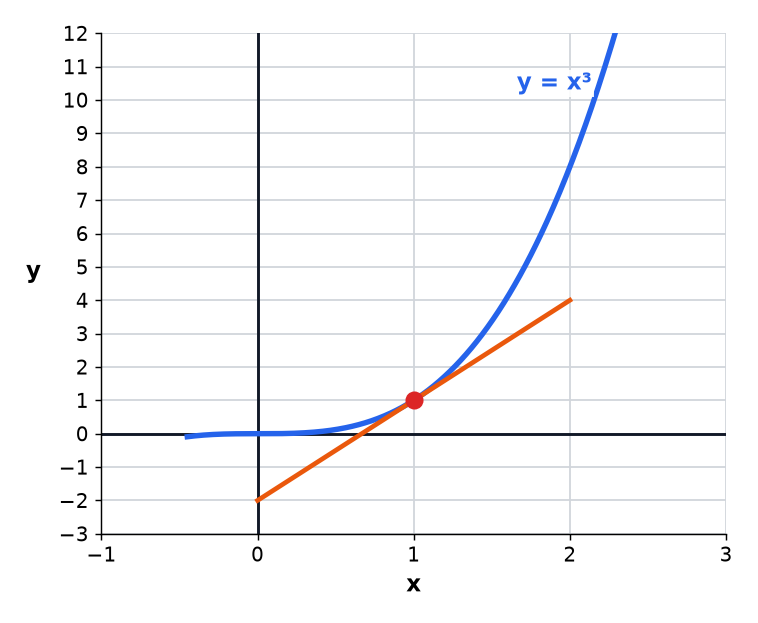
The diagram shows the graph of \(y = x^3\) and the tangent to the curve at the point \((1, 1)\). Calculate the gradient of the curve at the point \((1, 1)\). [3 marks]
Show answerHide answer
Model answer
The tangent passes through \((0, -2)\) and \((2, 4)\). Gradient \(= \dfrac{4 - (-2)}{2 - 0} = 3\).
Mark scheme
- Two points read from the tangent, such as \((0, -2)\) and \((2, 4)\) — M1
- \(\dfrac{4 - (-2)}{2 - 0}\) — M1
- \(3\) — A1
-
2 Calculate [3 marks]
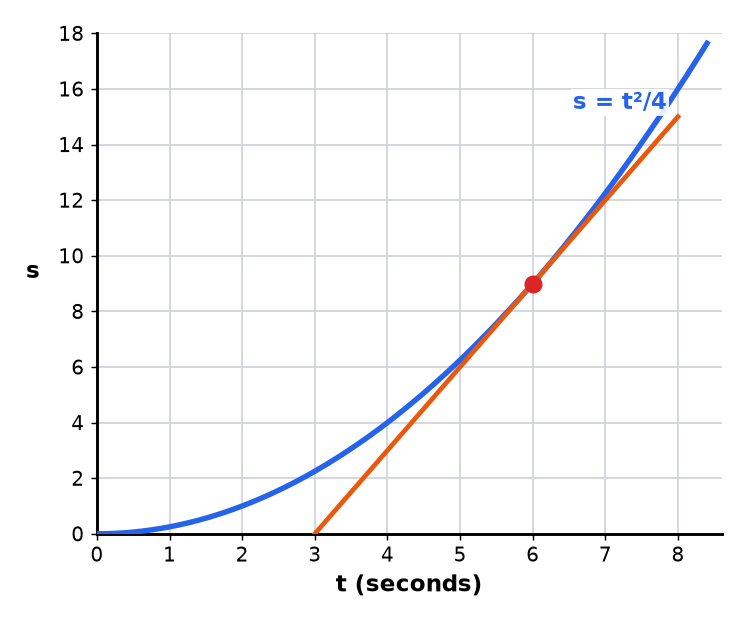
The graph shows the distance, \(s\) metres, travelled by a skater after \(t\) seconds. The line is the tangent to the curve at \(t = 6\). Calculate the speed of the skater at \(t = 6\). [3 marks]
Show answerHide answer
Model answer
The tangent passes through \((3, 0)\) and \((8, 15)\). Gradient \(= \dfrac{15}{5} = 3\), so the speed is 3 m/s.
Mark scheme
- Two points read from the tangent, such as \((3, 0)\) and \((8, 15)\) — M1
- \(\dfrac{15 - 0}{8 - 3}\) — M1
- \(3\) m/s — A1
-
3 Calculate [2 marks]
The distance, \(s\) metres, travelled by a particle after \(t\) seconds is given by \(s = t^3\). Calculate the average speed of the particle between \(t = 1\) and \(t = 3\). [2 marks]
Show answerHide answer
Model answer
\(s = 1\) when \(t = 1\) and \(s = 27\) when \(t = 3\). Average speed \(= \dfrac{27 - 1}{3 - 1} = 13\) m/s.
Mark scheme
- \(\dfrac{27 - 1}{3 - 1}\) — M1
- \(13\) m/s — A1
-
4 Calculate [5 marks]
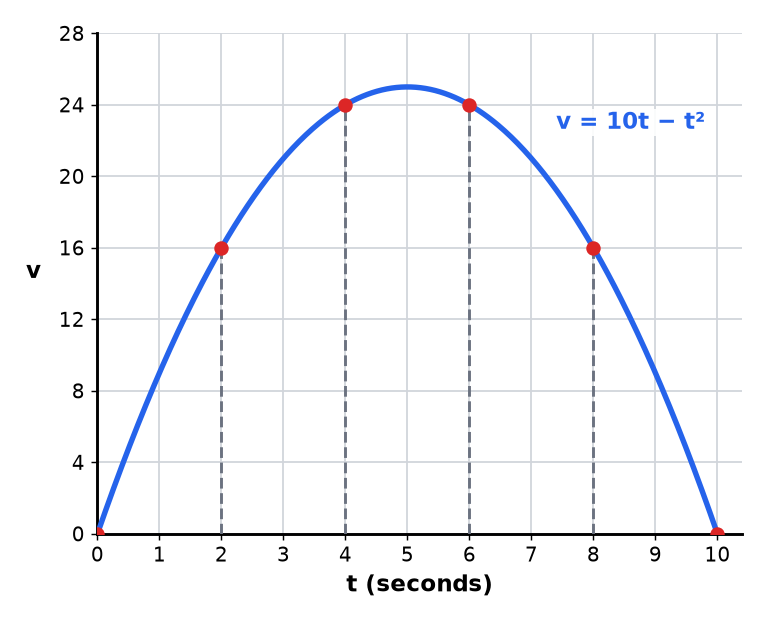
The graph shows the velocity, \(v\) m/s, of a particle at time \(t\) seconds. (a) Use 5 strips of equal width to estimate the distance travelled between \(t = 0\) and \(t = 10\). [3 marks] (b) Is your answer an underestimate or an overestimate? Give a reason for your answer. [2 marks]
Show answerHide answer
Model answer
(a) The heights are 0, 16, 24, 24, 16 and 0. Area \(= \dfrac{1}{2} \times 2 \times (0 + 16) + \dfrac{1}{2} \times 2 \times (16 + 24) + \dfrac{1}{2} \times 2 \times (24 + 24) + \dfrac{1}{2} \times 2 \times (24 + 16) + \dfrac{1}{2} \times 2 \times (16 + 0) = 16 + 40 + 48 + 40 + 16 = 160\) m. (b) An underestimate, because the curve bends downwards and the straight tops of the trapezia are below the curve.
Mark scheme
- (a) Reads the heights 16, 24, 24 and 16 — B1
- (a) Uses \(\dfrac{1}{2}(a + b)h\) for each strip — M1
- (a) \(160\) — A1
- (b) Underestimate — B1
- (b) The curve is above the straight tops of the trapezia — B1
-
5 Calculate [3 marks]
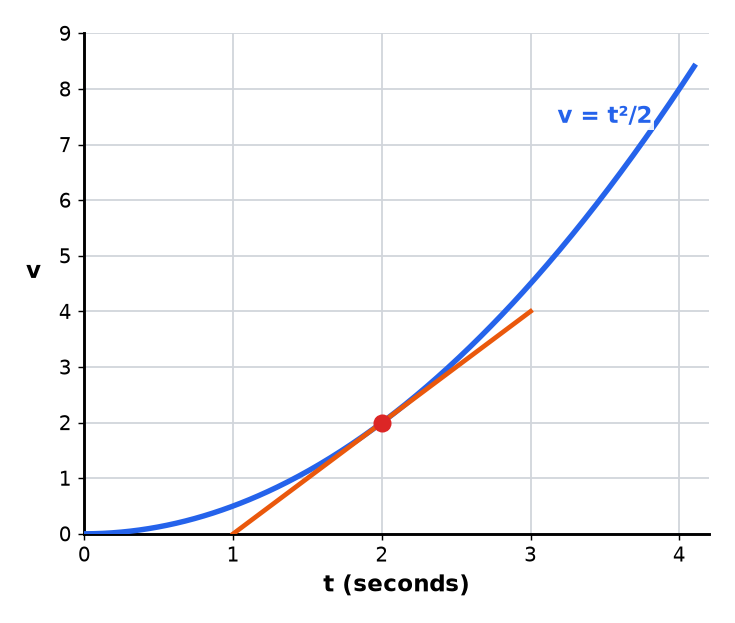
The graph shows the velocity, \(v\) m/s, of a car at time \(t\) seconds. The line is the tangent to the curve at \(t = 2\). Calculate an estimate of the acceleration of the car at \(t = 2\). [3 marks]
Show answerHide answer
Model answer
The tangent passes through \((1, 0)\) and \((3, 4)\). Gradient \(= \dfrac{4}{2} = 2\), so the acceleration is 2 m/s\(^2\).
Mark scheme
- Two points read from the tangent, such as \((1, 0)\) and \((3, 4)\) — M1
- \(\dfrac{4 - 0}{3 - 1}\) — M1
- \(2\) m/s\(^2\) — A1
-
6 Calculate [4 marks]
The velocity of a particle was measured every second. \(t\) (s): 0, 1, 2, 3, 4 \(v\) (m/s): 0, 4, 10, 18, 28 Use trapezia to estimate the distance travelled in the first 4 seconds. State whether your answer is an underestimate or an overestimate. Give a reason. [4 marks]
Show answerHide answer
Model answer
Area \(= \dfrac{1}{2}(0 + 4) + \dfrac{1}{2}(4 + 10) + \dfrac{1}{2}(10 + 18) + \dfrac{1}{2}(18 + 28) = 2 + 7 + 14 + 23 = 46\) m. It is an overestimate, because the velocity curve bends upwards, so the straight tops of the trapezia are above the curve.
Mark scheme
- \(\dfrac{1}{2}(0 + 4) + \dfrac{1}{2}(4 + 10) + \ldots\), with strips of width 1 — M1
- \(46\) — A1
- Overestimate — B1
- The curve bends upwards, so the straight tops are above the curve — B1
Quick check
-
1
What do you draw to find the gradient of a curve at a point?
Show answerHide answer
A: A tangent
A tangent touches the curve at that point.
-
2
What is a chord?
Show answerHide answer
D: A straight line joining two points on a curve
The chord joins two points on the curve.
-
3
What does the gradient of a distance-time graph represent?
Show answerHide answer
C: Speed
Distance divided by time is speed.
-
4
What does the area under a velocity-time graph represent?
Show answerHide answer
B: Distance travelled
Velocity multiplied by time is distance.
-
5
A tangent passes through \((1, 0)\) and \((3, 8)\). What is its gradient?
Show answerHide answer
A: 4
\(\dfrac{8 - 0}{3 - 1} = 4\).
-
6
What is the average rate of change of \(y = x^2\) between \(x = 1\) and \(x = 4\)?
Show answerHide answer
D: 5
\(\dfrac{16 - 1}{4 - 1} = 5\).
-
7
What is the area of a trapezium with parallel sides 4 and 6 and width 2?
Show answerHide answer
C: 10
\(\dfrac{1}{2}(4 + 6) \times 2 = 10\).
-
8
A velocity-time curve bends downwards. Is a trapezium estimate of the area an over- or underestimate?
Show answerHide answer
B: An underestimate
The straight tops lie below the curve.
-
9
A velocity-time graph has heights 0, 8, 8, 0 at times 0, 2, 4, 6. What is the trapezium estimate of the distance?
Show answerHide answer
A: 32
\(8 + 16 + 8 = 32\).
Transformations of Graphs
Just this lesson-
1 Write down [2 marks]
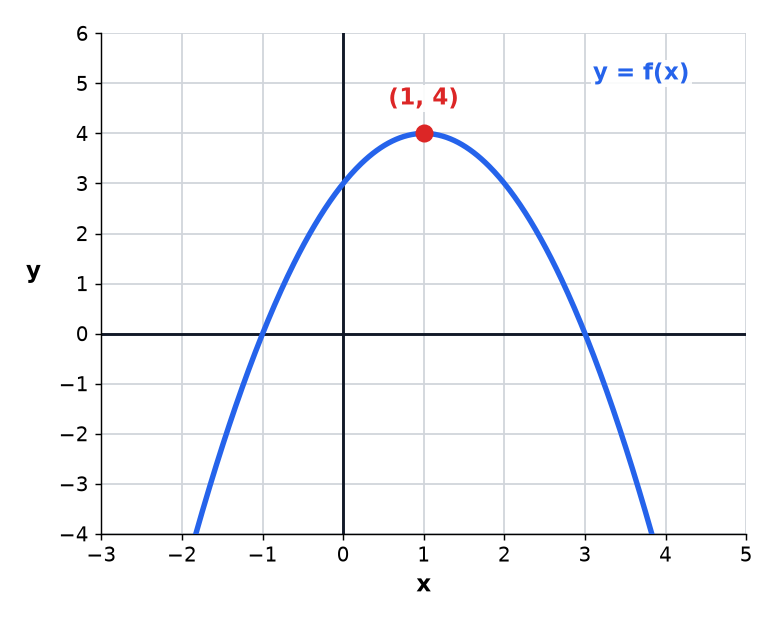
The graph of \(y = f(x)\) is shown. The turning point is \((1, 4)\). (a) Write down the coordinates of the turning point of the graph of \(y = f(x) + 3\). [1 mark] (b) Write down the coordinates of the turning point of the graph of \(y = f(x + 2)\). [1 mark]
Show answerHide answer
Model answer
(a) \((1, 7)\). (b) \((-1, 4)\).
Mark scheme
- (a) \((1, 7)\) — B1
- (b) \((-1, 4)\) — B1
-
2 Write down [2 marks]
The graph of \(y = g(x)\) has a minimum point at \((4, -1)\). (a) Write down the coordinates of the minimum point of \(y = g(x) - 2\). [1 mark] (b) Write down the coordinates of the minimum point of \(y = g(-x)\). [1 mark]
Show answerHide answer
Model answer
(a) \((4, -3)\). (b) \((-4, -1)\).
Mark scheme
- (a) \((4, -3)\) — B1
- (b) \((-4, -1)\) — B1
-
3 Write down [3 marks]
The graph of \(y = x^2\) is transformed. Write down the equation of the new graph after (a) a translation of 6 units to the right, [1 mark] (b) a translation of 1 unit down, [1 mark] (c) a translation by the vector \(\begin{pmatrix} -1 \\ 4 \end{pmatrix}\). [1 mark]
Show answerHide answer
Model answer
(a) \(y = (x - 6)^2\). (b) \(y = x^2 - 1\). (c) \(y = (x + 1)^2 + 4\).
Mark scheme
- (a) \(y = (x - 6)^2\) — B1
- (b) \(y = x^2 - 1\) — B1
- (c) \(y = (x + 1)^2 + 4\) — B1
-
4 Write down [4 marks]
The graph of \(y = f(x)\) has a minimum point at \((1, -2)\). Write down the coordinates of the minimum point of the graph of (a) \(y = f(x - 3)\) [1 mark] (b) \(y = f(x) + 5\) [1 mark] (c) \(y = -f(x)\) [1 mark] (d) \(y = f(-x)\) [1 mark]
Show answerHide answer
Model answer
(a) \((4, -2)\). (b) \((1, 3)\). (c) \((1, 2)\), which is now a maximum. (d) \((-1, -2)\).
Mark scheme
- (a) \((4, -2)\) — B1
- (b) \((1, 3)\) — B1
- (c) \((1, 2)\) — B1
- (d) \((-1, -2)\) — B1
-
5 Write down [3 marks]
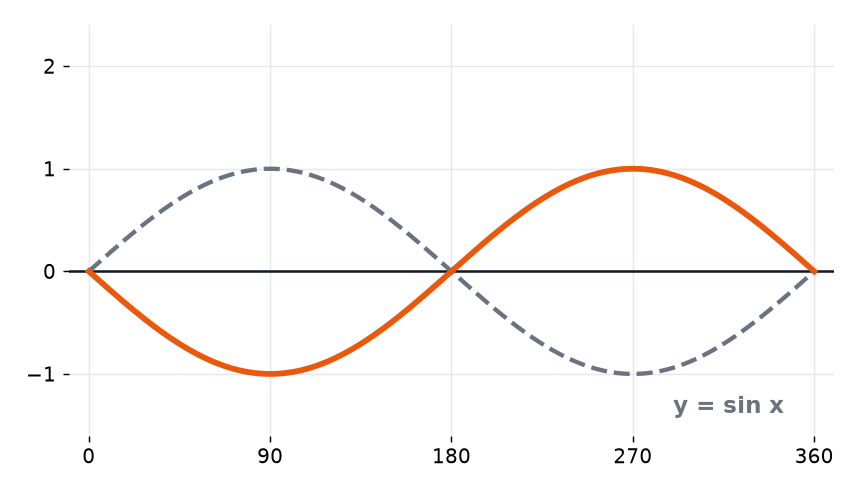
The diagram shows the graph of \(y = \sin x\) and a transformation of it, for \(0^\circ \le x \le 360^\circ\). (a) Write down the equation of the transformed graph. [1 mark] (b) Describe fully the single transformation. [2 marks]
Show answerHide answer
Model answer
(a) \(y = -\sin x\). (b) A reflection in the \(x\)-axis.
Mark scheme
- (a) \(y = -\sin x\) — B1
- (b) Reflection — B1
- (b) In the \(x\)-axis — B1
-
6 Calculate [4 marks]
\(f(x) = x^2 - 2x - 3\). Solve \(f(x) + 3 = 0\). [4 marks]
Show answerHide answer
Model answer
\(f(x) + 3 = x^2 - 2x - 3 + 3 = x^2 - 2x\). Then \(x(x - 2) = 0\), so \(x = 0\) or \(x = 2\).
Mark scheme
- \(x^2 - 2x - 3 + 3\) — M1
- \(x^2 - 2x\) — A1
- \(x(x - 2) = 0\) — M1
- \(x = 0\) and \(x = 2\) — A1
Quick check
-
1
What does \(y = f(x) + 3\) do to the graph of \(y = f(x)\)?
Show answerHide answer
B: Moves it up 3
Adding to the function moves the graph up.
-
2
What does \(y = f(x + 2)\) do to the graph of \(y = f(x)\)?
Show answerHide answer
A: Moves it left 2
A plus inside the bracket moves the graph left.
-
3
What does \(y = -f(x)\) do to the graph of \(y = f(x)\)?
Show answerHide answer
D: Reflects it in the \(x\)-axis
A minus outside changes the \(y\)-values.
-
4
What does \(y = f(-x)\) do to the graph of \(y = f(x)\)?
Show answerHide answer
C: Reflects it in the \(y\)-axis
A minus inside changes the \(x\)-values.
-
5
The maximum of \(y = f(x)\) is at \((3, 5)\). Where is the maximum of \(y = f(x - 2)\)?
Show answerHide answer
B: \((5, 5)\)
The graph moves right 2.
-
6
The maximum of \(y = f(x)\) is at \((3, 5)\). Where is the turning point of \(y = -f(x)\)?
Show answerHide answer
A: \((3, -5)\)
The \(y\)-coordinate changes sign.
-
7
What is the equation of \(y = x^2\) after a translation of 3 units to the right?
Show answerHide answer
D: \(y = (x - 3)^2\)
Moving right replaces \(x\) with \(x - 3\).
-
8
What is the maximum value of \(y = \sin x + 1\)?
Show answerHide answer
C: 2
The sine graph is moved up by 1, so its maximum is \(1 + 1 = 2\).
-
9
Which equation gives the same graph as \(y = \cos x\)?
Show answerHide answer
B: \(y = \sin(x + 90^\circ)\)
Moving the sine graph left by \(90^\circ\) gives the cosine graph.