Exam questions · Maths · Functions, Sequences and Rates of Change
Rates of Change and Areas Under Graphs
- 6 exam questions
- 20 marks
- 9 quick checks
-
1 Calculate [3 marks]
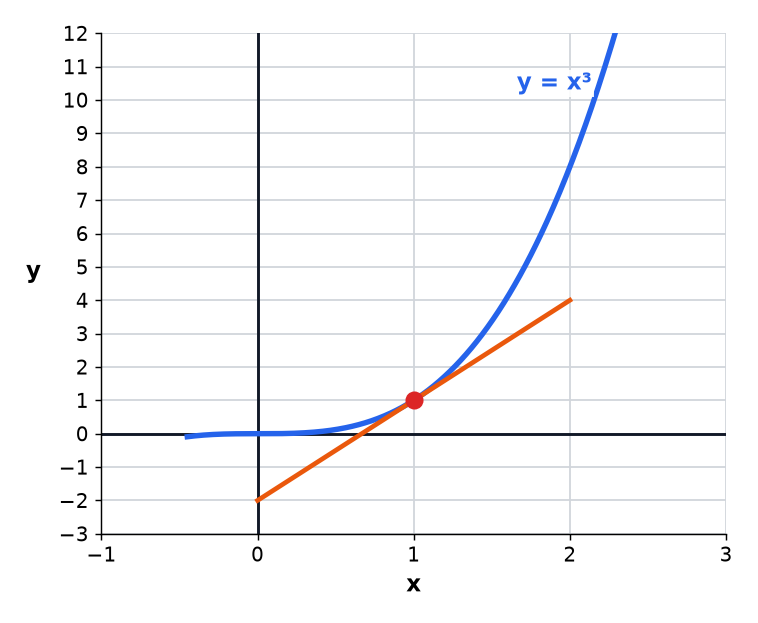
The diagram shows the graph of \(y = x^3\) and the tangent to the curve at the point \((1, 1)\). Calculate the gradient of the curve at the point \((1, 1)\). [3 marks]
Show answerHide answer
Model answer
The tangent passes through \((0, -2)\) and \((2, 4)\). Gradient \(= \dfrac{4 - (-2)}{2 - 0} = 3\).
Mark scheme
- Two points read from the tangent, such as \((0, -2)\) and \((2, 4)\) — M1
- \(\dfrac{4 - (-2)}{2 - 0}\) — M1
- \(3\) — A1
-
2 Calculate [3 marks]
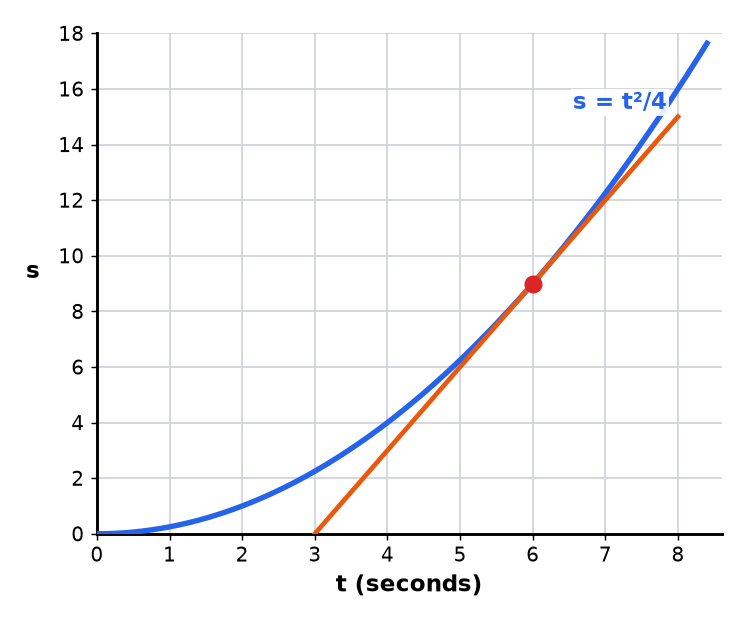
The graph shows the distance, \(s\) metres, travelled by a skater after \(t\) seconds. The line is the tangent to the curve at \(t = 6\). Calculate the speed of the skater at \(t = 6\). [3 marks]
Show answerHide answer
Model answer
The tangent passes through \((3, 0)\) and \((8, 15)\). Gradient \(= \dfrac{15}{5} = 3\), so the speed is 3 m/s.
Mark scheme
- Two points read from the tangent, such as \((3, 0)\) and \((8, 15)\) — M1
- \(\dfrac{15 - 0}{8 - 3}\) — M1
- \(3\) m/s — A1
-
3 Calculate [2 marks]
The distance, \(s\) metres, travelled by a particle after \(t\) seconds is given by \(s = t^3\). Calculate the average speed of the particle between \(t = 1\) and \(t = 3\). [2 marks]
Show answerHide answer
Model answer
\(s = 1\) when \(t = 1\) and \(s = 27\) when \(t = 3\). Average speed \(= \dfrac{27 - 1}{3 - 1} = 13\) m/s.
Mark scheme
- \(\dfrac{27 - 1}{3 - 1}\) — M1
- \(13\) m/s — A1
-
4 Calculate [5 marks]
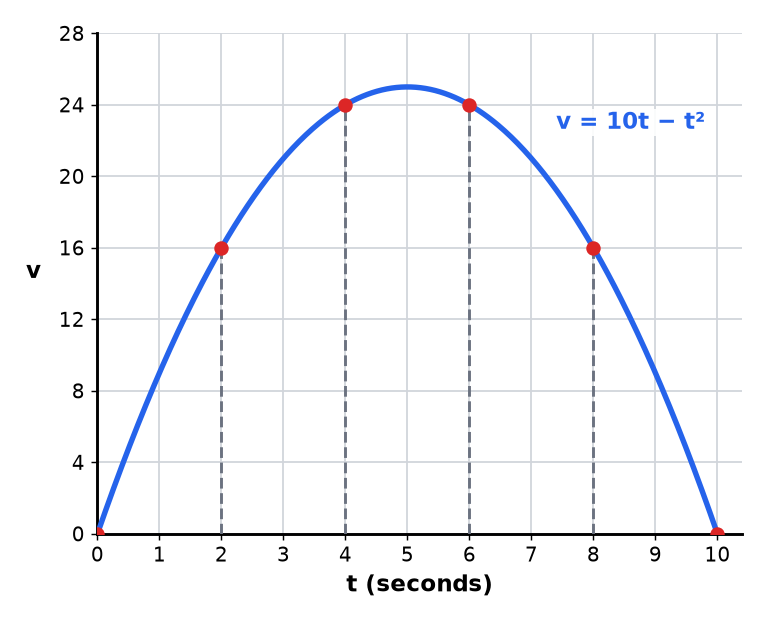
The graph shows the velocity, \(v\) m/s, of a particle at time \(t\) seconds. (a) Use 5 strips of equal width to estimate the distance travelled between \(t = 0\) and \(t = 10\). [3 marks] (b) Is your answer an underestimate or an overestimate? Give a reason for your answer. [2 marks]
Show answerHide answer
Model answer
(a) The heights are 0, 16, 24, 24, 16 and 0. Area \(= \dfrac{1}{2} \times 2 \times (0 + 16) + \dfrac{1}{2} \times 2 \times (16 + 24) + \dfrac{1}{2} \times 2 \times (24 + 24) + \dfrac{1}{2} \times 2 \times (24 + 16) + \dfrac{1}{2} \times 2 \times (16 + 0) = 16 + 40 + 48 + 40 + 16 = 160\) m. (b) An underestimate, because the curve bends downwards and the straight tops of the trapezia are below the curve.
Mark scheme
- (a) Reads the heights 16, 24, 24 and 16 — B1
- (a) Uses \(\dfrac{1}{2}(a + b)h\) for each strip — M1
- (a) \(160\) — A1
- (b) Underestimate — B1
- (b) The curve is above the straight tops of the trapezia — B1
-
5 Calculate [3 marks]
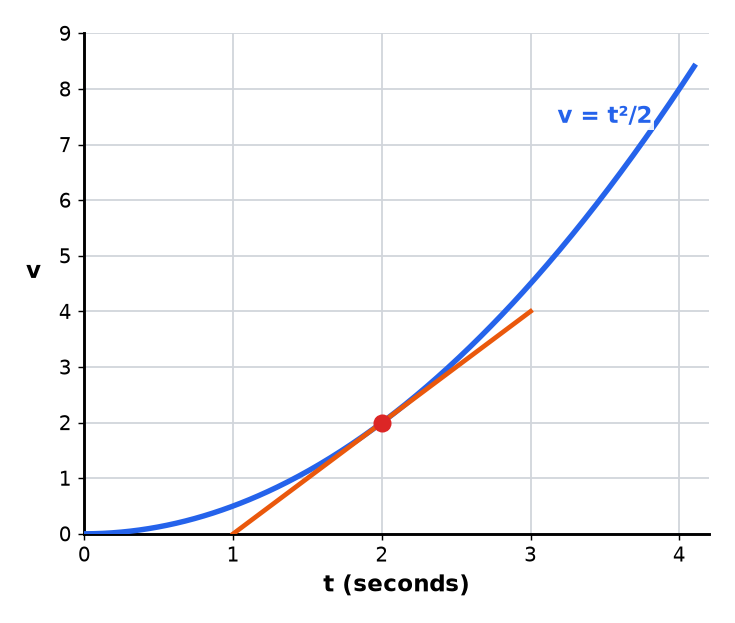
The graph shows the velocity, \(v\) m/s, of a car at time \(t\) seconds. The line is the tangent to the curve at \(t = 2\). Calculate an estimate of the acceleration of the car at \(t = 2\). [3 marks]
Show answerHide answer
Model answer
The tangent passes through \((1, 0)\) and \((3, 4)\). Gradient \(= \dfrac{4}{2} = 2\), so the acceleration is 2 m/s\(^2\).
Mark scheme
- Two points read from the tangent, such as \((1, 0)\) and \((3, 4)\) — M1
- \(\dfrac{4 - 0}{3 - 1}\) — M1
- \(2\) m/s\(^2\) — A1
-
6 Calculate [4 marks]
The velocity of a particle was measured every second. \(t\) (s): 0, 1, 2, 3, 4 \(v\) (m/s): 0, 4, 10, 18, 28 Use trapezia to estimate the distance travelled in the first 4 seconds. State whether your answer is an underestimate or an overestimate. Give a reason. [4 marks]
Show answerHide answer
Model answer
Area \(= \dfrac{1}{2}(0 + 4) + \dfrac{1}{2}(4 + 10) + \dfrac{1}{2}(10 + 18) + \dfrac{1}{2}(18 + 28) = 2 + 7 + 14 + 23 = 46\) m. It is an overestimate, because the velocity curve bends upwards, so the straight tops of the trapezia are above the curve.
Mark scheme
- \(\dfrac{1}{2}(0 + 4) + \dfrac{1}{2}(4 + 10) + \ldots\), with strips of width 1 — M1
- \(46\) — A1
- Overestimate — B1
- The curve bends upwards, so the straight tops are above the curve — B1
Quick check
-
1
What do you draw to find the gradient of a curve at a point?
Show answerHide answer
A: A tangent
A tangent touches the curve at that point.
-
2
What is a chord?
Show answerHide answer
D: A straight line joining two points on a curve
The chord joins two points on the curve.
-
3
What does the gradient of a distance-time graph represent?
Show answerHide answer
C: Speed
Distance divided by time is speed.
-
4
What does the area under a velocity-time graph represent?
Show answerHide answer
B: Distance travelled
Velocity multiplied by time is distance.
-
5
A tangent passes through \((1, 0)\) and \((3, 8)\). What is its gradient?
Show answerHide answer
A: 4
\(\dfrac{8 - 0}{3 - 1} = 4\).
-
6
What is the average rate of change of \(y = x^2\) between \(x = 1\) and \(x = 4\)?
Show answerHide answer
D: 5
\(\dfrac{16 - 1}{4 - 1} = 5\).
-
7
What is the area of a trapezium with parallel sides 4 and 6 and width 2?
Show answerHide answer
C: 10
\(\dfrac{1}{2}(4 + 6) \times 2 = 10\).
-
8
A velocity-time curve bends downwards. Is a trapezium estimate of the area an over- or underestimate?
Show answerHide answer
B: An underestimate
The straight tops lie below the curve.
-
9
A velocity-time graph has heights 0, 8, 8, 0 at times 0, 2, 4, 6. What is the trapezium estimate of the distance?
Show answerHide answer
A: 32
\(8 + 16 + 8 = 32\).