Exam questions · Maths · Graphs
Straight-Line Graphs
- 6 exam questions
- 18 marks
- 9 quick checks
-
1 Calculate [2 marks]
Calculate the gradient of the line through \((1, 2)\) and \((5, 10)\).
Show answerHide answer
Model answer
\(\dfrac{10 - 2}{5 - 1} = \dfrac{8}{4} = 2\).
Mark scheme
- \(\dfrac{10 - 2}{5 - 1}\) — M1
- 2 — A1
-
2 Complete [3 marks]
(a) Complete the table of values for \(y = 4x - 3\). \(x = 0, 1, 2, 3\) [2 marks] (b) Write down the \(y\)-intercept of the line \(y = 4x - 3\). [1 mark]
Show answerHide answer
Model answer
(a) The values are \(-3, 1, 5, 9\). (b) The \(y\)-intercept is \(-3\), where \(x = 0\).
Mark scheme
- (a) At least two correct values — M1
- (a) \(-3, 1, 5, 9\) — A1
- (b) \(-3\) — B1
-
3 Calculate [4 marks]
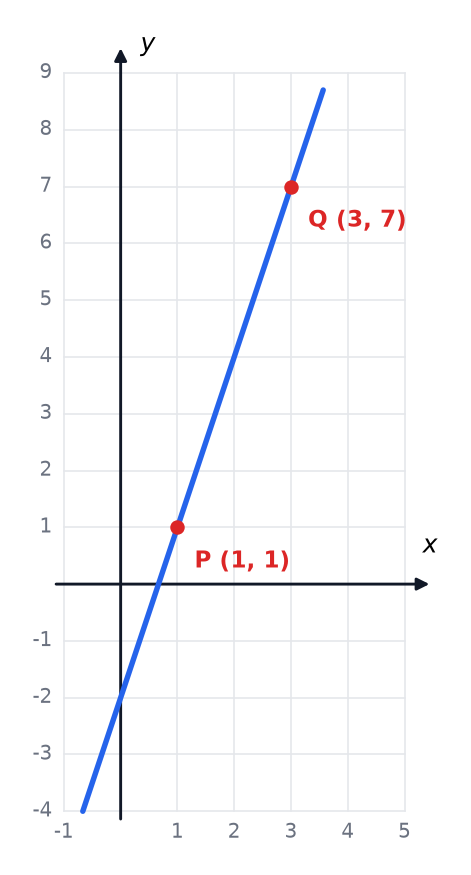
The diagram shows a straight line passing through the points \(P\) and \(Q\). (a) Calculate the gradient of the line. [2 marks] (b) Write down the equation of the line. [2 marks]
Show answerHide answer
Model answer
(a) \(\dfrac{7 - 1}{3 - 1} = \dfrac{6}{2} = 3\). (b) The line crosses the \(y\)-axis at \(-2\), so \(y = 3x - 2\).
Mark scheme
- (a) \(\dfrac{7 - 1}{3 - 1}\) — M1
- (a) 3 — A1
- (b) \(y = 3x + c\) or \(y = mx - 2\) — M1
- (b) \(y = 3x - 2\) — A1
-
4 Find [2 marks]
Find the equation of the line that is parallel to \(y = 3x - 7\) and passes through the point \((0, 2)\).
Show answerHide answer
Model answer
The gradient is 3 and the \(y\)-intercept is 2, so \(y = 3x + 2\).
Mark scheme
- Gradient 3 or \(c = 2\) used — M1
- \(y = 3x + 2\) — A1
-
5 Find [3 marks]
A straight line has gradient \(-2\) and passes through the point \((0, 5)\). (a) Write down the equation of the line. [1 mark] (b) Does the point \((4, -3)\) lie on the line? Show how you know. [2 marks]
Show answerHide answer
Model answer
(a) \(y = -2x + 5\). (b) When \(x = 4\), \(y = -2 \times 4 + 5 = -3\), so the point lies on the line.
Mark scheme
- (a) \(y = -2x + 5\) — B1
- (b) \(-2 \times 4 + 5\) or \(-8 + 5\) — M1
- (b) \(-3\) with a conclusion — A1
-
6 Show that [4 marks]
\(A\) is the point \((-3, 2)\) and \(B\) is the point \((5, 6)\). (a) Work out the gradient of \(AB\). [2 marks] (b) Show that the line \(y = \dfrac{1}{2}x + 3.5\) passes through \(A\). [2 marks]
Show answerHide answer
Model answer
(a) \(\dfrac{6 - 2}{5 - (-3)} = \dfrac{4}{8} = \dfrac{1}{2}\). (b) When \(x = -3\), \(y = \dfrac{1}{2} \times (-3) + 3.5 = -1.5 + 3.5 = 2\), so the line passes through \(A\).
Mark scheme
- (a) \(\dfrac{6 - 2}{5 - (-3)}\) — M1
- (a) \(\dfrac{1}{2}\) — A1
- (b) \(\dfrac{1}{2} \times (-3) + 3.5\) — M1
- (b) 2 with a conclusion — A1
Quick check
-
1
What is the equation of the \(x\)-axis?
Show answerHide answer
B: \(y = 0\)
Every point on the \(x\)-axis has \(y = 0\).
-
2
Which point is on the line \(y = 3x - 2\)?
Show answerHide answer
A: \((4, 10)\)
Put in the coordinates: \(3 \times 4 - 2 = 10\), so \((4, 10)\) fits.
-
3
Work out the gradient of the line through \((1, 7)\) and \((4, 1)\).
Show answerHide answer
D: \(-2\)
\(\dfrac{1 - 7}{4 - 1} = \dfrac{-6}{3} = -2\).
-
4
Which line is parallel to \(y = 3x + 1\)?
Show answerHide answer
C: \(y = 3x - 5\)
Parallel lines have the same gradient, 3.
-
5
What is the equation of the vertical line through 4 on the \(x\)-axis?
Show answerHide answer
B: \(x = 4\)
Every point on the line has \(x = 4\).
-
6
What is the gradient of the line \(y = 5 - 3x\)?
Show answerHide answer
A: \(-3\)
Written as \(y = -3x + 5\), the number multiplying \(x\) is \(-3\).
-
7
What is the value of \(y\) on the line \(y = 2x - 1\) when \(x = -1\)?
Show answerHide answer
D: \(-3\)
\(2 \times (-1) - 1 = -2 - 1 = -3\).
-
8
Where does the line \(y = 3x + 2\) cross the \(y\)-axis?
Show answerHide answer
C: \((0, 2)\)
The number on its own, 2, is the \(y\)-intercept.
-
9
Work out the gradient of the line through \((-2, 3)\) and \((4, -9)\).
Show answerHide answer
B: \(-2\)
\(\dfrac{-9 - 3}{4 - (-2)} = \dfrac{-12}{6} = -2\).