Maths · Graphs
Viewing as
Teaching this? The teacher view opens every answer and mark scheme.
Straight-Line Graphs
Plotting lines, finding gradients, and reading the gradient and intercept from y = mx + c.
Learning Objectives
- 1Plot and read coordinates, and draw straight-line graphs from a table of values.
- 2Work out the gradient of a line from two points or from a graph.
- 3Use \(y = mx + c\) to find the gradient and the \(y\)-intercept of a line.
- 4Recognise horizontal, vertical and parallel lines from their equations.
Pictures of equations
A graph is a picture of an equation. Every point on the line has an \(x\)-coordinate and a \(y\)-coordinate that fit the equation, and every point that fits is on the line. Straight-line graphs are on every Paper 1, usually worth between 3 and 6 marks, and the same few ideas, gradient, intercept and the form \(y = mx + c\), come up each time. The numbers are always whole or simple fractions, so no calculator is needed.
Coordinates and plotting a line
A point is written \((x, y)\), with the horizontal distance first. A table of values is the safest way to draw a line.
-
Make a table
Choose three or four values of \(x\), including a negative one, and work out \(y\) for each. For \(y = 2x - 1\), the values \(x = -1, 0, 1, 2\) give \(y = -3, -1, 1, 3\).
-
Plot the points
Mark each pair \((x, y)\). If they are not in a straight line, one of them is wrong, so check it.
-
Draw the line with a ruler
Make it go across the whole grid, and label it with its equation if asked.
-
Check a point
To see whether a point is on a line, put its coordinates into the equation. \((4, 10)\) is on \(y = 3x - 2\) because \(3 \times 4 - 2 = 10\).
Horizontal and vertical lines
Some lines have no slope at all, or an infinite one, and they look different from other equations.
-
\(y = a\)
A horizontal line through \(y = a\), such as \(y = 3\). Every point on it has \(y = 3\).
-
\(x = a\)
A vertical line through \(x = a\), such as \(x = -2\). Every point on it has \(x = -2\).
-
The axes
The \(x\)-axis is \(y = 0\) and the \(y\)-axis is \(x = 0\).
-
A common slip
\(x = 4\) is vertical, not horizontal, because it names where on the \(x\)-axis the line crosses.
Gradient from a triangle
To find a gradient, choose two points on the line, draw a right-angled triangle between them, and divide the vertical distance by the horizontal distance.
Finding a gradient
- The formula Gradient \(= \dfrac{\text{change in } y}{\text{change in } x} = \dfrac{\text{rise}}{\text{run}}\).
- Use the scale Read the rise and the run from the numbers on the axes, not by counting squares.
- Sign A line that goes up from left to right has a positive gradient. A line that goes down has a negative gradient.
- Two points For \((x_1, y_1)\) and \((x_2, y_2)\), the gradient is \(\dfrac{y_2 - y_1}{x_2 - x_1}\).
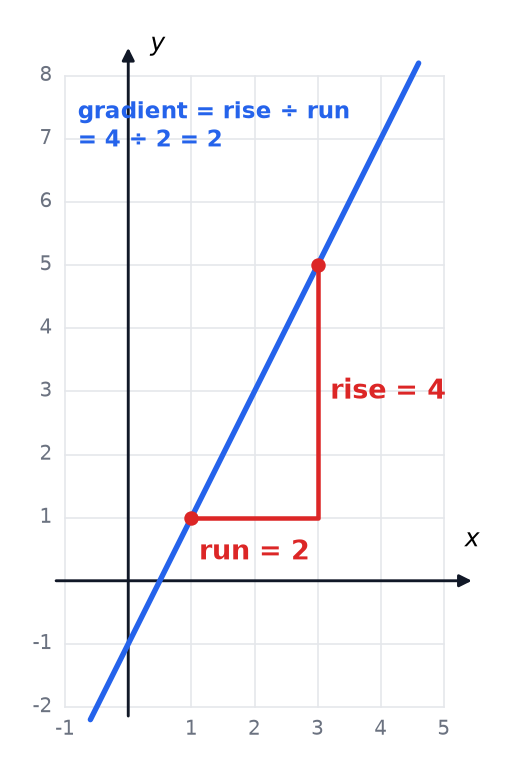
Gradient from two points
Work out the gradient of the line through \((1, 7)\) and \((4, 1)\).
Show the solutionHide the solution
- 1 Find the change in y \(1 - 7 = -6\).
- 2 Find the change in x \(4 - 1 = 3\).
- 3 Divide \(\dfrac{-6}{3} = -2\).
- 4 Check the sign The line goes down as \(x\) increases, so a negative gradient is right.
Answer\(-2\)
Reading y = mx + c
In \(y = mx + c\), the number multiplying \(x\) is the gradient \(m\), and the number on its own is where the line crosses the \(y\)-axis, called \(c\). The blue and green lines have the same gradient, so they are parallel.
What each part tells you
- \(m\) is the gradient In \(y = 2x + 1\) the gradient is 2: up 2 for every 1 across.
- \(c\) is the y-intercept The line crosses the \(y\)-axis at \((0, c)\). For \(y = -x + 4\) that is \((0, 4)\).
- Parallel lines Lines with the same gradient are parallel, whatever their intercepts.
- Rearrange first The equation must start with \(y =\) before you read off \(m\) and \(c\).
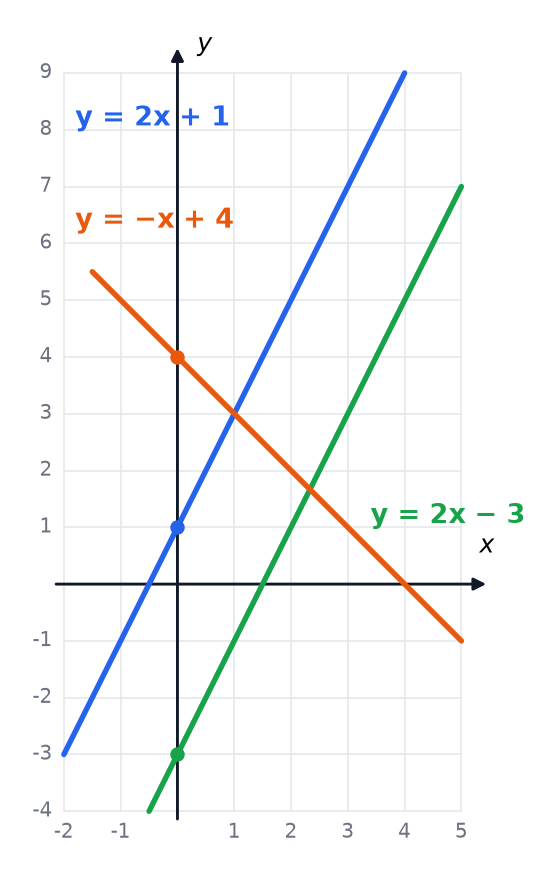
Gradient and intercept
A line has equation \(y = 5 - 3x\). Write down its gradient and the coordinates of the point where it crosses the y-axis.
Show the solutionHide the solution
- 1 Rewrite in the form y = mx + c \(y = -3x + 5\).
- 2 Read off m The number multiplying \(x\) is \(-3\).
- 3 Read off c The number on its own is 5.
- 4 Write the point It crosses the y-axis at \((0, 5)\).
AnswerGradient \(-3\), crossing at \((0, 5)\)
Sketching a line quickly
You do not always need a table. The gradient and the intercept are enough.
-
Start at the intercept
Mark \((0, c)\).
-
Use the gradient
From there go across 1 and up \(m\) (or down, if \(m\) is negative), and mark another point. A gradient of \(\dfrac{1}{2}\) means across 2 and up 1.
-
Join with a ruler
Extend the line past both points.
-
Use the axes
A line crosses the \(x\)-axis where \(y = 0\), which gives a quick check.
Test yourself
-
1
What is the gradient of the line \(y = 4x - 7\)?
Show answerHide answer
4.
-
2
Where does the line \(y = 3x + 2\) cross the y-axis?
Show answerHide answer
At \((0, 2)\).
-
3
What is the equation of the x-axis?
Show answerHide answer
\(y = 0\).
-
4
Which of \(y = 3x\) and \(y = 3x - 5\) is parallel to \(y = 3x + 1\)?
Show answerHide answer
Both, because they all have gradient 3.
-
5
Is the point \((2, 5)\) on the line \(y = 2x + 1\)?
Show answerHide answer
Yes, because \(2 \times 2 + 1 = 5\).
Exam technique: straight-line graphs
Most lost marks are on signs and on reading scales carelessly.
-
Show the rise and the run
Write "change in \(y\) = 6, change in \(x\) = 3" before dividing.
-
Use a ruler and a sharp pencil
A wobbly line costs the accuracy mark.
-
Label the points you use
It shows the method even if you make a slip.
-
Say which form you are using
Writing \(y = mx + c\) first helps you not to mix up \(m\) and \(c\).
Summary and exam focus
- A straight-line graph comes from a table of values, with three or more points in a line.
- The gradient is rise divided by run, and it is negative when the line goes down.
- In \(y = mx + c\), \(m\) is the gradient and \(c\) is where the line crosses the \(y\)-axis.
- Parallel lines have the same gradient. \(x = a\) is vertical and \(y = a\) is horizontal.
Exam focus
Work out the gradient of the line that passes through the points \((2, 3)\) and \((6, 11)\). (2 marks) (2 marks)
Write the change in \(y\) as \(11 - 3 = 8\) and the change in \(x\) as \(6 - 2 = 4\), and then divide to get 2. Keep the order the same on the top and on the bottom, or you will get the wrong sign.
Key terms
The words this lesson expects you to use. Each one is linked from the first place it appears above.
- Coordinates
- A pair of numbers \((x, y)\) that give the position of a point on a grid.
- Gradient
- A measure of how steep a line is, found by dividing the change in \(y\) by the change in \(x\).
- Intercept
- The point where a line crosses an axis.
- Table of values
- A table of \(x\)-values and the matching \(y\)-values, used to plot a graph.
- Linear
- A graph or equation that gives a straight line.
- Parallel lines
- Lines with the same gradient, which never meet.
- Rise
- The vertical distance between two points on a line.
- Run
- The horizontal distance between two points on a line.
- Origin
- The point \((0, 0)\), where the axes cross.
You've finished the notes
Check your understanding
Test yourself while it is fresh. Start with the flashcards, then try the exam questions.
Something here looks wrong?
Tell us what and we will go and look. It goes to whoever writes these pages, nobody else, and we do not ask who you are — so there is nothing to sign and nothing comes back to you.