Slides · PPTX · 274 KB · 30 slides
Specific heat capacity - Teacher Slides.pptx
The lesson slides with the teacher's notes on each slide, and every question and mark scheme built in. Built from the lesson script on 30 September 2026.
AQA GCSE PHYSICS · PAPER 1 · FOUNDATION & HIGHER

Specific heat capacity
Energy
Lesson 3 of 7
openrevise.com
AQA GCSE PHYSICS · PAPER 1 · FOUNDATION & HIGHER

Warm-up
Energy
Lesson 3 of 7
Answer each one, then check.
1
What is the unit of temperature change used in this equation?
2
What is the equation for power?
3
What unit is energy measured in?
4
Convert 500 g to kilograms.
5
Which store increases when a substance is heated?
openrevise.com
AQA GCSE PHYSICS · PAPER 1 · FOUNDATION & HIGHER

Warm-up - Answers
Energy
Lesson 3 of 7
1
What is the unit of temperature change used in this equation?
Degrees Celsius (°C)
2
What is the equation for power?
P = E ÷ t
3
What unit is energy measured in?
Joules
4
Convert 500 g to kilograms.
0.50 kg
5
Which store increases when a substance is heated?
Thermal
openrevise.com
AQA GCSE PHYSICS · PAPER 1 · FOUNDATION & HIGHER

Learning Objectives
Energy
Lesson 3 of 7
1
Define specific heat capacity.
2
Apply ΔE = mcΔθ to calculate energy, mass, temperature change or c.
3
Describe the method for Required Practical 1.
4
Explain why measured values are often too high.
5
Interpret energy against temperature graphs.
openrevise.com
AQA GCSE PHYSICS · PAPER 1 · FOUNDATION & HIGHER
Energy
Lesson 3 of 7

SPECIFIC HEAT CAPACITY
The specific heat capacity of a substance is the energy needed to raise the temperature of 1 kg of the substance by 1 °C.
ΔE = mcΔθ is given on the equation sheet. The unit of c is J/kg °C. For water, c = 4200 J/kg °C.
openrevise.com
AQA GCSE PHYSICS · PAPER 1 · FOUNDATION & HIGHER

Required Practical 1: Apparatus
Energy
Lesson 3 of 7

Insulation reduces energy lost to the surroundings.
openrevise.com
AQA GCSE PHYSICS · PAPER 1 · FOUNDATION & HIGHER

Method for Required Practical 1
Energy
Lesson 3 of 7
Find the specific heat capacity of a metal block.
1
Measure the mass
Use a balance; record m in kg.
2
Set up
Put the heater and thermometer in the block and wrap it in insulation.
3
Start
Record the starting temperature and switch on the heater.
4
Record
At regular intervals record the temperature and the energy transferred (from the joulemeter, or power times time).
5
Plot
Draw a graph of temperature against energy supplied.
6
Calculate
The gradient is 1/mc, so c = 1/(m × gradient).
openrevise.com
AQA GCSE PHYSICS · PAPER 1 · FOUNDATION & HIGHER

Calculating Energy
Energy
Lesson 3 of 7
Calculate the energy needed to heat 2.0 kg of water from 20 °C to 35 °C. c = 4200 J/kg °C.
1
Temperature change
35 − 20 = 15 °C
2
Substitute
ΔE = 2.0 × 4200 × 15
3
Answer
ΔE = 126 000 J
ANSWER
126 000 J (126 kJ)
openrevise.com
AQA GCSE PHYSICS · PAPER 1 · FOUNDATION & HIGHER

Finding c
Energy
Lesson 3 of 7
A 0.50 kg metal block needs 9000 J to raise its temperature by 20 °C. Find the specific heat capacity of the metal.
1
Rearrange
c = ΔE/mΔθ
2
Substitute
c = 9000/(0.50 × 20)
3
Answer
c = 900 J/kg °C
ANSWER
900 J/kg °C
openrevise.com
AQA GCSE PHYSICS · PAPER 1 · FOUNDATION & HIGHER

Finding the Temperature Change
Energy
Lesson 3 of 7
3.0 kg of oil (c = 2000 J/kg °C) is given 240 kJ of energy. What is the temperature rise?
1
Convert energy
240 kJ = 240 000 J
2
Rearrange
Δθ= ΔE/mc
3
Substitute
(240 000)/(3.0 × 2000)
4
Answer
40 °C
ANSWER
40 °C
openrevise.com
AQA GCSE PHYSICS · PAPER 1 · FOUNDATION & HIGHER

Why the Result Is Too High
Energy
Lesson 3 of 7
A very common exam question.
Energy is lost
Some of the energy from the heater warms the surroundings instead of the block.
So
The energy supplied is more than the energy that actually heats the block.
Effect
c = ΔE/mΔθ uses the energy supplied, so the calculated value is too big.
Fix
Use more insulation, add a lid, or use a lagged block.
openrevise.com
AQA GCSE PHYSICS · PAPER 1 · FOUNDATION & HIGHER

Specific Heat Capacity or Latent Heat?
Energy
Lesson 3 of 7
SPECIFIC HEAT CAPACITY
• Temperature changes.
• ΔE = mcΔθ.
• Unit: J/kg °C.
SPECIFIC LATENT HEAT
• Temperature stays constant (a change of state).
• E = mL.
• Unit: J/kg.
openrevise.com
AQA GCSE PHYSICS · PAPER 1 · FOUNDATION & HIGHER

Key Terms
Energy
Lesson 3 of 7
Specific heat capacity
Energy needed to raise 1 kg of a substance by 1 °C.
Thermal energy
Energy stored in the moving particles of a substance.
Temperature change
Final temperature minus starting temperature, Δθ.
Insulation
A material that reduces energy transfer by heating.
Joulemeter
A meter that shows the energy transferred in joules.
Gradient
How steep a graph line is.
openrevise.com
AQA GCSE PHYSICS · PAPER 1 · FOUNDATION & HIGHER
Energy
Lesson 3 of 7

YOUR TASK
Which Is Hotter?
12 minutes
1.0 kg of water and 1.0 kg of aluminium (c = 900 J/kg °C) each receive 45 000 J. Calculate the temperature rise of each and say which changes more.
1
Rearrange for temperature change.
2
Compare the two answers.
WHAT A GOOD ANSWER SHOWS
Water: 45 000 ÷ (1.0 × 4200) = 10.7 °C. Aluminium: 45 000 ÷ (1.0 × 900) = 50 °C. Aluminium heats up much more.
openrevise.com
AQA GCSE PHYSICS · PAPER 1 · FOUNDATION & HIGHER

Can I...?
Energy
Lesson 3 of 7
Recall the meaning of specific heat capacity.
Use ΔE = mcΔθ.
Rearrange for c.
Convert kJ to J and g to kg.
Describe Required Practical 1.
Explain why the measured c is too high.
Use a graph gradient to find c.
Choose sensible units.
openrevise.com
AQA GCSE PHYSICS · PAPER 1 · FOUNDATION & HIGHER
Summary & Exam Focus
ΔE = mcΔθ.
The unit of c is J/kg °C.
Measured values of c are too high if energy is lost.
Insulate the block to reduce losses.
EXAM FOCUS
Calculate the energy needed to raise the temperature of 1.5 kg of water by 40 °C. c = 4200 J/kg °C. (2 marks)
Substitute all three values then multiply.
openrevise.com
AQA GCSE PHYSICS · PAPER 1 · FOUNDATION & HIGHER

Exam Practice: Specific heat capacity
Energy
Lesson 3 of 7
Answer all questions. Use the mark allocation as a guide to how much to write. · 19 minutes
Question 1 · 2 marks · Calculate
Calculate the energy needed to raise the temperature of 1.5 kg of water by 40 °C. Specific heat capacity of water = 4200 J/kg °C. Use the…
Question 2 · 4 marks · Calculate
A student heats a block of aluminium of mass 0.80 kg using a heater of power 60 W. The graph shows how the temperature of the block changes…
Question 3 · 2 marks · Explain
The value of specific heat capacity found in the experiment is higher than the true value. Explain why.
openrevise.com
AQA GCSE PHYSICS · PAPER 1 · FOUNDATION & HIGHER

Exam Practice: Specific heat capacity (cont.)
Energy
Lesson 3 of 7
Question 4 · 6 marks · Describe
Describe an investigation to determine the specific heat capacity of an aluminium block. Your answer should include the apparatus…
Question 5 · 2 marks · Explain
Water is used in central heating systems. Suggest why.
Question 6 · 2 marks · Calculate
250 g of water cools from 80 °C to 30 °C. Calculate the energy transferred from the water. Specific heat capacity of water = 4200 J/kg °C.
openrevise.com
AQA GCSE PHYSICS · PAPER 1 · FOUNDATION & HIGHER

Question 1 · 2 marks · Calculate
Energy
Lesson 3 of 7
“
Calculate the energy needed to raise the temperature of 1.5 kg of water by 40 °C. Specific heat capacity of water = 4200 J/kg °C. Use the equation: change in thermal energy = mass × specific heat capacity × temperature change
HOW TO ANSWER IT
Command word: Calculate. Worth 2 marks, so plan before writing.
openrevise.com
AQA GCSE PHYSICS · PAPER 1 · FOUNDATION & HIGHER

Question 1 · mark scheme
Energy
Lesson 3 of 7
2 marks available. Award a mark for each point made.
Correct substitution
1 mark
252 000 J
1 mark
openrevise.com
AQA GCSE PHYSICS · PAPER 1 · FOUNDATION & HIGHER

Question 2 · 4 marks · Calculate
Energy
Lesson 3 of 7
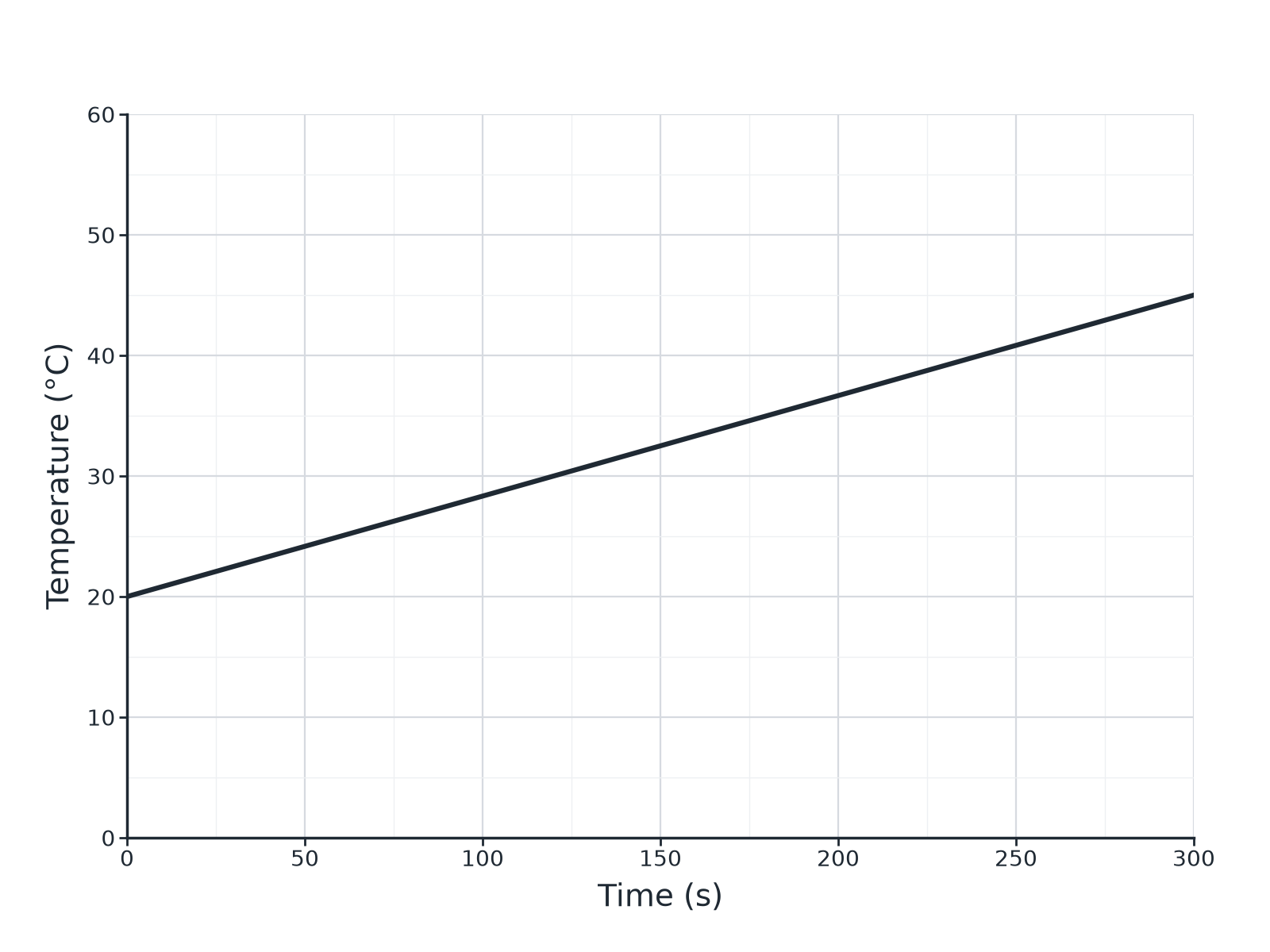
A student heats a block of aluminium of mass 0.80 kg using a heater of power 60 W. The graph shows how the temperature of the block changes with time. (a) Calculate the energy transferred by the heater in 300 s. (b) Use the graph and your answer to (a) to calculate the specific heat capacity of… (4 marks)
openrevise.com
AQA GCSE PHYSICS · PAPER 1 · FOUNDATION & HIGHER

Question 2 · mark scheme
Energy
Lesson 3 of 7
4 marks available. Award a mark for each point made.
18 000 J
1 mark
Temperature rise 25 °C read from graph
1 mark
c = ΔE ÷ (mΔθ)
1 mark
900 J/kg °C
1 mark
openrevise.com
AQA GCSE PHYSICS · PAPER 1 · FOUNDATION & HIGHER

Question 3 · 2 marks · Explain
Energy
Lesson 3 of 7
“
The value of specific heat capacity found in the experiment is higher than the true value. Explain why.
HOW TO ANSWER IT
Command word: Explain. Worth 2 marks, so plan before writing.
openrevise.com
AQA GCSE PHYSICS · PAPER 1 · FOUNDATION & HIGHER

Question 3 · mark scheme
Energy
Lesson 3 of 7
2 marks available. Award a mark for each point made.
Some energy is transferred to the surroundings
1 mark
Energy supplied is more than the energy stored in the block so c appears too high
1 mark
openrevise.com
AQA GCSE PHYSICS · PAPER 1 · FOUNDATION & HIGHER

Question 4 · 6 marks · Describe
Energy
Lesson 3 of 7
“
Describe an investigation to determine the specific heat capacity of an aluminium block. Your answer should include the apparatus, measurements, and how you would use them to obtain the result.
HOW TO ANSWER IT
Command word: Describe. Worth 6 marks, so plan before writing.
openrevise.com
AQA GCSE PHYSICS · PAPER 1 · FOUNDATION & HIGHER

Question 4 · mark scheme
Energy
Lesson 3 of 7
6 marks available. Award a mark for each point made.
Level 3 (5 to 6 marks): a clear, ordered method with apparatus (block, heater, thermometer, insulation, power supply or joulemeter), the measurements (mass, temperature, energy or power and time) and the calculation of c with a precaution
5 to 6 marks
Level 2 (3 to 4 marks): a method with most apparatus and measurements, and some reference to the calculation
3 to 4 marks
Level 1 (1 to 2 marks): simple statements about heating a block
1 to 2 marks
openrevise.com
AQA GCSE PHYSICS · PAPER 1 · FOUNDATION & HIGHER

Question 5 · 2 marks · Explain
Energy
Lesson 3 of 7
“
Water is used in central heating systems. Suggest why.
HOW TO ANSWER IT
Command word: Explain. Worth 2 marks, so plan before writing.
openrevise.com
AQA GCSE PHYSICS · PAPER 1 · FOUNDATION & HIGHER

Question 5 · mark scheme
Energy
Lesson 3 of 7
2 marks available. Award a mark for each point made.
High specific heat capacity
1 mark
Can carry or store a lot of energy per kg per degree
1 mark
openrevise.com
AQA GCSE PHYSICS · PAPER 1 · FOUNDATION & HIGHER

Question 6 · 2 marks · Calculate
Energy
Lesson 3 of 7
“
250 g of water cools from 80 °C to 30 °C. Calculate the energy transferred from the water. Specific heat capacity of water = 4200 J/kg °C.
HOW TO ANSWER IT
Command word: Calculate. Worth 2 marks, so plan before writing.
openrevise.com
AQA GCSE PHYSICS · PAPER 1 · FOUNDATION & HIGHER

Question 6 · mark scheme
Energy
Lesson 3 of 7
2 marks available. Award a mark for each point made.
Converts to 0.25 kg and uses 50 °C
1 mark
52 500 J
1 mark
openrevise.com
← → to move, F to present full screen, G for every slide at once.