Slides · PPTX · 330 KB · 26 slides
Energy transfers conservation and dissipation - Teacher Slides.pptx
The lesson slides with the teacher's notes on each slide, and every question and mark scheme built in. Built from the lesson script on 30 September 2026.
AQA GCSE PHYSICS · PAPER 1 · FOUNDATION & HIGHER

Energy transfers, conservation and dissipation
Energy
Lesson 5 of 7
openrevise.com
AQA GCSE PHYSICS · PAPER 1 · FOUNDATION & HIGHER

Warm-up
Energy
Lesson 5 of 7
Answer each one, then check.
1
Can energy be destroyed?
2
What is friction?
3
Name a good thermal insulator.
4
What is wasted energy?
5
Which store increases when friction acts?
openrevise.com
AQA GCSE PHYSICS · PAPER 1 · FOUNDATION & HIGHER

Warm-up - Answers
Energy
Lesson 5 of 7
1
Can energy be destroyed?
No
2
What is friction?
A force opposing motion between surfaces
3
Name a good thermal insulator.
Wool, foam or fibreglass
4
What is wasted energy?
Energy transferred to stores that are not useful
5
Which store increases when friction acts?
Thermal
openrevise.com
AQA GCSE PHYSICS · PAPER 1 · FOUNDATION & HIGHER

Learning Objectives
Energy
Lesson 5 of 7
1
Describe energy transfers in a closed system.
2
Explain how energy is dissipated.
3
Explain ways of reducing unwanted energy transfers: lubrication and thermal insulation.
4
Describe how thickness and thermal conductivity affect the rate of cooling of a building.
5
Describe an investigation into insulating materials.
openrevise.com
AQA GCSE PHYSICS · PAPER 1 · FOUNDATION & HIGHER
Energy
Lesson 5 of 7

DISSIPATION
Energy is never lost: it is transferred usefully, stored or dissipated. In every change some energy is dissipated into less useful stores.
The higher the thermal conductivity of a material, the higher the rate of energy transfer by conduction through it.
openrevise.com
AQA GCSE PHYSICS · PAPER 1 · FOUNDATION & HIGHER

Investigating Insulation (Required Practical 2)
Energy
Lesson 5 of 7

Only the insulating material should change.
Different insulating materials are compared by how slowly hot water cools inside them.
WHAT TO NOTICE
Insulated beaker
The material surrounds the beaker of hot water.
Control
An identical beaker with no insulation to compare against.
Thermometer and stopwatch
Record the temperature at regular times.
Fair test
Same volume, starting temperature, lid and beaker size.
openrevise.com
AQA GCSE PHYSICS · PAPER 1 · FOUNDATION & HIGHER

Reducing Unwanted Energy Transfers
Energy
Lesson 5 of 7
Lubrication
Oil between moving parts reduces friction, so less energy is dissipated to the thermal store.
Thermal insulation
Materials with low thermal conductivity, like foam and wool, reduce the rate of heat transfer.
Thicker walls
A thicker layer means a lower rate of energy transfer through it.
Lower conductivity
Walls made of material with lower thermal conductivity cool more slowly.
openrevise.com
AQA GCSE PHYSICS · PAPER 1 · FOUNDATION & HIGHER

A House Cooling
Energy
Lesson 5 of 7
Explain how the thickness and thermal conductivity of a house's walls affect its rate of cooling.
1
Thickness
Thicker walls slow the transfer of energy from inside to outside, so the house cools more slowly
2
Conductivity
Walls of lower thermal conductivity give a lower rate of energy transfer
3
Together
Thick walls made of a low-conductivity material give the lowest rate of cooling
ANSWER
The rate of cooling decreases with thicker walls and with lower thermal conductivity.
openrevise.com
AQA GCSE PHYSICS · PAPER 1 · FOUNDATION & HIGHER

Required Practical 2: Method
Energy
Lesson 5 of 7
Compare insulating materials.
1
Set up
Put a beaker of hot water inside a larger beaker with the insulating material packed around it.
2
Same start
Use the same volume of water at the same starting temperature (about 80 °C) for each material.
3
Measure
Record the temperature every minute for 15 to 20 minutes.
4
Repeat
Repeat with other materials and a control with no insulation.
5
Compare
Plot cooling curves. The smallest temperature fall shows the best insulator.
openrevise.com
AQA GCSE PHYSICS · PAPER 1 · FOUNDATION & HIGHER

Control Variables
Energy
Lesson 5 of 7
Make it a fair test.
Independent variable
The type of insulating material (or its thickness).
Dependent variable
The temperature drop, or the time to cool by a set amount.
Control
Volume of water, starting temperature, beaker size, lid, room temperature.
openrevise.com
AQA GCSE PHYSICS · PAPER 1 · FOUNDATION & HIGHER

Key Terms
Energy
Lesson 5 of 7
Dissipated
Transferred to the surroundings and stored in less useful ways.
Thermal conductivity
How well a material conducts thermal energy.
Insulator
A material with low thermal conductivity.
Lubrication
Using oil or grease to reduce friction.
Closed system
A system where no energy enters or leaves.
Control variable
A variable kept the same in a fair test.
openrevise.com
AQA GCSE PHYSICS · PAPER 1 · FOUNDATION & HIGHER
Energy
Lesson 5 of 7

YOUR TASK
Insulate the Cup
15 minutes
You have four cups, cotton wool, foam, newspaper and bubble wrap. Plan a fair test to find the best insulator, listing what you keep the same.
1
State what you change.
2
State what you measure and keep the same.
WHAT A GOOD ANSWER SHOWS
Independent: material. Dependent: temperature fall in 10 minutes. Control: volume and starting temperature of water, cup and lid, thickness of material, room conditions. Repeat and find a mean.
openrevise.com
AQA GCSE PHYSICS · PAPER 1 · FOUNDATION & HIGHER

Can I...?
Energy
Lesson 5 of 7
Explain energy conservation.
Explain dissipation.
Give ways to reduce unwanted energy transfers.
Explain lubrication.
Link thermal conductivity to rate of transfer.
Describe Required Practical 2.
Name control variables.
Read cooling curves.
openrevise.com
AQA GCSE PHYSICS · PAPER 1 · FOUNDATION & HIGHER
Summary & Exam Focus
Total energy is conserved.
Energy is always dissipated to the surroundings.
Lubrication reduces friction; insulation reduces heat loss.
Low thermal conductivity means slower heat transfer.
EXAM FOCUS
A student compares three insulating materials by measuring how quickly hot water cools. Describe how to make the test fair. (3 marks)
Name what you change, measure and keep the same.
openrevise.com
AQA GCSE PHYSICS · PAPER 1 · FOUNDATION & HIGHER

Exam Practice: Energy transfers, conservation and dissipation
Energy
Lesson 5 of 7
Answer all questions. Use the mark allocation as a guide to how much to write. · 18 minutes
Question 1 · 2 marks · Explain
A bicycle chain is lubricated with oil. Explain how this reduces the amount of energy wasted.
Question 2 · 2 marks · Explain
A ball bounces, and each bounce is lower than the one before. Explain why, using the idea of conservation of energy.
Question 3 · 4 marks · Use the graph
A student investigates how quickly hot water cools in three beakers, A, B and C. Each beaker is surrounded by a different insulating…
openrevise.com
AQA GCSE PHYSICS · PAPER 1 · FOUNDATION & HIGHER

Exam Practice: Energy transfers, conservation and dissipation (cont.)
Energy
Lesson 5 of 7
Question 4 · 3 marks · Explain
A house has walls of thickness 20 cm. The walls are replaced with walls of the same material but thickness 30 cm. Explain what happens to…
Question 5 · 6 marks · Describe
Describe an investigation to compare the effectiveness of different materials as thermal insulators. Your answer should include the…
openrevise.com
AQA GCSE PHYSICS · PAPER 1 · FOUNDATION & HIGHER

Question 1 · 2 marks · Explain
Energy
Lesson 5 of 7
“
A bicycle chain is lubricated with oil. Explain how this reduces the amount of energy wasted.
HOW TO ANSWER IT
Command word: Explain. Worth 2 marks, so plan before writing.
openrevise.com
AQA GCSE PHYSICS · PAPER 1 · FOUNDATION & HIGHER

Question 1 · mark scheme
Energy
Lesson 5 of 7
2 marks available. Award a mark for each point made.
Reduces friction
1 mark
Less energy transferred to thermal stores
1 mark
openrevise.com
AQA GCSE PHYSICS · PAPER 1 · FOUNDATION & HIGHER

Question 2 · 2 marks · Explain
Energy
Lesson 5 of 7
“
A ball bounces, and each bounce is lower than the one before. Explain why, using the idea of conservation of energy.
HOW TO ANSWER IT
Command word: Explain. Worth 2 marks, so plan before writing.
openrevise.com
AQA GCSE PHYSICS · PAPER 1 · FOUNDATION & HIGHER

Question 2 · mark scheme
Energy
Lesson 5 of 7
2 marks available. Award a mark for each point made.
Total energy is conserved or not destroyed
1 mark
Some energy dissipated to thermal stores or surroundings
1 mark
openrevise.com
AQA GCSE PHYSICS · PAPER 1 · FOUNDATION & HIGHER

Question 3 · 4 marks · Use the graph
Energy
Lesson 5 of 7
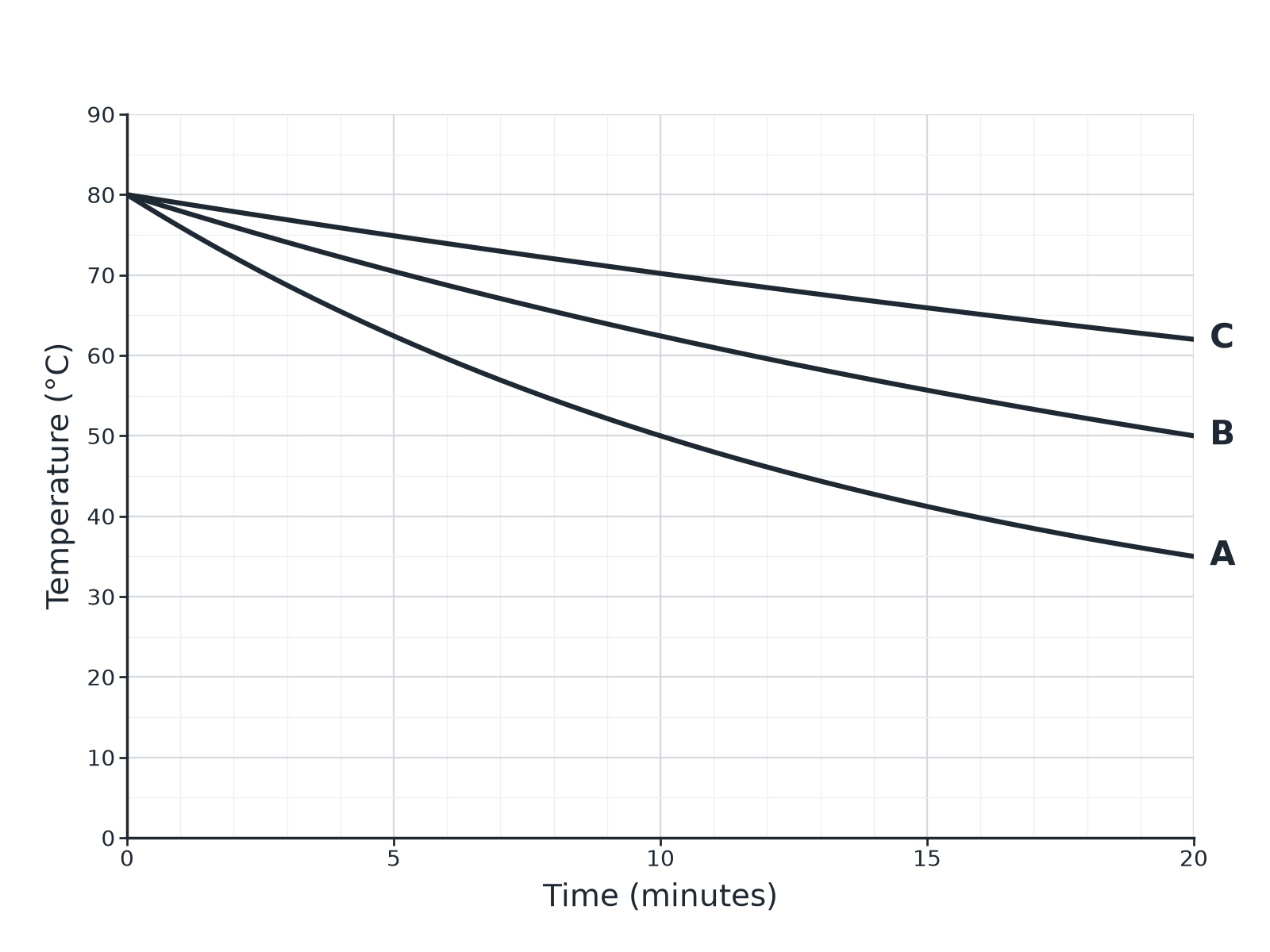
A student investigates how quickly hot water cools in three beakers, A, B and C. Each beaker is surrounded by a different insulating material. The graph shows the results. (a) Which beaker was surrounded by the best insulator? Give a reason. (b) Give two variables that should be controlled. (4 marks)
openrevise.com
AQA GCSE PHYSICS · PAPER 1 · FOUNDATION & HIGHER

Question 3 · mark scheme
Energy
Lesson 5 of 7
4 marks available. Award a mark for each point made.
C
1 mark
Smallest fall in temperature or slowest cooling
1 mark
Any two controls, 1 mark each
2 marks
openrevise.com
AQA GCSE PHYSICS · PAPER 1 · FOUNDATION & HIGHER

Question 4 · 3 marks · Explain
Energy
Lesson 5 of 7
“
A house has walls of thickness 20 cm. The walls are replaced with walls of the same material but thickness 30 cm. Explain what happens to the rate at which the house cools.
HOW TO ANSWER IT
Command word: Explain. Worth 3 marks, so plan before writing.
openrevise.com
AQA GCSE PHYSICS · PAPER 1 · FOUNDATION & HIGHER

Question 4 · mark scheme
Energy
Lesson 5 of 7
3 marks available. Award a mark for each point made.
Rate of cooling decreases
1 mark
Thicker walls
1 mark
Lower rate of energy transfer by conduction
1 mark
openrevise.com
AQA GCSE PHYSICS · PAPER 1 · FOUNDATION & HIGHER

Question 5 · 6 marks · Describe
Energy
Lesson 5 of 7
“
Describe an investigation to compare the effectiveness of different materials as thermal insulators. Your answer should include the apparatus, how you would make it a fair test, and how you would use the results.
HOW TO ANSWER IT
Command word: Describe. Worth 6 marks, so plan before writing.
openrevise.com
AQA GCSE PHYSICS · PAPER 1 · FOUNDATION & HIGHER

Question 5 · mark scheme
Energy
Lesson 5 of 7
6 marks available. Award a mark for each point made.
Level 3 (5 to 6 marks): a clear method using beakers, hot water, thermometer and timer with each material; several controls named; temperature change compared to identify the best insulator; repeats
5 to 6 marks
Level 2 (3 to 4 marks): a method with some controls and a way to compare
3 to 4 marks
Level 1 (1 to 2 marks): simple statements about insulating a beaker
1 to 2 marks
openrevise.com
← → to move, F to present full screen, G for every slide at once.