Slides · PPTX · 224 KB · 25 slides
The National Grid - Teacher Slides.pptx
The lesson slides with the teacher's notes on each slide, and every question and mark scheme built in. Built from the lesson script on 30 September 2026.
AQA GCSE PHYSICS · PAPER 1 · FOUNDATION & HIGHER
The National Grid
Electricity
Lesson 8 of 10
openrevise.com
AQA GCSE PHYSICS · PAPER 1 · FOUNDATION & HIGHER
Warm-up
Electricity
Lesson 8 of 10
Answer each one, then check.
1
What does a power station generate?
2
What happens to a wire when a current flows?
3
Write the equation for power using current and resistance.
4
What does step-up mean?
5
What is a cable?
openrevise.com
AQA GCSE PHYSICS · PAPER 1 · FOUNDATION & HIGHER
Warm-up - Answers
Electricity
Lesson 8 of 10
1
What does a power station generate?
Electricity
2
What happens to a wire when a current flows?
It heats up
3
Write the equation for power using current and resistance.
P = I²R
4
What does step-up mean?
Increases the potential difference
5
What is a cable?
A wire used to carry current
openrevise.com
AQA GCSE PHYSICS · PAPER 1 · FOUNDATION & HIGHER
Learning Objectives
Electricity
Lesson 8 of 10
1
Describe the National Grid as a system of cables and transformers.
2
State the roles of step-up and step-down transformers.
3
Explain why the National Grid is an efficient way to transfer energy.
openrevise.com
AQA GCSE PHYSICS · PAPER 1 · FOUNDATION & HIGHER
Electricity
Lesson 8 of 10
THE NATIONAL GRID
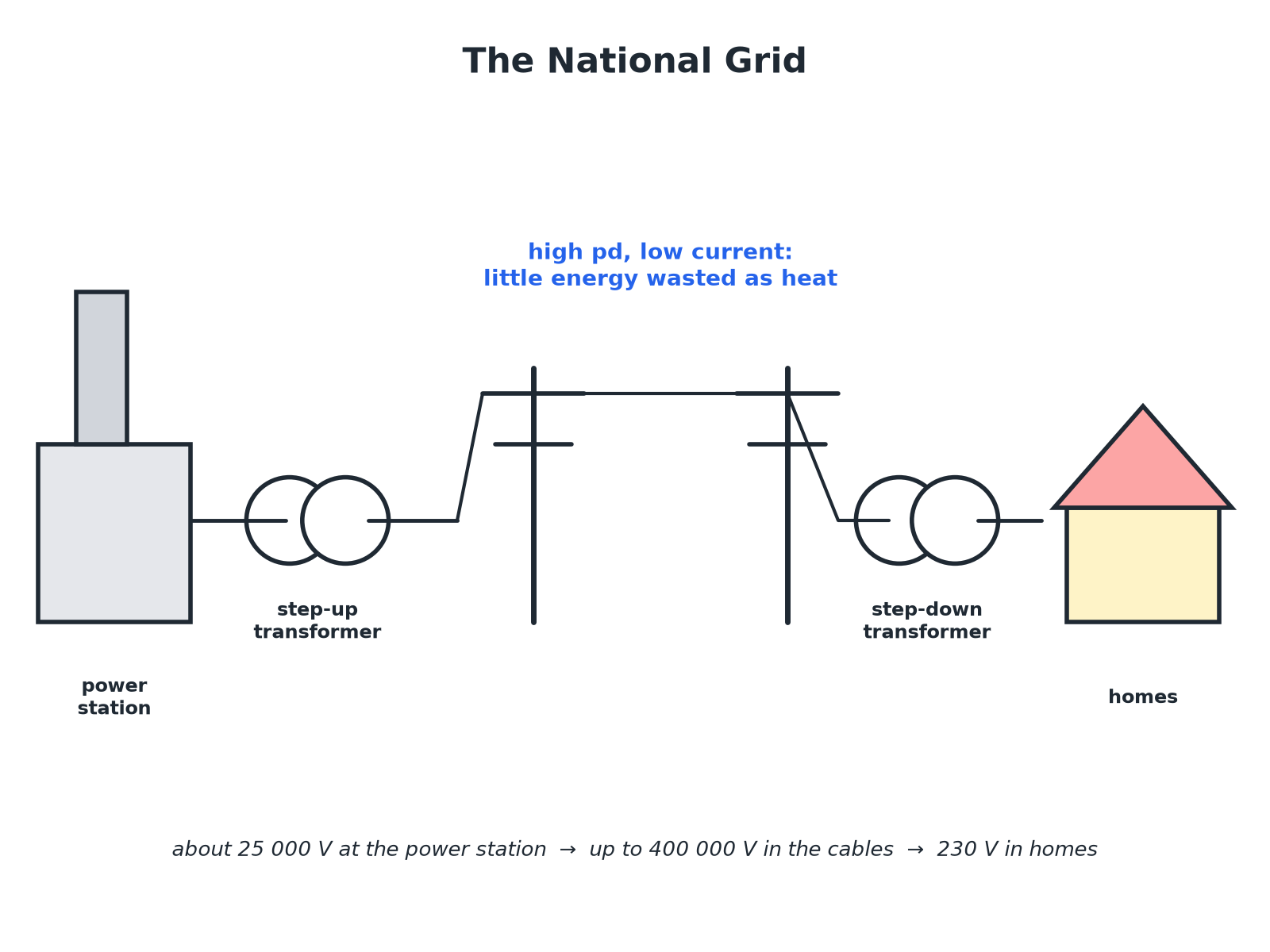
Step-up transformers increase the potential difference for transmission, which reduces the current and so the energy wasted as heat in the cables.
The National Grid is a system of cables and transformers linking power stations to consumers.
openrevise.com
AQA GCSE PHYSICS · PAPER 1 · FOUNDATION & HIGHER
From Power Station to Home
Electricity
Lesson 8 of 10

High pd means low current.
openrevise.com
AQA GCSE PHYSICS · PAPER 1 · FOUNDATION & HIGHER
Why High pd Means Efficient
Electricity
Lesson 8 of 10
Follow the logic.
1
Power = pd × current
For the same power, a higher pd means a smaller current.
2
Less current
A smaller current means less heating in the cables.
3
Energy wasted
Power loss in the cable is P = I²R, so halving the current cuts the loss to a quarter.
4
Step-up transformers
Increase the pd before the cables.
5
Step-down transformers
Decrease the pd to a safe value for homes (230 V).
openrevise.com
AQA GCSE PHYSICS · PAPER 1 · FOUNDATION & HIGHER
Comparing Losses
Electricity
Lesson 8 of 10
100 kW is transmitted through cables of total resistance 2.0 Ω. Compare the power lost at 1000 V with the power lost at 10 000 V.
1
Current at 1000 V
I = P ÷ V = 100 000 ÷ 1000 = 100 A
2
Power lost
P = I²R = 100² × 2.0 = 20 000 W
3
Current at 10 000 V
I = 100 000 ÷ 10 000 = 10 A
4
Power lost
10² × 2.0 = 200 W
ANSWER
20 kW lost at 1000 V but only 200 W lost at 10 000 V: high pd wastes far less energy.
openrevise.com
AQA GCSE PHYSICS · PAPER 1 · FOUNDATION & HIGHER
Key Points
Electricity
Lesson 8 of 10
For an exam answer.
Efficient
High pd, low current means little energy wasted as heat in the cables.
Step-up
Used at the power station end.
Step-down
Used near homes and factories.
Safety
The high pd is reduced to 230 V before homes.
openrevise.com
AQA GCSE PHYSICS · PAPER 1 · FOUNDATION & HIGHER
Key Terms
Electricity
Lesson 8 of 10
National Grid
A system of cables and transformers linking power stations to consumers.
Transformer
A device that changes the size of an alternating pd.
Step-up transformer
Increases the pd.
Step-down transformer
Decreases the pd.
Transmission cables
Cables that carry electricity over long distances.
Efficient
Wasting little energy.
openrevise.com
AQA GCSE PHYSICS · PAPER 1 · FOUNDATION & HIGHER
Electricity
Lesson 8 of 10
YOUR TASK
Follow the Grid
10 minutes
Put these in the correct order: homes, step-up transformer, power station, step-down transformer, transmission cables.
1
Start at the power station.
2
End at homes.
WHAT A GOOD ANSWER SHOWS
Power station, step-up transformer, transmission cables, step-down transformer, homes.
openrevise.com
AQA GCSE PHYSICS · PAPER 1 · FOUNDATION & HIGHER
Can I...?
Electricity
Lesson 8 of 10
Describe the National Grid.
State what a step-up transformer does.
State what a step-down transformer does.
Explain why high pd is used.
Link current to energy wasted.
Compare power losses.
Draw or complete a grid diagram.
Explain why 230 V is needed in homes.
openrevise.com
AQA GCSE PHYSICS · PAPER 1 · FOUNDATION & HIGHER
Summary & Exam Focus
Step-up transformers increase pd, step-down decrease it.
High pd means low current for the same power.
Low current means less energy wasted as heat in the cables.
The National Grid is efficient.
EXAM FOCUS
Explain why the National Grid transmits electricity at a high potential difference. (3 marks)
Say higher pd means lower current, so less heating.
openrevise.com
AQA GCSE PHYSICS · PAPER 1 · FOUNDATION & HIGHER
Exam Practice: The National Grid
Electricity
Lesson 8 of 10
Answer all questions. Use the mark allocation as a guide to how much to write. · 15 minutes
Question 1 · 2 marks · Complete
Name the two types of transformer used in the National Grid and state what each does.
Question 2 · 3 marks · Use the diagram
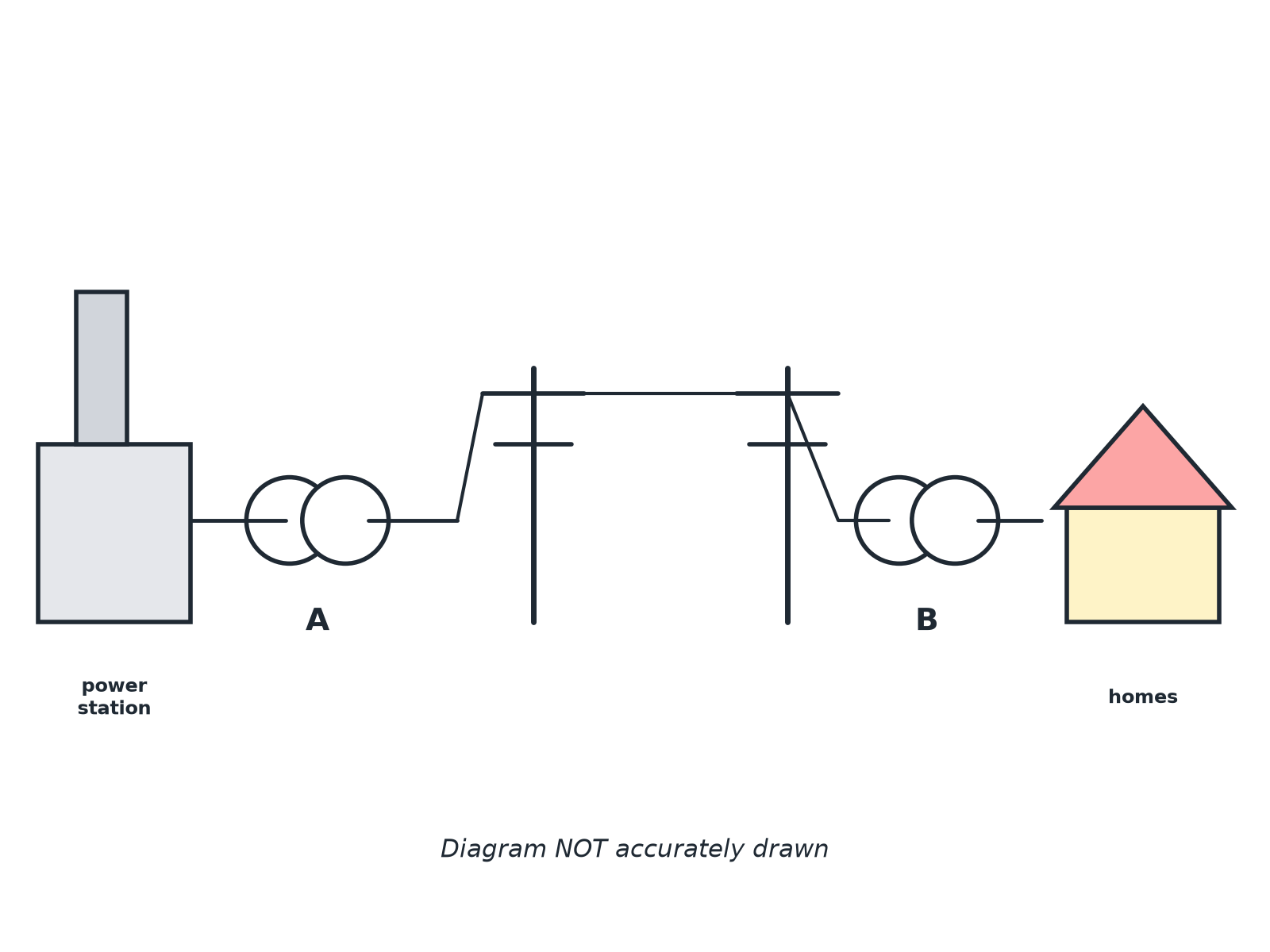
The diagram shows part of the National Grid. (a) Name the parts labelled A and B. (b) State why B is needed near homes.
Question 3 · 3 marks · Explain
Explain why using a high potential difference to transmit electricity is efficient.
openrevise.com
AQA GCSE PHYSICS · PAPER 1 · FOUNDATION & HIGHER
Exam Practice: The National Grid (cont.)
Electricity
Lesson 8 of 10
Question 4 · 4 marks · Calculate
A power of 100 kW is transmitted at 10 000 V through cables of total resistance 2.0 Ω. Calculate the power wasted as heat in the cables.
Question 5 · 2 marks · Explain
The potential difference in the transmission cables is much higher than in homes. Explain why the potential difference in homes is reduced.
openrevise.com
AQA GCSE PHYSICS · PAPER 1 · FOUNDATION & HIGHER
Question 1 · 2 marks · Complete
Electricity
Lesson 8 of 10
“
Name the two types of transformer used in the National Grid and state what each does.
HOW TO ANSWER IT
Command word: Complete. Worth 2 marks, so plan before writing.
openrevise.com
AQA GCSE PHYSICS · PAPER 1 · FOUNDATION & HIGHER
Question 1 · mark scheme
Electricity
Lesson 8 of 10
2 marks available. Award a mark for each point made.
Step-up increases pd
1 mark
Step-down decreases pd
1 mark
openrevise.com
AQA GCSE PHYSICS · PAPER 1 · FOUNDATION & HIGHER
Question 2 · 3 marks · Use the diagram
Electricity
Lesson 8 of 10

The diagram shows part of the National Grid. (a) Name the parts labelled A and B. (b) State why B is needed near homes. (3 marks)
openrevise.com
AQA GCSE PHYSICS · PAPER 1 · FOUNDATION & HIGHER
Question 2 · mark scheme
Electricity
Lesson 8 of 10
3 marks available. Award a mark for each point made.
A: step-up transformer
1 mark
B: step-down transformer
1 mark
Reduces the pd to a safe value for homes
1 mark
openrevise.com
AQA GCSE PHYSICS · PAPER 1 · FOUNDATION & HIGHER
Question 3 · 3 marks · Explain
Electricity
Lesson 8 of 10
“
Explain why using a high potential difference to transmit electricity is efficient.
HOW TO ANSWER IT
Command word: Explain. Worth 3 marks, so plan before writing.
openrevise.com
AQA GCSE PHYSICS · PAPER 1 · FOUNDATION & HIGHER
Question 3 · mark scheme
Electricity
Lesson 8 of 10
3 marks available. Award a mark for each point made.
High pd means lower current for the same power
1 mark
Lower current means less heating of the cables
1 mark
So less energy wasted
1 mark
openrevise.com
AQA GCSE PHYSICS · PAPER 1 · FOUNDATION & HIGHER
Question 4 · 4 marks · Calculate
Electricity
Lesson 8 of 10
“
A power of 100 kW is transmitted at 10 000 V through cables of total resistance 2.0 Ω. Calculate the power wasted as heat in the cables.
HOW TO ANSWER IT
Command word: Calculate. Worth 4 marks, so plan before writing.
openrevise.com
AQA GCSE PHYSICS · PAPER 1 · FOUNDATION & HIGHER
Question 4 · mark scheme
Electricity
Lesson 8 of 10
4 marks available. Award a mark for each point made.
Rearranges to I = P ÷ V
1 mark
10 A
1 mark
Correct substitution into I²R
1 mark
200 W
1 mark
openrevise.com
AQA GCSE PHYSICS · PAPER 1 · FOUNDATION & HIGHER
Question 5 · 2 marks · Explain
Electricity
Lesson 8 of 10
“
The potential difference in the transmission cables is much higher than in homes. Explain why the potential difference in homes is reduced.
HOW TO ANSWER IT
Command word: Explain. Worth 2 marks, so plan before writing.
openrevise.com
AQA GCSE PHYSICS · PAPER 1 · FOUNDATION & HIGHER
Question 5 · mark scheme
Electricity
Lesson 8 of 10
2 marks available. Award a mark for each point made.
Safe for homes or appliances designed for 230 V
1 mark
Step-down transformer decreases the pd
1 mark
openrevise.com
← → to move, F to present full screen, G for every slide at once.