Slides · PPTX · 353 KB · 30 slides
Resistors and IV characteristics - Teacher Slides.pptx
The lesson slides with the teacher's notes on each slide, and every question and mark scheme built in. Built from the lesson script on 30 September 2026.
AQA GCSE PHYSICS · PAPER 1 · FOUNDATION & HIGHER

Resistors and I–V characteristics
Electricity
Lesson 3 of 10
openrevise.com
AQA GCSE PHYSICS · PAPER 1 · FOUNDATION & HIGHER

Warm-up
Electricity
Lesson 3 of 10
Answer each one, then check.
1
What is an ohmic conductor?
2
What does I–V stand for?
3
What is a straight line graph through the origin?
4
What happens to a metal when its temperature rises?
5
What does LDR stand for?
openrevise.com
AQA GCSE PHYSICS · PAPER 1 · FOUNDATION & HIGHER

Warm-up - Answers
Electricity
Lesson 3 of 10
1
What is an ohmic conductor?
A conductor with constant resistance at constant temperature
2
What does I–V stand for?
Current against potential difference
3
What is a straight line graph through the origin?
Directly proportional
4
What happens to a metal when its temperature rises?
Its resistance rises
5
What does LDR stand for?
Light-dependent resistor
openrevise.com
AQA GCSE PHYSICS · PAPER 1 · FOUNDATION & HIGHER

Learning Objectives
Electricity
Lesson 3 of 10
1
Describe the I–V graphs of a resistor, filament lamp and diode.
2
Explain the changes in resistance of a filament lamp, diode, thermistor and LDR.
3
Describe how to investigate I–V characteristics (Required Practical 4).
4
Use graphs to say whether a component is linear or non-linear.
openrevise.com
AQA GCSE PHYSICS · PAPER 1 · FOUNDATION & HIGHER
Electricity
Lesson 3 of 10

I–V CHARACTERISTICS
The current through an ohmic conductor at constant temperature is directly proportional to the potential difference across it, so its resistance is constant.
The resistance of a filament lamp, diode, thermistor and LDR is not constant.
openrevise.com
AQA GCSE PHYSICS · PAPER 1 · FOUNDATION & HIGHER

I–V Graphs
Electricity
Lesson 3 of 10
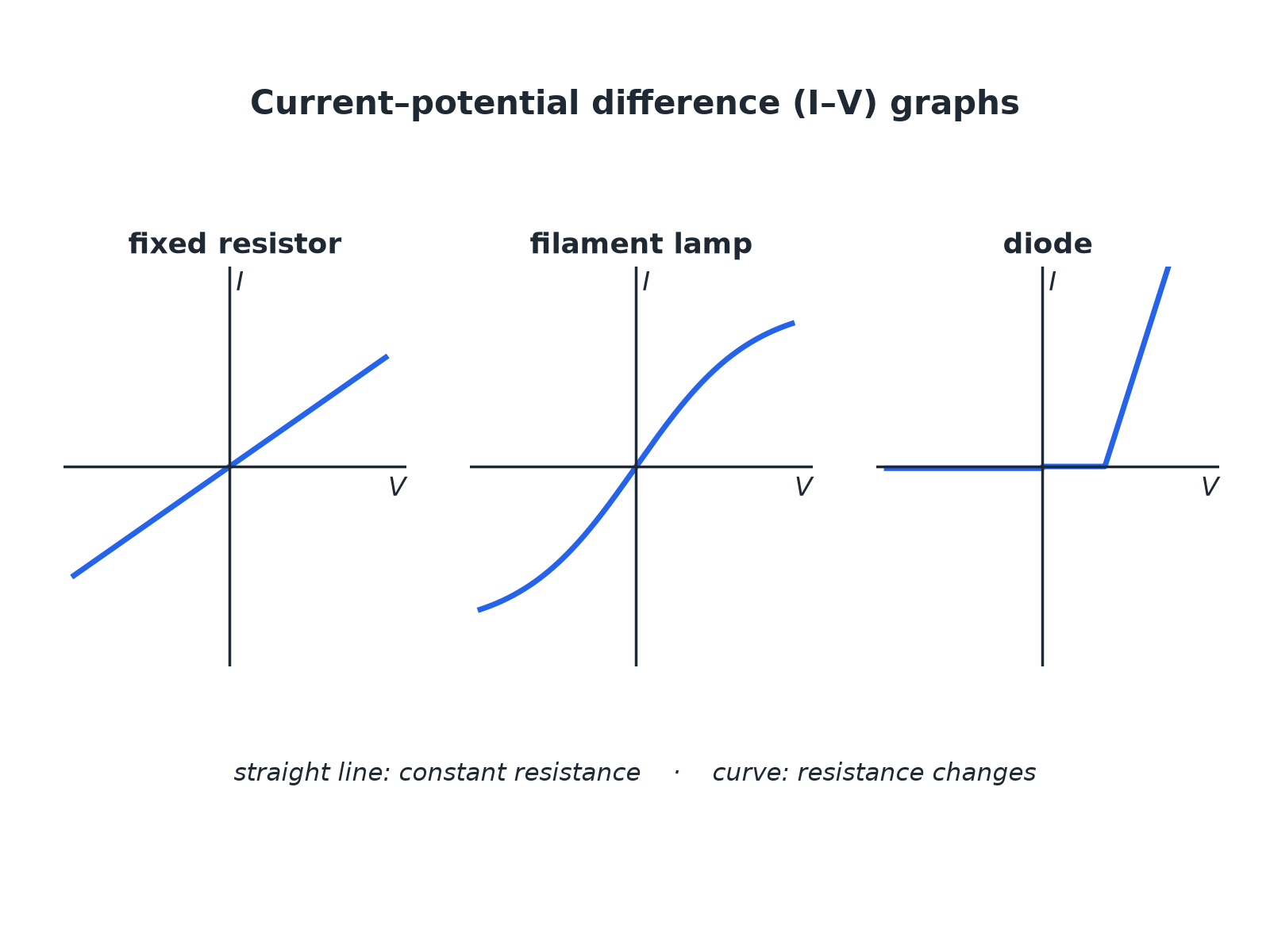
Straight line: constant resistance. Curve: changing resistance.
openrevise.com
AQA GCSE PHYSICS · PAPER 1 · FOUNDATION & HIGHER

Thermistor and LDR
Electricity
Lesson 3 of 10
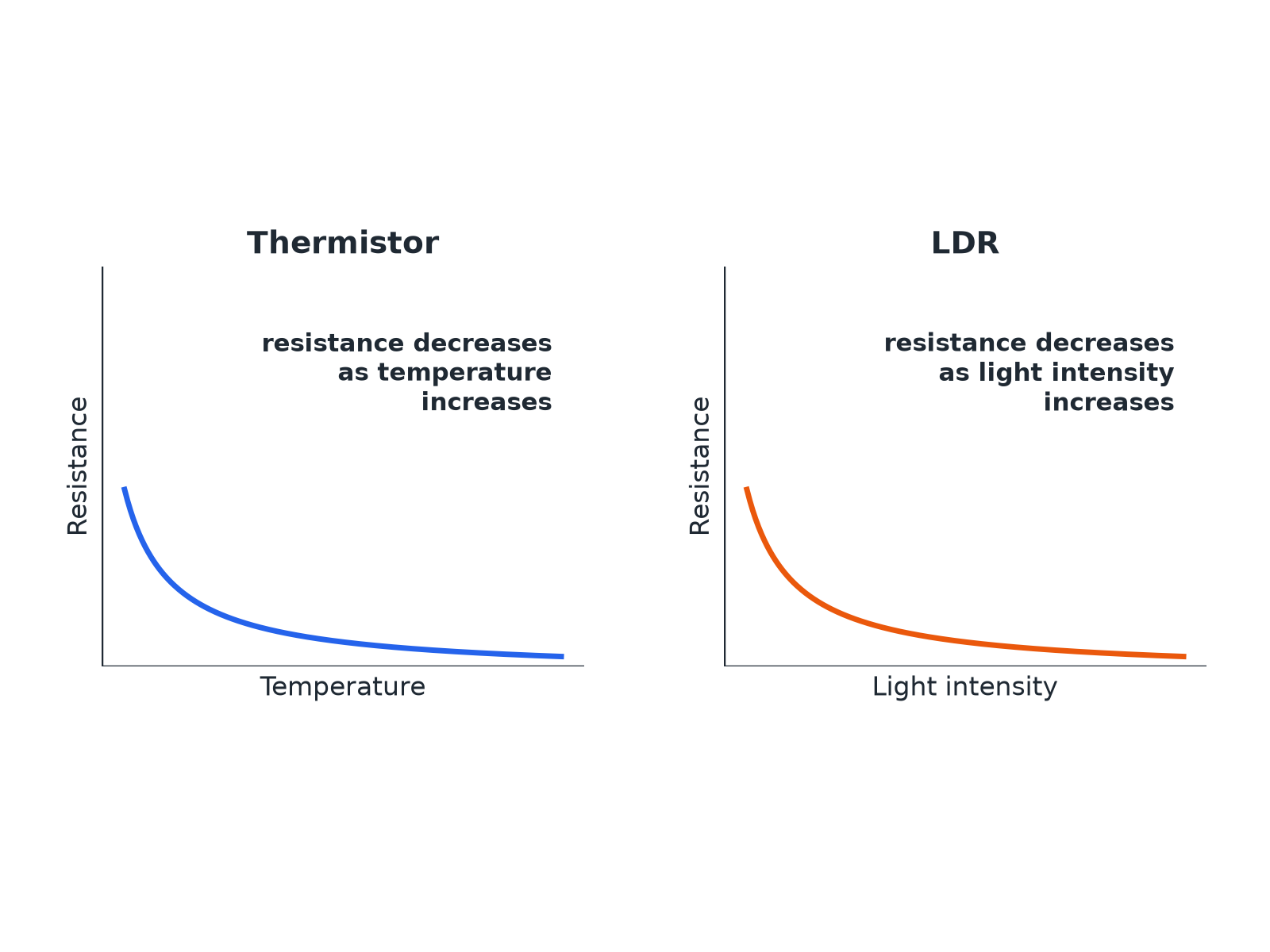
Both fall as the quantity increases.
openrevise.com
AQA GCSE PHYSICS · PAPER 1 · FOUNDATION & HIGHER

Required Practical 4: I–V Circuit
Electricity
Lesson 3 of 10

Vary the pd and measure the current each time.
openrevise.com
AQA GCSE PHYSICS · PAPER 1 · FOUNDATION & HIGHER

Component Behaviour
Electricity
Lesson 3 of 10
Learn each description.
Component
Resistance
Graph or behaviour
Fixed resistor
Constant at constant temperature
Straight line through the origin
Filament lamp
Increases as the filament gets hotter
Curve that flattens; gradient decreases
Diode
Very high in the reverse direction
Current flows in one direction only
Thermistor
Decreases as temperature increases
Used in thermostats and temperature sensors
LDR
Decreases as light intensity increases
Used in automatic lights
openrevise.com
AQA GCSE PHYSICS · PAPER 1 · FOUNDATION & HIGHER

Required Practical 4: Method
Electricity
Lesson 3 of 10
Find the I–V characteristic of a component.
1
Set up
Connect the component in series with the ammeter and variable resistor, and the voltmeter across the component.
2
Vary
Change the variable resistor to get different pds.
3
Record
For each setting record V and I.
4
Reverse
Swap the connections and repeat to get negative values (not for a diode with a protective resistor).
5
Plot
Draw current against pd and draw a smooth line.
6
Repeat
For the filament lamp and the diode.
openrevise.com
AQA GCSE PHYSICS · PAPER 1 · FOUNDATION & HIGHER

Resistance of a Filament Lamp
Electricity
Lesson 3 of 10
The current through a filament lamp is 0.34 A at 2.0 V and 0.62 A at 6.0 V. Calculate the resistance at each pd and explain the difference.
1
At 2.0 V
R = 2.0 ÷ 0.34 = 5.9 Ω
2
At 6.0 V
R = 6.0 ÷ 0.62 = 9.7 Ω
3
Explain
At the higher pd the current is greater, so the filament is hotter and its resistance is higher
ANSWER
5.9 Ω and 9.7 Ω; the resistance increases as the filament gets hotter.
openrevise.com
AQA GCSE PHYSICS · PAPER 1 · FOUNDATION & HIGHER

Uses in Circuits
Electricity
Lesson 3 of 10
Applications you need to know.
Thermistor
In a thermostat: as the temperature rises the resistance falls, changing the pd across it to switch heating off.
LDR
In automatic lights: as it gets dark the resistance rises, which switches the light on.
Diode
Allows current in one direction only, protecting circuits from being connected the wrong way round.
openrevise.com
AQA GCSE PHYSICS · PAPER 1 · FOUNDATION & HIGHER

Key Terms
Electricity
Lesson 3 of 10
Ohmic conductor
A conductor whose resistance is constant at constant temperature.
Filament lamp
A lamp with a thin wire that gets hot and glows.
Diode
A component that lets current flow in one direction only.
Thermistor
A resistor whose resistance decreases when the temperature increases.
LDR
A resistor whose resistance decreases when the light intensity increases.
Linear
Following a straight line graph.
openrevise.com
AQA GCSE PHYSICS · PAPER 1 · FOUNDATION & HIGHER
Electricity
Lesson 3 of 10

YOUR TASK
Match the Graph
10 minutes
Match each component to its I–V graph description: resistor, filament lamp, diode. (1) Curve that flattens as pd increases. (2) Straight line through the origin. (3) Almost no current one way, then a rapid increase the other way.
1
Look at the shape.
2
Explain the resistance change.
WHAT A GOOD ANSWER SHOWS
Resistor: (2). Filament lamp: (1). Diode: (3).
openrevise.com
AQA GCSE PHYSICS · PAPER 1 · FOUNDATION & HIGHER

Can I...?
Electricity
Lesson 3 of 10
Draw and describe the I–V graph of a resistor.
Describe the I–V graph of a filament lamp.
Describe the I–V graph of a diode.
Explain why a filament lamp's resistance increases.
Describe how a thermistor behaves.
Describe how an LDR behaves.
Describe Required Practical 4.
Give one use each of a thermistor and an LDR.
openrevise.com
AQA GCSE PHYSICS · PAPER 1 · FOUNDATION & HIGHER
Summary & Exam Focus
Resistor: constant resistance, straight line through the origin.
Filament lamp: resistance increases with temperature.
Diode: current in one direction only.
Thermistor and LDR resistances decrease as temperature or light increases.
EXAM FOCUS
Explain why the resistance of a filament lamp increases as the current increases. (3 marks)
Say the filament gets hotter and link it to resistance.
openrevise.com
AQA GCSE PHYSICS · PAPER 1 · FOUNDATION & HIGHER

Exam Practice: Resistors and I–V characteristics
Electricity
Lesson 3 of 10
Answer all questions. Use the mark allocation as a guide to how much to write. · 22 minutes
Question 1 · 3 marks · Complete
Name the component whose I–V characteristic shows current flowing in one direction only, and the component whose resistance decreases as…
Question 2 · 4 marks · Use the graph
The graph shows the I–V characteristic of a filament lamp. (a) Calculate the resistance of the lamp when the potential difference is 6.0 V…
Question 3 · 3 marks · Explain
A thermistor is used in a circuit to control a heating system. Explain how the resistance of the thermistor changes as the room warms up.
openrevise.com
AQA GCSE PHYSICS · PAPER 1 · FOUNDATION & HIGHER

Exam Practice: Resistors and I–V characteristics (cont.)
Electricity
Lesson 3 of 10
Question 4 · 6 marks · Describe
Describe how you would investigate the relationship between the current through a filament lamp and the potential difference across it…
Question 5 · 2 marks · Explain
A student measures the resistance of a diode. Explain why the resistance is very high when the diode is connected the other way round.
Question 6 · 3 marks · Suggest
An automatic outdoor light contains an LDR. Explain how the light switches on when it gets dark.
openrevise.com
AQA GCSE PHYSICS · PAPER 1 · FOUNDATION & HIGHER

Question 1 · 3 marks · Complete
Electricity
Lesson 3 of 10
“
Name the component whose I–V characteristic shows current flowing in one direction only, and the component whose resistance decreases as the temperature increases. Then state what happens to the resistance of an LDR in bright light.
HOW TO ANSWER IT
Command word: Complete. Worth 3 marks, so plan before writing.
openrevise.com
AQA GCSE PHYSICS · PAPER 1 · FOUNDATION & HIGHER

Question 1 · mark scheme
Electricity
Lesson 3 of 10
3 marks available. Award a mark for each point made.
Diode
1 mark
Thermistor
1 mark
LDR resistance decreases
1 mark
openrevise.com
AQA GCSE PHYSICS · PAPER 1 · FOUNDATION & HIGHER

Question 2 · 4 marks · Use the graph
Electricity
Lesson 3 of 10
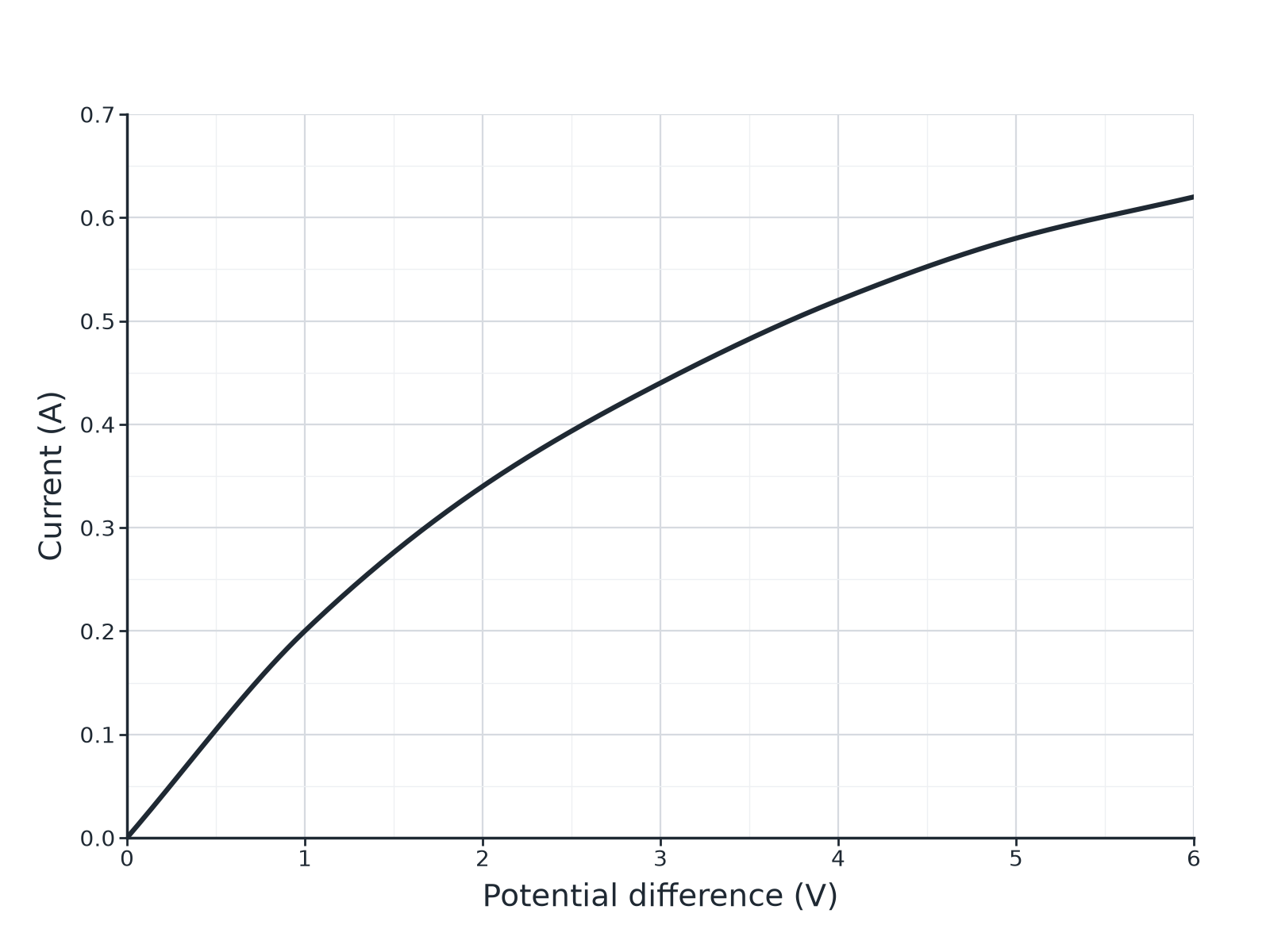
The graph shows the I–V characteristic of a filament lamp. (a) Calculate the resistance of the lamp when the potential difference is 6.0 V. (b) The resistance at 2.0 V is 5.9 Ω. Explain why the resistance at 6.0 V is different. (4 marks)
openrevise.com
AQA GCSE PHYSICS · PAPER 1 · FOUNDATION & HIGHER

Question 2 · mark scheme
Electricity
Lesson 3 of 10
4 marks available. Award a mark for each point made.
Reads 0.62 A
1 mark
9.7 Ω
1 mark
Higher current means higher temperature
1 mark
Resistance increases with temperature
1 mark
openrevise.com
AQA GCSE PHYSICS · PAPER 1 · FOUNDATION & HIGHER

Question 3 · 3 marks · Explain
Electricity
Lesson 3 of 10
“
A thermistor is used in a circuit to control a heating system. Explain how the resistance of the thermistor changes as the room warms up.
HOW TO ANSWER IT
Command word: Explain. Worth 3 marks, so plan before writing.
openrevise.com
AQA GCSE PHYSICS · PAPER 1 · FOUNDATION & HIGHER

Question 3 · mark scheme
Electricity
Lesson 3 of 10
3 marks available. Award a mark for each point made.
Resistance decreases as temperature increases
1 mark
Current or potential difference changes in the circuit
1 mark
Used to switch the heating off
1 mark
openrevise.com
AQA GCSE PHYSICS · PAPER 1 · FOUNDATION & HIGHER

Question 4 · 6 marks · Describe
Electricity
Lesson 3 of 10
“
Describe how you would investigate the relationship between the current through a filament lamp and the potential difference across it. Include a circuit diagram description, the readings to take and how you would present and use the results.
HOW TO ANSWER IT
Command word: Describe. Worth 6 marks, so plan before writing.
openrevise.com
AQA GCSE PHYSICS · PAPER 1 · FOUNDATION & HIGHER

Question 4 · mark scheme
Electricity
Lesson 3 of 10
6 marks available. Award a mark for each point made.
Level 3 (5 to 6 marks): a correct circuit (ammeter in series, voltmeter across the lamp, variable resistor or supply), a range of pd values and matching currents, a graph of I against V and a description of its shape or the changing gradient
5 to 6 marks
Level 2 (3 to 4 marks): a method with the main apparatus and some readings; the graph is mentioned
3 to 4 marks
Level 1 (1 to 2 marks): simple statements about measuring current and pd
1 to 2 marks
openrevise.com
AQA GCSE PHYSICS · PAPER 1 · FOUNDATION & HIGHER

Question 5 · 2 marks · Explain
Electricity
Lesson 3 of 10
“
A student measures the resistance of a diode. Explain why the resistance is very high when the diode is connected the other way round.
HOW TO ANSWER IT
Command word: Explain. Worth 2 marks, so plan before writing.
openrevise.com
AQA GCSE PHYSICS · PAPER 1 · FOUNDATION & HIGHER

Question 5 · mark scheme
Electricity
Lesson 3 of 10
2 marks available. Award a mark for each point made.
Very high resistance in reverse
1 mark
Almost no current flows
1 mark
openrevise.com
AQA GCSE PHYSICS · PAPER 1 · FOUNDATION & HIGHER

Question 6 · 3 marks · Suggest
Electricity
Lesson 3 of 10
“
An automatic outdoor light contains an LDR. Explain how the light switches on when it gets dark.
HOW TO ANSWER IT
Command word: Suggest. Worth 3 marks, so plan before writing.
openrevise.com
AQA GCSE PHYSICS · PAPER 1 · FOUNDATION & HIGHER

Question 6 · mark scheme
Electricity
Lesson 3 of 10
3 marks available. Award a mark for each point made.
Resistance of LDR increases in the dark
1 mark
Change in pd or current in the circuit
1 mark
Circuit switches the light on
1 mark
openrevise.com
← → to move, F to present full screen, G for every slide at once.