Slides · PPTX · 186 KB · 26 slides
Changes of state - Teacher Slides.pptx
The lesson slides with the teacher's notes on each slide, and every question and mark scheme built in. Built from the lesson script on 30 September 2026.
AQA GCSE PHYSICS · PAPER 1 · FOUNDATION & HIGHER
Changes of state
Particle model of matter
Lesson 2 of 6
openrevise.com
AQA GCSE PHYSICS · PAPER 1 · FOUNDATION & HIGHER
Warm-up
Particle model of matter
Lesson 2 of 6
Answer each one, then check.
1
What is the change from solid to liquid called?
2
What is the change from gas to liquid called?
3
What is the unit of mass?
4
What is freezing?
5
Give an example of a chemical change.
openrevise.com
AQA GCSE PHYSICS · PAPER 1 · FOUNDATION & HIGHER
Warm-up - Answers
Particle model of matter
Lesson 2 of 6
1
What is the change from solid to liquid called?
Melting
2
What is the change from gas to liquid called?
Condensing
3
What is the unit of mass?
Kilogram
4
What is freezing?
Liquid to solid
5
Give an example of a chemical change.
Burning wood
openrevise.com
AQA GCSE PHYSICS · PAPER 1 · FOUNDATION & HIGHER
Learning Objectives
Particle model of matter
Lesson 2 of 6
1
Name each change of state.
2
Explain that mass is conserved in a change of state.
3
Explain that changes of state are physical changes and are reversible.
4
Draw and interpret particle diagrams for solids, liquids and gases.
openrevise.com
AQA GCSE PHYSICS · PAPER 1 · FOUNDATION & HIGHER
Particle model of matter
Lesson 2 of 6
CHANGES OF STATE
Changes of state are physical changes: the material recovers its original properties if the change is reversed. Mass is conserved.
The particles are the same before and after, so the mass is the same. Only the arrangement and energy of the particles change.
openrevise.com
AQA GCSE PHYSICS · PAPER 1 · FOUNDATION & HIGHER
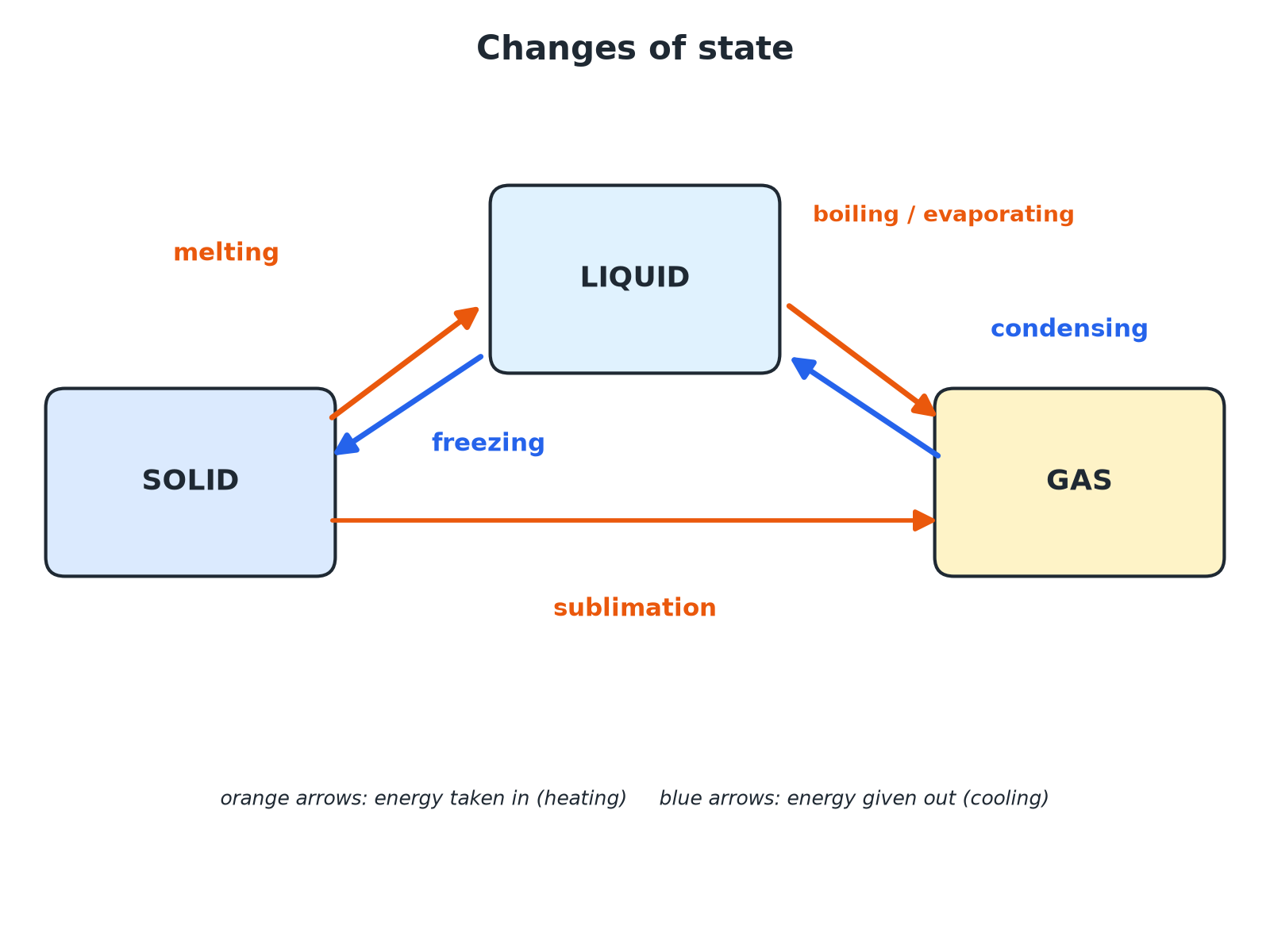
Six Changes of State
Particle model of matter
Lesson 2 of 6

Heating goes one way; cooling reverses it.
openrevise.com
AQA GCSE PHYSICS · PAPER 1 · FOUNDATION & HIGHER
The Changes
Particle model of matter
Lesson 2 of 6
Learn the names.
Change
From
To
Energy
Melting
Solid
Liquid
Energy taken in
Freezing
Liquid
Solid
Energy given out
Boiling or evaporating
Liquid
Gas
Energy taken in
Condensing
Gas
Liquid
Energy given out
Sublimation
Solid
Gas
Energy taken in
openrevise.com
AQA GCSE PHYSICS · PAPER 1 · FOUNDATION & HIGHER
Mass in a Change of State
Particle model of matter
Lesson 2 of 6
A 200 g ice cube melts to form water. What is the mass of the water? Explain.
1
Number of particles
The same particles are present as liquid water
2
Mass
Unchanged, because no particles are lost
ANSWER
200 g: mass is conserved.
openrevise.com
AQA GCSE PHYSICS · PAPER 1 · FOUNDATION & HIGHER
Physical or Chemical?
Particle model of matter
Lesson 2 of 6
Explain why melting ice is a physical change but burning wood is a chemical change.
1
Melting ice
The water is the same substance, and it freezes back to ice with the same properties
2
Burning wood
New substances are made and the wood cannot be recovered
ANSWER
Physical changes are reversible and the material recovers its original properties.
openrevise.com
AQA GCSE PHYSICS · PAPER 1 · FOUNDATION & HIGHER
Particle Explanation
Particle model of matter
Lesson 2 of 6
Say what the particles do.
Melting
Particles gain energy and break free from their fixed positions.
Boiling
Particles gain enough energy to overcome the attractions and move far apart.
Condensing and freezing
Particles lose energy and get closer.
openrevise.com
AQA GCSE PHYSICS · PAPER 1 · FOUNDATION & HIGHER
Key Terms
Particle model of matter
Lesson 2 of 6
Melting
Solid to liquid.
Freezing
Liquid to solid.
Boiling
Liquid to gas throughout the liquid.
Evaporating
Liquid to gas at the surface.
Condensing
Gas to liquid.
Sublimation
Solid straight to gas.
openrevise.com
AQA GCSE PHYSICS · PAPER 1 · FOUNDATION & HIGHER
Particle model of matter
Lesson 2 of 6
YOUR TASK
Name the Change
8 minutes
Name each change: (a) water becomes steam; (b) steam becomes water on a cold window; (c) a puddle freezes; (d) dry ice becomes carbon dioxide gas without becoming liquid.
1
Name the start and end state.
2
Choose the change.
WHAT A GOOD ANSWER SHOWS
(a) Boiling (or evaporating). (b) Condensing. (c) Freezing. (d) Sublimation.
openrevise.com
AQA GCSE PHYSICS · PAPER 1 · FOUNDATION & HIGHER
Can I...?
Particle model of matter
Lesson 2 of 6
Name all the changes of state.
Say whether energy is taken in or given out.
Explain that mass is conserved.
Explain physical changes.
Draw solid, liquid, gas particles.
Explain melting with particles.
Distinguish physical and chemical.
Give an example of sublimation.
openrevise.com
AQA GCSE PHYSICS · PAPER 1 · FOUNDATION & HIGHER
Summary & Exam Focus
Melting, freezing, boiling, condensing, sublimation.
Mass is conserved.
Physical changes are reversible.
Particles' energy changes but the particles stay the same.
EXAM FOCUS
Name the change of state when a liquid becomes a solid. (1 mark)
Freezing.
openrevise.com
AQA GCSE PHYSICS · PAPER 1 · FOUNDATION & HIGHER
Exam Practice: Changes of state
Particle model of matter
Lesson 2 of 6
Answer all questions. Use the mark allocation as a guide to how much to write. · 14 minutes
Question 1 · 3 marks · Complete
Name the change of state when (a) a solid changes to a liquid (b) a gas changes to a liquid (c) a solid changes to a gas without becoming a…
Question 2 · 2 marks · Explain
A 200 g ice cube melts. State the mass of the water and explain your answer.
Question 3 · 2 marks · Explain
Explain the difference between a physical change and a chemical change.
openrevise.com
AQA GCSE PHYSICS · PAPER 1 · FOUNDATION & HIGHER
Exam Practice: Changes of state (cont.)
Particle model of matter
Lesson 2 of 6
Question 4 · 3 marks · Describe
Describe what happens to the arrangement and movement of the particles when a solid melts.
Question 5 · 3 marks · Explain
A student heats water until it boils. The water changes to steam. Explain, in terms of particles, why the steam takes up much more space…
openrevise.com
AQA GCSE PHYSICS · PAPER 1 · FOUNDATION & HIGHER
Question 1 · 3 marks · Complete
Particle model of matter
Lesson 2 of 6
“
Name the change of state when (a) a solid changes to a liquid (b) a gas changes to a liquid (c) a solid changes to a gas without becoming a liquid.
HOW TO ANSWER IT
Command word: Complete. Worth 3 marks, so plan before writing.
openrevise.com
AQA GCSE PHYSICS · PAPER 1 · FOUNDATION & HIGHER
Question 1 · mark scheme
Particle model of matter
Lesson 2 of 6
3 marks available. Award a mark for each point made.
Melting
1 mark
Condensing
1 mark
Sublimation
1 mark
openrevise.com
AQA GCSE PHYSICS · PAPER 1 · FOUNDATION & HIGHER
Question 2 · 2 marks · Explain
Particle model of matter
Lesson 2 of 6
“
A 200 g ice cube melts. State the mass of the water and explain your answer.
HOW TO ANSWER IT
Command word: Explain. Worth 2 marks, so plan before writing.
openrevise.com
AQA GCSE PHYSICS · PAPER 1 · FOUNDATION & HIGHER
Question 2 · mark scheme
Particle model of matter
Lesson 2 of 6
2 marks available. Award a mark for each point made.
200 g
1 mark
Mass conserved or the same number of particles
1 mark
openrevise.com
AQA GCSE PHYSICS · PAPER 1 · FOUNDATION & HIGHER
Question 3 · 2 marks · Explain
Particle model of matter
Lesson 2 of 6
“
Explain the difference between a physical change and a chemical change.
HOW TO ANSWER IT
Command word: Explain. Worth 2 marks, so plan before writing.
openrevise.com
AQA GCSE PHYSICS · PAPER 1 · FOUNDATION & HIGHER
Question 3 · mark scheme
Particle model of matter
Lesson 2 of 6
2 marks available. Award a mark for each point made.
Physical: reversible with original properties
1 mark
Chemical: new substances
1 mark
openrevise.com
AQA GCSE PHYSICS · PAPER 1 · FOUNDATION & HIGHER
Question 4 · 3 marks · Describe
Particle model of matter
Lesson 2 of 6
“
Describe what happens to the arrangement and movement of the particles when a solid melts.
HOW TO ANSWER IT
Command word: Describe. Worth 3 marks, so plan before writing.
openrevise.com
AQA GCSE PHYSICS · PAPER 1 · FOUNDATION & HIGHER
Question 4 · mark scheme
Particle model of matter
Lesson 2 of 6
3 marks available. Award a mark for each point made.
Solid: fixed regular positions, vibrating
1 mark
Gain energy
1 mark
Liquid: still close but move around each other
1 mark
openrevise.com
AQA GCSE PHYSICS · PAPER 1 · FOUNDATION & HIGHER
Question 5 · 3 marks · Explain
Particle model of matter
Lesson 2 of 6
“
A student heats water until it boils. The water changes to steam. Explain, in terms of particles, why the steam takes up much more space than the water.
HOW TO ANSWER IT
Command word: Explain. Worth 3 marks, so plan before writing.
openrevise.com
AQA GCSE PHYSICS · PAPER 1 · FOUNDATION & HIGHER
Question 5 · mark scheme
Particle model of matter
Lesson 2 of 6
3 marks available. Award a mark for each point made.
Particles far apart in gas
1 mark
Close together in liquid
1 mark
Same mass, greater volume
1 mark
openrevise.com
← → to move, F to present full screen, G for every slide at once.