Slides · PPTX · 250 KB · 26 slides
Internal energy - Teacher Slides.pptx
The lesson slides with the teacher's notes on each slide, and every question and mark scheme built in. Built from the lesson script on 30 September 2026.
AQA GCSE PHYSICS · PAPER 1 · FOUNDATION & HIGHER
Internal energy
Particle model of matter
Lesson 3 of 6
openrevise.com
AQA GCSE PHYSICS · PAPER 1 · FOUNDATION & HIGHER
Warm-up
Particle model of matter
Lesson 3 of 6
Answer each one, then check.
1
What is kinetic energy?
2
What is the equation for a change in thermal energy?
3
What is temperature a measure of?
4
What is a system?
5
What is potential energy?
openrevise.com
AQA GCSE PHYSICS · PAPER 1 · FOUNDATION & HIGHER
Warm-up - Answers
Particle model of matter
Lesson 3 of 6
1
What is kinetic energy?
Energy stored in moving objects
2
What is the equation for a change in thermal energy?
ΔE = mcΔθ
3
What is temperature a measure of?
How hot something is
4
What is a system?
An object or group of objects
5
What is potential energy?
Stored energy due to position or bonds
openrevise.com
AQA GCSE PHYSICS · PAPER 1 · FOUNDATION & HIGHER
Learning Objectives
Particle model of matter
Lesson 3 of 6
1
Define internal energy.
2
Explain how heating changes the energy stored within a system.
3
Use ΔE = mcΔθ to calculate the energy for a temperature change.
4
Distinguish temperature from internal energy.
openrevise.com
AQA GCSE PHYSICS · PAPER 1 · FOUNDATION & HIGHER
Particle model of matter
Lesson 3 of 6
INTERNAL ENERGY
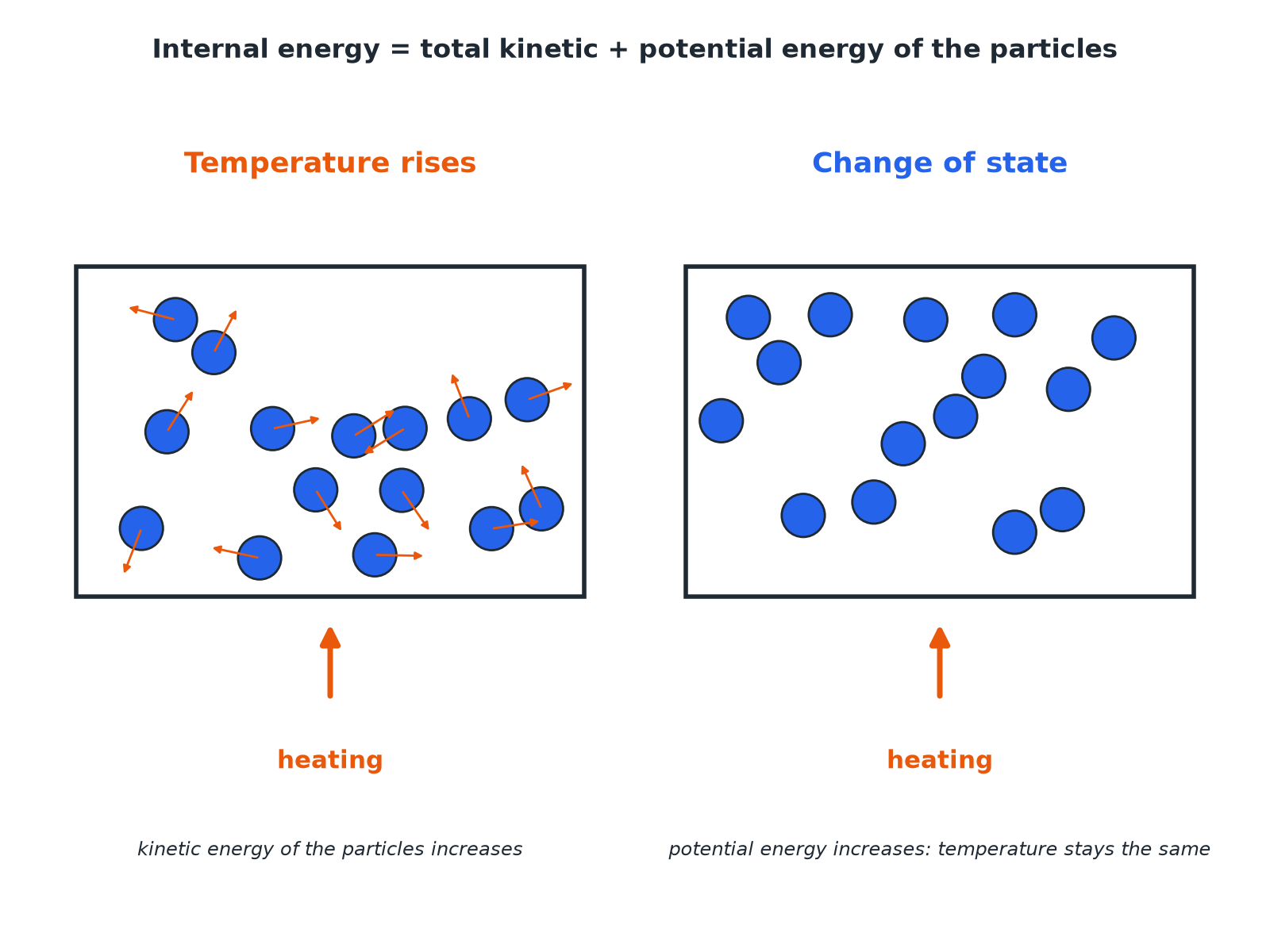
Internal energy is the total kinetic energy and potential energy of all the particles that make up a system.
Heating increases the energy of the particles. This either raises the temperature of the system or produces a change of state.
openrevise.com
AQA GCSE PHYSICS · PAPER 1 · FOUNDATION & HIGHER
Where the Energy Goes
Particle model of matter
Lesson 3 of 6

Kinetic energy relates to temperature.
openrevise.com
AQA GCSE PHYSICS · PAPER 1 · FOUNDATION & HIGHER
Temperature or Change of State?
Particle model of matter
Lesson 3 of 6
TEMPERATURE RISES
• The kinetic energy of the particles increases.
• The average speed of the particles increases.
• Calculate with ΔE = mcΔθ.
STATE CHANGES
• The potential energy of the particles increases.
• The particles move further apart or become free.
• The temperature stays the same.
openrevise.com
AQA GCSE PHYSICS · PAPER 1 · FOUNDATION & HIGHER
Energy for a Temperature Rise
Particle model of matter
Lesson 3 of 6
Calculate the energy needed to raise the temperature of 0.50 kg of water from 20 °C to 60 °C. c = 4200 J/kg °C.
1
Temperature change
60 − 20 = 40 °C
2
Substitute
ΔE = 0.50 × 4200 × 40
3
Answer
ΔE = 84 000 J
ANSWER
84 000 J (84 kJ)
openrevise.com
AQA GCSE PHYSICS · PAPER 1 · FOUNDATION & HIGHER
Comparing Internal Energy
Particle model of matter
Lesson 3 of 6
Which has more internal energy: 1.0 kg of water at 50 °C or 2.0 kg of water at 50 °C?
1
Same temperature
The particles have the same average kinetic energy
2
Different mass
2.0 kg has twice as many particles, so twice as much total energy
ANSWER
2.0 kg of water has more internal energy.
openrevise.com
AQA GCSE PHYSICS · PAPER 1 · FOUNDATION & HIGHER
Key Ideas
Particle model of matter
Lesson 3 of 6
Learn the links.
Temperature
Related to the average kinetic energy of the particles.
Internal energy
The total, including potential energy.
Heating
Increases internal energy by raising temperature or changing state.
Cooling
Decreases internal energy.
openrevise.com
AQA GCSE PHYSICS · PAPER 1 · FOUNDATION & HIGHER
Key Terms
Particle model of matter
Lesson 3 of 6
Internal energy
The total kinetic and potential energy of all the particles in a system.
Kinetic energy
Energy of movement.
Potential energy
Energy stored because of forces between particles.
Specific heat capacity
Energy needed to raise 1 kg by 1 °C.
Temperature
A measure of the average kinetic energy of particles.
System
An object or group of objects.
openrevise.com
AQA GCSE PHYSICS · PAPER 1 · FOUNDATION & HIGHER
Particle model of matter
Lesson 3 of 6
YOUR TASK
More Energy
10 minutes
Explain what happens to the internal energy and the temperature of a beaker of water as it is heated (a) from 20 °C to 60 °C (b) while ice at 0 °C is melting.
1
Say what changes in the particles.
2
Say what happens to temperature.
WHAT A GOOD ANSWER SHOWS
(a) Internal energy increases, mainly kinetic energy, so the temperature rises. (b) Internal energy increases as potential energy rises, but the temperature stays at 0 °C.
openrevise.com
AQA GCSE PHYSICS · PAPER 1 · FOUNDATION & HIGHER
Can I...?
Particle model of matter
Lesson 3 of 6
Define internal energy.
Say heating increases internal energy.
Link kinetic energy to temperature.
Link potential energy to change of state.
Use ΔE = mcΔθ.
Compare two objects.
Explain cooling.
Use correct units.
openrevise.com
AQA GCSE PHYSICS · PAPER 1 · FOUNDATION & HIGHER
Summary & Exam Focus
Internal energy = total kinetic + potential energy of the particles.
Heating raises temperature or changes state.
Temperature relates to kinetic energy.
ΔE = mcΔθ.
EXAM FOCUS
What is meant by the internal energy of a system? (2 marks)
The total kinetic and potential energy of all the particles.
openrevise.com
AQA GCSE PHYSICS · PAPER 1 · FOUNDATION & HIGHER
Exam Practice: Internal energy
Particle model of matter
Lesson 3 of 6
Answer all questions. Use the mark allocation as a guide to how much to write. · 15 minutes
Question 1 · 2 marks · State
What is meant by the internal energy of a system?
Question 2 · 3 marks · Explain
A beaker of water is heated. Explain what happens to the energy stored within the water and to its temperature.
Question 3 · 3 marks · Calculate
Calculate the energy needed to raise the temperature of 0.50 kg of water from 20 °C to 60 °C. Specific heat capacity of water = 4200 J/kg…
openrevise.com
AQA GCSE PHYSICS · PAPER 1 · FOUNDATION & HIGHER
Exam Practice: Internal energy (cont.)
Particle model of matter
Lesson 3 of 6
Question 4 · 2 marks · Explain
1.0 kg of water and 2.0 kg of water are both at 50 °C. Which has more internal energy? Explain your answer.
Question 5 · 4 marks · Explain
Ice at 0 °C is heated and melts to water at 0 °C. Explain what happens to the internal energy and to the temperature during melting.
openrevise.com
AQA GCSE PHYSICS · PAPER 1 · FOUNDATION & HIGHER
Question 1 · 2 marks · State
Particle model of matter
Lesson 3 of 6
“
What is meant by the internal energy of a system?
HOW TO ANSWER IT
Command word: State. Worth 2 marks, so plan before writing.
openrevise.com
AQA GCSE PHYSICS · PAPER 1 · FOUNDATION & HIGHER
Question 1 · mark scheme
Particle model of matter
Lesson 3 of 6
2 marks available. Award a mark for each point made.
Total of kinetic energy
1 mark
and potential energy of all the particles
1 mark
openrevise.com
AQA GCSE PHYSICS · PAPER 1 · FOUNDATION & HIGHER
Question 2 · 3 marks · Explain
Particle model of matter
Lesson 3 of 6
“
A beaker of water is heated. Explain what happens to the energy stored within the water and to its temperature.
HOW TO ANSWER IT
Command word: Explain. Worth 3 marks, so plan before writing.
openrevise.com
AQA GCSE PHYSICS · PAPER 1 · FOUNDATION & HIGHER
Question 2 · mark scheme
Particle model of matter
Lesson 3 of 6
3 marks available. Award a mark for each point made.
Internal energy increases
1 mark
Particles gain kinetic energy
1 mark
Temperature rises
1 mark
openrevise.com
AQA GCSE PHYSICS · PAPER 1 · FOUNDATION & HIGHER
Question 3 · 3 marks · Calculate
Particle model of matter
Lesson 3 of 6
“
Calculate the energy needed to raise the temperature of 0.50 kg of water from 20 °C to 60 °C. Specific heat capacity of water = 4200 J/kg °C.
HOW TO ANSWER IT
Command word: Calculate. Worth 3 marks, so plan before writing.
openrevise.com
AQA GCSE PHYSICS · PAPER 1 · FOUNDATION & HIGHER
Question 3 · mark scheme
Particle model of matter
Lesson 3 of 6
3 marks available. Award a mark for each point made.
Temperature change 40 °C
1 mark
Correct substitution
1 mark
84 000 J
1 mark
openrevise.com
AQA GCSE PHYSICS · PAPER 1 · FOUNDATION & HIGHER
Question 4 · 2 marks · Explain
Particle model of matter
Lesson 3 of 6
“
1.0 kg of water and 2.0 kg of water are both at 50 °C. Which has more internal energy? Explain your answer.
HOW TO ANSWER IT
Command word: Explain. Worth 2 marks, so plan before writing.
openrevise.com
AQA GCSE PHYSICS · PAPER 1 · FOUNDATION & HIGHER
Question 4 · mark scheme
Particle model of matter
Lesson 3 of 6
2 marks available. Award a mark for each point made.
2.0 kg of water
1 mark
More particles so more total energy
1 mark
openrevise.com
AQA GCSE PHYSICS · PAPER 1 · FOUNDATION & HIGHER
Question 5 · 4 marks · Explain
Particle model of matter
Lesson 3 of 6
“
Ice at 0 °C is heated and melts to water at 0 °C. Explain what happens to the internal energy and to the temperature during melting.
HOW TO ANSWER IT
Command word: Explain. Worth 4 marks, so plan before writing.
openrevise.com
AQA GCSE PHYSICS · PAPER 1 · FOUNDATION & HIGHER
Question 5 · mark scheme
Particle model of matter
Lesson 3 of 6
4 marks available. Award a mark for each point made.
Internal energy increases
1 mark
Potential energy of particles increases
1 mark
Kinetic energy does not increase
1 mark
Temperature stays constant
1 mark
openrevise.com
← → to move, F to present full screen, G for every slide at once.