Slides · PPTX · 272 KB · 27 slides
Specific latent heat - Teacher Slides.pptx
The lesson slides with the teacher's notes on each slide, and every question and mark scheme built in. Built from the lesson script on 30 September 2026.
AQA GCSE PHYSICS · PAPER 1 · FOUNDATION & HIGHER
Specific latent heat
Particle model of matter
Lesson 4 of 6
openrevise.com
AQA GCSE PHYSICS · PAPER 1 · FOUNDATION & HIGHER
Warm-up
Particle model of matter
Lesson 4 of 6
Answer each one, then check.
1
What happens to temperature during melting?
2
What is the unit of energy?
3
What is the equation for a temperature change?
4
Name the change from liquid to gas.
5
What is internal energy?
openrevise.com
AQA GCSE PHYSICS · PAPER 1 · FOUNDATION & HIGHER
Warm-up - Answers
Particle model of matter
Lesson 4 of 6
1
What happens to temperature during melting?
It stays constant
2
What is the unit of energy?
Joule
3
What is the equation for a temperature change?
ΔE = mcΔθ
4
Name the change from liquid to gas.
Boiling / evaporating
5
What is internal energy?
Total kinetic and potential energy of the particles
openrevise.com
AQA GCSE PHYSICS · PAPER 1 · FOUNDATION & HIGHER
Learning Objectives
Particle model of matter
Lesson 4 of 6
1
Define specific latent heat and distinguish fusion from vaporisation.
2
Apply E = mL.
3
Interpret heating and cooling graphs that include changes of state.
4
Distinguish specific heat capacity from specific latent heat.
openrevise.com
AQA GCSE PHYSICS · PAPER 1 · FOUNDATION & HIGHER
Particle model of matter
Lesson 4 of 6
SPECIFIC LATENT HEAT
The specific latent heat of a substance is the energy needed to change the state of 1 kg of the substance with no change in temperature.
E = mL is given on the equation sheet. Specific latent heat of fusion: solid to liquid. Specific latent heat of vaporisation: liquid to gas. L is in J/kg.
openrevise.com
AQA GCSE PHYSICS · PAPER 1 · FOUNDATION & HIGHER
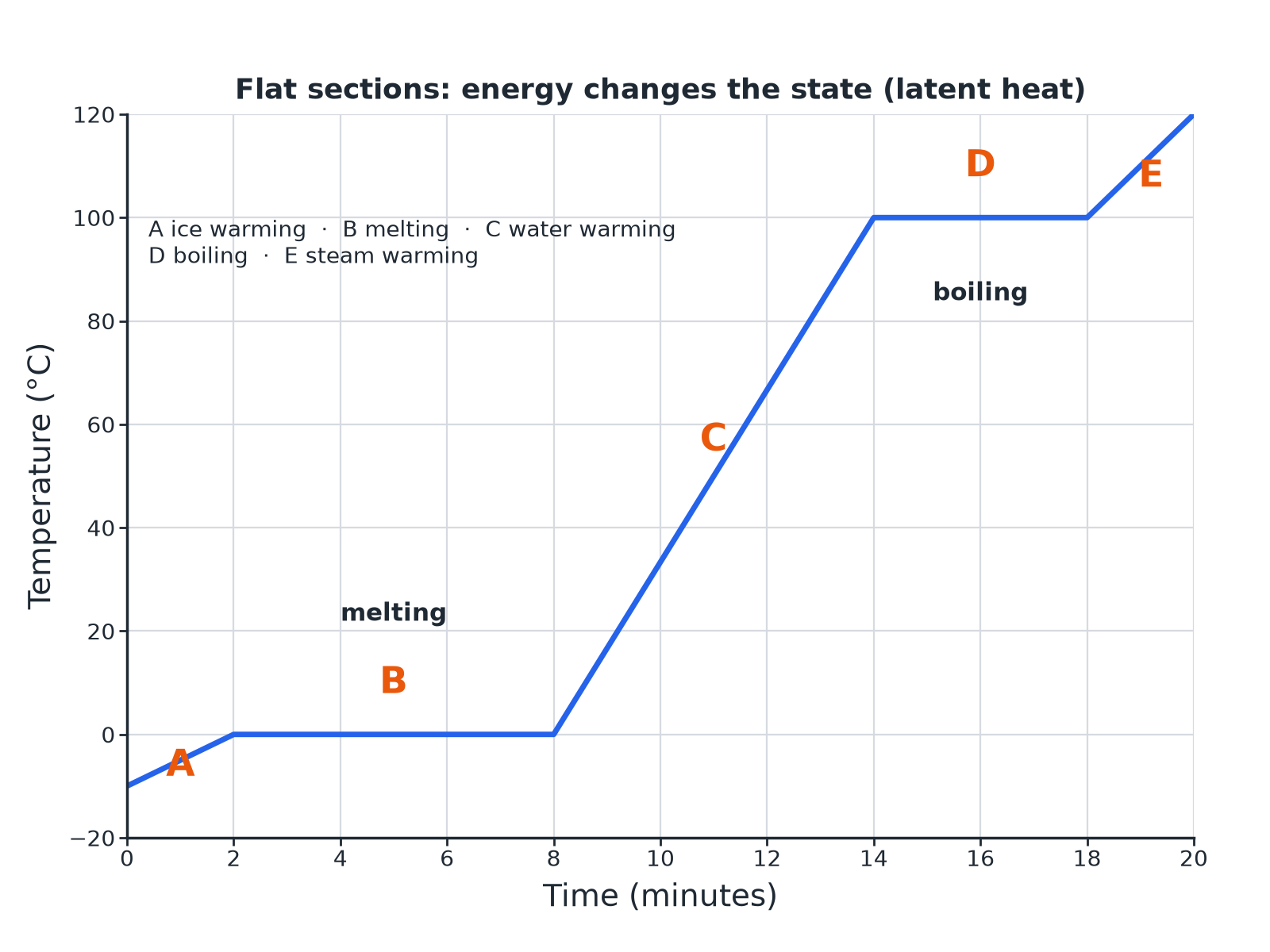
A Heating Curve
Particle model of matter
Lesson 4 of 6

Flat sections show a change of state.
openrevise.com
AQA GCSE PHYSICS · PAPER 1 · FOUNDATION & HIGHER
Two Different Ideas
Particle model of matter
Lesson 4 of 6
SPECIFIC HEAT CAPACITY
• Energy to raise the temperature of 1 kg by 1 °C.
• The temperature changes.
• ΔE = mcΔθ; J/kg °C.
SPECIFIC LATENT HEAT
• Energy to change the state of 1 kg with no temperature change.
• The temperature stays the same.
• E = mL; J/kg.
openrevise.com
AQA GCSE PHYSICS · PAPER 1 · FOUNDATION & HIGHER
Melting Ice
Particle model of matter
Lesson 4 of 6
Calculate the energy needed to melt 0.20 kg of ice at 0 °C. Specific latent heat of fusion of water = 334 000 J/kg.
1
Write the equation
E = mL
2
Substitute
E = 0.20 × 334 000
3
Answer
E = 66 800 J
ANSWER
66 800 J
openrevise.com
AQA GCSE PHYSICS · PAPER 1 · FOUNDATION & HIGHER
Boiling Water
Particle model of matter
Lesson 4 of 6
Calculate the energy to change 0.50 kg of water at 100 °C into steam. Specific latent heat of vaporisation = 2 260 000 J/kg.
1
Substitute
E = 0.50 × 2 260 000
2
Answer
E = 1 130 000 J
ANSWER
1 130 000 J (1.13 MJ)
openrevise.com
AQA GCSE PHYSICS · PAPER 1 · FOUNDATION & HIGHER
Reading the Graph
Particle model of matter
Lesson 4 of 6
Explain why the temperature stays constant during section B of the heating curve.
1
Energy is still supplied
The particles are gaining energy
2
Where it goes
It increases the potential energy of the particles as the bonds are broken
3
So
The average kinetic energy, and the temperature, stay the same
ANSWER
The energy supplied breaks the bonds (changing potential energy) so the temperature does not rise.
openrevise.com
AQA GCSE PHYSICS · PAPER 1 · FOUNDATION & HIGHER
Why Steam Burns More
Particle model of matter
Lesson 4 of 6
A favourite exam idea.
Condensing
Steam at 100 °C condenses to water at 100 °C and releases a lot of latent heat.
Then
The water then cools and releases more energy.
So
Steam transfers more energy to skin than boiling water at the same temperature.
openrevise.com
AQA GCSE PHYSICS · PAPER 1 · FOUNDATION & HIGHER
Key Terms
Particle model of matter
Lesson 4 of 6
Specific latent heat
Energy to change the state of 1 kg with no temperature change.
Latent heat of fusion
For solid to liquid.
Latent heat of vaporisation
For liquid to gas.
Heating curve
A temperature-time graph for a heated substance.
Constant temperature
Temperature that does not change during a change of state.
Potential energy
Energy stored due to the forces between particles.
openrevise.com
AQA GCSE PHYSICS · PAPER 1 · FOUNDATION & HIGHER
Particle model of matter
Lesson 4 of 6
YOUR TASK
Read the Curve
12 minutes
On a heating curve for water there are flat sections at 0 °C and 100 °C. Explain what is happening in each and why the second is longer.
1
Name each change.
2
Compare the latent heats.
WHAT A GOOD ANSWER SHOWS
At 0 °C the ice is melting; at 100 °C the water is boiling. The boiling section is longer because the latent heat of vaporisation is much greater than the latent heat of fusion.
openrevise.com
AQA GCSE PHYSICS · PAPER 1 · FOUNDATION & HIGHER
Can I...?
Particle model of matter
Lesson 4 of 6
State what specific latent heat is.
Distinguish fusion from vaporisation.
Use E = mL.
Read a heating curve.
Explain flat sections.
Distinguish c from L.
Explain steam burns.
Give units of L.
openrevise.com
AQA GCSE PHYSICS · PAPER 1 · FOUNDATION & HIGHER
Summary & Exam Focus
E = mL.
Temperature is constant during a change of state.
Heating curves have flat sections at melting and boiling points.
Distinguish c and L.
EXAM FOCUS
Calculate the energy needed to melt 0.35 kg of ice at 0 °C. Specific latent heat of fusion = 334 000 J/kg. (2 marks)
Multiply mass by L.
openrevise.com
AQA GCSE PHYSICS · PAPER 1 · FOUNDATION & HIGHER
Exam Practice: Specific latent heat
Particle model of matter
Lesson 4 of 6
Answer all questions. Use the mark allocation as a guide to how much to write. · 15 minutes
Question 1 · 2 marks · Calculate
Calculate the energy needed to melt 0.35 kg of ice at 0 °C. The specific latent heat of fusion of water is 334 000 J/kg. Use the equation…
Question 2 · 4 marks · Use the graph
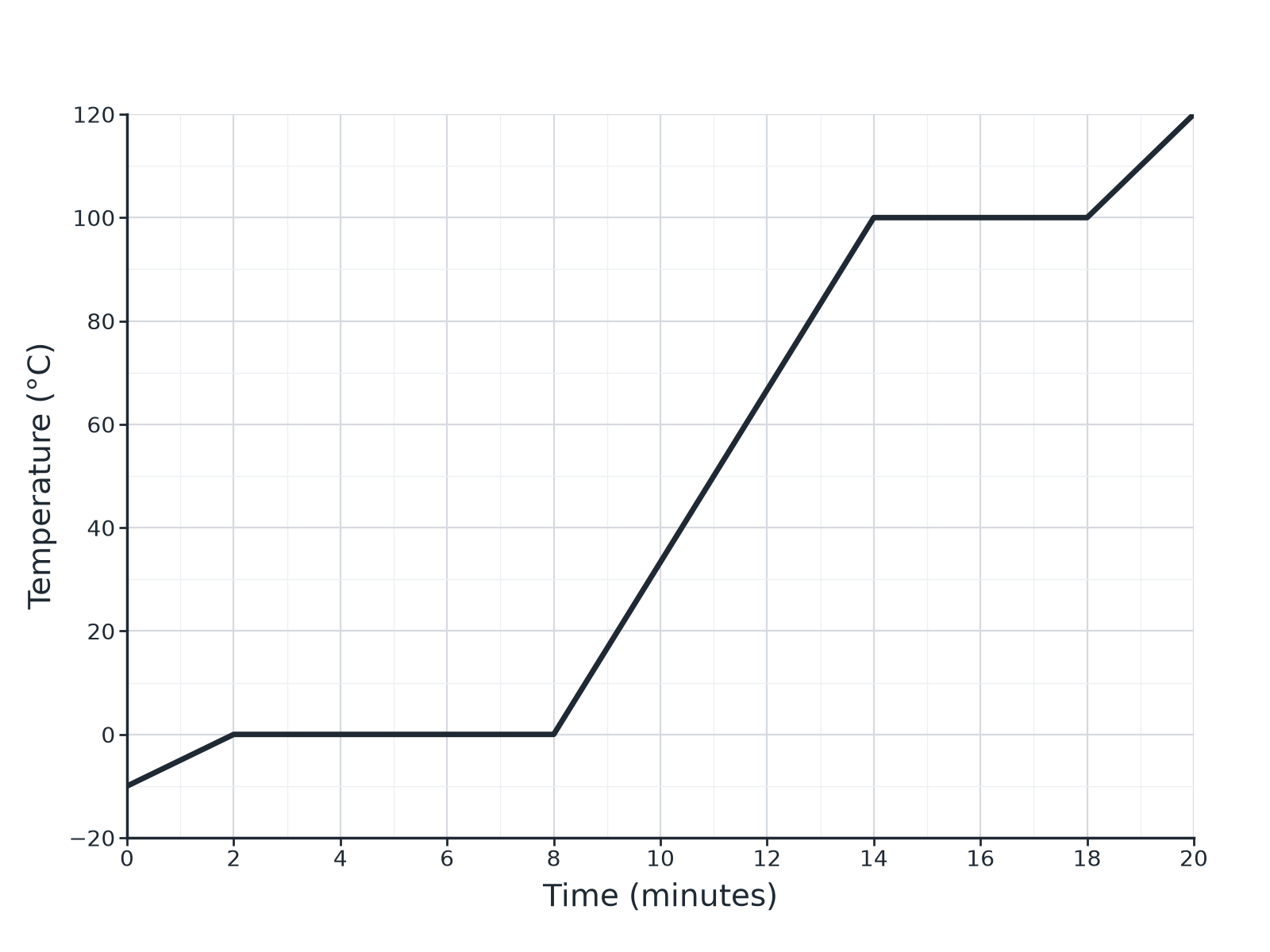
The graph shows how the temperature of a solid changes as it is heated at a steady rate until it is a gas. (a) State the melting point. (b)…
Question 3 · 2 marks · Distinguish
Describe the difference between specific heat capacity and specific latent heat.
openrevise.com
AQA GCSE PHYSICS · PAPER 1 · FOUNDATION & HIGHER
Exam Practice: Specific latent heat (cont.)
Particle model of matter
Lesson 4 of 6
Question 4 · 3 marks · Calculate
Calculate the energy needed to change 0.50 kg of water at 100 °C into steam. The specific latent heat of vaporisation of water is 2 260 000…
Question 5 · 3 marks · Explain
Steam at 100 °C causes a more serious burn than boiling water at 100 °C. Explain why.
openrevise.com
AQA GCSE PHYSICS · PAPER 1 · FOUNDATION & HIGHER
Question 1 · 2 marks · Calculate
Particle model of matter
Lesson 4 of 6
“
Calculate the energy needed to melt 0.35 kg of ice at 0 °C. The specific latent heat of fusion of water is 334 000 J/kg. Use the equation: energy for a change of state = mass × specific latent heat
HOW TO ANSWER IT
Command word: Calculate. Worth 2 marks, so plan before writing.
openrevise.com
AQA GCSE PHYSICS · PAPER 1 · FOUNDATION & HIGHER
Question 1 · mark scheme
Particle model of matter
Lesson 4 of 6
2 marks available. Award a mark for each point made.
Correct substitution
1 mark
116 900 J
1 mark
openrevise.com
AQA GCSE PHYSICS · PAPER 1 · FOUNDATION & HIGHER
Question 2 · 4 marks · Use the graph
Particle model of matter
Lesson 4 of 6

The graph shows how the temperature of a solid changes as it is heated at a steady rate until it is a gas. (a) State the melting point. (b) What is happening between 2 and 8 minutes? (c) Explain why the temperature stays constant during this time. (4 marks)
openrevise.com
AQA GCSE PHYSICS · PAPER 1 · FOUNDATION & HIGHER
Question 2 · mark scheme
Particle model of matter
Lesson 4 of 6
4 marks available. Award a mark for each point made.
0 °C
1 mark
Melting
1 mark
Energy used to break bonds or change potential energy
1 mark
Kinetic energy or temperature does not increase
1 mark
openrevise.com
AQA GCSE PHYSICS · PAPER 1 · FOUNDATION & HIGHER
Question 3 · 2 marks · Distinguish
Particle model of matter
Lesson 4 of 6
“
Describe the difference between specific heat capacity and specific latent heat.
HOW TO ANSWER IT
Command word: Distinguish. Worth 2 marks, so plan before writing.
openrevise.com
AQA GCSE PHYSICS · PAPER 1 · FOUNDATION & HIGHER
Question 3 · mark scheme
Particle model of matter
Lesson 4 of 6
2 marks available. Award a mark for each point made.
Specific heat capacity: temperature change
1 mark
Specific latent heat: change of state, no temperature change
1 mark
openrevise.com
AQA GCSE PHYSICS · PAPER 1 · FOUNDATION & HIGHER
Question 4 · 3 marks · Calculate
Particle model of matter
Lesson 4 of 6
“
Calculate the energy needed to change 0.50 kg of water at 100 °C into steam. The specific latent heat of vaporisation of water is 2 260 000 J/kg.
HOW TO ANSWER IT
Command word: Calculate. Worth 3 marks, so plan before writing.
openrevise.com
AQA GCSE PHYSICS · PAPER 1 · FOUNDATION & HIGHER
Question 4 · mark scheme
Particle model of matter
Lesson 4 of 6
3 marks available. Award a mark for each point made.
Correct substitution
1 mark
1 130 000 J
1 mark
Unit J
1 mark
openrevise.com
AQA GCSE PHYSICS · PAPER 1 · FOUNDATION & HIGHER
Question 5 · 3 marks · Explain
Particle model of matter
Lesson 4 of 6
“
Steam at 100 °C causes a more serious burn than boiling water at 100 °C. Explain why.
HOW TO ANSWER IT
Command word: Explain. Worth 3 marks, so plan before writing.
openrevise.com
AQA GCSE PHYSICS · PAPER 1 · FOUNDATION & HIGHER
Question 5 · mark scheme
Particle model of matter
Lesson 4 of 6
3 marks available. Award a mark for each point made.
Steam condenses on the skin
1 mark
Releases latent heat
1 mark
So more energy is transferred than from the water alone
1 mark
openrevise.com
← → to move, F to present full screen, G for every slide at once.