Slides · PPTX · 278 KB · 26 slides
The structure of an atom - Teacher Slides.pptx
The lesson slides with the teacher's notes on each slide, and every question and mark scheme built in. Built from the lesson script on 30 September 2026.
AQA GCSE PHYSICS · PAPER 1 · FOUNDATION & HIGHER
The structure of an atom
Atomic structure
Lesson 1 of 10
openrevise.com
AQA GCSE PHYSICS · PAPER 1 · FOUNDATION & HIGHER
Warm-up
Atomic structure
Lesson 1 of 10
Answer each one, then check.
1
What is an atom?
2
What charge does an electron have?
3
What charge does a proton have?
4
What is standard form?
5
What is electromagnetic radiation?
openrevise.com
AQA GCSE PHYSICS · PAPER 1 · FOUNDATION & HIGHER
Warm-up - Answers
Atomic structure
Lesson 1 of 10
1
What is an atom?
The smallest part of an element that can exist
2
What charge does an electron have?
Negative
3
What charge does a proton have?
Positive
4
What is standard form?
A number written as a × 10ⁿ
5
What is electromagnetic radiation?
Waves such as light and X-rays
openrevise.com
AQA GCSE PHYSICS · PAPER 1 · FOUNDATION & HIGHER
Learning Objectives
Atomic structure
Lesson 1 of 10
1
Describe the basic structure of an atom.
2
Recall the size of an atom and how it compares with the size of a nucleus.
3
State the relative charge and mass of protons, neutrons and electrons.
4
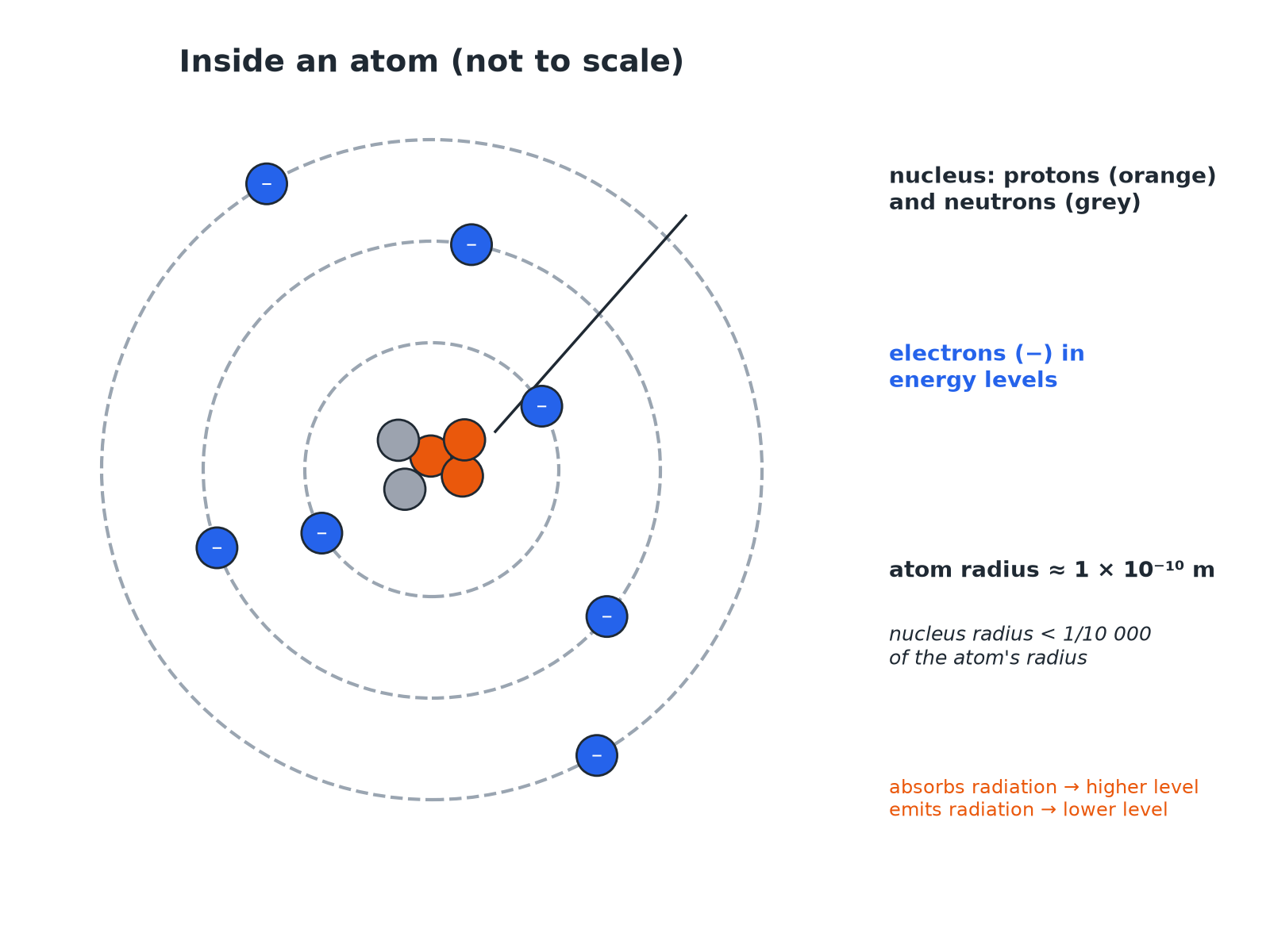
Explain how electrons change energy levels by absorbing or emitting electromagnetic radiation.
openrevise.com
AQA GCSE PHYSICS · PAPER 1 · FOUNDATION & HIGHER
Atomic structure
Lesson 1 of 10
THE ATOM
Atoms have a radius of about 1 × 10⁻¹⁰ m. The nucleus has a radius of less than 1/(10 000) of the atom's radius but contains most of the mass.
The nucleus is positively charged (protons and neutrons) and is surrounded by negatively charged electrons at different distances (energy levels).
openrevise.com
AQA GCSE PHYSICS · PAPER 1 · FOUNDATION & HIGHER
Inside an Atom
Atomic structure
Lesson 1 of 10

The nucleus is tiny compared with the whole atom.
openrevise.com
AQA GCSE PHYSICS · PAPER 1 · FOUNDATION & HIGHER
Particles in an Atom
Atomic structure
Lesson 1 of 10
Learn the relative charge and mass.
Particle
Relative charge
Relative mass
Where
Proton
+1
1
Nucleus
Neutron
0
1
Nucleus
Electron
−1
Very small (about 1/2000)
Energy levels around the nucleus
openrevise.com
AQA GCSE PHYSICS · PAPER 1 · FOUNDATION & HIGHER
Size of the Nucleus
Atomic structure
Lesson 1 of 10
The radius of an atom is about 1 × 10⁻¹⁰ m. The radius of its nucleus is less than 1/10 000 of this. Calculate the largest possible radius of the nucleus.
1
Divide
(1 × 10⁻¹⁰)/(10 000)
2
Write 10 000 as a power of ten
10 000 = 1 × 10⁴
3
Answer
1 × 10⁻¹⁴ m
ANSWER
The nucleus has a radius of less than 1 × 10⁻¹⁴ m.
openrevise.com
AQA GCSE PHYSICS · PAPER 1 · FOUNDATION & HIGHER
Electron Energy Levels
Atomic structure
Lesson 1 of 10
Describe what happens when an electron absorbs electromagnetic radiation.
1
Energy
The electron gains energy from the radiation
2
Movement
It moves to a higher energy level, further from the nucleus
3
Reverse
If it emits radiation it falls to a lower energy level, closer to the nucleus
ANSWER
Absorbing radiation moves an electron further from the nucleus; emitting radiation moves it closer.
openrevise.com
AQA GCSE PHYSICS · PAPER 1 · FOUNDATION & HIGHER
Key Facts
Atomic structure
Lesson 1 of 10
Points examiners ask about.
Neutral atoms
The number of electrons equals the number of protons, so there is no overall charge.
Mass
Most of the mass of an atom is in the nucleus.
Space
Most of an atom is empty space.
Positive ions
An atom that loses one or more outer electrons becomes a positive ion.
openrevise.com
AQA GCSE PHYSICS · PAPER 1 · FOUNDATION & HIGHER
Key Terms
Atomic structure
Lesson 1 of 10
Atom
The smallest part of an element that can exist.
Nucleus
The positively charged centre of an atom containing protons and neutrons.
Proton
A positive particle in the nucleus.
Neutron
A neutral particle in the nucleus.
Electron
A negative particle that orbits the nucleus.
Energy level
A distance from the nucleus at which an electron can be.
openrevise.com
AQA GCSE PHYSICS · PAPER 1 · FOUNDATION & HIGHER
Atomic structure
Lesson 1 of 10
YOUR TASK
Atom Sizes
10 minutes
An atom has a radius of 1 × 10⁻¹⁰ m and a nucleus of radius 1 × 10⁻¹⁵ m. How many times larger is the atom's radius than the nucleus's radius? Where is most of the mass?
1
Divide the two radii.
2
Use powers of ten.
WHAT A GOOD ANSWER SHOWS
The atom is 100 000 times larger (10⁻¹⁰ ÷ 10⁻¹⁵ = 10⁵). Most of the mass is in the nucleus.
openrevise.com
AQA GCSE PHYSICS · PAPER 1 · FOUNDATION & HIGHER
Can I...?
Atomic structure
Lesson 1 of 10
Describe the parts of an atom.
Give the size of an atom.
Compare atom and nucleus sizes.
State charges and masses.
Explain why atoms are neutral.
Describe electron energy levels.
Say what happens when radiation is absorbed.
Use standard form.
openrevise.com
AQA GCSE PHYSICS · PAPER 1 · FOUNDATION & HIGHER
Summary & Exam Focus
Atoms are about 1 × 10⁻¹⁰ m in radius.
The nucleus is less than 1/10 000 of the atom's radius.
Protons +1, neutrons 0, electrons −1.
Electrons move to higher levels by absorbing radiation.
EXAM FOCUS
Describe the structure of an atom. (3 marks)
Nucleus with protons and neutrons; electrons around it.
openrevise.com
AQA GCSE PHYSICS · PAPER 1 · FOUNDATION & HIGHER
Exam Practice: The structure of an atom
Atomic structure
Lesson 1 of 10
Answer all questions. Use the mark allocation as a guide to how much to write. · 15 minutes
Question 1 · 3 marks · Describe
Describe the structure of an atom.
Question 2 · 3 marks · Complete
Complete the table to show the relative charge of a proton, a neutron and an electron.
Question 3 · 3 marks · Calculate
The radius of an atom is 1 × 10⁻¹⁰ m. The radius of its nucleus is less than 1/10 000 of the radius of the atom. Calculate the largest…
openrevise.com
AQA GCSE PHYSICS · PAPER 1 · FOUNDATION & HIGHER
Exam Practice: The structure of an atom (cont.)
Atomic structure
Lesson 1 of 10
Question 4 · 2 marks · Explain
An atom has no overall electrical charge. Explain why.
Question 5 · 3 marks · Explain
An electron in an atom absorbs electromagnetic radiation. Describe what happens to the electron. Then say what happens when the electron…
openrevise.com
AQA GCSE PHYSICS · PAPER 1 · FOUNDATION & HIGHER
Question 1 · 3 marks · Describe
Atomic structure
Lesson 1 of 10
“
Describe the structure of an atom.
HOW TO ANSWER IT
Command word: Describe. Worth 3 marks, so plan before writing.
openrevise.com
AQA GCSE PHYSICS · PAPER 1 · FOUNDATION & HIGHER
Question 1 · mark scheme
Atomic structure
Lesson 1 of 10
3 marks available. Award a mark for each point made.
Small central nucleus
1 mark
Nucleus contains protons and neutrons
1 mark
Electrons around the nucleus
1 mark
openrevise.com
AQA GCSE PHYSICS · PAPER 1 · FOUNDATION & HIGHER
Question 2 · 3 marks · Complete
Atomic structure
Lesson 1 of 10
“
Complete the table to show the relative charge of a proton, a neutron and an electron.
HOW TO ANSWER IT
Command word: Complete. Worth 3 marks, so plan before writing.
openrevise.com
AQA GCSE PHYSICS · PAPER 1 · FOUNDATION & HIGHER
Question 2 · mark scheme
Atomic structure
Lesson 1 of 10
3 marks available. Award a mark for each point made.
+1
1 mark
0
1 mark
−1
1 mark
openrevise.com
AQA GCSE PHYSICS · PAPER 1 · FOUNDATION & HIGHER
Question 3 · 3 marks · Calculate
Atomic structure
Lesson 1 of 10
“
The radius of an atom is 1 × 10⁻¹⁰ m. The radius of its nucleus is less than 1/10 000 of the radius of the atom. Calculate the largest possible radius of the nucleus. Give your answer in standard form.
HOW TO ANSWER IT
Command word: Calculate. Worth 3 marks, so plan before writing.
openrevise.com
AQA GCSE PHYSICS · PAPER 1 · FOUNDATION & HIGHER
Question 3 · mark scheme
Atomic structure
Lesson 1 of 10
3 marks available. Award a mark for each point made.
Divides by 10 000
1 mark
Correct power
1 mark
1 × 10⁻¹⁴ m
1 mark
openrevise.com
AQA GCSE PHYSICS · PAPER 1 · FOUNDATION & HIGHER
Question 4 · 2 marks · Explain
Atomic structure
Lesson 1 of 10
“
An atom has no overall electrical charge. Explain why.
HOW TO ANSWER IT
Command word: Explain. Worth 2 marks, so plan before writing.
openrevise.com
AQA GCSE PHYSICS · PAPER 1 · FOUNDATION & HIGHER
Question 4 · mark scheme
Atomic structure
Lesson 1 of 10
2 marks available. Award a mark for each point made.
Number of electrons equals number of protons
1 mark
Charges cancel
1 mark
openrevise.com
AQA GCSE PHYSICS · PAPER 1 · FOUNDATION & HIGHER
Question 5 · 3 marks · Explain
Atomic structure
Lesson 1 of 10
“
An electron in an atom absorbs electromagnetic radiation. Describe what happens to the electron. Then say what happens when the electron emits radiation.
HOW TO ANSWER IT
Command word: Explain. Worth 3 marks, so plan before writing.
openrevise.com
AQA GCSE PHYSICS · PAPER 1 · FOUNDATION & HIGHER
Question 5 · mark scheme
Atomic structure
Lesson 1 of 10
3 marks available. Award a mark for each point made.
Absorbs radiation: moves to higher energy level or further from nucleus
1 mark
Emits radiation: moves to lower energy level
1 mark
Closer to the nucleus
1 mark
openrevise.com
← → to move, F to present full screen, G for every slide at once.