Slides · PPTX · 222 KB · 26 slides
Radioactive contamination and irradiation - Teacher Slides.pptx
The lesson slides with the teacher's notes on each slide, and every question and mark scheme built in. Built from the lesson script on 30 September 2026.
AQA GCSE PHYSICS · PAPER 1 · FOUNDATION & HIGHER
Radioactive contamination and irradiation
Atomic structure
Lesson 7 of 10
openrevise.com
AQA GCSE PHYSICS · PAPER 1 · FOUNDATION & HIGHER
Warm-up
Atomic structure
Lesson 7 of 10
Answer each one, then check.
1
What is ionising radiation?
2
What are alpha, beta and gamma?
3
Which radiation is most penetrating?
4
What is a hazard?
5
What does peer review mean?
openrevise.com
AQA GCSE PHYSICS · PAPER 1 · FOUNDATION & HIGHER
Warm-up - Answers
Atomic structure
Lesson 7 of 10
1
What is ionising radiation?
Radiation that can knock electrons off atoms
2
What are alpha, beta and gamma?
Types of nuclear radiation
3
Which radiation is most penetrating?
Gamma
4
What is a hazard?
Something that could cause harm
5
What does peer review mean?
Checking by other scientists before results are accepted
openrevise.com
AQA GCSE PHYSICS · PAPER 1 · FOUNDATION & HIGHER
Learning Objectives
Atomic structure
Lesson 7 of 10
1
Define radioactive contamination and irradiation.
2
Compare the hazards of contamination and irradiation.
3
Describe precautions when handling sources.
4
Explain why studies on the effects of radiation are published and peer reviewed.
openrevise.com
AQA GCSE PHYSICS · PAPER 1 · FOUNDATION & HIGHER
Atomic structure
Lesson 7 of 10
CONTAMINATION VS IRRADIATION
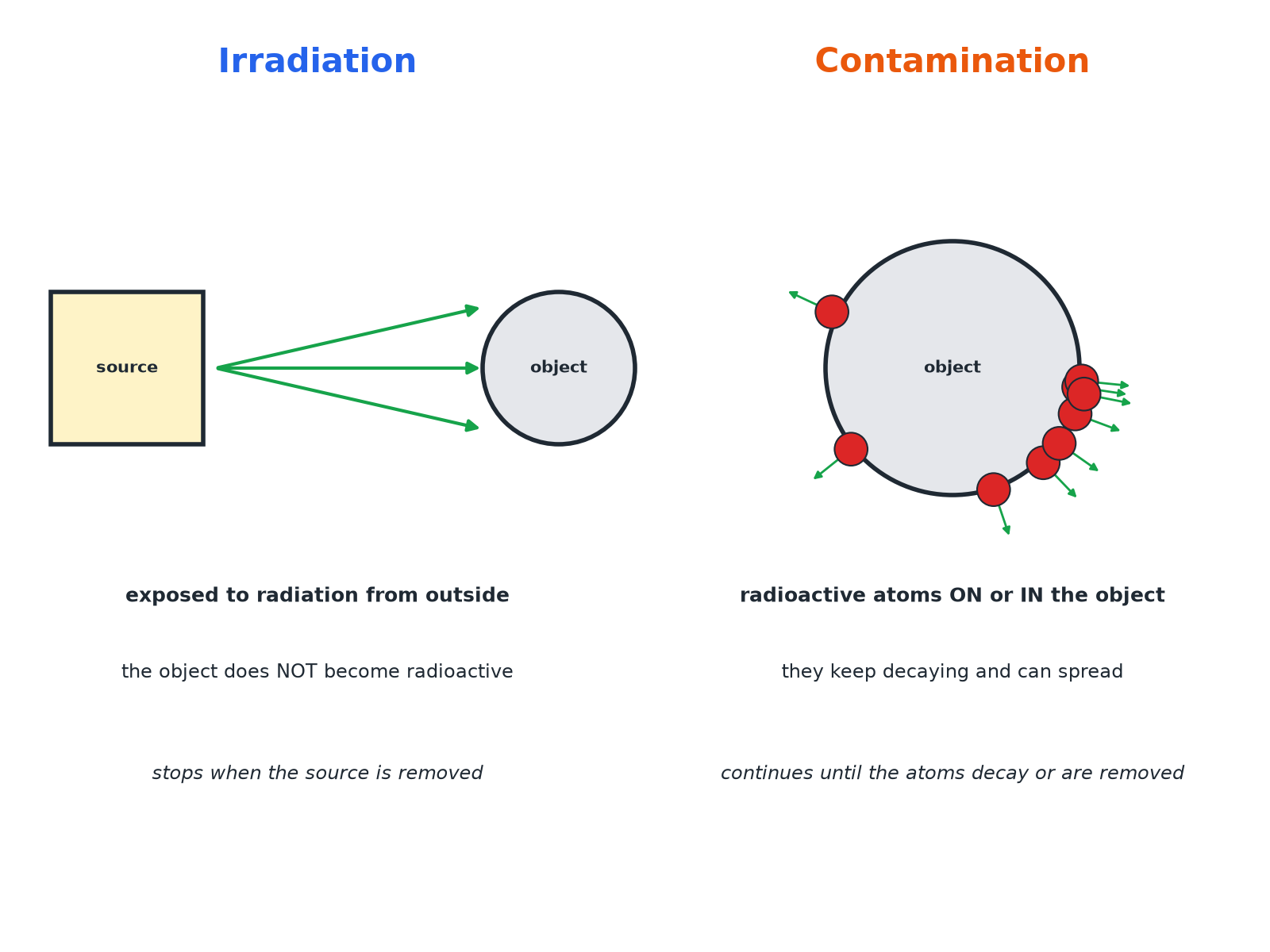
Radioactive contamination is the unwanted presence of materials containing radioactive atoms on other materials. Irradiation is exposing an object to nuclear radiation: the irradiated object does not become radioactive.
The hazard from contamination is due to the decay of the contaminating atoms; the type of radiation emitted affects the level of hazard.
openrevise.com
AQA GCSE PHYSICS · PAPER 1 · FOUNDATION & HIGHER
Contamination and Irradiation
Atomic structure
Lesson 7 of 10

Contamination puts radioactive atoms on the object itself.
openrevise.com
AQA GCSE PHYSICS · PAPER 1 · FOUNDATION & HIGHER
Which Is More Hazardous?
Atomic structure
Lesson 7 of 10
IRRADIATION
• The object is exposed from outside.
• It stops when the source is removed or shielded.
• The object does not become radioactive.
• Hazard depends on the type of radiation and time exposed.
CONTAMINATION
• Radioactive atoms are on or in the object.
• Radiation continues until the atoms decay or are removed.
• Alpha sources inside the body are very dangerous.
• Can spread to other objects.
openrevise.com
AQA GCSE PHYSICS · PAPER 1 · FOUNDATION & HIGHER
Precautions When Using Sources
Atomic structure
Lesson 7 of 10
Protect against irradiation and contamination.
1
Distance
Handle sources with tongs; keep away.
2
Time
Keep exposure times short.
3
Shielding
Store sources in lead-lined containers.
4
Protective clothing
Gloves and coats stop contamination.
5
Hygiene
No eating or drinking; wash hands.
openrevise.com
AQA GCSE PHYSICS · PAPER 1 · FOUNDATION & HIGHER
Comparing Hazards
Atomic structure
Lesson 7 of 10
Explain why an alpha source is not very hazardous outside the body but is very hazardous if swallowed.
1
Outside
Alpha is stopped by air, paper or skin
2
Inside
Contamination puts the source in contact with living cells
3
Ionising
Alpha is strongly ionising and damages cells
ANSWER
Outside, alpha cannot penetrate skin; inside it is contamination and its strong ionising damages cells.
openrevise.com
AQA GCSE PHYSICS · PAPER 1 · FOUNDATION & HIGHER
Peer Review
Atomic structure
Lesson 7 of 10
Why it matters.
Publish and share
Findings on the effects of radiation on humans must be published so that other scientists can check them.
Peer review
Other scientists check the methods and conclusions before they are accepted.
Trust
This makes conclusions more reliable and helps set safety rules.
openrevise.com
AQA GCSE PHYSICS · PAPER 1 · FOUNDATION & HIGHER
Key Terms
Atomic structure
Lesson 7 of 10
Contamination
The unwanted presence of radioactive atoms on or in other materials.
Irradiation
Exposure to nuclear radiation without radioactive atoms being transferred.
Shielding
Material used to absorb radiation.
Peer review
Checking of scientific work by other scientists.
Hazard
Something that could cause harm.
Precaution
An action to reduce a risk.
openrevise.com
AQA GCSE PHYSICS · PAPER 1 · FOUNDATION & HIGHER
Atomic structure
Lesson 7 of 10
YOUR TASK
Compare the Hazards
12 minutes
A worker handles a gamma source with tongs and a worker accidentally spills a solution containing radioactive iodine on their skin. Say which is irradiation and which is contamination, and compare the hazards.
1
Name each.
2
Compare how long exposure lasts.
WHAT A GOOD ANSWER SHOWS
The gamma source: irradiation (they are exposed while nearby, they do not become radioactive). The spill: contamination (radioactive atoms are on the skin and keep decaying). Contamination can continue and be spread or absorbed, so is more serious unless removed.
openrevise.com
AQA GCSE PHYSICS · PAPER 1 · FOUNDATION & HIGHER
Can I...?
Atomic structure
Lesson 7 of 10
Define contamination.
Define irradiation.
Explain irradiated objects are not radioactive.
Compare the hazards.
Give precautions.
Explain why peer review matters.
Explain why alpha is dangerous inside the body.
Choose safe handling.
openrevise.com
AQA GCSE PHYSICS · PAPER 1 · FOUNDATION & HIGHER
Summary & Exam Focus
Contamination: radioactive atoms on or in the object.
Irradiation: exposed to radiation; not radioactive.
Hazard depends on the type of radiation.
Peer review checks findings.
EXAM FOCUS
State the difference between contamination and irradiation. (2 marks)
Contamination involves radioactive atoms on the object; irradiation is exposure without the object becoming radioactive.
openrevise.com
AQA GCSE PHYSICS · PAPER 1 · FOUNDATION & HIGHER
Exam Practice: Radioactive contamination and irradiation
Atomic structure
Lesson 7 of 10
Answer all questions. Use the mark allocation as a guide to how much to write. · 13 minutes
Question 1 · 2 marks · State
Explain the difference between radioactive contamination and irradiation.
Question 2 · 3 marks · Explain
A student says that a person who has been irradiated by a gamma source is now radioactive. Explain why the student is wrong.
Question 3 · 2 marks · Suggest
Give two precautions that should be taken when a teacher handles a radioactive source.
openrevise.com
AQA GCSE PHYSICS · PAPER 1 · FOUNDATION & HIGHER
Exam Practice: Radioactive contamination and irradiation (cont.)
Atomic structure
Lesson 7 of 10
Question 4 · 3 marks · Compare
Compare the hazards of contamination and irradiation from an alpha source.
Question 5 · 2 marks · Explain
Scientists who study the effects of radiation on humans publish their findings. Explain why it is important that the findings are peer…
openrevise.com
AQA GCSE PHYSICS · PAPER 1 · FOUNDATION & HIGHER
Question 1 · 2 marks · State
Atomic structure
Lesson 7 of 10
“
Explain the difference between radioactive contamination and irradiation.
HOW TO ANSWER IT
Command word: State. Worth 2 marks, so plan before writing.
openrevise.com
AQA GCSE PHYSICS · PAPER 1 · FOUNDATION & HIGHER
Question 1 · mark scheme
Atomic structure
Lesson 7 of 10
2 marks available. Award a mark for each point made.
Contamination: radioactive atoms present on other materials
1 mark
Irradiation: exposure and the object does not become radioactive
1 mark
openrevise.com
AQA GCSE PHYSICS · PAPER 1 · FOUNDATION & HIGHER
Question 2 · 3 marks · Explain
Atomic structure
Lesson 7 of 10
“
A student says that a person who has been irradiated by a gamma source is now radioactive. Explain why the student is wrong.
HOW TO ANSWER IT
Command word: Explain. Worth 3 marks, so plan before writing.
openrevise.com
AQA GCSE PHYSICS · PAPER 1 · FOUNDATION & HIGHER
Question 2 · mark scheme
Atomic structure
Lesson 7 of 10
3 marks available. Award a mark for each point made.
Irradiation is exposure
1 mark
No radioactive atoms transferred
1 mark
So the person is not radioactive
1 mark
openrevise.com
AQA GCSE PHYSICS · PAPER 1 · FOUNDATION & HIGHER
Question 3 · 2 marks · Suggest
Atomic structure
Lesson 7 of 10
“
Give two precautions that should be taken when a teacher handles a radioactive source.
HOW TO ANSWER IT
Command word: Suggest. Worth 2 marks, so plan before writing.
openrevise.com
AQA GCSE PHYSICS · PAPER 1 · FOUNDATION & HIGHER
Question 3 · mark scheme
Atomic structure
Lesson 7 of 10
2 marks available. Award a mark for each point made.
First precaution
1 mark
Second precaution
1 mark
openrevise.com
AQA GCSE PHYSICS · PAPER 1 · FOUNDATION & HIGHER
Question 4 · 3 marks · Compare
Atomic structure
Lesson 7 of 10
“
Compare the hazards of contamination and irradiation from an alpha source.
HOW TO ANSWER IT
Command word: Compare. Worth 3 marks, so plan before writing.
openrevise.com
AQA GCSE PHYSICS · PAPER 1 · FOUNDATION & HIGHER
Question 4 · mark scheme
Atomic structure
Lesson 7 of 10
3 marks available. Award a mark for each point made.
Irradiation by alpha: low hazard, absorbed
1 mark
Contamination inside the body: high hazard
1 mark
Alpha strongly ionising
1 mark
openrevise.com
AQA GCSE PHYSICS · PAPER 1 · FOUNDATION & HIGHER
Question 5 · 2 marks · Explain
Atomic structure
Lesson 7 of 10
“
Scientists who study the effects of radiation on humans publish their findings. Explain why it is important that the findings are peer reviewed.
HOW TO ANSWER IT
Command word: Explain. Worth 2 marks, so plan before writing.
openrevise.com
AQA GCSE PHYSICS · PAPER 1 · FOUNDATION & HIGHER
Question 5 · mark scheme
Atomic structure
Lesson 7 of 10
2 marks available. Award a mark for each point made.
Findings checked by other scientists
1 mark
So more reliable or valid
1 mark
openrevise.com
← → to move, F to present full screen, G for every slide at once.