Slides · PPTX · 188 KB · 27 slides
Resultant forces - Teacher Slides.pptx
The lesson slides with the teacher's notes on each slide, and every question and mark scheme built in. Built from the lesson script on 30 September 2026.
AQA GCSE PHYSICS · PAPER 2 · FOUNDATION & HIGHER
Resultant forces
Forces
Lesson 3 of 20
openrevise.com
AQA GCSE PHYSICS · PAPER 2 · FOUNDATION & HIGHER
Warm-up
Forces
Lesson 3 of 20
Answer each one, then check.
1
What is a force measured in?
2
What does balanced mean?
3
Is force a vector?
4
What does a resultant force of zero mean for motion?
5
Add 40 N and 15 N.
openrevise.com
AQA GCSE PHYSICS · PAPER 2 · FOUNDATION & HIGHER
Warm-up - Answers
Forces
Lesson 3 of 20
1
What is a force measured in?
Newtons
2
What does balanced mean?
Equal and opposite
3
Is force a vector?
Yes
4
What does a resultant force of zero mean for motion?
No change in velocity
5
Add 40 N and 15 N.
55 N
openrevise.com
AQA GCSE PHYSICS · PAPER 2 · FOUNDATION & HIGHER
Learning Objectives
Forces
Lesson 3 of 20
1
Define a resultant force.
2
Calculate the resultant of two forces acting in a straight line.
3
Describe the forces on an isolated object using a free body diagram (Higher tier).
4
Use scale drawings to find the resultant of two forces, and resolve a force into components (Higher tier).
openrevise.com
AQA GCSE PHYSICS · PAPER 2 · FOUNDATION & HIGHER
Forces
Lesson 3 of 20
RESULTANT FORCE
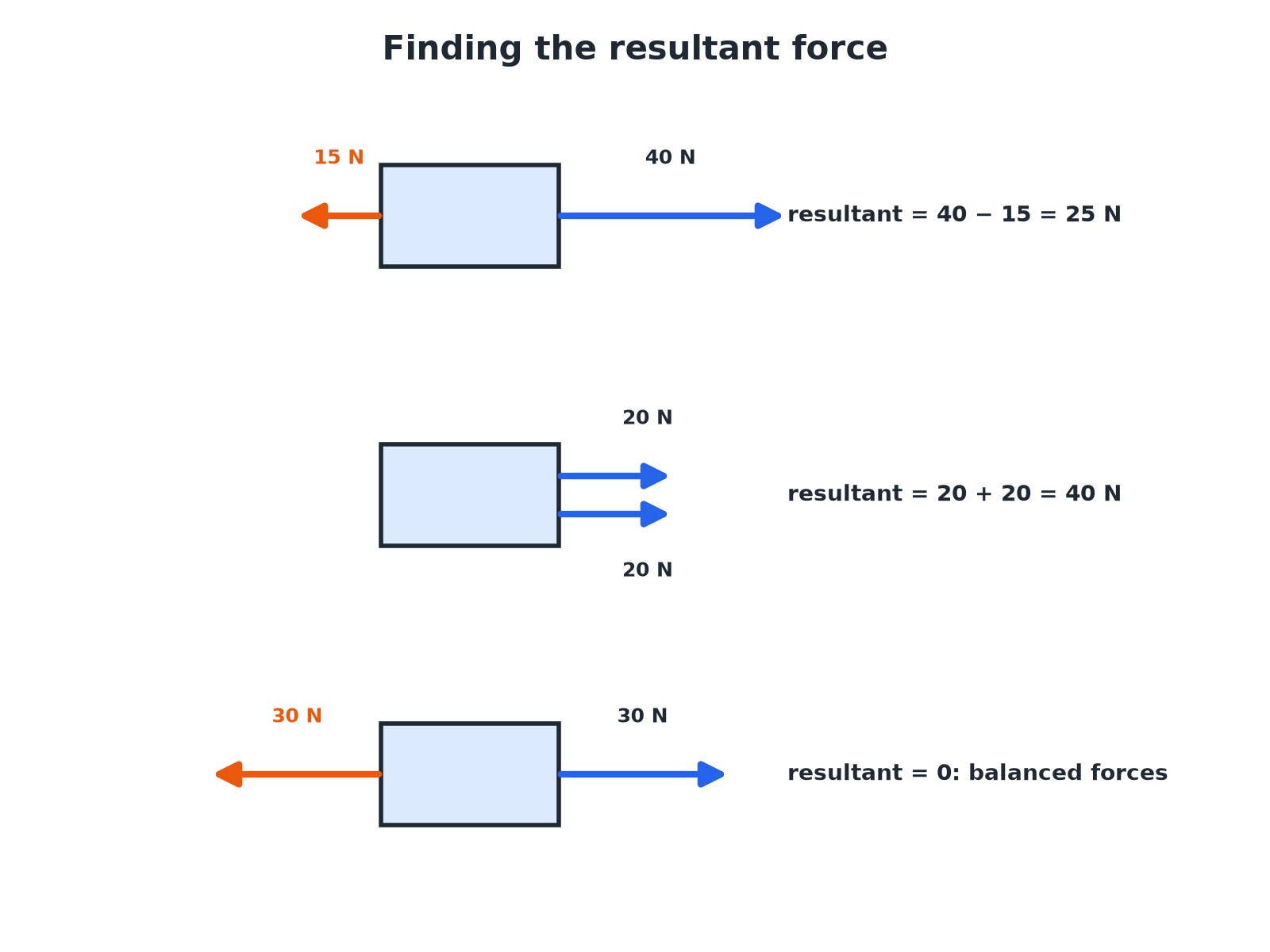
A number of forces acting on an object may be replaced by a single force that has the same effect: the resultant force.
Forces in the same direction are added. Forces in opposite directions are subtracted. If the resultant is zero the forces are balanced.
openrevise.com
AQA GCSE PHYSICS · PAPER 2 · FOUNDATION & HIGHER
Finding the Resultant
Forces
Lesson 3 of 20

Add same-direction forces; subtract opposite ones.
openrevise.com
AQA GCSE PHYSICS · PAPER 2 · FOUNDATION & HIGHER
Forces in a Straight Line
Forces
Lesson 3 of 20
A car's engine produces a driving force of 1800 N. Friction and air resistance give 1200 N in the opposite direction. Find the resultant force.
1
Opposite directions
Subtract
2
Calculate
1800 − 1200 = 600 N
ANSWER
600 N in the direction of the driving force.
openrevise.com
AQA GCSE PHYSICS · PAPER 2 · FOUNDATION & HIGHER
Free Body Diagram (Higher)
Forces
Lesson 3 of 20
Draw a free body diagram for a book at rest on a table.
1
Isolate the book
Draw the book as a box on its own
2
Weight
An arrow down from the centre of the box
3
Normal contact force
An arrow up of equal length
4
Resultant
Zero, so the forces are balanced
ANSWER
Equal arrows up and down: the resultant force is zero, so the book stays at rest.
openrevise.com
AQA GCSE PHYSICS · PAPER 2 · FOUNDATION & HIGHER
Scale Drawing (Higher)
Forces
Lesson 3 of 20
Two forces of 3.0 N (east) and 4.0 N (north) act on an object. Find the resultant using a scale drawing.
1
Scale
1 cm = 1 N
2
Draw
3 cm east, then 4 cm north from the end of the first arrow
3
Join start to finish
The arrow is 5.0 cm
4
Direction
Measure the angle: about 53° north of east
ANSWER
Resultant 5.0 N at about 53° north of east.
openrevise.com
AQA GCSE PHYSICS · PAPER 2 · FOUNDATION & HIGHER
Resolving a Force (Higher)
Forces
Lesson 3 of 20
A force of 10 N acts at 30° above the horizontal. Find the horizontal and vertical components using a scale drawing.
1
Scale
1 cm = 1 N
2
Draw
A 10 cm line at 30° to a horizontal line
3
Drop a perpendicular
Make a right-angled triangle
4
Measure
Horizontal about 8.7 cm and vertical 5.0 cm
ANSWER
Components: about 8.7 N horizontally and 5.0 N vertically.
openrevise.com
AQA GCSE PHYSICS · PAPER 2 · FOUNDATION & HIGHER
Key Points
Forces
Lesson 3 of 20
Remember in an exam.
Direction
Give the direction of the resultant.
Balanced
Zero resultant means constant velocity (Newton's first law).
Free body diagram
Show only the forces on the object, as arrows from its centre.
Units
Forces in newtons.
openrevise.com
AQA GCSE PHYSICS · PAPER 2 · FOUNDATION & HIGHER
Key Terms
Forces
Lesson 3 of 20
Resultant force
A single force with the same effect as all the forces on an object.
Balanced forces
Forces that are equal and opposite.
Free body diagram
A diagram showing all forces acting on an isolated object.
Component
One of two perpendicular forces that together have the same effect as one force.
Resolve
Split a force into two components at right angles.
Equilibrium
When the forces on an object are balanced.
openrevise.com
AQA GCSE PHYSICS · PAPER 2 · FOUNDATION & HIGHER
Forces
Lesson 3 of 20
YOUR TASK
Find the Resultant
10 minutes
Find the resultant force: (a) 50 N right and 20 N left (b) 30 N up and 30 N down (c) 12 N right and 8 N right.
1
Same direction: add.
2
Opposite: subtract.
WHAT A GOOD ANSWER SHOWS
(a) 30 N right (b) 0 N (c) 20 N right.
openrevise.com
AQA GCSE PHYSICS · PAPER 2 · FOUNDATION & HIGHER
Can I...?
Forces
Lesson 3 of 20
Define a resultant.
Add forces in the same direction.
Subtract opposite forces.
Recognise balanced forces.
Draw a free body diagram.
Use a scale drawing.
Resolve a force.
Give direction.
openrevise.com
AQA GCSE PHYSICS · PAPER 2 · FOUNDATION & HIGHER
Summary & Exam Focus
Resultant: same direction add, opposite subtract.
Zero resultant: balanced.
Higher: free body diagrams and scale drawings.
Resolve into perpendicular components.
EXAM FOCUS
A driving force of 1800 N and a resistive force of 1200 N act on a car. Calculate the resultant force. (2 marks)
Subtract the smaller from the larger and give the direction.
openrevise.com
AQA GCSE PHYSICS · PAPER 2 · FOUNDATION & HIGHER
Exam Practice: Resultant forces
Forces
Lesson 3 of 20
Answer all questions. Use the mark allocation as a guide to how much to write. · 14 minutes
Question 1 · 2 marks · Calculate
A car engine produces a driving force of 1800 N. The total resistive force is 1200 N. Calculate the resultant force on the car and state…
Question 2 · 2 marks · Use the diagram
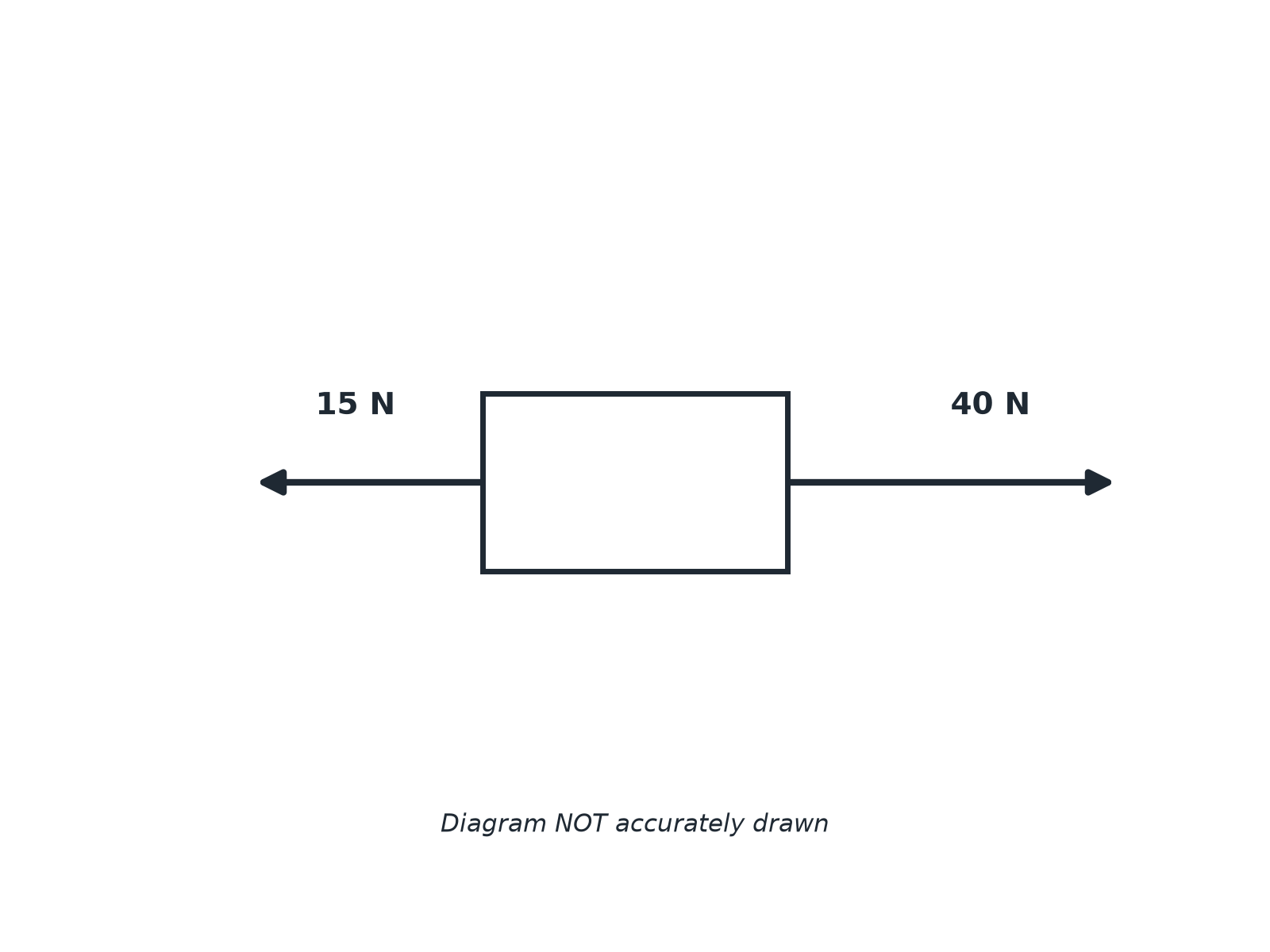
The diagram shows the forces acting on a box. Calculate the resultant force.
Question 3 · 2 marks · Explain
A skydiver has a weight of 800 N and air resistance of 500 N. Calculate the resultant force and state its direction.
openrevise.com
AQA GCSE PHYSICS · PAPER 2 · FOUNDATION & HIGHER
Exam Practice: Resultant forces (cont.)
Forces
Lesson 3 of 20
Question 4 · 3 marks · Draw
Draw a free body diagram for a stationary book on a table. Label the forces.
Question 5 · 4 marks · Determine
Two forces act on an object at right angles to each other: 3.0 N east and 4.0 N north. Use a scale drawing to find the magnitude and…
openrevise.com
AQA GCSE PHYSICS · PAPER 2 · FOUNDATION & HIGHER
Question 1 · 2 marks · Calculate
Forces
Lesson 3 of 20
“
A car engine produces a driving force of 1800 N. The total resistive force is 1200 N. Calculate the resultant force on the car and state its direction.
HOW TO ANSWER IT
Command word: Calculate. Worth 2 marks, so plan before writing.
openrevise.com
AQA GCSE PHYSICS · PAPER 2 · FOUNDATION & HIGHER
Question 1 · mark scheme
Forces
Lesson 3 of 20
2 marks available. Award a mark for each point made.
600 N
1 mark
In the direction of the driving force
1 mark
openrevise.com
AQA GCSE PHYSICS · PAPER 2 · FOUNDATION & HIGHER
Question 2 · 2 marks · Use the diagram
Forces
Lesson 3 of 20

The diagram shows the forces acting on a box. Calculate the resultant force. (2 marks)
openrevise.com
AQA GCSE PHYSICS · PAPER 2 · FOUNDATION & HIGHER
Question 2 · mark scheme
Forces
Lesson 3 of 20
2 marks available. Award a mark for each point made.
Subtracts 15 from 40
1 mark
25 N to the right
1 mark
openrevise.com
AQA GCSE PHYSICS · PAPER 2 · FOUNDATION & HIGHER
Question 3 · 2 marks · Explain
Forces
Lesson 3 of 20
“
A skydiver has a weight of 800 N and air resistance of 500 N. Calculate the resultant force and state its direction.
HOW TO ANSWER IT
Command word: Explain. Worth 2 marks, so plan before writing.
openrevise.com
AQA GCSE PHYSICS · PAPER 2 · FOUNDATION & HIGHER
Question 3 · mark scheme
Forces
Lesson 3 of 20
2 marks available. Award a mark for each point made.
300 N
1 mark
Downwards
1 mark
openrevise.com
AQA GCSE PHYSICS · PAPER 2 · FOUNDATION & HIGHER
Question 4 · 3 marks · Draw
Forces
Lesson 3 of 20
“
Draw a free body diagram for a stationary book on a table. Label the forces.
HOW TO ANSWER IT
Command word: Draw. Worth 3 marks, so plan before writing.
openrevise.com
AQA GCSE PHYSICS · PAPER 2 · FOUNDATION & HIGHER
Question 4 · mark scheme
Forces
Lesson 3 of 20
3 marks available. Award a mark for each point made.
Downward arrow labelled weight
1 mark
Upward arrow labelled normal contact force
1 mark
Arrows equal in length
1 mark
openrevise.com
AQA GCSE PHYSICS · PAPER 2 · FOUNDATION & HIGHER
Question 5 · 4 marks · Determine
Forces
Lesson 3 of 20
“
Two forces act on an object at right angles to each other: 3.0 N east and 4.0 N north. Use a scale drawing to find the magnitude and direction of the resultant force.
HOW TO ANSWER IT
Command word: Determine. Worth 4 marks, so plan before writing.
openrevise.com
AQA GCSE PHYSICS · PAPER 2 · FOUNDATION & HIGHER
Question 5 · mark scheme
Forces
Lesson 3 of 20
4 marks available. Award a mark for each point made.
Correct scale chosen
1 mark
Right-angled triangle drawn accurately
1 mark
5.0 N
1 mark
Direction about 53° north of east
1 mark
openrevise.com
← → to move, F to present full screen, G for every slide at once.