Slides · PPTX · 196 KB · 26 slides
Newtons Third Law - Teacher Slides.pptx
The lesson slides with the teacher's notes on each slide, and every question and mark scheme built in. Built from the lesson script on 30 September 2026.
AQA GCSE PHYSICS · PAPER 2 · FOUNDATION & HIGHER
Newton's Third Law
Forces
Lesson 16 of 20
openrevise.com
AQA GCSE PHYSICS · PAPER 2 · FOUNDATION & HIGHER
Warm-up
Forces
Lesson 16 of 20
Answer each one, then check.
1
What is a force?
2
What are balanced forces?
3
Give a contact force.
4
What is a non-contact force?
5
What is weight?
openrevise.com
AQA GCSE PHYSICS · PAPER 2 · FOUNDATION & HIGHER
Warm-up - Answers
Forces
Lesson 16 of 20
1
What is a force?
A push or a pull
2
What are balanced forces?
Equal and opposite forces on the same object
3
Give a contact force.
Friction, tension or normal contact force
4
What is a non-contact force?
A force between objects that are not touching
5
What is weight?
The force of gravity on an object
openrevise.com
AQA GCSE PHYSICS · PAPER 2 · FOUNDATION & HIGHER
Learning Objectives
Forces
Lesson 16 of 20
1
State Newton's Third Law.
2
Identify pairs of forces between two interacting objects.
3
Explain why interaction pairs do not cancel each other.
4
Apply the law to objects in equilibrium.
openrevise.com
AQA GCSE PHYSICS · PAPER 2 · FOUNDATION & HIGHER
Forces
Lesson 16 of 20
NEWTON'S THIRD LAW
Whenever two objects interact, the forces they exert on each other are equal and opposite.
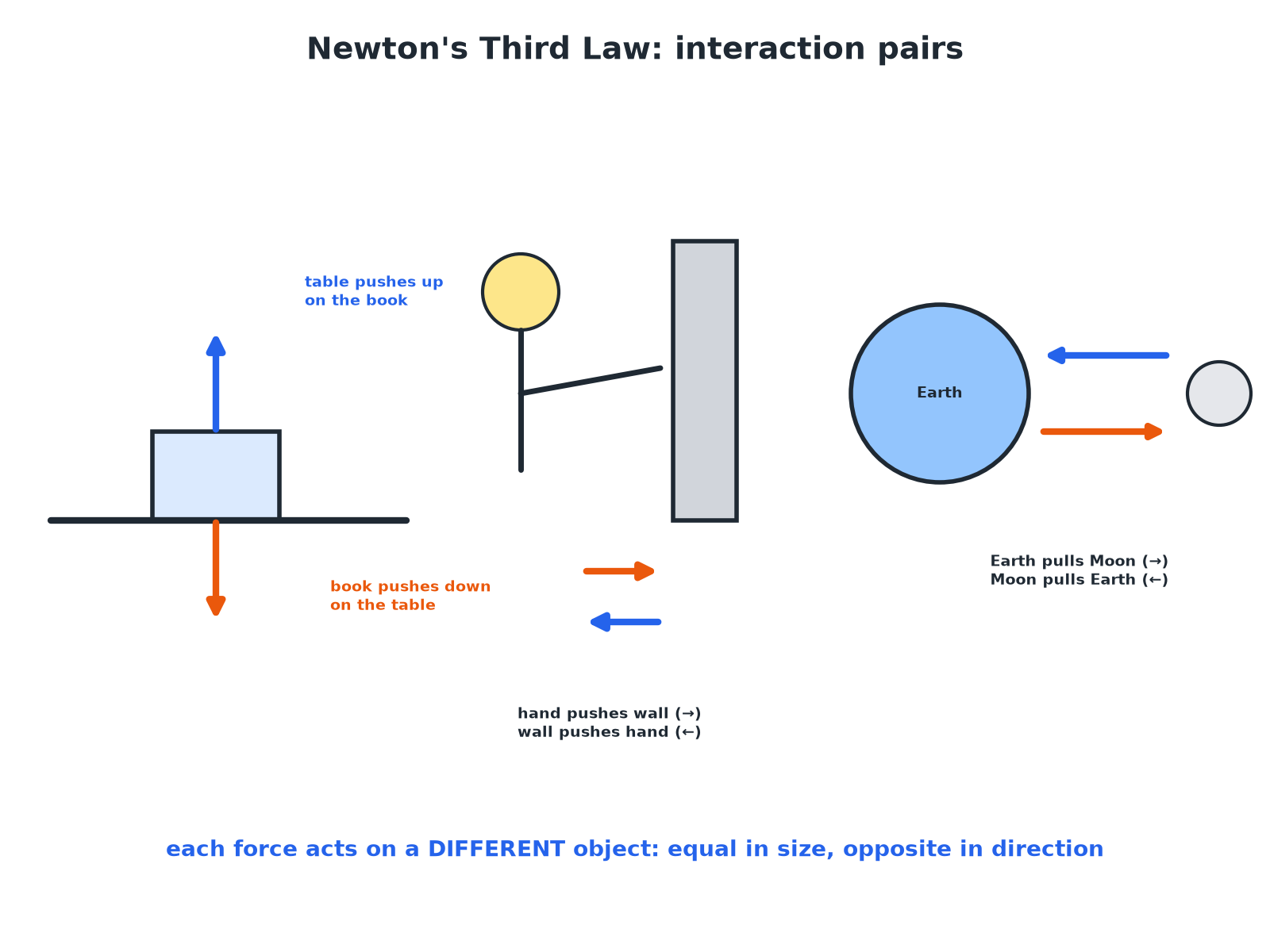
The two forces in an interaction pair act on different objects, are the same type of force, and are equal in size and opposite in direction.
openrevise.com
AQA GCSE PHYSICS · PAPER 2 · FOUNDATION & HIGHER
Interaction Pairs
Forces
Lesson 16 of 20

Each force acts on a different object.
openrevise.com
AQA GCSE PHYSICS · PAPER 2 · FOUNDATION & HIGHER
Finding an Interaction Pair
Forces
Lesson 16 of 20
A book rests on a table. The table exerts an upward force on the book. What is the other force in this interaction pair?
1
Type of force
A contact (normal) force
2
Acts on
The table
3
Direction
Downwards
ANSWER
The book pushes down on the table with an equal force.
openrevise.com
AQA GCSE PHYSICS · PAPER 2 · FOUNDATION & HIGHER
Weight and Contact Force
Forces
Lesson 16 of 20
A book at rest on a table has a weight of 10 N. Is the normal contact force from the table the Third-Law pair of the weight? Explain.
1
Weight
The Earth pulls the book down; the pair is the book pulling the Earth up
2
Normal contact force
The table pushes the book up: a different kind of force
3
So
They are equal and opposite because the book is in equilibrium, not because of the Third Law
ANSWER
No. The pair of the weight is the book's gravitational pull on the Earth. The contact force balances the weight (Newton's First Law).
openrevise.com
AQA GCSE PHYSICS · PAPER 2 · FOUNDATION & HIGHER
Why Things Move
Forces
Lesson 16 of 20
A swimmer pushes backwards on the water. Explain why the swimmer moves forwards.
1
Action
The swimmer pushes the water backwards
2
Reaction
The water pushes the swimmer forwards with an equal force
3
Resultant
Acts on the swimmer and causes acceleration
ANSWER
The water pushes back on the swimmer with an equal and opposite force.
openrevise.com
AQA GCSE PHYSICS · PAPER 2 · FOUNDATION & HIGHER
Common Mistakes
Forces
Lesson 16 of 20
Avoid these.
Same object
Forces that cancel act on the same object; a Third-Law pair acts on different objects.
Always equal
The forces in a pair are always equal, even if one object is much lighter.
Same type
The pair is always the same type of force.
Motion
Equal forces on different objects can give different accelerations (F = ma).
openrevise.com
AQA GCSE PHYSICS · PAPER 2 · FOUNDATION & HIGHER
Key Terms
Forces
Lesson 16 of 20
Newton's Third Law
The forces two interacting objects exert on each other are equal and opposite.
Interaction pair
The two forces in an interaction between two objects.
Equilibrium
When the forces on an object are balanced.
Normal contact force
The push from a surface on an object resting on it.
Reaction force
The force that forms a pair with another force.
Different objects
The two forces in a pair act on separate bodies.
openrevise.com
AQA GCSE PHYSICS · PAPER 2 · FOUNDATION & HIGHER
Forces
Lesson 16 of 20
YOUR TASK
Find the Pair
10 minutes
For each, state the other force in the pair: (a) a foot pushes backwards on the ground (b) the Sun pulls the Earth (c) a rocket pushes gas out of its engine.
1
Swap the objects.
2
Keep the same type of force.
WHAT A GOOD ANSWER SHOWS
(a) The ground pushes the foot forwards. (b) The Earth pulls the Sun. (c) The gas pushes the rocket forwards.
openrevise.com
AQA GCSE PHYSICS · PAPER 2 · FOUNDATION & HIGHER
Can I...?
Forces
Lesson 16 of 20
State the third law.
Name the object each force acts on.
Identify a pair.
Explain that pairs do not cancel.
Apply it to a book on a table.
Apply it to a swimmer.
Apply it to gravity.
Explain equilibrium.
openrevise.com
AQA GCSE PHYSICS · PAPER 2 · FOUNDATION & HIGHER
Summary & Exam Focus
Interaction pairs: equal and opposite, on different objects.
Same type of force in a pair.
Weight and normal force are not a Third-Law pair.
Equilibrium: balanced forces on one object.
EXAM FOCUS
State Newton's Third Law. (2 marks)
Forces equal in size and opposite in direction on different objects.
openrevise.com
AQA GCSE PHYSICS · PAPER 2 · FOUNDATION & HIGHER
Exam Practice: Newton's Third Law
Forces
Lesson 16 of 20
Answer all questions. Use the mark allocation as a guide to how much to write. · 16 minutes
Question 1 · 2 marks · State
State Newton's Third Law of motion.
Question 2 · 3 marks · Explain
A book rests on a table. The table pushes up on the book. State the force that forms a Newton's Third Law pair with this force, and the…
Question 3 · 3 marks · Explain
A swimmer pushes the water backwards and moves forwards. Explain why, using Newton's Third Law.
openrevise.com
AQA GCSE PHYSICS · PAPER 2 · FOUNDATION & HIGHER
Exam Practice: Newton's Third Law (cont.)
Forces
Lesson 16 of 20
Question 4 · 3 marks · Explain
The Earth pulls the Moon with a gravitational force. A student says that the Moon pulls on the Earth with a much smaller force because the…
Question 5 · 4 marks · Explain
A book of weight 10 N rests on a table. A student says the weight and the upward force from the table are a Newton's Third Law pair…
openrevise.com
AQA GCSE PHYSICS · PAPER 2 · FOUNDATION & HIGHER
Question 1 · 2 marks · State
Forces
Lesson 16 of 20
“
State Newton's Third Law of motion.
HOW TO ANSWER IT
Command word: State. Worth 2 marks, so plan before writing.
openrevise.com
AQA GCSE PHYSICS · PAPER 2 · FOUNDATION & HIGHER
Question 1 · mark scheme
Forces
Lesson 16 of 20
2 marks available. Award a mark for each point made.
Forces are equal
1 mark
and opposite
1 mark
openrevise.com
AQA GCSE PHYSICS · PAPER 2 · FOUNDATION & HIGHER
Question 2 · 3 marks · Explain
Forces
Lesson 16 of 20
“
A book rests on a table. The table pushes up on the book. State the force that forms a Newton's Third Law pair with this force, and the object it acts on.
HOW TO ANSWER IT
Command word: Explain. Worth 3 marks, so plan before writing.
openrevise.com
AQA GCSE PHYSICS · PAPER 2 · FOUNDATION & HIGHER
Question 2 · mark scheme
Forces
Lesson 16 of 20
3 marks available. Award a mark for each point made.
Book pushes down
1 mark
On the table
1 mark
Equal in size and opposite in direction
1 mark
openrevise.com
AQA GCSE PHYSICS · PAPER 2 · FOUNDATION & HIGHER
Question 3 · 3 marks · Explain
Forces
Lesson 16 of 20
“
A swimmer pushes the water backwards and moves forwards. Explain why, using Newton's Third Law.
HOW TO ANSWER IT
Command word: Explain. Worth 3 marks, so plan before writing.
openrevise.com
AQA GCSE PHYSICS · PAPER 2 · FOUNDATION & HIGHER
Question 3 · mark scheme
Forces
Lesson 16 of 20
3 marks available. Award a mark for each point made.
Swimmer pushes water backwards
1 mark
Water pushes swimmer forwards with an equal force
1 mark
Forces act on different objects or make the swimmer accelerate
1 mark
openrevise.com
AQA GCSE PHYSICS · PAPER 2 · FOUNDATION & HIGHER
Question 4 · 3 marks · Explain
Forces
Lesson 16 of 20
“
The Earth pulls the Moon with a gravitational force. A student says that the Moon pulls on the Earth with a much smaller force because the Moon is much less massive. Explain why the student is wrong.
HOW TO ANSWER IT
Command word: Explain. Worth 3 marks, so plan before writing.
openrevise.com
AQA GCSE PHYSICS · PAPER 2 · FOUNDATION & HIGHER
Question 4 · mark scheme
Forces
Lesson 16 of 20
3 marks available. Award a mark for each point made.
Forces are equal
1 mark
Opposite in direction
1 mark
Newton's Third Law applies whatever the masses
1 mark
openrevise.com
AQA GCSE PHYSICS · PAPER 2 · FOUNDATION & HIGHER
Question 5 · 4 marks · Explain
Forces
Lesson 16 of 20
“
A book of weight 10 N rests on a table. A student says the weight and the upward force from the table are a Newton's Third Law pair. Explain why the student is wrong. Name the force that does form a pair with the weight.
HOW TO ANSWER IT
Command word: Explain. Worth 4 marks, so plan before writing.
openrevise.com
AQA GCSE PHYSICS · PAPER 2 · FOUNDATION & HIGHER
Question 5 · mark scheme
Forces
Lesson 16 of 20
4 marks available. Award a mark for each point made.
Both forces act on the book
1 mark
Third Law pairs act on different objects
1 mark
Equal because of equilibrium
1 mark
Book pulls the Earth upwards
1 mark
openrevise.com
← → to move, F to present full screen, G for every slide at once.