Slides · PPTX · 250 KB · 28 slides
Stopping distance and reaction time - Teacher Slides.pptx
The lesson slides with the teacher's notes on each slide, and every question and mark scheme built in. Built from the lesson script on 30 September 2026.
AQA GCSE PHYSICS · PAPER 2 · FOUNDATION & HIGHER
Stopping distance and reaction time
Forces
Lesson 17 of 20
openrevise.com
AQA GCSE PHYSICS · PAPER 2 · FOUNDATION & HIGHER
Warm-up
Forces
Lesson 17 of 20
Answer each one, then check.
1
What is speed?
2
What is distance = speed × time?
3
What is reaction time?
4
What does braking do?
5
What is a typical human reaction time?
openrevise.com
AQA GCSE PHYSICS · PAPER 2 · FOUNDATION & HIGHER
Warm-up - Answers
Forces
Lesson 17 of 20
1
What is speed?
Distance divided by time
2
What is distance = speed × time?
s = vt
3
What is reaction time?
The time between seeing something and reacting
4
What does braking do?
Reduces the vehicle's kinetic energy
5
What is a typical human reaction time?
0.2 s to 0.9 s
openrevise.com
AQA GCSE PHYSICS · PAPER 2 · FOUNDATION & HIGHER
Learning Objectives
Forces
Lesson 17 of 20
1
Define stopping distance, thinking distance and braking distance.
2
Explain how speed affects stopping distance.
3
Describe factors that affect reaction time, and methods used to measure it.
4
Interpret graphs relating speed to stopping distance.
openrevise.com
AQA GCSE PHYSICS · PAPER 2 · FOUNDATION & HIGHER
Forces
Lesson 17 of 20
STOPPING DISTANCE
stopping distance = thinking distance + braking distance
Thinking distance is the distance travelled during the driver's reaction time. Braking distance is the distance travelled under the braking force. For a given braking force, the greater the speed, the greater the stopping distance.
openrevise.com
AQA GCSE PHYSICS · PAPER 2 · FOUNDATION & HIGHER
Stopping Distance
Forces
Lesson 17 of 20

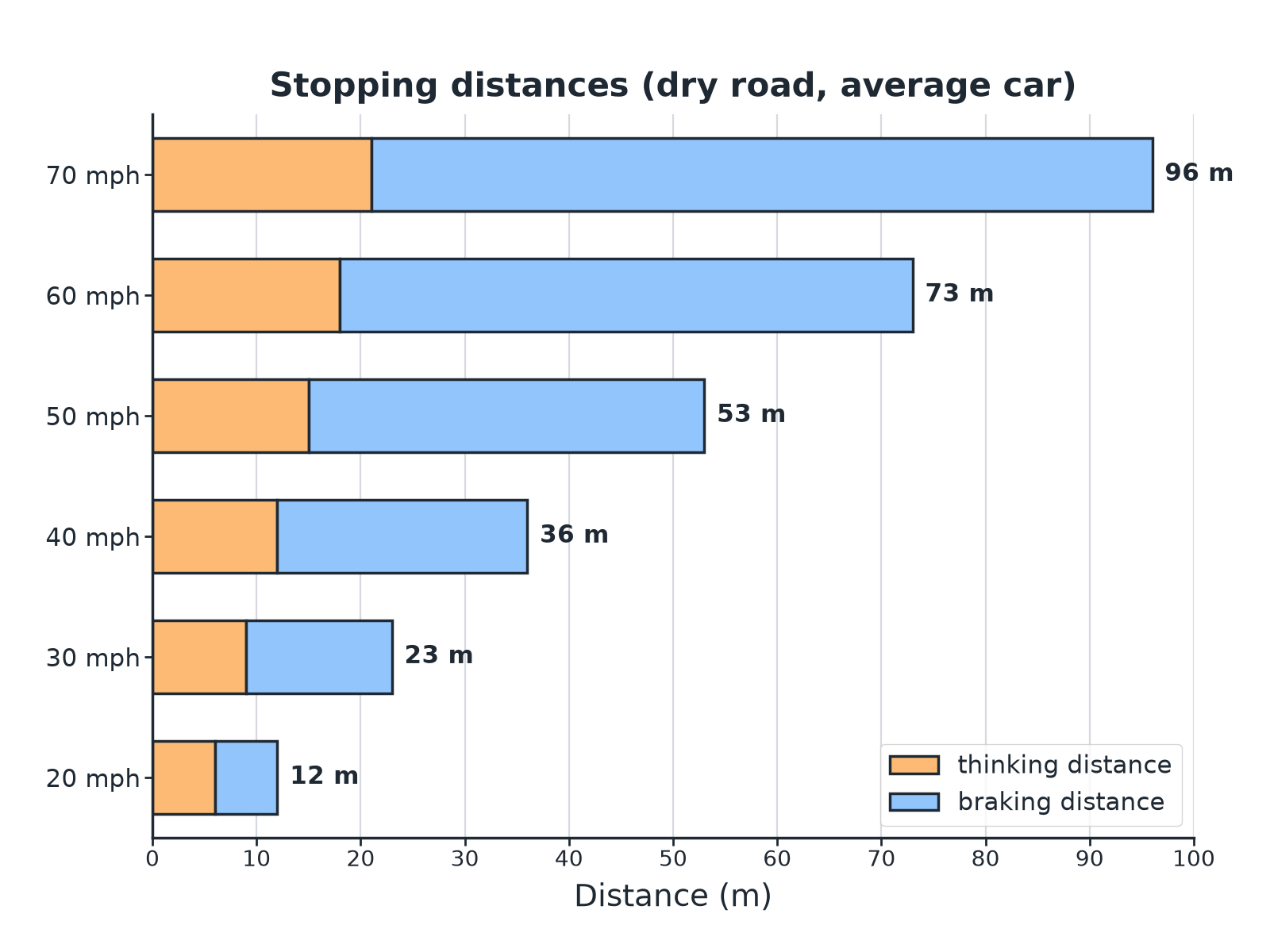
Thinking distance is proportional to speed; braking distance is not.
openrevise.com
AQA GCSE PHYSICS · PAPER 2 · FOUNDATION & HIGHER
Reaction Time
Forces
Lesson 17 of 20
Typical values and factors.
Idea
Detail
Typical reaction time
0.2 s to 0.9 s
Increases with
Tiredness, drugs, alcohol, distractions such as a mobile phone
Thinking distance
s = vt: reaction time × speed
Measuring it
Ruler drop test: the distance the ruler falls gives the reaction time
openrevise.com
AQA GCSE PHYSICS · PAPER 2 · FOUNDATION & HIGHER
Thinking Distance
Forces
Lesson 17 of 20
A driver travelling at 15 m/s has a reaction time of 0.60 s. Calculate the thinking distance.
1
Write the equation
s = vt
2
Substitute
s = 15 × 0.60
3
Answer
s = 9.0 m
ANSWER
9.0 m
openrevise.com
AQA GCSE PHYSICS · PAPER 2 · FOUNDATION & HIGHER
Stopping Distance
Forces
Lesson 17 of 20
A car has a thinking distance of 9.0 m and a braking distance of 14 m. Calculate the stopping distance.
1
Add
9.0 + 14 = 23 m
ANSWER
23 m
openrevise.com
AQA GCSE PHYSICS · PAPER 2 · FOUNDATION & HIGHER
Measuring Reaction Time
Forces
Lesson 17 of 20
Describe the ruler drop method.
1
Set up
A partner holds a ruler vertically with the zero between your thumb and finger
2
Drop
Without warning they drop it, and you catch it as fast as you can
3
Measure
The distance fallen is read from the ruler
4
Convert
Use a table of distance against time, then repeat and find a mean
ANSWER
The longer the distance the ruler falls, the longer the reaction time.
openrevise.com
AQA GCSE PHYSICS · PAPER 2 · FOUNDATION & HIGHER
Distractions
Forces
Lesson 17 of 20
Explain the effect of a driver texting on the stopping distance.
1
Reaction time
Increases
2
Thinking distance
s = vt is greater
3
Stopping distance
So the total stopping distance is greater
ANSWER
A longer reaction time gives a longer thinking distance and so a longer stopping distance.
openrevise.com
AQA GCSE PHYSICS · PAPER 2 · FOUNDATION & HIGHER
Why It Matters
Forces
Lesson 17 of 20
Safety.
Speed limits
Higher speed means a much greater stopping distance.
Driver factors
Tiredness, alcohol, drugs and distractions raise reaction time.
Estimates
Estimate how emergency stopping distance varies over typical speeds.
Graphs
Interpret graphs of speed against stopping distance for different vehicles.
openrevise.com
AQA GCSE PHYSICS · PAPER 2 · FOUNDATION & HIGHER
Key Terms
Forces
Lesson 17 of 20
Stopping distance
Thinking distance plus braking distance.
Thinking distance
Distance travelled in the driver's reaction time.
Braking distance
Distance travelled while the brakes slow the vehicle.
Reaction time
The time between a stimulus and a response.
Distraction
Something that takes a driver's attention away.
Mean
The average of repeated readings.
openrevise.com
AQA GCSE PHYSICS · PAPER 2 · FOUNDATION & HIGHER
Forces
Lesson 17 of 20
YOUR TASK
Reaction Test
12 minutes
In a ruler drop test a student's three results for the distance fallen are 14 cm, 16 cm and 15 cm. Calculate the mean. Explain why a tired driver would have a longer stopping distance.
1
Find the mean.
2
Link to s = vt.
WHAT A GOOD ANSWER SHOWS
Mean = 15 cm. Tiredness increases reaction time, so thinking distance increases, increasing the stopping distance.
openrevise.com
AQA GCSE PHYSICS · PAPER 2 · FOUNDATION & HIGHER
Can I...?
Forces
Lesson 17 of 20
Define stopping distance.
Define thinking and braking distance.
Use s = vt.
List factors affecting reaction time.
Describe a reaction-time test.
Read a stopping distance chart.
Explain the effect of speed.
Estimate stopping distances.
openrevise.com
AQA GCSE PHYSICS · PAPER 2 · FOUNDATION & HIGHER
Summary & Exam Focus
Stopping = thinking + braking.
Thinking distance: s = vt.
Reaction time 0.2 to 0.9 s; increased by tiredness, drugs, alcohol, distractions.
Higher speed gives a greater stopping distance.
EXAM FOCUS
A driver travels at 15 m/s with a reaction time of 0.60 s. Calculate the thinking distance. (2 marks)
Multiply speed by reaction time.
openrevise.com
AQA GCSE PHYSICS · PAPER 2 · FOUNDATION & HIGHER
Exam Practice: Stopping distance and reaction time
Forces
Lesson 17 of 20
Answer all questions. Use the mark allocation as a guide to how much to write. · 16 minutes
Question 1 · 2 marks · Calculate
A car travels at 15 m/s. The driver's reaction time is 0.60 s. Calculate the thinking distance. Use the equation: distance = speed × time
Question 2 · 2 marks · State
Give two factors that can increase a driver's reaction time.
Question 3 · 4 marks · Use the chart
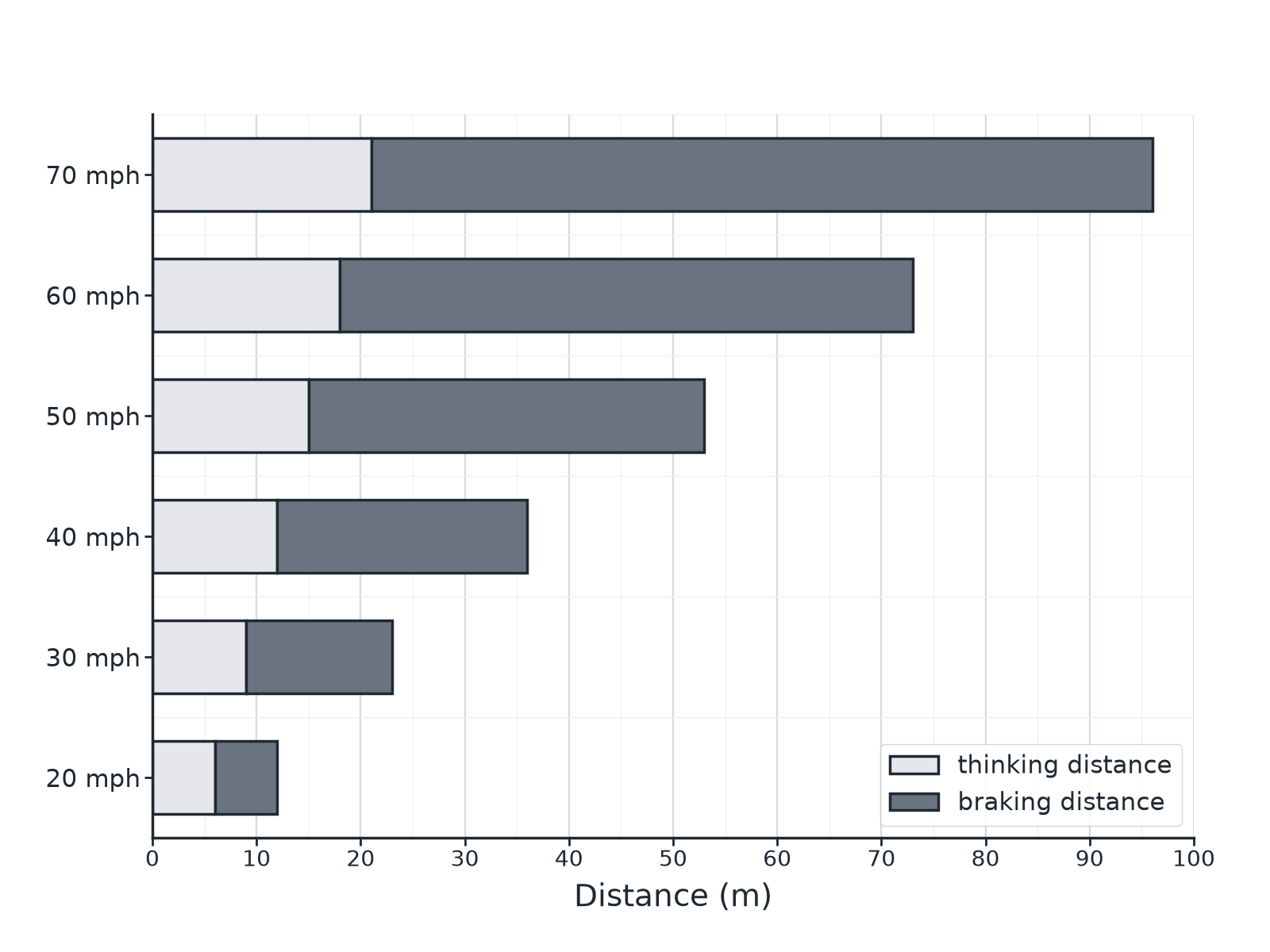
The chart shows the thinking distance and braking distance for a car at different speeds. (a) Use the chart to find the stopping distance…
openrevise.com
AQA GCSE PHYSICS · PAPER 2 · FOUNDATION & HIGHER
Exam Practice: Stopping distance and reaction time (cont.)
Forces
Lesson 17 of 20
Question 4 · 3 marks · Explain
A driver is sending a text message while driving. Explain how this affects the stopping distance of the car.
Question 5 · 4 marks · Describe
Describe an experiment to measure a person's reaction time using a ruler. Explain how the result is used.
openrevise.com
AQA GCSE PHYSICS · PAPER 2 · FOUNDATION & HIGHER
Question 1 · 2 marks · Calculate
Forces
Lesson 17 of 20
“
A car travels at 15 m/s. The driver's reaction time is 0.60 s. Calculate the thinking distance. Use the equation: distance = speed × time
HOW TO ANSWER IT
Command word: Calculate. Worth 2 marks, so plan before writing.
openrevise.com
AQA GCSE PHYSICS · PAPER 2 · FOUNDATION & HIGHER
Question 1 · mark scheme
Forces
Lesson 17 of 20
2 marks available. Award a mark for each point made.
Correct substitution
1 mark
9.0 m
1 mark
openrevise.com
AQA GCSE PHYSICS · PAPER 2 · FOUNDATION & HIGHER
Question 2 · 2 marks · State
Forces
Lesson 17 of 20
“
Give two factors that can increase a driver's reaction time.
HOW TO ANSWER IT
Command word: State. Worth 2 marks, so plan before writing.
openrevise.com
AQA GCSE PHYSICS · PAPER 2 · FOUNDATION & HIGHER
Question 2 · mark scheme
Forces
Lesson 17 of 20
2 marks available. Award a mark for each point made.
First factor
1 mark
Second factor
1 mark
openrevise.com
AQA GCSE PHYSICS · PAPER 2 · FOUNDATION & HIGHER
Question 3 · 4 marks · Use the chart
Forces
Lesson 17 of 20

The chart shows the thinking distance and braking distance for a car at different speeds. (a) Use the chart to find the stopping distance at 50 mph. (b) Describe how the thinking distance changes with speed. (c) Explain why the braking distance increases more quickly than the thinking distance. (4 marks)
openrevise.com
AQA GCSE PHYSICS · PAPER 2 · FOUNDATION & HIGHER
Question 3 · mark scheme
Forces
Lesson 17 of 20
4 marks available. Award a mark for each point made.
53 m
1 mark
Thinking distance increases steadily or proportionally
1 mark
Braking distance depends on kinetic energy
1 mark
Kinetic energy ∝ speed²
1 mark
openrevise.com
AQA GCSE PHYSICS · PAPER 2 · FOUNDATION & HIGHER
Question 4 · 3 marks · Explain
Forces
Lesson 17 of 20
“
A driver is sending a text message while driving. Explain how this affects the stopping distance of the car.
HOW TO ANSWER IT
Command word: Explain. Worth 3 marks, so plan before writing.
openrevise.com
AQA GCSE PHYSICS · PAPER 2 · FOUNDATION & HIGHER
Question 4 · mark scheme
Forces
Lesson 17 of 20
3 marks available. Award a mark for each point made.
Reaction time increases
1 mark
Thinking distance increases
1 mark
Stopping distance greater
1 mark
openrevise.com
AQA GCSE PHYSICS · PAPER 2 · FOUNDATION & HIGHER
Question 5 · 4 marks · Describe
Forces
Lesson 17 of 20
“
Describe an experiment to measure a person's reaction time using a ruler. Explain how the result is used.
HOW TO ANSWER IT
Command word: Describe. Worth 4 marks, so plan before writing.
openrevise.com
AQA GCSE PHYSICS · PAPER 2 · FOUNDATION & HIGHER
Question 5 · mark scheme
Forces
Lesson 17 of 20
4 marks available. Award a mark for each point made.
Ruler held and dropped without warning
1 mark
Distance fallen measured
1 mark
Converted to a reaction time
1 mark
Repeat and mean, compare conditions
1 mark
openrevise.com
← → to move, F to present full screen, G for every slide at once.