Slides · PPTX · 236 KB · 28 slides
Lenses - Teacher Slides.pptx
The lesson slides with the teacher's notes on each slide, and every question and mark scheme built in. Built from the lesson script on 30 September 2026.
AQA GCSE PHYSICS · PAPER 2 · FOUNDATION & HIGHER
Lenses
Waves
Lesson 10 of 12
openrevise.com
AQA GCSE PHYSICS · PAPER 2 · FOUNDATION & HIGHER

Warm-up
Waves
Lesson 10 of 12
Answer each one, then check.
1
What is refraction?
2
What is a ray?
3
What is an image?
4
What is magnification?
5
Give an example of a lens use.
openrevise.com
AQA GCSE PHYSICS · PAPER 2 · FOUNDATION & HIGHER

Warm-up - Answers
Waves
Lesson 10 of 12
1
What is refraction?
A change of direction caused by a change in speed
2
What is a ray?
A line showing the path of light
3
What is an image?
What you see when light from an object is focused
4
What is magnification?
How many times bigger an image is than the object
5
Give an example of a lens use.
Glasses, cameras or magnifying glasses
openrevise.com
AQA GCSE PHYSICS · PAPER 2 · FOUNDATION & HIGHER

Learning Objectives
Waves
Lesson 10 of 12
1
Describe how a lens forms an image by refracting light.
2
Define principal focus and focal length for a convex lens.
3
Construct ray diagrams for convex and concave lenses.
4
Distinguish real and virtual images and calculate magnification.
openrevise.com
AQA GCSE PHYSICS · PAPER 2 · FOUNDATION & HIGHER
Waves
Lesson 10 of 12

LENSES
A lens forms an image by refracting light. A convex lens brings parallel rays together at the principal focus; a concave lens spreads them out.
Magnification has no units: image height and object height must be in the same units (mm or cm). The magnification equation is given on the Physics equation sheet.
openrevise.com
AQA GCSE PHYSICS · PAPER 2 · FOUNDATION & HIGHER

A Convex Lens
Waves
Lesson 10 of 12
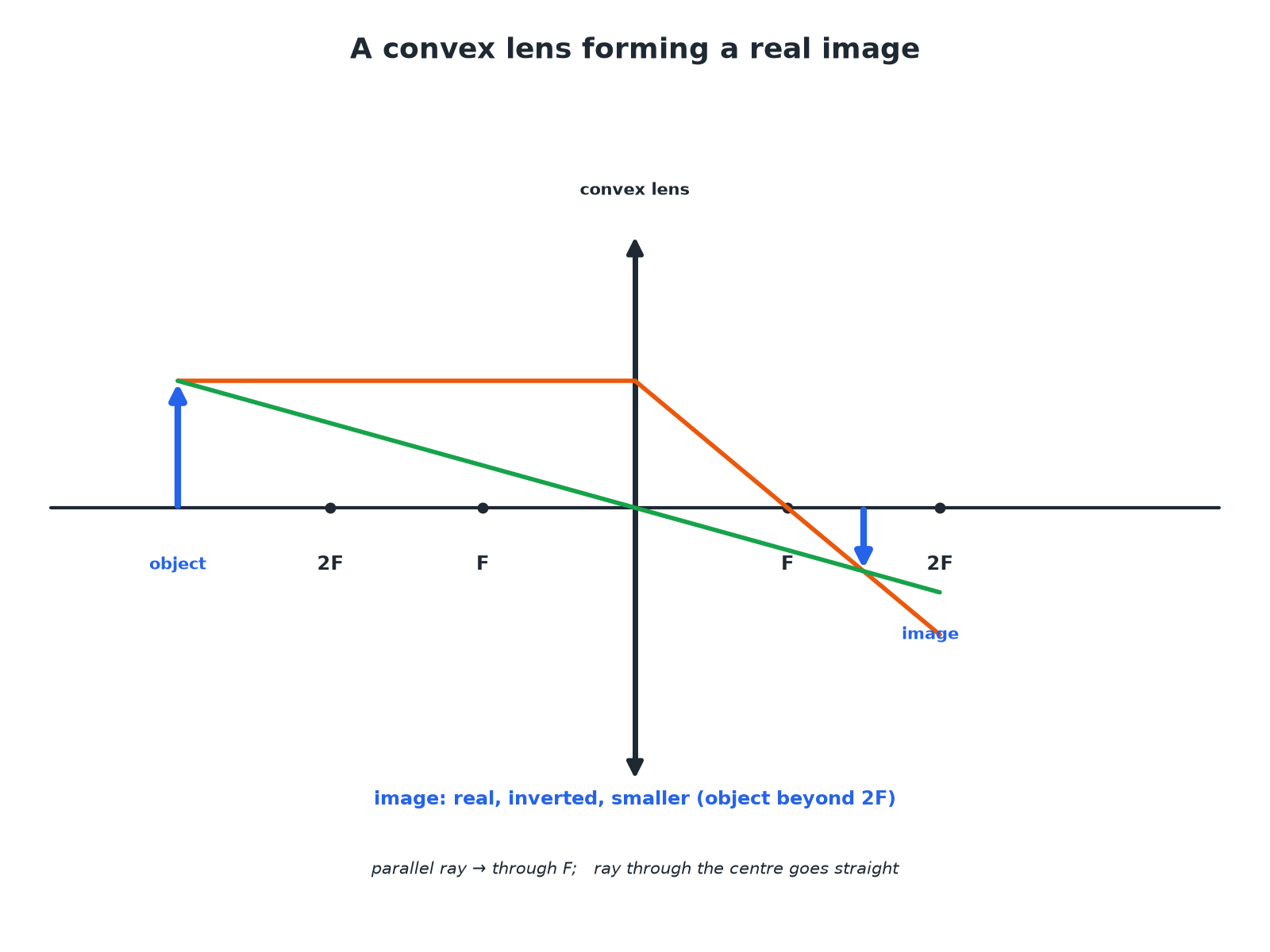
Two rays are enough to find the image position.
openrevise.com
AQA GCSE PHYSICS · PAPER 2 · FOUNDATION & HIGHER

A Concave Lens
Waves
Lesson 10 of 12
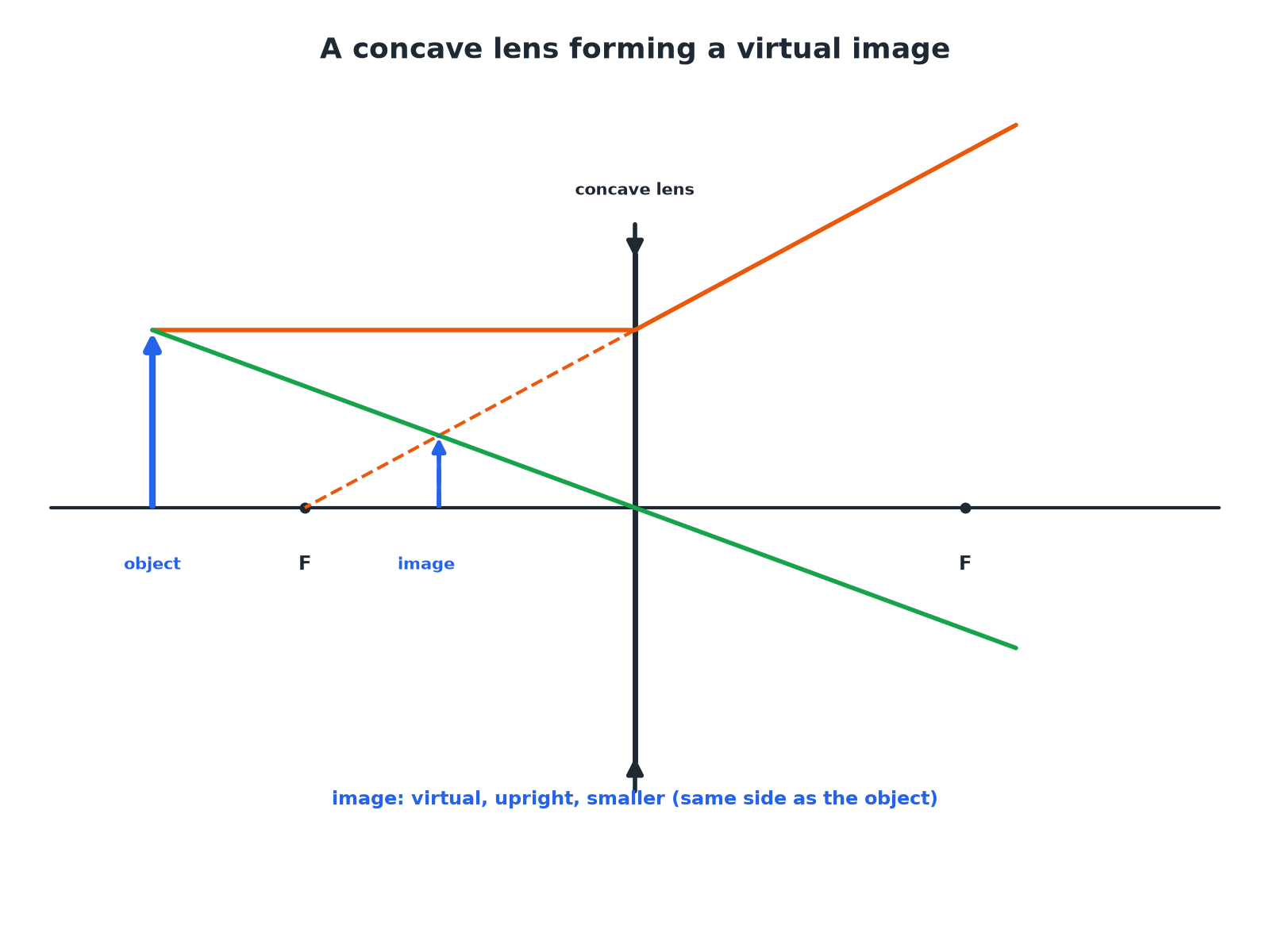
Rays spread out, so the image is virtual.
openrevise.com
AQA GCSE PHYSICS · PAPER 2 · FOUNDATION & HIGHER

Convex and Concave Lenses
Waves
Lesson 10 of 12
Compare them.
Feature
Convex (converging)
Concave (diverging)
Effect on parallel rays
Brings them together at the principal focus
Spreads them out
Image
Real or virtual
Always virtual
Symbol
Vertical line with outward arrowheads
Vertical line with inward arrowheads
Uses
Magnifying glass, camera, projector
Correcting short sight
openrevise.com
AQA GCSE PHYSICS · PAPER 2 · FOUNDATION & HIGHER

Magnification
Waves
Lesson 10 of 12
An object is 2.0 cm high. The image formed by a lens is 6.0 cm high. Calculate the magnification.
1
Write the equation
magnification = (image height)/(object height)
2
Substitute
6.0/2.0
3
Answer
3.0 (no units)
ANSWER
Magnification = 3.0
openrevise.com
AQA GCSE PHYSICS · PAPER 2 · FOUNDATION & HIGHER

Finding the Image Height
Waves
Lesson 10 of 12
A lens has a magnification of 5. The object is 4 mm high. Calculate the image height.
1
Rearrange
image height = magnification × object height
2
Substitute
5 × 4
3
Answer
20 mm
ANSWER
20 mm
openrevise.com
AQA GCSE PHYSICS · PAPER 2 · FOUNDATION & HIGHER

Real or Virtual?
Waves
Lesson 10 of 12
Explain the difference between a real image and a virtual image.
1
Real
Light rays actually meet at the image; it can be shown on a screen
2
Virtual
Rays only appear to come from the image; it cannot be shown on a screen
ANSWER
A real image can be projected onto a screen; a virtual image cannot.
openrevise.com
AQA GCSE PHYSICS · PAPER 2 · FOUNDATION & HIGHER

Drawing Tips
Waves
Lesson 10 of 12
Get full marks.
Use a ruler
Draw straight rays with arrowheads.
Two rays
One parallel to the axis (through F after a convex lens), one through the centre (undeviated).
Mark F
Mark the principal focus on both sides.
Virtual images
Draw the rays as dashed lines behind the lens.
openrevise.com
AQA GCSE PHYSICS · PAPER 2 · FOUNDATION & HIGHER

Key Terms
Waves
Lesson 10 of 12
Convex lens
A lens that brings parallel rays to a focus.
Concave lens
A lens that spreads parallel rays out.
Principal focus
The point where parallel rays meet after a convex lens.
Focal length
The distance from the lens to the principal focus.
Real image
An image formed where light rays actually meet.
Virtual image
An image formed where rays appear to come from.
openrevise.com
AQA GCSE PHYSICS · PAPER 2 · FOUNDATION & HIGHER
Waves
Lesson 10 of 12

YOUR TASK
Lens Sums
10 minutes
An object of height 3.0 cm gives an image of height 1.2 cm. Calculate the magnification. Is the image bigger or smaller than the object?
1
Use image ÷ object.
2
Compare with 1.
WHAT A GOOD ANSWER SHOWS
Magnification = 1.2 ÷ 3.0 = 0.40. The image is smaller (diminished).
openrevise.com
AQA GCSE PHYSICS · PAPER 2 · FOUNDATION & HIGHER

Can I...?
Waves
Lesson 10 of 12
Define convex and concave.
Define principal focus.
Define focal length.
Draw a convex lens ray diagram.
Draw a concave lens ray diagram.
Define real and virtual images.
Calculate magnification.
Give a use of each lens.
openrevise.com
AQA GCSE PHYSICS · PAPER 2 · FOUNDATION & HIGHER
Summary & Exam Focus
Convex: converging; concave: diverging.
Convex images can be real or virtual; concave always virtual.
Magnification = image height ÷ object height (no units).
Two rays to locate the image.
EXAM FOCUS
An object is 2.0 cm high. The image is 6.0 cm high. Calculate the magnification. (2 marks)
Image height divided by object height.
openrevise.com
AQA GCSE PHYSICS · PAPER 2 · FOUNDATION & HIGHER

Exam Practice: Lenses
Waves
Lesson 10 of 12
Answer all questions. Use the mark allocation as a guide to how much to write. · 15 minutes
Question 1 · 2 marks · Calculate
An object is 2.0 cm high. A lens produces an image that is 6.0 cm high. Calculate the magnification. Use the equation: magnification =…
Question 2 · 4 marks · Complete the diagram
The diagram shows an object in front of a convex lens. Two rays have been drawn. Complete the ray diagram to find the position of the image…
Question 3 · 2 marks · Explain
Explain the difference between a real image and a virtual image.
openrevise.com
AQA GCSE PHYSICS · PAPER 2 · FOUNDATION & HIGHER

Exam Practice: Lenses (cont.)
Waves
Lesson 10 of 12
Question 4 · 3 marks · Describe
State what happens to parallel rays of light when they pass through (a) a convex lens (b) a concave lens.
Question 5 · 3 marks · Calculate
A lens forms an image 20 mm high. The magnification is 5. Calculate the height of the object.
openrevise.com
AQA GCSE PHYSICS · PAPER 2 · FOUNDATION & HIGHER

Question 1 · 2 marks · Calculate
Waves
Lesson 10 of 12
“
An object is 2.0 cm high. A lens produces an image that is 6.0 cm high. Calculate the magnification. Use the equation: magnification = image height ÷ object height
HOW TO ANSWER IT
Command word: Calculate. Worth 2 marks, so plan before writing.
openrevise.com
AQA GCSE PHYSICS · PAPER 2 · FOUNDATION & HIGHER

Question 1 · mark scheme
Waves
Lesson 10 of 12
2 marks available. Award a mark for each point made.
Correct substitution
1 mark
3.0 (no units)
1 mark
openrevise.com
AQA GCSE PHYSICS · PAPER 2 · FOUNDATION & HIGHER

Question 2 · 4 marks · Complete the diagram
Waves
Lesson 10 of 12
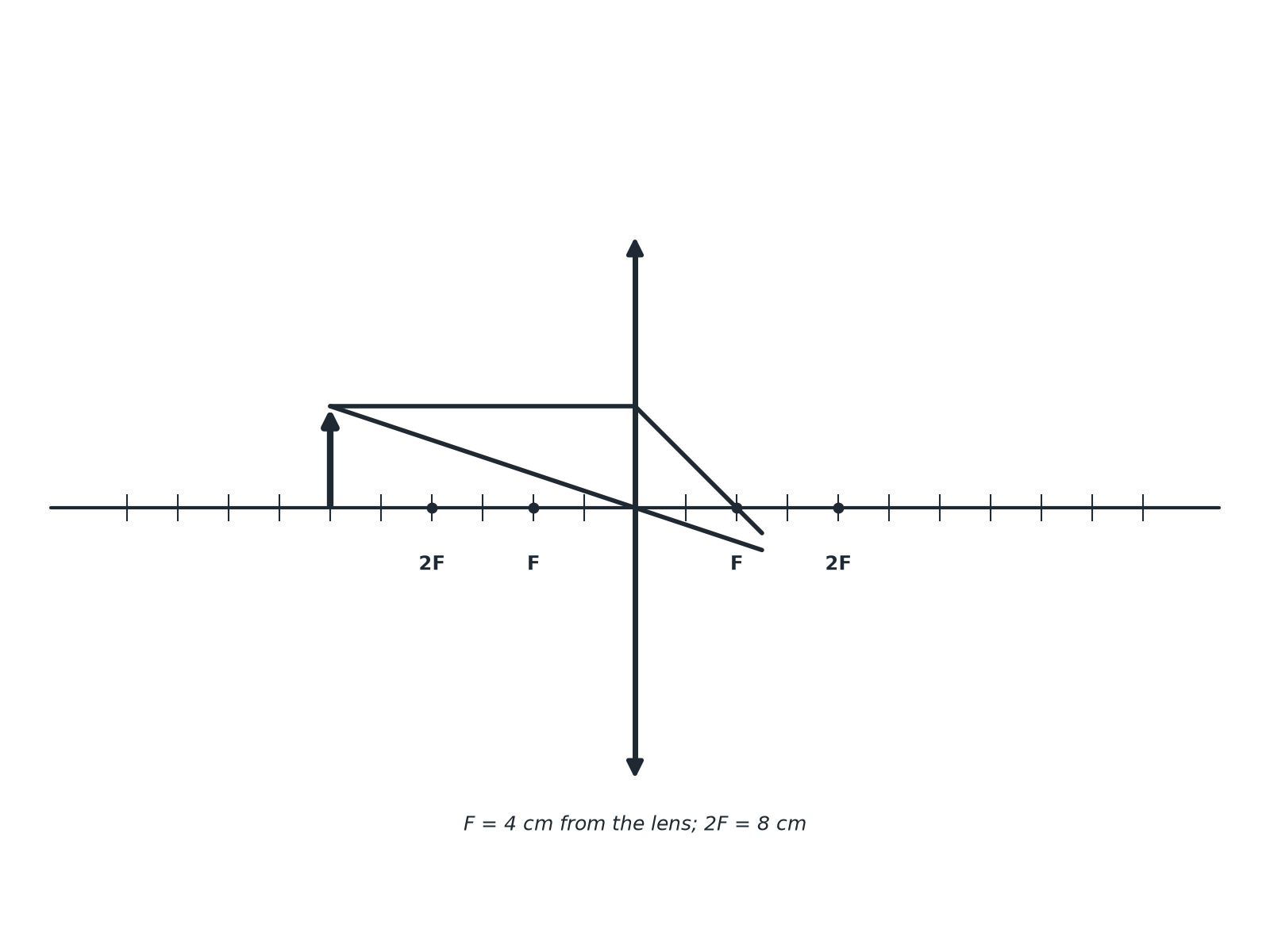
The diagram shows an object in front of a convex lens. Two rays have been drawn. Complete the ray diagram to find the position of the image and draw the image. Describe the image. (4 marks)
openrevise.com
AQA GCSE PHYSICS · PAPER 2 · FOUNDATION & HIGHER

Question 2 · mark scheme
Waves
Lesson 10 of 12
4 marks available. Award a mark for each point made.
Rays continue to cross
1 mark
Image drawn from the axis to the intersection
1 mark
Real and inverted
1 mark
Smaller than the object
1 mark
openrevise.com
AQA GCSE PHYSICS · PAPER 2 · FOUNDATION & HIGHER

Question 3 · 2 marks · Explain
Waves
Lesson 10 of 12
“
Explain the difference between a real image and a virtual image.
HOW TO ANSWER IT
Command word: Explain. Worth 2 marks, so plan before writing.
openrevise.com
AQA GCSE PHYSICS · PAPER 2 · FOUNDATION & HIGHER

Question 3 · mark scheme
Waves
Lesson 10 of 12
2 marks available. Award a mark for each point made.
Real: rays meet, on a screen
1 mark
Virtual: rays appear to come from, not on a screen
1 mark
openrevise.com
AQA GCSE PHYSICS · PAPER 2 · FOUNDATION & HIGHER

Question 4 · 3 marks · Describe
Waves
Lesson 10 of 12
“
State what happens to parallel rays of light when they pass through (a) a convex lens (b) a concave lens.
HOW TO ANSWER IT
Command word: Describe. Worth 3 marks, so plan before writing.
openrevise.com
AQA GCSE PHYSICS · PAPER 2 · FOUNDATION & HIGHER

Question 4 · mark scheme
Waves
Lesson 10 of 12
3 marks available. Award a mark for each point made.
Convex: converge at a point
1 mark
Concave: diverge
1 mark
Principal focus mentioned
1 mark
openrevise.com
AQA GCSE PHYSICS · PAPER 2 · FOUNDATION & HIGHER

Question 5 · 3 marks · Calculate
Waves
Lesson 10 of 12
“
A lens forms an image 20 mm high. The magnification is 5. Calculate the height of the object.
HOW TO ANSWER IT
Command word: Calculate. Worth 3 marks, so plan before writing.
openrevise.com
AQA GCSE PHYSICS · PAPER 2 · FOUNDATION & HIGHER

Question 5 · mark scheme
Waves
Lesson 10 of 12
3 marks available. Award a mark for each point made.
Rearranges the equation
1 mark
Correct substitution
1 mark
4.0 mm
1 mark
openrevise.com
← → to move, F to present full screen, G for every slide at once.