Slides · PPTX · 176 KB · 26 slides
The motor effect - Teacher Slides.pptx
The lesson slides with the teacher's notes on each slide, and every question and mark scheme built in. Built from the lesson script on 30 September 2026.
AQA GCSE PHYSICS · PAPER 2 · HIGHER TIER ONLY
The motor effect
Magnetism and electromagnetism
Lesson 3 of 8
openrevise.com
AQA GCSE PHYSICS · PAPER 2 · HIGHER TIER ONLY
Warm-up
Magnetism and electromagnetism
Lesson 3 of 8
Answer each one, then check.
1
What is a force?
2
What is the unit of force?
3
What is a magnetic field?
4
What is current?
5
What is a conductor?
openrevise.com
AQA GCSE PHYSICS · PAPER 2 · HIGHER TIER ONLY
Warm-up - Answers
Magnetism and electromagnetism
Lesson 3 of 8
1
What is a force?
A push or a pull
2
What is the unit of force?
Newton (N)
3
What is a magnetic field?
A region where a force acts on a magnet
4
What is current?
A flow of charge
5
What is a conductor?
A material that lets current flow
openrevise.com
AQA GCSE PHYSICS · PAPER 2 · HIGHER TIER ONLY
Learning Objectives
Magnetism and electromagnetism
Lesson 3 of 8
1
Explain why a current-carrying wire in a magnetic field experiences a force.
2
Use Fleming's left-hand rule to find the direction of the force.
3
Recall and use F = BIl.
4
State when the force is greatest and when it is zero.
5
Explain how the force can be reversed.
openrevise.com
AQA GCSE PHYSICS · PAPER 2 · HIGHER TIER ONLY
Magnetism and electromagnetism
Lesson 3 of 8
THE MOTOR EFFECT
force = magnetic flux density × current × length F = BIl
F in newtons (N), B in tesla (T), I in amperes (A) and l in metres (m). The conductor must be at right angles to the field. F = BIl is on the equation sheet.
openrevise.com
AQA GCSE PHYSICS · PAPER 2 · HIGHER TIER ONLY
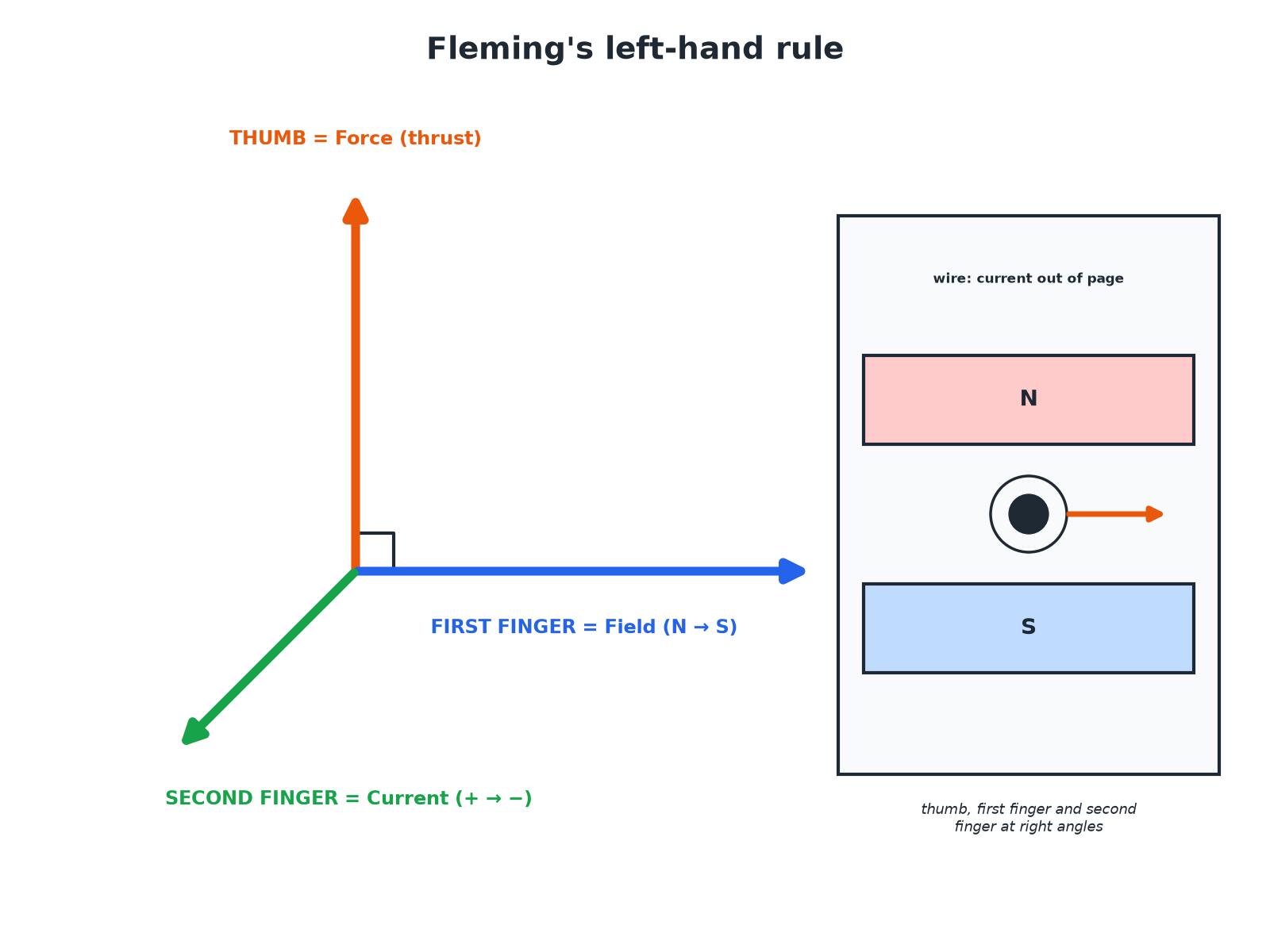
Fleming's Left-Hand Rule
Magnetism and electromagnetism
Lesson 3 of 8

Thumb: force. First finger: field. Second finger: current.
openrevise.com
AQA GCSE PHYSICS · PAPER 2 · HIGHER TIER ONLY
Calculating the Force
Magnetism and electromagnetism
Lesson 3 of 8
A wire of length 0.20 m carries a current of 3.0 A at right angles to a magnetic field of flux density 0.40 T. Calculate the force.
1
Write the equation
F = BIl
2
Substitute
F = 0.40 × 3.0 × 0.20
3
Answer
F = 0.24 N
ANSWER
0.24 N
openrevise.com
AQA GCSE PHYSICS · PAPER 2 · HIGHER TIER ONLY
Finding the Current
Magnetism and electromagnetism
Lesson 3 of 8
A force of 0.60 N acts on a 0.30 m wire in a field of 0.50 T. Calculate the current.
1
Rearrange
I = F ÷ (Bl)
2
Substitute
I = 0.60 ÷ (0.50 × 0.30)
3
Answer
I = 4.0 A
ANSWER
4.0 A
openrevise.com
AQA GCSE PHYSICS · PAPER 2 · HIGHER TIER ONLY
Reversing and Changing the Force
Magnetism and electromagnetism
Lesson 3 of 8
Learn what happens.
Change
Effect on the force
Reverse the current
Force reverses
Reverse the magnetic field
Force reverses
Increase the current
Force increases
Stronger magnets (larger B)
Force increases
Wire parallel to the field
No force
openrevise.com
AQA GCSE PHYSICS · PAPER 2 · HIGHER TIER ONLY
Why Does It Happen?
Magnetism and electromagnetism
Lesson 3 of 8
Two magnetic fields.
Two fields
The magnet's field and the field round the wire interact.
Result
The two fields push on each other and the wire feels a force.
Right angles
The force is greatest when the wire is at 90° to the field.
Parallel
No force when the wire is parallel to the field.
openrevise.com
AQA GCSE PHYSICS · PAPER 2 · HIGHER TIER ONLY
Key Terms
Magnetism and electromagnetism
Lesson 3 of 8
Motor effect
The force on a current-carrying conductor in a magnetic field.
Magnetic flux density
A measure of the strength of a magnetic field, in tesla (T).
Tesla
The unit of magnetic flux density.
Fleming's left-hand rule
A rule for finding the direction of the force on a current-carrying wire in a magnetic field.
Conductor
A material that allows a current to flow.
Thumb
Gives the direction of the force in Fleming's left-hand rule.
openrevise.com
AQA GCSE PHYSICS · PAPER 2 · HIGHER TIER ONLY
Magnetism and electromagnetism
Lesson 3 of 8
YOUR TASK
Hand Rule
10 minutes
A current flows left to right through a wire between a north pole (above) and a south pole (below). Use Fleming's left-hand rule. Which way is the force? Then calculate F for B = 0.30 T, I = 5.0 A, l = 0.10 m.
1
Thumb = force.
2
First finger = field.
3
Second finger = current.
WHAT A GOOD ANSWER SHOWS
The field points downwards (north to south), the current points to the right, so the force is into the page. F = 0.30 × 5.0 × 0.10 = 0.15 N.
openrevise.com
AQA GCSE PHYSICS · PAPER 2 · HIGHER TIER ONLY
Can I...?
Magnetism and electromagnetism
Lesson 3 of 8
State the motor effect.
Use the left-hand rule.
Write F = BIl.
Give units.
Use right angles.
Reverse the force.
Change the force.
Calculate F, I, B or l.
openrevise.com
AQA GCSE PHYSICS · PAPER 2 · HIGHER TIER ONLY
Summary & Exam Focus
F = BIl (tesla, amperes, metres).
Left-hand rule: thumb force, first finger field, second finger current.
Reversing current or field reverses the force.
No force if parallel to the field.
EXAM FOCUS
A 0.20 m wire carries 3.0 A at right angles to a 0.40 T field. Calculate the force. (2 marks)
F = BIl.
openrevise.com
AQA GCSE PHYSICS · PAPER 2 · HIGHER TIER ONLY
Exam Practice: The motor effect
Magnetism and electromagnetism
Lesson 3 of 8
Answer all questions. Use the mark allocation as a guide to how much to write. · 14 minutes
Question 1 · 2 marks · Calculate
A wire of length 0.20 m carries a current of 3.0 A at right angles to a magnetic field of flux density 0.40 T. Calculate the force on the…
Question 2 · 2 marks · State
State two ways of reversing the direction of the force on a current-carrying wire in a magnetic field.
Question 3 · 3 marks · Calculate
A force of 0.60 N acts on a wire of length 0.30 m in a magnetic field of 0.50 T. The wire is at right angles to the field. Calculate the…
openrevise.com
AQA GCSE PHYSICS · PAPER 2 · HIGHER TIER ONLY
Exam Practice: The motor effect (cont.)
Magnetism and electromagnetism
Lesson 3 of 8
Question 4 · 3 marks · Explain
Explain why a wire carrying a current experiences a force when it is placed between the poles of a magnet.
Question 5 · 3 marks · Explain
Explain what happens to the force on the wire in a magnetic field when the wire is turned so that it is parallel to the field lines. Give a…
openrevise.com
AQA GCSE PHYSICS · PAPER 2 · HIGHER TIER ONLY
Question 1 · 2 marks · Calculate
Magnetism and electromagnetism
Lesson 3 of 8
“
A wire of length 0.20 m carries a current of 3.0 A at right angles to a magnetic field of flux density 0.40 T. Calculate the force on the wire. Use the equation: force = magnetic flux density × current × length
HOW TO ANSWER IT
Command word: Calculate. Worth 2 marks, so plan before writing.
openrevise.com
AQA GCSE PHYSICS · PAPER 2 · HIGHER TIER ONLY
Question 1 · mark scheme
Magnetism and electromagnetism
Lesson 3 of 8
2 marks available. Award a mark for each point made.
Correct substitution
1 mark
0.24 N
1 mark
openrevise.com
AQA GCSE PHYSICS · PAPER 2 · HIGHER TIER ONLY
Question 2 · 2 marks · State
Magnetism and electromagnetism
Lesson 3 of 8
“
State two ways of reversing the direction of the force on a current-carrying wire in a magnetic field.
HOW TO ANSWER IT
Command word: State. Worth 2 marks, so plan before writing.
openrevise.com
AQA GCSE PHYSICS · PAPER 2 · HIGHER TIER ONLY
Question 2 · mark scheme
Magnetism and electromagnetism
Lesson 3 of 8
2 marks available. Award a mark for each point made.
Reverse the current
1 mark
Reverse the field
1 mark
openrevise.com
AQA GCSE PHYSICS · PAPER 2 · HIGHER TIER ONLY
Question 3 · 3 marks · Calculate
Magnetism and electromagnetism
Lesson 3 of 8
“
A force of 0.60 N acts on a wire of length 0.30 m in a magnetic field of 0.50 T. The wire is at right angles to the field. Calculate the current in the wire.
HOW TO ANSWER IT
Command word: Calculate. Worth 3 marks, so plan before writing.
openrevise.com
AQA GCSE PHYSICS · PAPER 2 · HIGHER TIER ONLY
Question 3 · mark scheme
Magnetism and electromagnetism
Lesson 3 of 8
3 marks available. Award a mark for each point made.
Rearranges to I = F ÷ (B l)
1 mark
Substitution
1 mark
4.0 A
1 mark
openrevise.com
AQA GCSE PHYSICS · PAPER 2 · HIGHER TIER ONLY
Question 4 · 3 marks · Explain
Magnetism and electromagnetism
Lesson 3 of 8
“
Explain why a wire carrying a current experiences a force when it is placed between the poles of a magnet.
HOW TO ANSWER IT
Command word: Explain. Worth 3 marks, so plan before writing.
openrevise.com
AQA GCSE PHYSICS · PAPER 2 · HIGHER TIER ONLY
Question 4 · mark scheme
Magnetism and electromagnetism
Lesson 3 of 8
3 marks available. Award a mark for each point made.
Current produces a magnetic field
1 mark
Interacts with the magnet's field
1 mark
Resulting force on the wire
1 mark
openrevise.com
AQA GCSE PHYSICS · PAPER 2 · HIGHER TIER ONLY
Question 5 · 3 marks · Explain
Magnetism and electromagnetism
Lesson 3 of 8
“
Explain what happens to the force on the wire in a magnetic field when the wire is turned so that it is parallel to the field lines. Give a reason.
HOW TO ANSWER IT
Command word: Explain. Worth 3 marks, so plan before writing.
openrevise.com
AQA GCSE PHYSICS · PAPER 2 · HIGHER TIER ONLY
Question 5 · mark scheme
Magnetism and electromagnetism
Lesson 3 of 8
3 marks available. Award a mark for each point made.
Force decreases to zero
1 mark
Force is greatest at right angles
1 mark
Fields no longer interact / no component at right angles
1 mark
openrevise.com
← → to move, F to present full screen, G for every slide at once.