Slides · PPTX · 204 KB · 26 slides
Alternators dynamos and microphones - Teacher Slides.pptx
The lesson slides with the teacher's notes on each slide, and every question and mark scheme built in. Built from the lesson script on 30 September 2026.
AQA GCSE PHYSICS · PAPER 2 · FOUNDATION & HIGHER
Alternators, dynamos and microphones
Magnetism and electromagnetism
Lesson 7 of 8
openrevise.com
AQA GCSE PHYSICS · PAPER 2 · FOUNDATION & HIGHER
Warm-up
Magnetism and electromagnetism
Lesson 7 of 8
Answer each one, then check.
1
What is a.c.?
2
What is d.c.?
3
What is the generator effect?
4
What is the UK mains frequency?
5
What is a slip ring?
openrevise.com
AQA GCSE PHYSICS · PAPER 2 · FOUNDATION & HIGHER
Warm-up - Answers
Magnetism and electromagnetism
Lesson 7 of 8
1
What is a.c.?
Alternating current
2
What is d.c.?
Direct current
3
What is the generator effect?
p.d. induced by a changing magnetic field
4
What is the UK mains frequency?
50 Hz
5
What is a slip ring?
A continuous ring that keeps contact with a brush
openrevise.com
AQA GCSE PHYSICS · PAPER 2 · FOUNDATION & HIGHER
Learning Objectives
Magnetism and electromagnetism
Lesson 7 of 8
1
Describe how an alternator generates an alternating current.
2
Describe how a dynamo generates direct current.
3
Interpret potential difference–time graphs from a.c. and d.c. generators.
4
Describe how a microphone converts sound to an electrical signal (Higher).
openrevise.com
AQA GCSE PHYSICS · PAPER 2 · FOUNDATION & HIGHER
Magnetism and electromagnetism
Lesson 7 of 8
GENERATORS
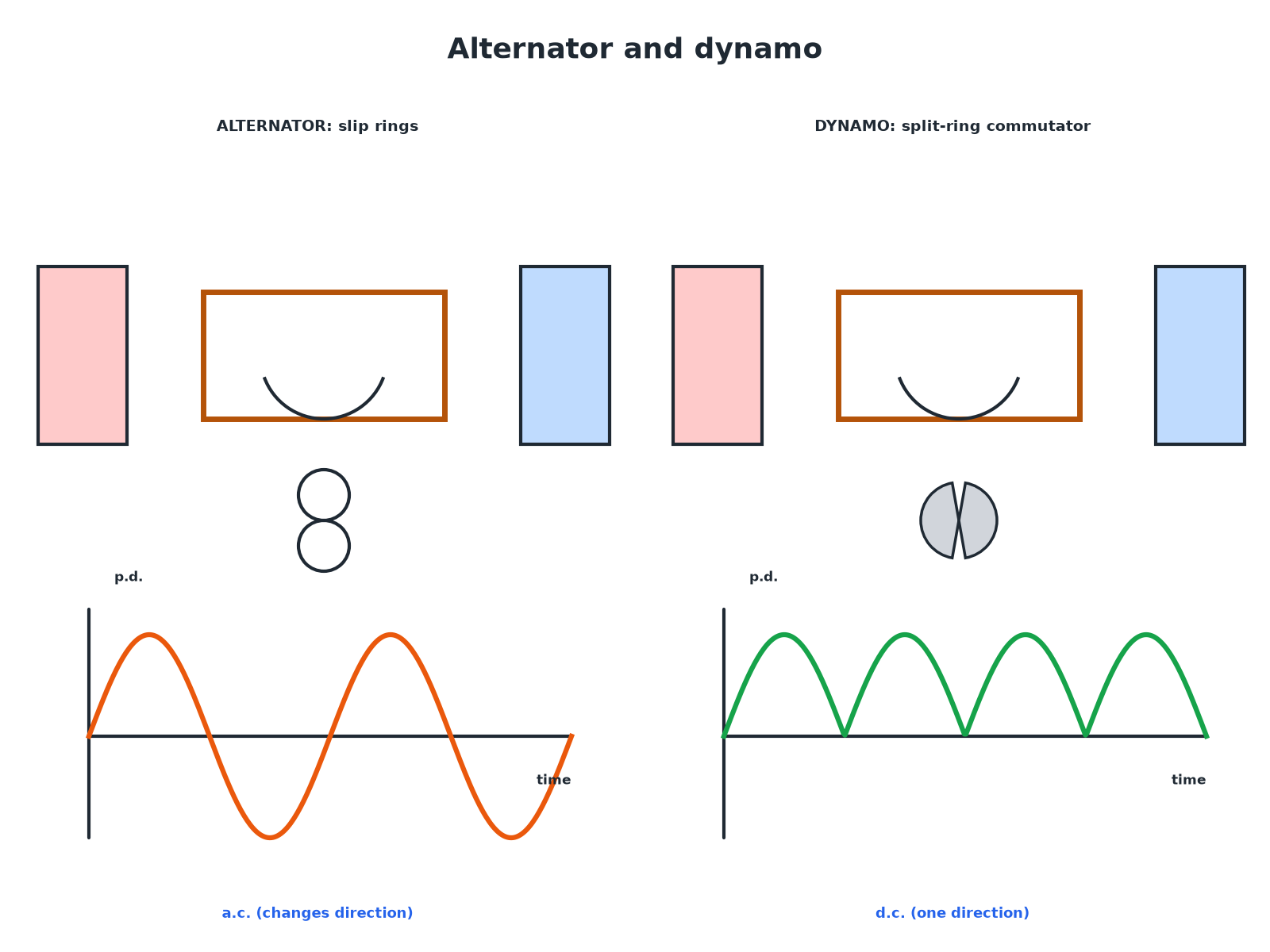
An alternator rotates a coil in a magnetic field using slip rings and brushes to produce an alternating potential difference. A dynamo uses a split-ring commutator so the output is direct current (p.d. in one direction).
The output increases with faster rotation, more turns or a stronger field. Faster rotation also increases the frequency.
openrevise.com
AQA GCSE PHYSICS · PAPER 2 · FOUNDATION & HIGHER
Alternator and Dynamo Graphs
Magnetism and electromagnetism
Lesson 7 of 8

Slip rings give a.c.; a commutator gives d.c.
openrevise.com
AQA GCSE PHYSICS · PAPER 2 · FOUNDATION & HIGHER
Alternator or Dynamo?
Magnetism and electromagnetism
Lesson 7 of 8
ALTERNATOR
• Coil rotates in a magnetic field.
• Slip rings and brushes.
• Output: alternating p.d., changing direction each half turn.
DYNAMO
• Coil rotates in a magnetic field.
• Split-ring commutator and brushes.
• Output: direct p.d., always in one direction.
openrevise.com
AQA GCSE PHYSICS · PAPER 2 · FOUNDATION & HIGHER
Changing the Output
Magnetism and electromagnetism
Lesson 7 of 8
Learn what changes the graph.
Change
Effect on the graph
Faster rotation
Larger amplitude and higher frequency
Stronger magnet
Larger amplitude
More turns
Larger amplitude
Slower rotation
Smaller amplitude and lower frequency
openrevise.com
AQA GCSE PHYSICS · PAPER 2 · FOUNDATION & HIGHER
Reading an a.c. Graph
Magnetism and electromagnetism
Lesson 7 of 8
The graph shows a sine wave with period 0.020 s. Find the frequency.
1
Equation
f = 1 ÷ T
2
Substitute
f = 1 ÷ 0.020
3
Answer
f = 50 Hz
ANSWER
50 Hz
openrevise.com
AQA GCSE PHYSICS · PAPER 2 · FOUNDATION & HIGHER
How a Microphone Works (Higher)
Magnetism and electromagnetism
Lesson 7 of 8
Explain how a moving-coil microphone changes sound into an electrical signal.
1
Sound waves
Make a diaphragm vibrate
2
Coil
Attached to the diaphragm, moves in the field of a magnet
3
Generator effect
Induces an a.c. p.d. in the coil with the same frequency as the sound
ANSWER
Sound vibrates the diaphragm, the coil moves in a magnetic field, and a p.d. is induced.
openrevise.com
AQA GCSE PHYSICS · PAPER 2 · FOUNDATION & HIGHER
Key Terms
Magnetism and electromagnetism
Lesson 7 of 8
Alternator
A generator that produces alternating current.
Dynamo
A generator that produces direct current.
Slip rings
Rings that keep the coil connected to the brushes without reversing the output.
Commutator
A split ring that reverses the connections each half turn.
Microphone
A device that converts sound into an electrical signal.
Brush
A carbon contact that touches a ring.
openrevise.com
AQA GCSE PHYSICS · PAPER 2 · FOUNDATION & HIGHER
Magnetism and electromagnetism
Lesson 7 of 8
YOUR TASK
Generator Graphs
12 minutes
Sketch the p.d.–time graph for an alternator. Then sketch it when the coil spins twice as fast.
1
Count the number of cycles.
WHAT A GOOD ANSWER SHOWS
Sine wave; twice as fast gives twice the amplitude and twice the frequency.
openrevise.com
AQA GCSE PHYSICS · PAPER 2 · FOUNDATION & HIGHER
Can I...?
Magnetism and electromagnetism
Lesson 7 of 8
Describe an alternator.
Describe a dynamo.
Name slip rings.
Name the commutator.
Sketch a.c. and d.c. graphs.
Change the output.
Describe a microphone.
Calculate frequency.
openrevise.com
AQA GCSE PHYSICS · PAPER 2 · FOUNDATION & HIGHER
Summary & Exam Focus
Alternator: slip rings, a.c.
Dynamo: split ring, d.c.
Faster rotation increases the p.d. and the frequency.
Microphone: sound makes a coil move in a field, inducing an a.c.
EXAM FOCUS
Explain the difference between the output of an alternator and a dynamo. (2 marks)
Alternator a.c., dynamo d.c.
openrevise.com
AQA GCSE PHYSICS · PAPER 2 · FOUNDATION & HIGHER
Exam Practice: Alternators, dynamos and microphones
Magnetism and electromagnetism
Lesson 7 of 8
Answer all questions. Use the mark allocation as a guide to how much to write. · 15 minutes
Question 1 · 2 marks · State
State the type of current produced by (a) an alternator and (b) a dynamo.
Question 2 · 3 marks · Explain
An alternator rotates at a constant speed. Describe how the output potential difference changes with time.
Question 3 · 3 marks · Explain
The speed of rotation of the coil in an alternator is doubled. Describe two changes to the potential difference–time graph.
openrevise.com
AQA GCSE PHYSICS · PAPER 2 · FOUNDATION & HIGHER
Exam Practice: Alternators, dynamos and microphones (cont.)
Magnetism and electromagnetism
Lesson 7 of 8
Question 4 · 2 marks · Calculate
A potential difference–time graph of an alternator shows one complete wave lasts 0.020 s. Calculate the frequency.
Question 5 · 4 marks · Explain
Explain how a moving-coil microphone converts sound waves into an electrical signal.
openrevise.com
AQA GCSE PHYSICS · PAPER 2 · FOUNDATION & HIGHER
Question 1 · 2 marks · State
Magnetism and electromagnetism
Lesson 7 of 8
“
State the type of current produced by (a) an alternator and (b) a dynamo.
HOW TO ANSWER IT
Command word: State. Worth 2 marks, so plan before writing.
openrevise.com
AQA GCSE PHYSICS · PAPER 2 · FOUNDATION & HIGHER
Question 1 · mark scheme
Magnetism and electromagnetism
Lesson 7 of 8
2 marks available. Award a mark for each point made.
Alternator a.c.
1 mark
Dynamo d.c.
1 mark
openrevise.com
AQA GCSE PHYSICS · PAPER 2 · FOUNDATION & HIGHER
Question 2 · 3 marks · Explain
Magnetism and electromagnetism
Lesson 7 of 8
“
An alternator rotates at a constant speed. Describe how the output potential difference changes with time.
HOW TO ANSWER IT
Command word: Explain. Worth 3 marks, so plan before writing.
openrevise.com
AQA GCSE PHYSICS · PAPER 2 · FOUNDATION & HIGHER
Question 2 · mark scheme
Magnetism and electromagnetism
Lesson 7 of 8
3 marks available. Award a mark for each point made.
Alternating or repeating pattern
1 mark
Positive and negative
1 mark
Reverses every half turn
1 mark
openrevise.com
AQA GCSE PHYSICS · PAPER 2 · FOUNDATION & HIGHER
Question 3 · 3 marks · Explain
Magnetism and electromagnetism
Lesson 7 of 8
“
The speed of rotation of the coil in an alternator is doubled. Describe two changes to the potential difference–time graph.
HOW TO ANSWER IT
Command word: Explain. Worth 3 marks, so plan before writing.
openrevise.com
AQA GCSE PHYSICS · PAPER 2 · FOUNDATION & HIGHER
Question 3 · mark scheme
Magnetism and electromagnetism
Lesson 7 of 8
3 marks available. Award a mark for each point made.
Larger amplitude
1 mark
Higher frequency
1 mark
Shorter period / more waves in same time
1 mark
openrevise.com
AQA GCSE PHYSICS · PAPER 2 · FOUNDATION & HIGHER
Question 4 · 2 marks · Calculate
Magnetism and electromagnetism
Lesson 7 of 8
“
A potential difference–time graph of an alternator shows one complete wave lasts 0.020 s. Calculate the frequency.
HOW TO ANSWER IT
Command word: Calculate. Worth 2 marks, so plan before writing.
openrevise.com
AQA GCSE PHYSICS · PAPER 2 · FOUNDATION & HIGHER
Question 4 · mark scheme
Magnetism and electromagnetism
Lesson 7 of 8
2 marks available. Award a mark for each point made.
Substitution
1 mark
50 Hz
1 mark
openrevise.com
AQA GCSE PHYSICS · PAPER 2 · FOUNDATION & HIGHER
Question 5 · 4 marks · Explain
Magnetism and electromagnetism
Lesson 7 of 8
“
Explain how a moving-coil microphone converts sound waves into an electrical signal.
HOW TO ANSWER IT
Command word: Explain. Worth 4 marks, so plan before writing.
openrevise.com
AQA GCSE PHYSICS · PAPER 2 · FOUNDATION & HIGHER
Question 5 · mark scheme
Magnetism and electromagnetism
Lesson 7 of 8
4 marks available. Award a mark for each point made.
Sound makes the diaphragm vibrate
1 mark
Coil moves in a magnetic field
1 mark
Generator effect / induced p.d.
1 mark
a.c. with the same frequency as the sound
1 mark
openrevise.com
← → to move, F to present full screen, G for every slide at once.