Flashcards · Biology
DNA and the Genome
-
Where is DNA found in an animal cell?
In the nucleus, contained in chromosomes.
-
What shape is a DNA molecule?
A double helix: two strands coiled around each other.
-
Is DNA a polymer?
Yes. It is a long molecule made of repeating units.
-
How many chromosomes are in a human body cell?
46, in 23 pairs.
-
What is a chromosome?
A structure in the nucleus made from one very long molecule of DNA.
-
What is a gene?
A small section of DNA on a chromosome.
-
What does a gene code for?
A particular sequence of amino acids, to make a specific protein.
-
What are proteins made from?
Amino acids joined in a chain.
-
What is the genome of an organism?
All of its genetic material.
-
Has the whole human genome been studied?
Yes, it has now been studied.
-
Name three reasons why the human genome is important.
Finding genes linked to disease, understanding and treating inherited disorders, and tracing human migration.
-
What was the Human Genome Project?
An international project, 1990 to 2003, that worked out the whole human genome.
-
Which is bigger, a gene or a chromosome?
A chromosome. It carries many genes.
-
Which is bigger, a gene or the genome?
The genome, which contains all of an organism's genes.
-
What do identical twins share that other siblings do not?
The same genome.
-
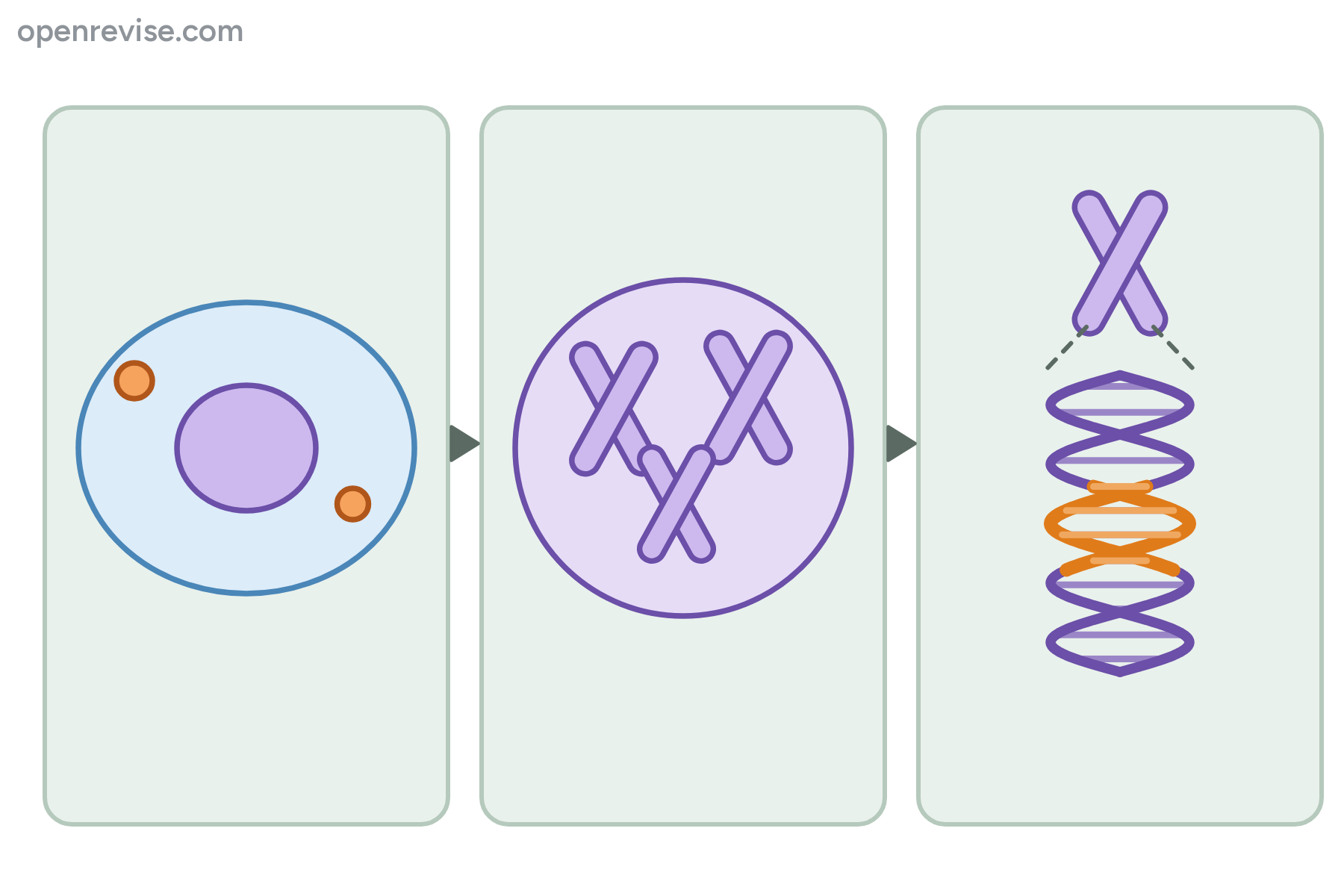 Name each level of the diagram, from the cell down to the gene.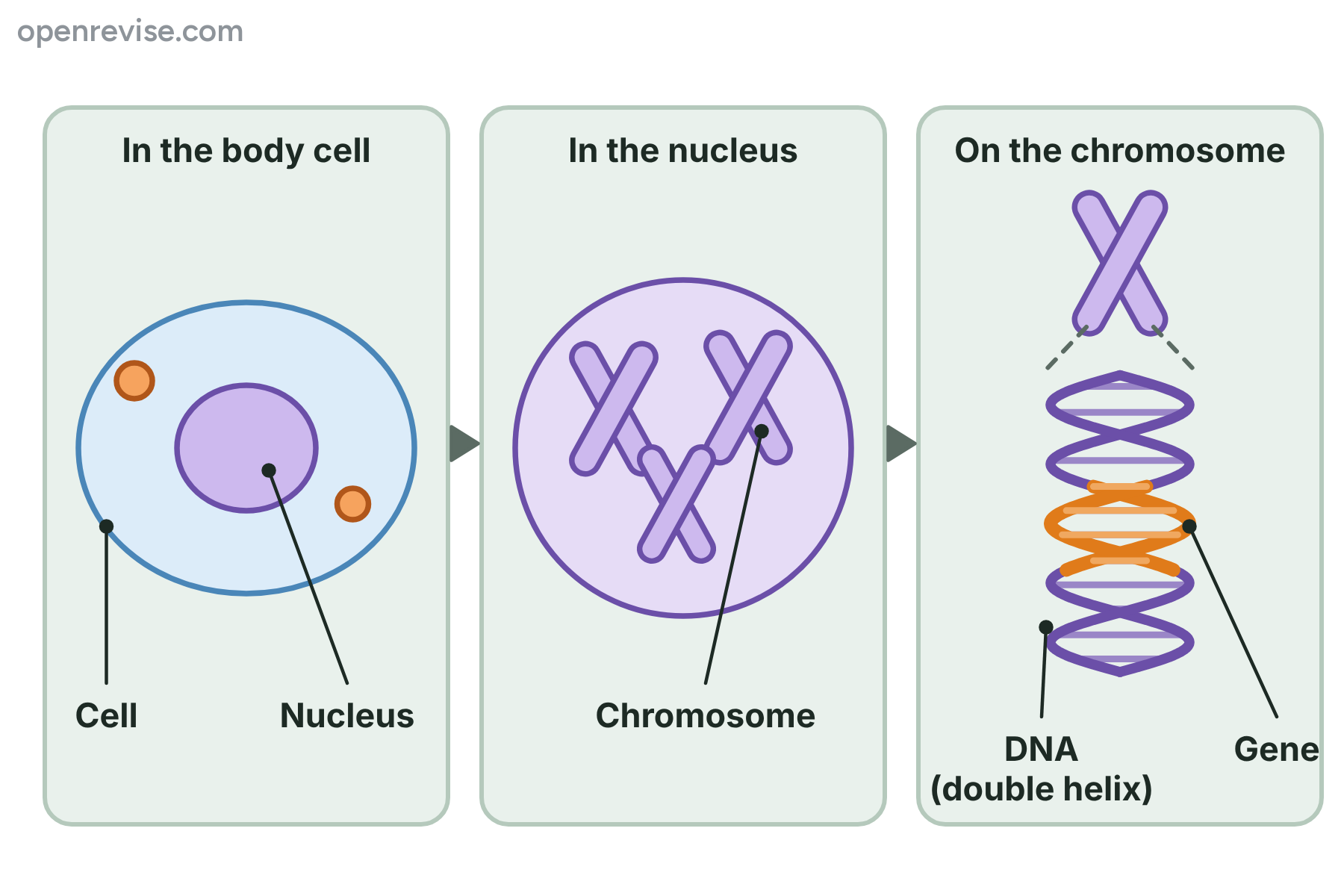
The cell contains a nucleus. The nucleus contains chromosomes. A chromosome is made of DNA, a double helix. A gene is a small section of the DNA.
-
What type of molecule is DNA?
A polymer made from nucleotides.
-
How many different nucleotides are in DNA?
Four.
-
What are the three parts of a nucleotide?
A sugar, a phosphate group and a base.
-
What are the four bases in DNA?
A, C, G and T.
-
What makes the four nucleotides different from each other?
The base attached to the sugar.
-
What forms the backbone of a DNA strand?
Alternating sugar and phosphate sections.
-
Where is the base attached?
To the sugar.
-
How many bases code for one amino acid?
Three.
-
What does the order of bases in a gene control?
The order in which amino acids are assembled to make a protein.
-
A gene has 600 bases. About how many amino acids does it code for?
200, because 600 divided by 3 is 200.
-
Is knowing the DNA structure diagram from memory needed for the exam?
No. You must be able to interpret a diagram of DNA, not reproduce it.
-
Which base is linked to C on the opposite strand? (Higher tier)
G.
-
Which base is linked to T on the opposite strand? (Higher tier)
A.
-
What is the complementary strand of A T C G? (Higher tier)
T A G C.
-
What is a nucleotide repeated many times called?
A DNA polymer.
-
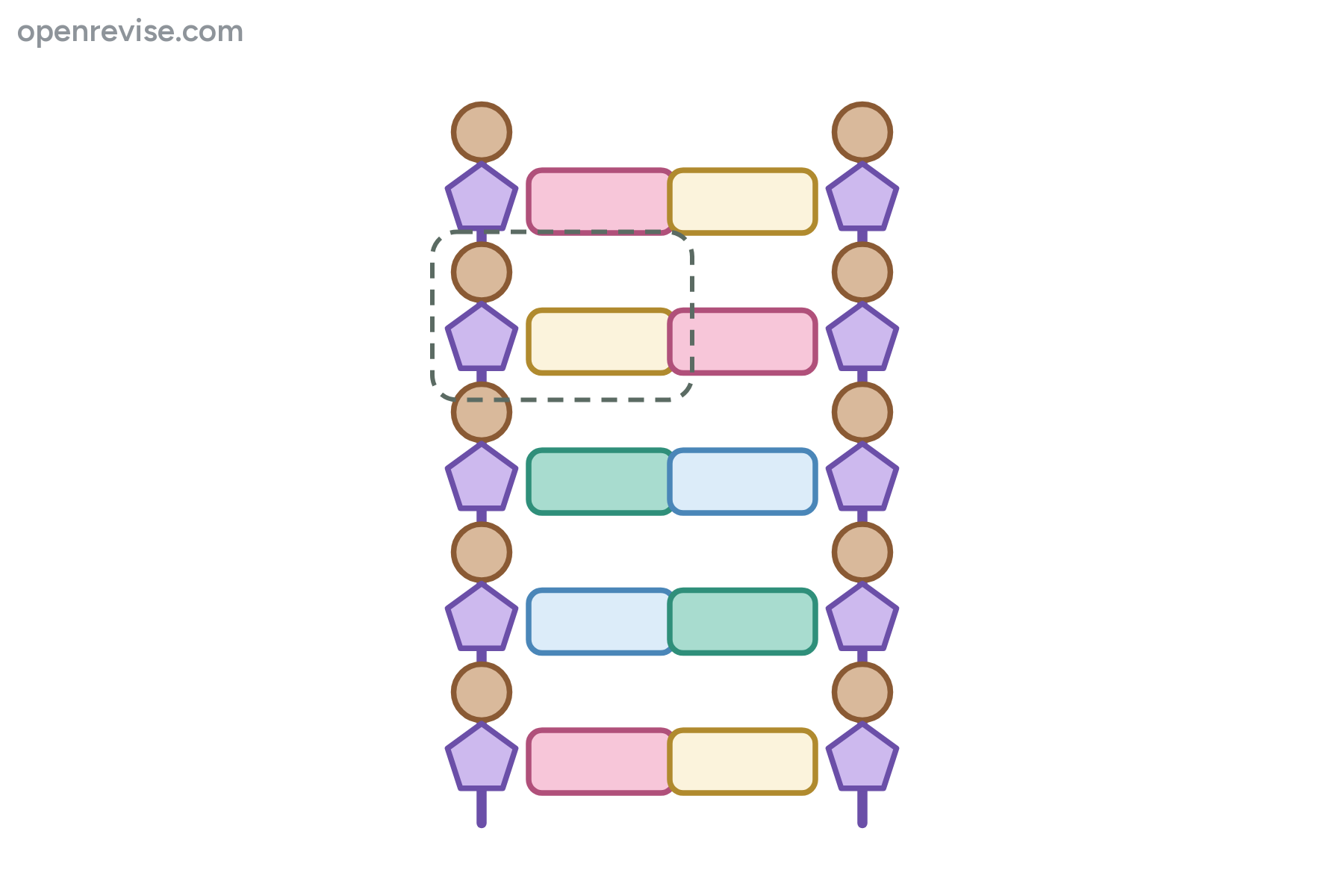 Name the parts of a nucleotide and the part that makes the code.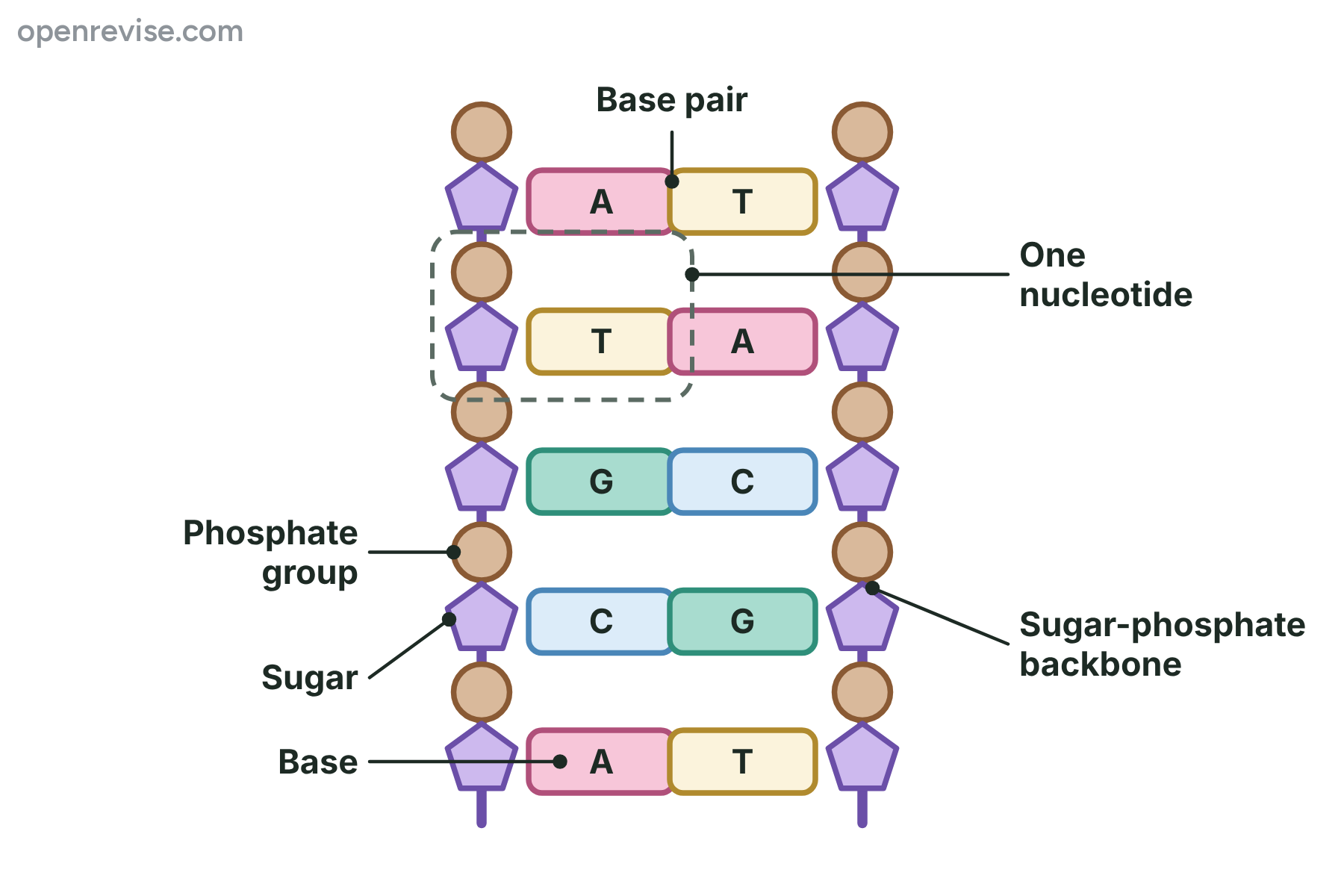
A nucleotide is a sugar, a phosphate group and a base. The base carries the code, and the order of the bases is the genetic code.
-
Where are proteins made in a cell? (Higher tier)
On ribosomes.
-
What does the template do in protein synthesis? (Higher tier)
It carries a copy of the gene's instructions to the ribosome.
-
What do carrier molecules do? (Higher tier)
They bring specific amino acids to the ribosome, in the correct order.
-
What happens when the protein chain is complete? (Higher tier)
It folds up to form a unique shape.
-
Why must a protein have the right shape? (Higher tier)
The shape lets it do its job, as an enzyme, a hormone or a structural protein.
-
What decides the order of the amino acids in a protein? (Higher tier)
The order of the bases in the gene.
-
How many bases specify one amino acid? (Higher tier)
Three.
-
What is collagen? (Higher tier)
A structural protein that makes strong fibres in tissues such as skin and tendons.
-
Where is DNA kept in the cell? (Higher tier)
In the nucleus.
-
Do you need to know the detailed structure of mRNA for the exam? (Higher tier)
No. You need only a simple description of protein synthesis.
-
What can happen to a protein if the DNA structure changes? (Higher tier)
The order of the amino acids may change, so a different protein may be made.
-
What kind of protein catalyses reactions? (Higher tier)
An enzyme.
-
Why does a mutation sometimes make a protein stop working? (Higher tier)
The changed amino acid order can change the shape, so it no longer does its job.
-
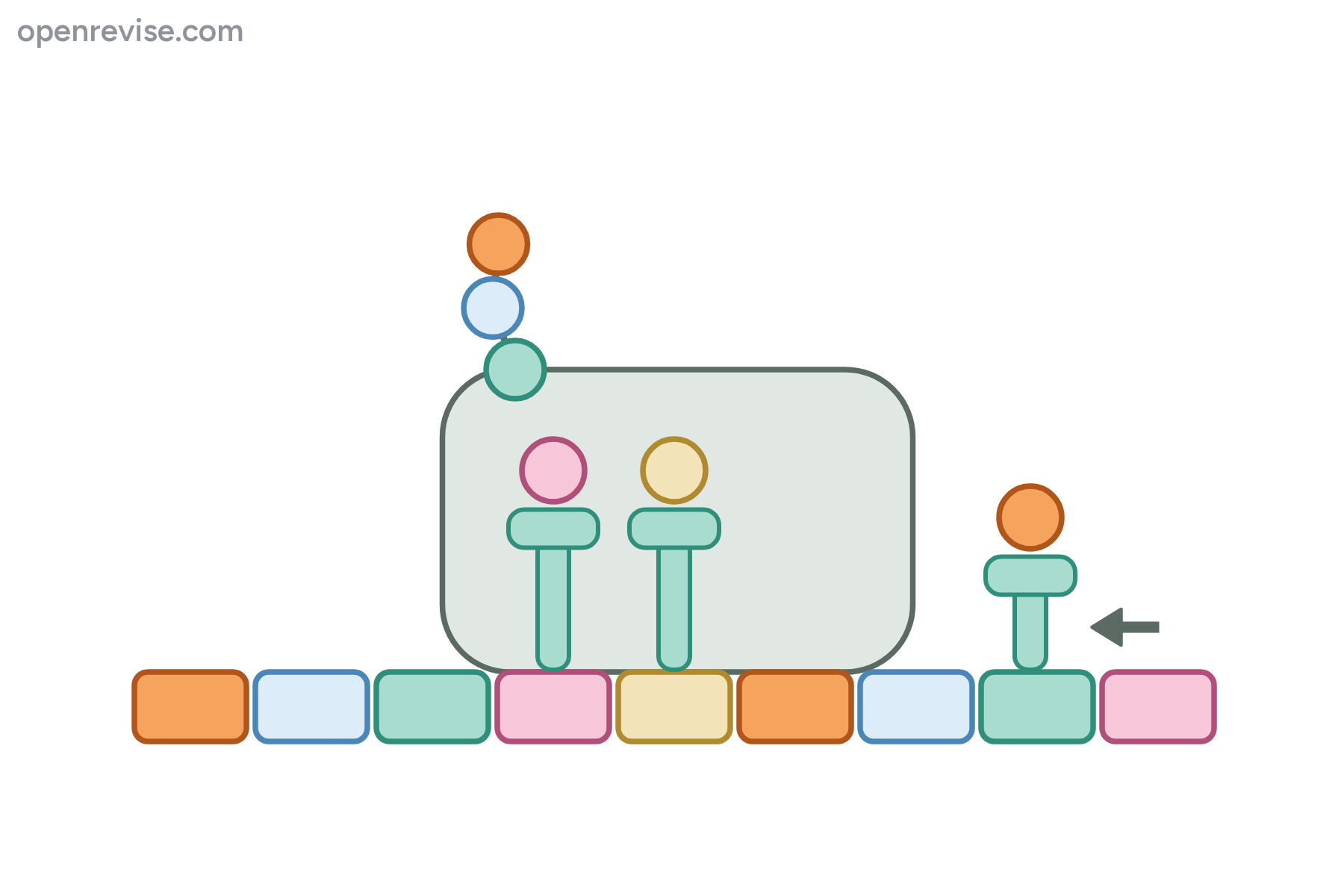 Describe what is happening in this diagram, from the template to the finished chain. (Higher tier)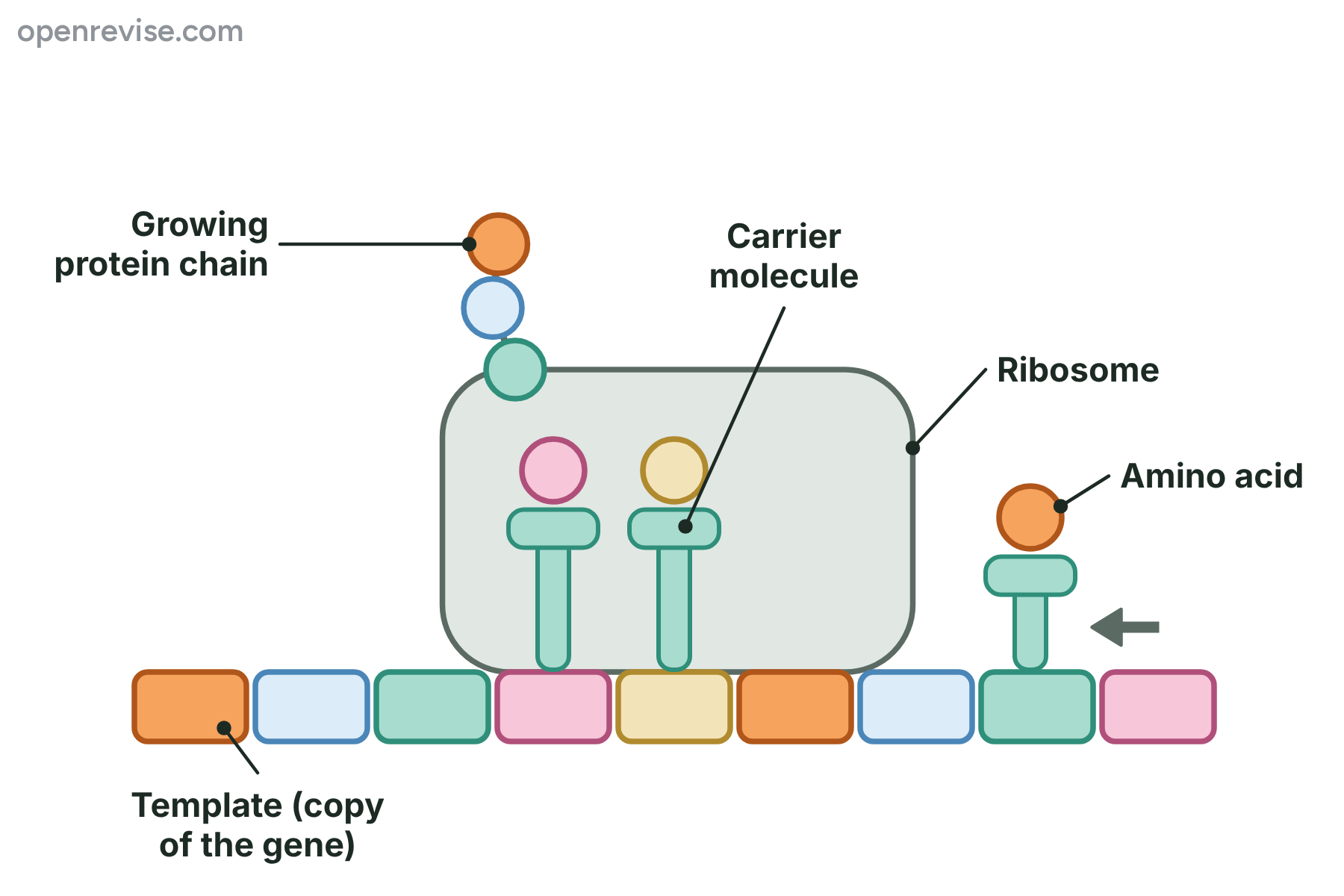
The ribosome reads the template. Carrier molecules bring specific amino acids in the correct order. The amino acids are joined into a growing protein chain, which folds into a unique shape when complete.
-
What is a mutation? (Higher tier)
A change in the base sequence of DNA.
-
How often do mutations occur? (Higher tier)
Continuously.
-
What do most mutations do to the protein? (Higher tier)
Nothing, or they change it only slightly, so its function is not changed.
-
What can a few mutations do to a protein? (Higher tier)
Code for an altered protein with a different shape.
-
What can happen to an enzyme with an altered shape? (Higher tier)
The substrate may no longer fit its active site.
-
What can happen to a structural protein with an altered shape? (Higher tier)
It may lose its strength.
-
What is a substitution? (Higher tier)
One base is replaced by a different base.
-
Why does a deletion usually have a bigger effect than a substitution? (Higher tier)
It shifts the grouping of every triplet after it, so many amino acids can change.
-
Do all parts of DNA code for proteins? (Higher tier)
No.
-
What can non-coding DNA do? (Higher tier)
Switch genes on and off.
-
How can a variant in non-coding DNA affect an organism? (Higher tier)
It can alter how genes are expressed.
-
How can a variant in coding DNA affect an organism? (Higher tier)
It can alter the activity of a protein.
-
What can cause mutations? (Higher tier)
Chance errors when DNA is copied, ionising radiation and some chemicals.
-
Can a mutation ever be beneficial? (Higher tier)
Yes, very rarely, if the new phenotype suits the environment.
-
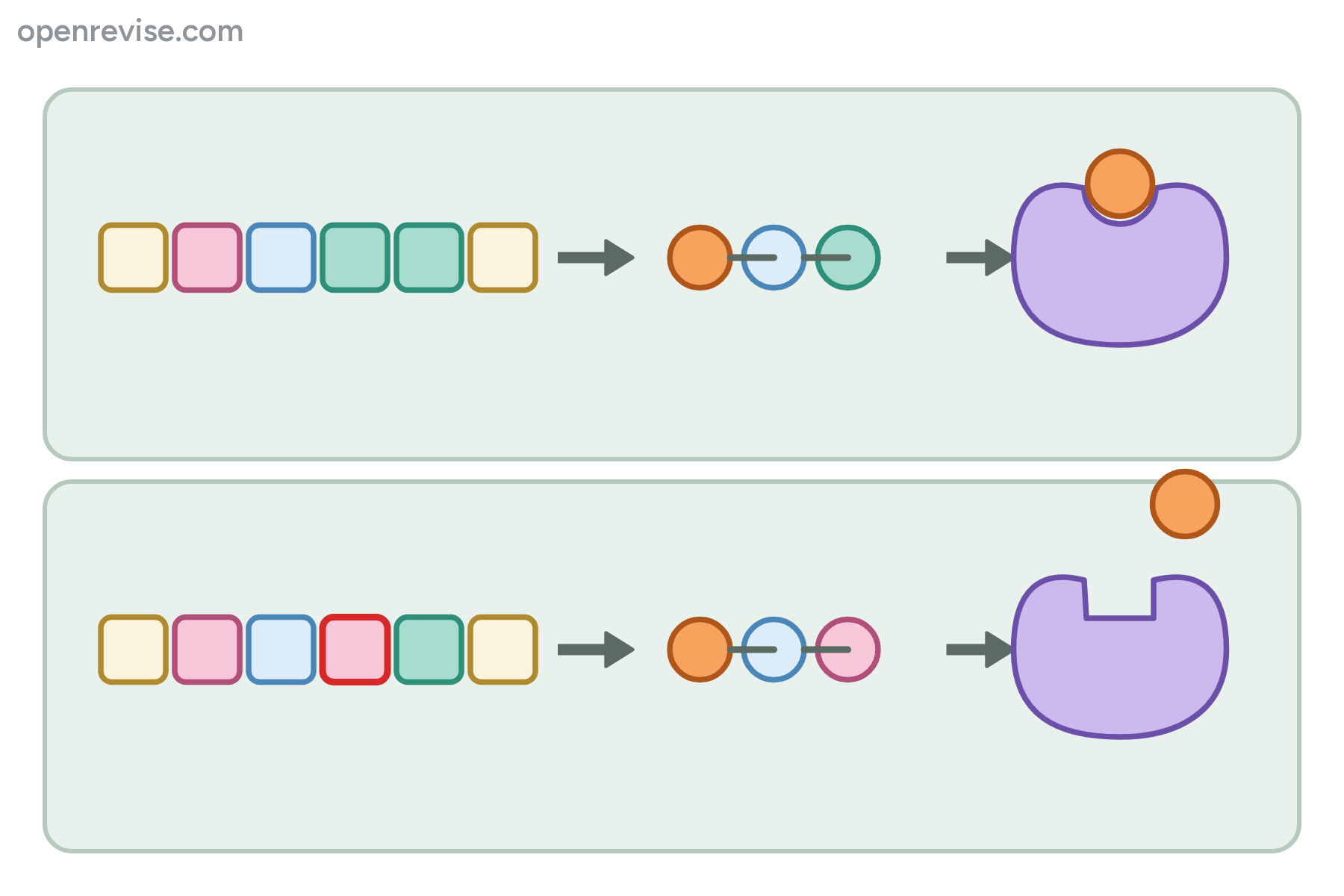 Explain what has gone wrong in the bottom row. (Higher tier)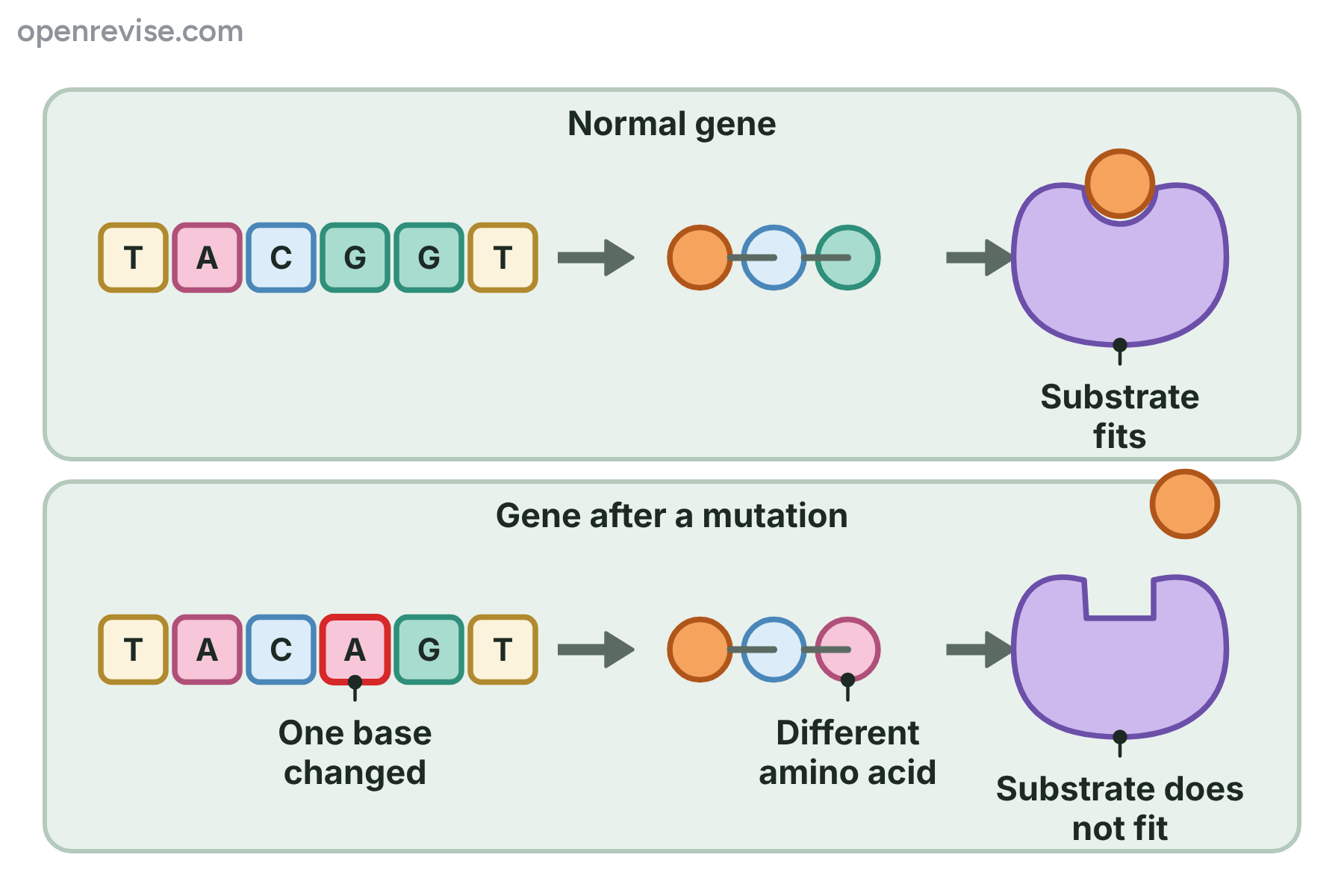
One base has changed, so one amino acid is different. The protein folds into a different shape, so the substrate no longer fits the active site and the enzyme cannot work.