Exam questions · Biology
DNA and the Genome
- 28 exam questions
- 78 marks
- 32 quick checks
DNA, Genes and the Genome
Just this lesson-
1 State [1 mark]
State where the DNA is found in an animal cell.
Show answerHide answer
Model answer
In the nucleus, in the chromosomes.
Mark scheme
- In the nucleus (or in the chromosomes) — 1 mark
-
2 Describe [2 marks]
Describe the structure of DNA.
Show answerHide answer
Model answer
DNA is a polymer. It is made of two strands that coil around each other to form a double helix.
Mark scheme
- A polymer made of two strands — 1 mark
- The strands form a double helix — 1 mark
-
3 Define [2 marks]
What is a gene?
Show answerHide answer
Model answer
A gene is a small section of DNA on a chromosome. It codes for a particular sequence of amino acids, to make a specific protein.
Mark scheme
- A small section of DNA on a chromosome — 1 mark
- Codes for a sequence of amino acids to make a specific protein — 1 mark
-
4 Name [3 marks]
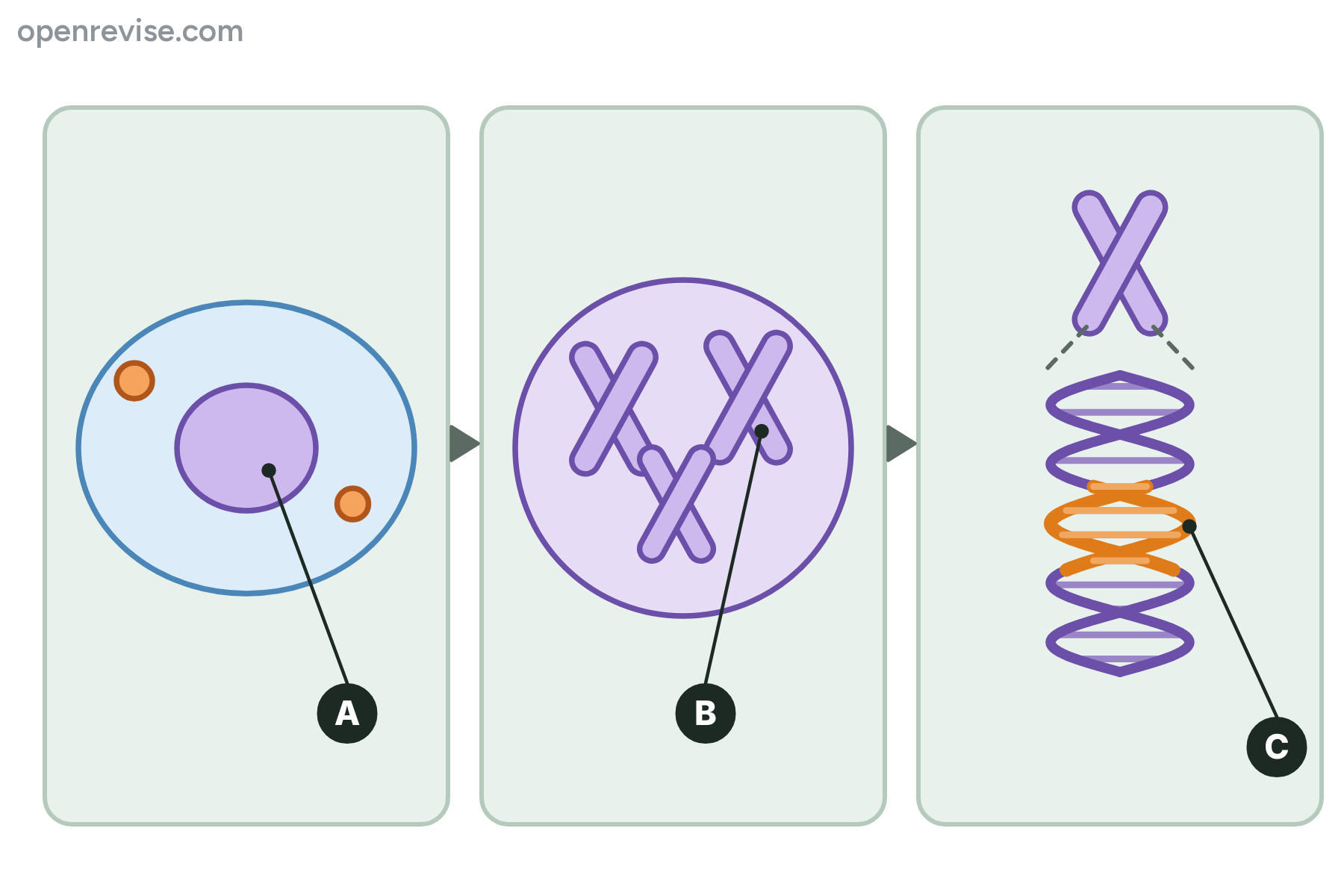
The diagram shows part of a human cell. Name the parts labelled A, B and C.
Show answerHide answer
Model answer
A is the nucleus. B is a chromosome. C is a gene.
Mark scheme
- A: nucleus — 1 mark
- B: chromosome — 1 mark
- C: gene — 1 mark
-
5 Explain [3 marks]
Explain the difference between a gene and the genome of an organism.
Show answerHide answer
Model answer
A gene is a small section of DNA on a chromosome that codes for one specific protein. The genome is the entire genetic material of the organism. So the genome contains all of the genes, and a gene is only one small part of it.
Mark scheme
- A gene is a small section of DNA that codes for a protein — 1 mark
- The genome is the entire genetic material of an organism — 1 mark
- The genome contains all the genes, so a gene is only part of it — 1 mark
-
6 Describe [3 marks]
The whole human genome has now been studied. Describe three reasons why this is important.
Show answerHide answer
Model answer
Scientists can search the genome for genes that are linked to different types of disease. Understanding which genes cause inherited disorders helps scientists to understand and treat them. Comparing the genomes of people from different places can be used to trace how early humans migrated around the world.
Mark scheme
- Search for genes linked to different diseases — 1 mark
- Understanding and treatment of inherited disorders — 1 mark
- Tracing human migration patterns from the past — 1 mark
-
7 Explain [4 marks]
A family has a history of an inherited disorder. Explain how knowledge of the human genome could help this family.
Show answerHide answer
Model answer
Scientists can search the genome to find the gene that is linked to the disorder. Knowing the gene means that family members can be tested to find out whether they carry the faulty allele. Understanding what the gene does helps scientists to understand how the disorder develops, which makes it easier to develop a treatment for it.
Mark scheme
- The gene linked to the disorder can be found — 1 mark
- Family members can be tested for the allele — 1 mark
- Understanding what the gene does explains the disorder — 1 mark
- This helps scientists to develop treatments — 1 mark
Quick check
-
1
Where is DNA found in an animal cell?
Show answerHide answer
B: In the nucleus
DNA is found in the nucleus, contained in chromosomes.
-
2
What is the shape of a DNA molecule?
Show answerHide answer
C: A double helix
DNA is made of two strands that coil together to form a double helix.
-
3
What is a gene?
Show answerHide answer
A: A small section of DNA that codes for a protein
A gene is a small section of DNA on a chromosome that codes for a protein.
-
4
How many chromosomes are there in a normal human body cell?
Show answerHide answer
D: 46
Human body cells have 23 pairs of chromosomes, which is 46 in total.
-
5
What does a gene code for?
Show answerHide answer
B: A sequence of amino acids
Each gene codes for a particular sequence of amino acids, which join to make a specific protein.
-
6
What is the genome of an organism?
Show answerHide answer
C: All of its genetic material
The genome is the entire genetic material of an organism.
-
7
Which of these is one use of the human genome?
Show answerHide answer
A: Tracing how early humans migrated around the world
The human genome can be used to trace human migration patterns, to search for disease genes and to understand inherited disorders.
-
8
Which statement about genes and chromosomes is correct?
Show answerHide answer
D: A chromosome carries many genes
A chromosome is a long molecule of DNA that carries many genes.
The Structure of DNA
Just this lesson-
1 Name [2 marks]
Name the four bases found in DNA.
Show answerHide answer
Model answer
A, C, G and T (adenine, cytosine, guanine and thymine).
Mark scheme
- Any two bases correct — 1 mark
- All four bases correct — 1 mark
-
2 Describe [3 marks]
Describe the structure of one nucleotide of DNA.
Show answerHide answer
Model answer
A nucleotide has a sugar and a phosphate group. One of four bases is attached to the sugar.
Mark scheme
- A sugar — 1 mark
- A phosphate group — 1 mark
- One of four bases attached to the sugar — 1 mark
-
3 Name [3 marks]
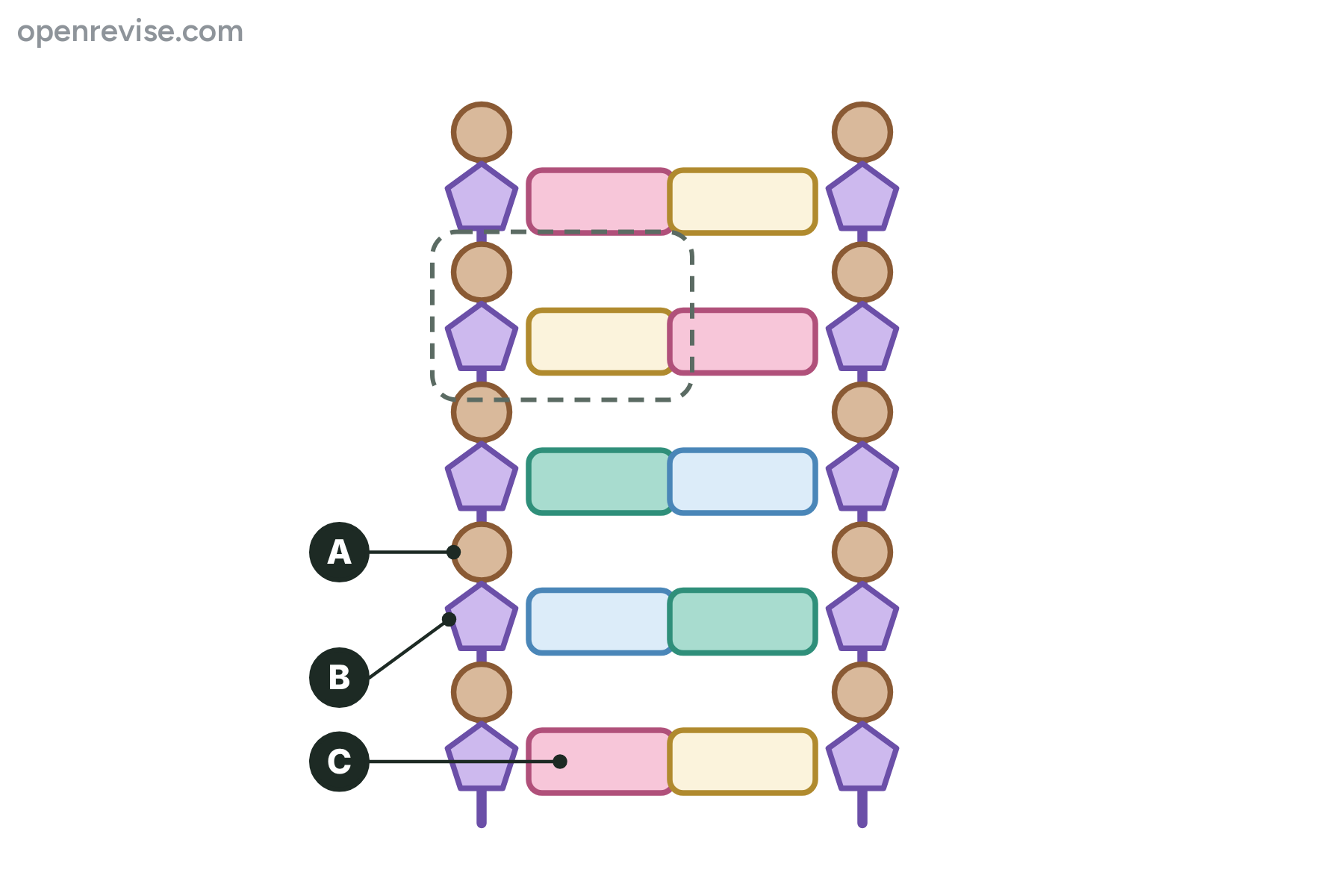
The diagram shows part of a DNA molecule. Name the parts labelled A, B and C.
Show answerHide answer
Model answer
A is a phosphate group. B is a sugar. C is a base.
Mark scheme
- A: phosphate (group) — 1 mark
- B: sugar — 1 mark
- C: base — 1 mark
-
4 Calculate [2 marks]
A gene has 1 800 bases. Every three bases code for one amino acid. Calculate the number of amino acids in the protein.
Show answerHide answer
Model answer
600 amino acids
Mark scheme
- \(1800 \div 3\) — 1 mark
- 600 — 1 mark
-
5 Explain [3 marks]
Explain how the order of bases in a gene controls the protein that is made.
Show answerHide answer
Model answer
A sequence of three bases is the code for one amino acid. The order of the bases therefore controls the order in which the amino acids are assembled. A different order of amino acids makes a different protein.
Mark scheme
- Three bases code for one amino acid — 1 mark
- The order of the bases controls the order of the amino acids — 1 mark
- The order of the amino acids decides which protein is made — 1 mark
-
6 Describe [4 marks]
Describe the structure of the DNA polymer.
Show answerHide answer
Model answer
DNA is a polymer made of repeating nucleotide units. Each nucleotide has a sugar, a phosphate group and one of four bases attached to the sugar. The long strands have alternating sugar and phosphate sections, with a base attached to each sugar. There are four different bases, A, C, G and T.
Mark scheme
- A polymer made from repeating nucleotides — 1 mark
- Each nucleotide is a sugar, phosphate and base — 1 mark
- Alternating sugar and phosphate sections in the strands — 1 mark
- Four different bases A, C, G and T — 1 mark
-
7 Give [3 marks]
One strand of a DNA molecule has the base sequence T T A G C. Give the base sequence of the complementary strand and state the two pairing rules you used.
Show answerHide answer
Model answer
The complementary strand is A A T C G. A is always linked to T, and C is always linked to G.
Mark scheme
- A A T C G — 1 mark
- T is linked to A — 1 mark
- C is linked to G — 1 mark
Quick check
-
1
How many different bases are found in DNA?
Show answerHide answer
C: Four
DNA contains four bases: A, C, G and T.
-
2
Which two parts alternate along the backbone of a DNA strand?
Show answerHide answer
B: Sugars and phosphate groups
The long strands consist of alternating sugar and phosphate sections.
-
3
To which part of a nucleotide is the base attached?
Show answerHide answer
D: The sugar
Each nucleotide has a sugar and a phosphate group, and the base is attached to the sugar.
-
4
How many bases code for one amino acid?
Show answerHide answer
A: Three
A sequence of three bases is the code for a particular amino acid.
-
5
A gene is 1 500 bases long. About how many amino acids will its protein have?
Show answerHide answer
C: 500
Three bases code for one amino acid, so 1 500 divided by 3 is 500.
-
6
What do the four different nucleotides in DNA differ in?
Show answerHide answer
B: Their base
They have the same sugar and phosphate group, and differ only in the base.
-
7
In the complementary strands of DNA, which base is always linked to C?
Show answerHide answer
A: G
C is always linked to G on the opposite strand.
-
8
One strand of DNA reads A C C G T. What is the complementary strand?
Show answerHide answer
D: T G G C A
A pairs with T, C with G, C with G, G with C and T with A, which gives T G G C A.
Protein Synthesis (Higher tier)
Just this lesson-
1 State [1 mark]
Name the structures in a cell on which proteins are made.
Show answerHide answer
Model answer
Ribosomes.
Mark scheme
- Ribosomes — 1 mark
-
2 Describe [3 marks]
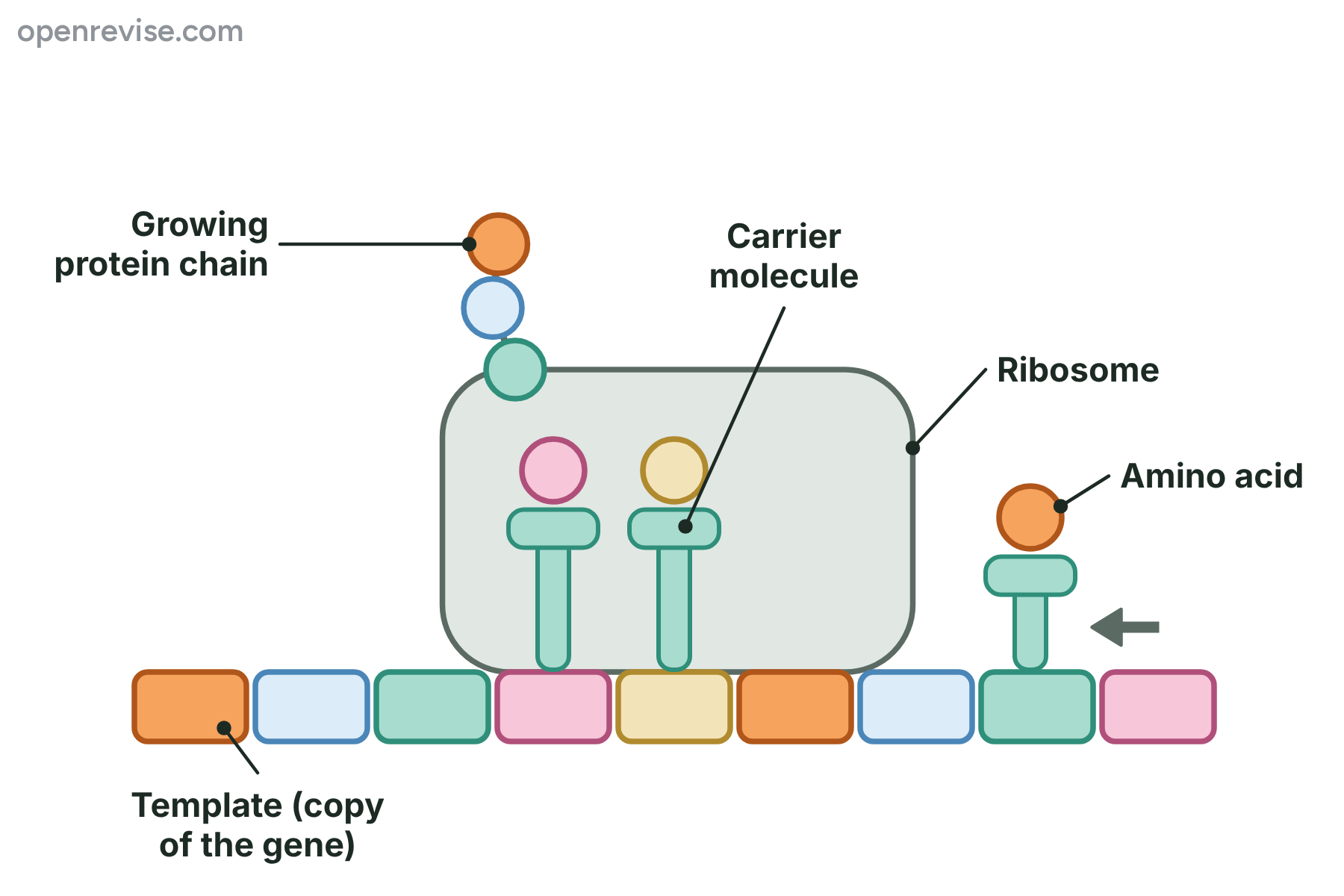
The diagram shows protein synthesis. Describe the job of the carrier molecules.
Show answerHide answer
Model answer
Each carrier molecule brings a specific amino acid to the ribosome. The amino acids are added to the growing protein chain in the correct order, as specified by the template.
Mark scheme
- Bring amino acids to the ribosome — 1 mark
- Each carrier brings a specific amino acid — 1 mark
- Added to the growing chain in the correct order — 1 mark
-
3 Explain [3 marks]
Explain how the order of bases in a gene affects the protein that is made.
Show answerHide answer
Model answer
The order of bases decides the order of the amino acids that the carrier molecules add to the chain. The order of the amino acids decides the shape into which the chain folds. A different base order can therefore make a different protein.
Mark scheme
- The base order decides the amino acid order — 1 mark
- The amino acid order decides the shape of the protein — 1 mark
- A different base order may make a different protein — 1 mark
-
4 Calculate [2 marks]
A gene has 2 100 bases. Three bases specify one amino acid. Calculate the number of amino acids in the protein.
Show answerHide answer
Model answer
700 amino acids
Mark scheme
- \(2100 \div 3\) — 1 mark
- 700 — 1 mark
-
5 Explain [3 marks]
Explain why a protein must fold into the correct shape.
Show answerHide answer
Model answer
When the chain is complete it folds into a unique shape. The shape enables the protein to do its job, for example as an enzyme, which has to fit its substrate, as a hormone or as a structural protein such as collagen. If the shape is wrong the protein may not work.
Mark scheme
- The chain folds into a unique shape — 1 mark
- The shape enables the protein to do its job — 1 mark
- An example such as an enzyme fitting its substrate — 1 mark
-
6 Describe [4 marks]
Describe how a protein is made on a ribosome.
Show answerHide answer
Model answer
The ribosome reads the template, which is a copy of the gene. Carrier molecules bring specific amino acids to the ribosome. The amino acids are added to the growing chain in the order set by the template. When the chain is complete it folds into a unique shape.
Mark scheme
- Ribosome reads a template — 1 mark
- Carrier molecules bring specific amino acids — 1 mark
- Amino acids added to the chain in the correct order — 1 mark
- The finished chain folds into a unique shape — 1 mark
-
7 Explain [4 marks]
Collagen is a structural protein. A change in the gene for collagen can make the bones weak. Explain how a change in a gene could make weak collagen.
Show answerHide answer
Model answer
A change in the DNA changes the order of the bases in the gene. This can change the order of the amino acids in the collagen chain. A different order of amino acids may make the chain fold into a different shape. The collagen is then not as strong, so the bones are weak.
Mark scheme
- The order of the bases in the gene changes — 1 mark
- The order of the amino acids changes — 1 mark
- The protein folds into a different shape — 1 mark
- The collagen is not as strong — 1 mark
Quick check
-
1
Where does protein synthesis happen in a cell?
Show answerHide answer
B: On ribosomes
Proteins are made on ribosomes.
-
2
What do carrier molecules do in protein synthesis?
Show answerHide answer
A: Bring specific amino acids to the ribosome
Each carrier molecule brings a specific amino acid to add to the growing chain.
-
3
What happens to a protein chain once it is complete?
Show answerHide answer
C: It folds into a unique shape
It folds up to form a unique shape.
-
4
What decides the order of amino acids in a protein?
Show answerHide answer
D: The order of bases in the gene
The order of the bases in the gene decides the order of the amino acids.
-
5
Why must a protein fold into the right shape?
Show answerHide answer
B: So that it can do its job
The shape lets the protein do its job, such as an enzyme fitting its substrate.
-
6
A gene has 900 bases. About how many amino acids does its protein have?
Show answerHide answer
A: 300
Three bases specify one amino acid, so 900 divided by 3 is 300.
-
7
Which of these is a structural protein?
Show answerHide answer
C: Collagen
Collagen is a structural protein found in skin, tendons and bones.
-
8
What can happen if the structure of the DNA in a gene changes?
Show answerHide answer
D: A different protein may be made
The order of the amino acids may change, so a different protein may be made.
Mutations and Non-coding DNA (Higher tier)
Just this lesson-
1 State [1 mark]
What is a mutation?
Show answerHide answer
Model answer
A change in the base sequence of DNA.
Mark scheme
- A change in the base sequence (structure) of DNA — 1 mark
-
2 Explain [2 marks]
Most mutations do not change the way an organism looks or works. Give two reasons why.
Show answerHide answer
Model answer
Most mutations do not alter the protein, or only alter it slightly, so its function is not changed. Some happen in non-coding DNA, or the changed triplet codes for the same amino acid.
Mark scheme
- Protein not altered, or altered only slightly — 1 mark
- A further correct reason, such as the mutation being in non-coding DNA — 1 mark
-
3 Explain [4 marks]
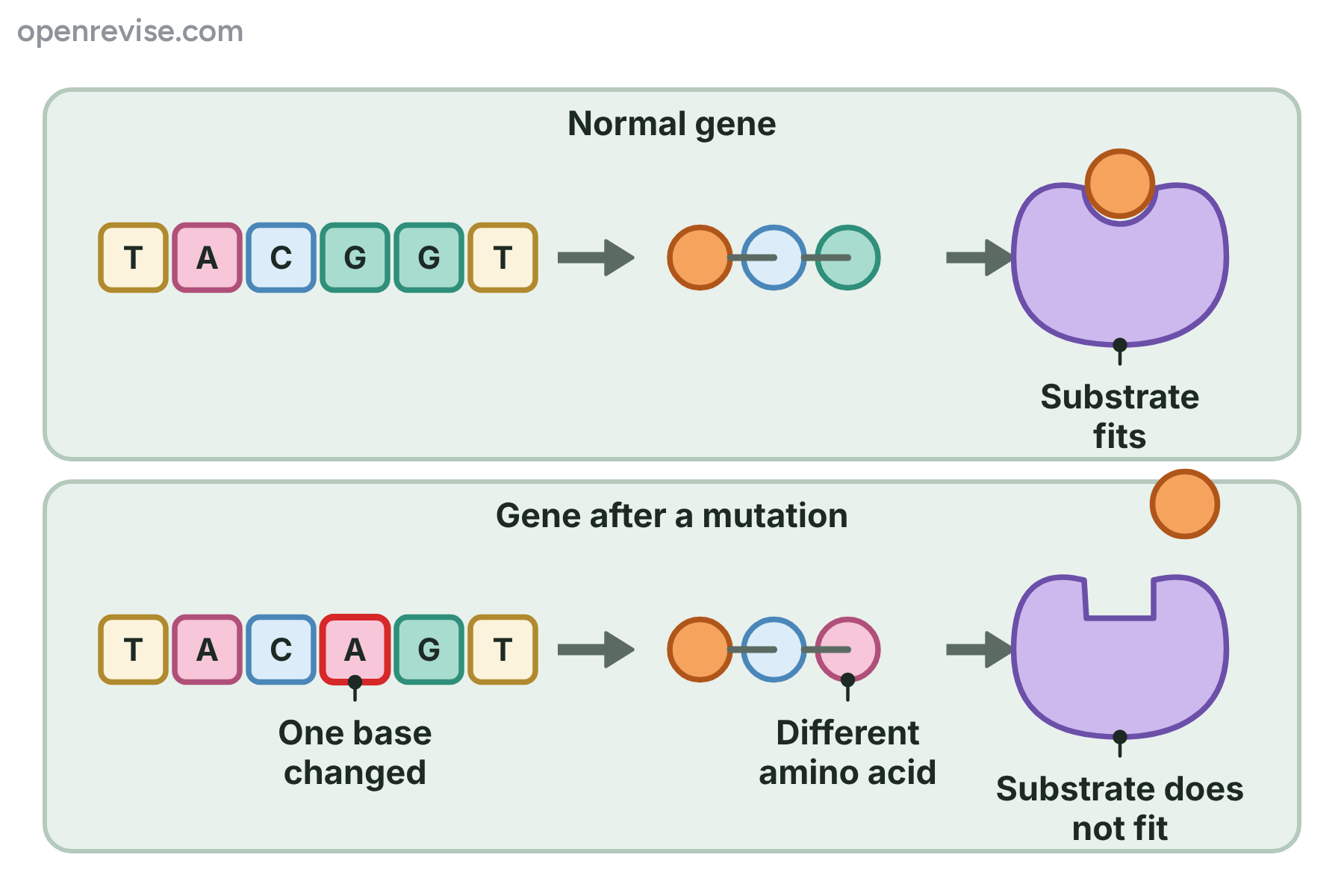
The diagram shows a normal gene and the same gene after a mutation. Explain how the mutation has stopped the enzyme working.
Show answerHide answer
Model answer
One base in the gene has changed, so the order of the amino acids is different. The different amino acid makes the protein fold into a different shape. The active site no longer fits the substrate, so the enzyme cannot catalyse the reaction.
Mark scheme
- One base has changed — 1 mark
- The amino acid sequence is different — 1 mark
- The enzyme has a different shape — 1 mark
- The substrate no longer fits the active site — 1 mark
-
4 Calculate [3 marks]
A gene has the base sequence CAT GGA TTC. The first base of the gene is deleted. Write the new sequence in groups of three and state how many of the original three triplets are now different.
Show answerHide answer
Model answer
ATG GAT TC. All three of the original triplets are different (the last group is also incomplete).
Mark scheme
- Deletion gives ATGGATTC — 1 mark
- Regrouped as ATG GAT TC — 1 mark
- All the triplets after the deletion are changed — 1 mark
-
5 Explain [3 marks]
A mutation in the gene for a structural protein can make the protein weaker. Explain how.
Show answerHide answer
Model answer
The mutation changes the sequence of bases, so the order of the amino acids is different. The protein may fold into a different shape. The altered shape can mean the protein loses its strength.
Mark scheme
- The base sequence changes so the amino acids change — 1 mark
- The protein folds into a different shape — 1 mark
- The altered shape makes the protein lose its strength — 1 mark
-
6 Describe [3 marks]
Not all parts of DNA code for proteins. Describe how variants in non-coding DNA can affect an organism.
Show answerHide answer
Model answer
Non-coding parts of DNA can switch genes on and off. A variation in a non-coding part can therefore alter how genes are expressed, so the amount of a protein that is made can change even though the protein itself is the same.
Mark scheme
- Non-coding DNA does not code for proteins — 1 mark
- It can switch genes on and off — 1 mark
- A variant alters how genes are expressed — 1 mark
-
7 Evaluate [4 marks]
Mutations occur continuously, yet most people are healthy. Explain why mutations do not always cause a problem, and why a few do.
Show answerHide answer
Model answer
Most mutations do not alter the protein, or only alter it slightly, so the function does not change. Many happen in non-coding DNA. A few mutations code for an altered protein with a different shape. An enzyme may then no longer fit its substrate, or a structural protein may lose strength, which can cause a problem.
Mark scheme
- Most mutations do not alter the protein or alter it slightly — 1 mark
- Some are in non-coding DNA — 1 mark
- A few give a protein with a different shape — 1 mark
- Enzyme and substrate no longer fit, or structural protein weaker — 1 mark
Quick check
-
1
How often do mutations occur?
Show answerHide answer
C: Continuously
Mutations occur continuously.
-
2
What do most mutations do to the protein that a gene codes for?
Show answerHide answer
A: Nothing, or only a slight change
Most mutations do not alter the protein, or alter it only slightly, so its function is unchanged.
-
3
What can happen to an enzyme made from a mutated gene?
Show answerHide answer
D: The substrate may no longer fit its active site
The enzyme may have a different shape, so the substrate no longer fits the active site.
-
4
Which mutation is most likely to change every amino acid after the mutation?
Show answerHide answer
B: Deleting one base
Inserting or deleting a base shifts the grouping of every triplet after it.
-
5
What can non-coding DNA do?
Show answerHide answer
A: Switch genes on and off
Non-coding parts of DNA can switch genes on and off.
-
6
A structural protein is changed by a mutation. What is a likely effect?
Show answerHide answer
C: It loses strength
A structural protein with an altered shape may lose its strength.
-
7
A gene reads ATG CCA GTT. A substitution changes the second triplet to CCG. How many triplets are changed?
Show answerHide answer
B: One
A substitution changes one base, so only the triplet containing that base is changed.
-
8
How can a variant in non-coding DNA affect an organism?
Show answerHide answer
D: It can alter how genes are expressed
It can alter how genes are expressed.